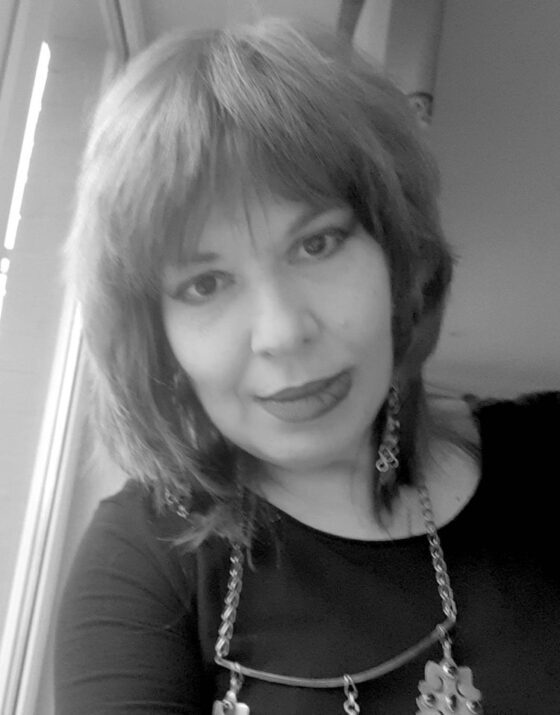
 Recently, I’ve been digging again through the wilds of the CD Baby site, where no print run is too small and no approach to music is too individual, and in this regard I have found a lot of great work recently, some of which I will deal with here soon, but none of it more interesting than an Italian exponent of extended vocal technique named Romina Daniele.
Daniele was born in Naples, but these days lives in Milan, where, I imagine, the climate for experimental singing is more receptive. The recording I happened on, entirely by chance, was her first, Diffrazioni Sonore (2005), which consists entirely of multi-tracked, and often entirely improvised vocal music, some of it treated digitally (radical EQ, echo, and a little reverb), but otherwise left well enough alone. Daniele’s approach has somewhat to do with the great exemplars of this sort of “vocality” (of whom more below), but it is also wholly singular in that the singer has never studied composition, and seems to come more from the wilds of literature, and particularly from the wilds of European philosophy, than from any rigorous background in music.
Her second album, Aisthanomai, Il Dramma Della Coscienza (2007), or The Tragedy of Consciousness, is even more uncompromising than the first, consisting of textual philosophizing more abundantly, and of more electronic sound in addition to her voice. Aisthanomai also has a thoroughly daunting booklet (available in English), that provides some theoretical support for the formal ideas expressed within.
From the above, you might get the idea that Daniele’s work is only complex, only demanding, only methodical, but, actually, though it has its challenges, it is also playful, sweet, sometimes funny, and, on occasion, rooted in an appreciation of vernacular music like jazz, blues, and pop, though these flavors are used much more expressionistically than we are used to. Because I liked these two albums so well—they have surprised me as few things have surprised me recently—I decided to try to track down Daniele and to ask her a few questions. As befits someone for whom the work is most personal when it is least confessional, Daniele will answer very few personal questions, except under duress, so I warn the reader in search of a conventional interview, that there is none of that here. This interview is as much a position paper as it is a confessional document. Because Daniele is a bit skeptical on the self-promotional part of her project, I will provide a few links for those who are curious for more. Her CD Baby page is here. Her MySpace page is here. A couple of very illuminating videos of her in her very rare performances (she will admit to having performed only twelve times) are available on YouTube, as in this case. And, for the record, this interview was conducted by e-mail in English and Italian, and translated back into English by Giorgi Testa, with some minor amendments by myself and Romina Daniele herself. (Her English is very strong.)
***
Rick Moody: Of the two albums available in the U.S. (on CD Baby), the first, Diffrazioni Sonore, seems to wear its influences more on its sleeve. I suppose, to my ears, these influences would include, most perceptibly, Meredith Monk and Diamanda Galás, but also, to some extent, Yoko Ono, Nina Hagen, Tim Buckley, and so on. In each case (and I’m thinking especially about Monk and Galás), you manage to transmute the influence by virtue of your essential Europeanness. That is, you sing extended vocal technique in a way that recalls some American composers, but in a way that is to me, much more Italian, or even pan-European. Can you talk a little bit about your vocal influences, how you came by this work, and what kind of impact it had on you? Is there a sense for you of performing this idiom in a way that is European?
Romina Daniele: Diffrazioni Sonore is a result of the research I have been conducting since 2000 in a number of areas: voice, composition by electronic means, philosophy applied to multimedia.
Studying film history and theory, art criticism and aesthetic analysis, I approached the fields of thought that my research is based on, which include Gilles Deleuze’s philosophy and Michel Chion’s theory applied to film, a multimedia art form. I am referring specifically to the linguistic and morphological foundations of my work, by virtue of the relationship between, and coexistence among, different languages, including voice, poetry, writing, music, electronics, art, thought, man.
I developed an interest in Meredith Monk’s music very early on. This came about through Auli Kokko, the Swedish vocalist of Neapolitan sax player Daniele Sepe’s popular jazz band. I studied with her for three years around 2001. During that time I was also studying the great jazz voices. I was particularly fond of blues and jazz-rock combinations. I was always listening to Demetrio Stratos.
Stratos is the foundation. I have often observed that my approach to voice stems from his boundless experience, which is unfortunately still very little known outside Italy and Europe. Even Diamanda Galás learned about Stratos when she came to receive her Demetrio Stratos International Prize for experimental music in 2005. That is where I met Diamanda Galás, since I was awarded a prize as a young talent on that occasion; I remember Meredith Monk also winning the same prize in 2007. I met her, too, for the same reason.
Just as Galás didn’t know Stratos, however, I didn’t know Galás when I started out. Later on, someone told me how much we had in common. Since then, I have been listening to her work and I believe it is beyond compare. Our similarities should be found in the attempt to look for an extended vocality and a voice freed from conventions, rather than on a stylistic level. Style is at most the way an individual artist deploys the results of his or her research. History must also be considered, as every experience has a historical background.
 Historically, what today may be described as “extended vocality” is a concept and a dimension intrinsic to the “Euro-educated” development of music. Music gradually departed from traditional language forms,
 from the late nineteenth century harmonic complexity of Richard Wagner to the electro-acoustic experiences of the fifties. This development includes the vast and complex experiences of today’s history and its significant personalities. Let me mention one case: Schönberg’s “dodecaphonny.” Schönberg was the first artist to use the “Sprechgesang” style, where spoken and sung language are fused, in his Pierrot Lunaire (1899). Other similar experiences involved Schönberg’s students Berg and Webern and other artists from all over Europe and the world, up to today. One contemporary example: Visage by Luciano Berio (1960), a piece for electronic sounds on a magnetic tape, sung by Cathy Berberian. The song is based on the symbolic and representative charge of gestures and voice inflections, “from inarticulate sounds to syllables, from laughter to tears and singing, from aphasia to inflection patterns from specific languages: English and Italian, Hebrew, the Neapolitan dialect, etc.”[1]
A central idea of this approach is that of “material” – or “idea of constructing a timbre” (Chion) which designates what the composer works on initially. The term “material” appears as soon as Western music rejects classical elements such as notes, themes, chords, arpeggi. That is what defines “sound matter,” “voice matter,” and, therefore, “extended vocality.”
Diamanda Galás and Meredith Monk, being great musicians and composers, have also had to come to terms with this “Euro-educated” development, which they used to form their personal and unique vision of music.
Stratos, too, crossed known boundaries in working on his voice. However, in his case voice has an even more special role, as it is made independent of music composition. So my experience, inspired by Stratos, has been focused on the necessary realization of “being as voice.” Voice is recognized as a powerful expression of self, regardless of any conventional division or role. The idea is for voice to project toward stylistic undifferentiatedness for artistic and exploratory purposes, by focusing on the unconditioned, non-indifferent force of the desire to know oneself as a “voice that gives itself voice.” In this way, I reject practice, the idea of doctrine and indoctrination, and every kind of style: my style is no style, as I have sometimes said quoting Hegel. I consider indoctrination just a way for sterilized containers to be assigned a label.
Moody: Can you talk a little more about your education, how critical theory featured in it, and how an interest in philosophy expresses itself in what you do?
Daniele: The linguistic and morphological foundations of my work and the relationship among different languages, which I mentioned earlier, are matters that deserve to be described as philosophical. My education was mainly humanities-centered. Human issues are what interests me the most, and the source of every artistic form, including my own.
Let’s start from the beginning.
The project Diffrazioni Sonore was created as a response to a concern over the relationship between improvisation and construction, over the “between” that divides instantaneous perception and the conscience of perceiving, which involves memory “as an extension of the past into the present(Bergson),” i.e. as a constituent of individuals. On the other hand, “between” indicates a non-place, a void, an “undefinable idea.” This is the object of my artistic research: I consider it the key to the creative process.
The last emblematic composition in Diffrazioni Sonore is titled Rizhome. This term was used by Deleuze and Guattari to define “what does not begin or end, but is always in between, among things, inter-being, intermediate.” The tree [the hierarchical and sectoral system] is derivation, but the rhizome is only alliance.
Quoting my essay from Aisthànomai, Il Dramma della Coscienza, all my work (variously textual, vocal, musical, theatrical) does not want to be compartmentalized or linear, but rather net-like, not a definite system but an “open circularity continually redefinable and irreducible to a unity.” It is a chain of postponements that presents itself through difference: denying any all-understanding rationality.
What I call acting, working in the sterile sores of a common language where concepts such as “centre,” “structure,” “field” hold sway; in favor of a “non-common” activism that tends instead to “decentering,” “proliferation,” “displacing.”
While I was doing Diffrazioni I said I was “interested in what Deleuze calls ‘entre-deux-coups-de-dés’.” These are the connection, heterogeneity, multiplicity principles that coexist, in perspective, with the work inspired by them as a “sensory resonance” (in Eisenstein’s terms), building dynamic units. Each of these units contains the principles from previous stages.
 I was avoiding meaning as an object of recognition or deci
phering. I aimed at dispersion, at a mirror effect among significants, which are presented over and over again, as new ones are constantly produced by listening. Meaning should never be fixed in the well-known structures of thought: new meanings, new forms of thought should be sought. This idea is one of the pillars supporting my work. A different version of it informs Aisthànomai, whose title is etymologically linked to “aesthetics,” the science of thought applied to art. This idea has an immediate practical consequence: “each new problem requires making an entirely new effort and abandoning some thinking and perception habits (Bergson).”
Thought must be used in a different way so that humanity can change and renew itself. Only then can (and should) art ask questions about the possible ways of reaching that goal. The necessary requirement is for one to give up one’s standard way of thinking and act, thus feeding doubt and a whirlpool of feelings. As I said, it is primarily a question of structuring thought: a human one. It’s about how one thinks, it’s about mind. That is where creation happens. Secondly, and consequently, it is about the way one acts and does things. I discuss this and more, with respect to my creation processes, in the essay Voce Sola. I am currently working on it, and it will be out next year in Italy.
Moody: I know that Meredith Monk thinks of some of her voices as expressing particular characters, almost as if extended vocal technique, for her, has a multiple personality disorder component to it. I am wondering if your own case, especially since your voice has so many different aspects to its multi-octave range, there is a sense of particular sounds belonging to particular characters. And if there are characters, is there narrative? Or is narrative too linear a way to think about these suites of music?
Daniele: My songs never have narrative references to characters. What I am interested in is not narration music, but poetry. The different vocal characteristics that I use identify with myself, or at least should be interpreted as different sign systems, different statuses of states, connection principles, heterogeneity, multiplicity, which I can represent with my own strength and my work.
Let me quote from the essay I am currently working on:
It is all about perceiving differences (here are the “sores,” here is “indifferentiation”). The following step is swapping among different interpretations, among individual thought processes, “jump cuts” of consciousness. These are possible through observation and distancing, i.e. difference. This dimension of perception has nothing to do with reasoning, but with pure intuition: this is what is known as cognitive synthesis.[2] The shape of the work as we see it, its construction, amazes us even before we read it, as an evidently ongoing process. Its tension derives from the transformation of relationships,[3] “the ‘sense’ of disruption within its content.”[4] Content is not a narrated story, an interpreted text, a precise, common, identifiable feeling. It is a phenomenon, “the distribution of elements in the composition.” The disruption lies in the phenomenon, as it belongs to the phenomenon: composition in its operative stage, discourse flowing, “starting by conceiving the object as a whole, then looking into the composition and structure of the work, down to its smallest particles.”[5] A piece is formed by listening. Diffrazioni is a process: propagating intuitions that act through my perceptive and mental processes, as well as through my work (my action).
For me, the idea of diffraction lay in the intuition of the process. This is what I wanted to stress, admittedly not very clearly, when I remarked as follows during the recording of some of the tracks: “With diffractions inside and outside my work and myself, I am different.” I was thinking in terms of perception, rather than “inside” and “outside” as opposites, i.e., content and form, according to the old “aesthetic tradition” which I consider delusive and therefore particularly questionable. I was thinking of my voice as a pyschophysical entity and my work, i.e., the performance of my thought and its creation. (It should not be forgotten that thought is creation of language.) On the other hand, I was and am alien to the idea of “difference” as a social component (difference is a consequence, not a motive of my actions). There are diffractions in different relationships: between me as a psychophysical entity and my thought (diffractions inside myself); between me, including my relationship with my thought, and the outside world (diffractions outside me); between the different elements and levels of my discourse-work (diffractions inside my work); finally, between my work, including the relationship between the different elements and levels, and the outside world (diffractions outside my work). With these diffractions, I am different, as I am a source of propagating intuitions which act through my perceptive and mental processes, and consequently through my work. Diffrazioni was already inspired by the issue of consciousness. [6]
 Moody: How much vocal training have you done in the past? Did you take conventional voice lessons? Music theory? And to what extent does the Italian tradition of operatic singing exert an influence on what you do?
Daniele: I didn’t study singing or composition at a conservatory, because I am not interested in an educated voice or an educated mind composing according to the rules. I am deeply convinced that art and academe follow divergent paths, in every field. In the past, however, I did study music theory. Right now I am taking a diploma course in sound technology and electronic music at Milan’s conservatory. I want to learn more about these subjects, which are distinct from singing and form a very important part of my work. Thanks to my studies, I became one of the eight finalists for the National Award of Arts, held in Benevento last 31 March, in the Electronic Music section.
The Italian operatic tradition has no influence on my work. Experimental theater, like Antonin Artaud’s or Stratos’s does, of course
For me, studying is an extremely intimate process, as it has to do with awareness, consciousness and knowledge issues. I have been studying my own voice for years, just as I have been studying myself and human consciousness.
Moody: I’m interested in your coming originally from Napoli and having moved, in your adulthood to Milano? Does this have anything to do with Milano’s receptiveness to the arts? Was Napoli a dead end for the kind of work you are doing, such that it is easier to find an audience in the North? Or were there other reasons to make the move?
Daniele: Italy has a deep link with its history and traditions. Each form of thought and art looking at a broader vision inevitably risks being described as abstract and detached from reality as it is immediately perceived. This has nothing to do with the intellectualist “weight of history,” because it consists of a social rather than sociological dimension. This collective feeling is definitely stronger and more vivid in Naples, as a consequence of its traditions and customs.
The issue of reality occupies a big part of my mind: I really think that individuals – human beings from any place in the world – don’t have eyes to comprehend their own reality, as they are confused by society and wrongly convinced that this is all possible reality. Society is just another form of reality, but man cannot know any others as it ignores himself in the first place.
In this sense, in the consideration of some of the most insightful reflections on reality, I can say I share Pasolini’s view. Although he analyzed situations that were extremely close to his culture and were the most conspicuous of social issues (in his novels and early films), his private thoughts were occupied by philosophy and linguistics. His reflections as a social man are just a way of applying those thoughts. Human thought and the issue of its relationship with awareness and knowledge is the basis of every problem, history, tradition, local characteristic.
The reality I see and have always seen is man’s unawareness of man, in a philosophical and existential perspective. Finally, this should be considered with respect to my idea of art as a network that creates a deep link among thought, language, expression and existence.
I moved to Milan as I saw Naples as a dead end for the kind of work I was doing. I did move, but I haven’t left Italy. At least so far.
 Moody: Tragedy of Consciousness (if I may use the English translation of the title of your second album) seems to feature more digital processing and non-vocal instrumentation in the work. And yet it still feels, to these ears, as though the whole is a solo work, one that is unaffected by particular collaborative energies at all. Are you conscious of yourself as a solo artist? And what accounts for the increased use of processing on some of these tracks? Do you find yourself influenced by digital art being made by others in Europe? Or is it a natural outgrowth by virtue of working on the computer?
Daniele: I am a solo artist in that I write my own work. In this sense, a composer, a writer and a painter are the same. That is why since the mid-20th century works of art of every kind have been considered as “texts,” with reference to the important developments of linguistics toward philosophy, for example the formation of thoughts. In music, this is especially true for electronic music, as the question of playing is solved preliminarily, and making music means expressing oneself directly from oneself using a machine. I wouldn’t describe this as “cold” or “static” just because there is no-one playing the instruments; I would call this “my direct will,” as the machine reproduces exactly what I have been working on for months or years.
When I work on electronic sounds I impart to them my will. In that sense I am the author of those sounds, and I am not delegating the responsibility of creating or altering the sound substance.
Furthermore, no instrument can replace computers in sound production. With computers, you can penetrate sound down to its most intimate vibrations and connect it as creative units through mixing. And I am not interested in organic or traditional instruments.
Secondly, my interest in the relationship between electronic methods and “making poetry” was what led me to extend my production to electronic sounds. In Diffrazioni, I already used technology along with my voice, as I processed and manipulated sound by digital means. In Aisthànomai, I’m using voice, technology, and electronics.
The essay included in Aisthànomai is mainly about this. I can say that I am fascinated by multimedia, as the interconnection among many different media, and the relationship between the spiritual and physical world, between technologies and instinct, among different media and languages. In particular, the stratification of levels corresponds to the following sets: Voice-matter-nature. Electronics-sound-technique. Language-text-concept.
The universe of electronics should be seen in a conceptual and factual connection with the universe of sound and technique (in the sense of technology). Similarly, the universe of voice should be seen in connection with that of matter and nature; the universe of language with that of text and concept.
I wouldn’t say I was influenced by any specific European artists. I am interested in linguistic interconnections as I just described them, in every form of art dealing with that issue, and I am always fascinated by some approaches to electro-acoustic and vocal music, such as Luciano Berio’s Visage.
 Moody: Both albums have introductions, and Tragedy of Consciousness, both in its
 title and its particular song titles, seems to list in the direction of an operatic work, or, at least, a chamber opera of a sort. And what about the popular song? Did it have any impact on you as a young person, or as you work now?
Daniele: As I am interested in the stratification of levels, the word “opera” does not correspond to its traditional meaning, i.e. a theater and music performance which is sung and acted. What it means is the product of an intellectual and artistic activity, as in “opera d’arte”, work of art: a form which is as emblematic and evocative as it is real and tangible. In this perspective, my work is halfway between electronics and “making poetry.”
As I was saying, I am also fond of blues and jazz, in that I love everything genuine and profound; in particular, I love Billie Holiday’s later work in terms of vocality, and Miles Davis for composition.
There’s this text I wrote for one of Odetta’s concerts in Milan. It’s called “la mia anima blues (My Blues Soul),” and it is about the reception of blues by the Italian audience, and my own relationship with blues. I wrote that an audience that enjoys cover bands playing blues is not ready for an intensely emotional experience like Odetta’s performance in Milan. The force of singing and the meanings of vocal expression, in my experience, cannot but depend on these considerations. Today, classical music only exists as a hybrid, as a consequence of a historical process that began with the critics’ codification of blues and jazz.
My work, which has gained recognition through the Demetrio Stratos Prize, has its roots in everything that is acknowledged as real, regardless of all conceptuality. I could not study Stratos’s work if I didn’t feel that force within me, nor could I offer any approach to unconditioned vocality if I didn’t identify with what can be described as “being-giving voice.”
Demetrio Stratos was himself primarily a blues singer, and the singer of the famous popular music ensemble Area.
Aisthànomai also includes a tribute to Miles Davis’ “Nuit sur les Champs-Élysées,” takes I and II, from the soundtrack of the French film Ascenseur pour l’échafaud (1958) by Louis Malle. The relationship between music and images in that film was the topic of my Master’s dissertation, which I wrote between 2006 and 2008, while I was producing Aisthànomai. This is therefore a very important text. It will be published in Italian by RDM in the near future.
Moody: Much contemporary work in extended vocal technique avoids lyrics, as if lyrics will give away too much, and I find, since my Italian is meager, that I treat your work in the same way, because I can’t speak the language. All of which means that for this American listener, I have no idea about the lyrics. Can you give American listeners some hint about where the lyrics go? Is there a lyrical subject or a lyrical trajectory in your work that we should know about?
Daniele: The use of language, too, is included in the idea of “opera” as described earlier, in a stratification of different levels: Voice-matter-nature. Electronics-sound-technique. Language-text-concept.
The original purpose of my work is not being identified as an “extended vocal” technique, although I like the expression. I am against definitions, even for known techniques, because they are barriers that do not help one develop one’s individual creative energy and one’s thought and personal technique.
Each technique must be used within the limits of one’s expressive needs, to create a piece; but no technique determines my work. In other words, I come first, with my thought and creative energy; then come the techniques (those I have learned and a few I have invented), which I use as a means. My energy flows through the techniques and uses them, not the other way around. This topic is also discussed in the essay I mentioned earlier, which I invite you to read. So, “extended vocality” is a technique which I deploy naturally, according to my expressive needs; the same happens with my use of language. Each sector in the cultural system tends to prevail by establishing its own independence and difference from other sectors. Writing, for example, is only true writing if it remains on a printed page; its value changes or decreases if it is made into a screenplay. Music is true if it is recorded or played at a concert; its value changes or decreases if it is used as a movie or installation soundtrack. Similarly, voice as an instrument defines itself as independent from music and language, by becoming “extended vocality.” What I’m most interested in, though, is interconnections. I consider culture a network and identify categorization as the black hole in the development of human mind.
Italian is the language I use most often since it is my mother tongue, and it cannot be replaced by any other language. However, I also use passages in English and French. Sometimes I even write in English, as in “Fallacità, Take II,” a couple of unpublished pieces and some things I am currently working on. I also provide an English translation of all my lyrics. Aisthànomai comes with a 36-page booklet, as the poetry and texts used are an important element of my work. Many of my texts are poetical as well as musical, and they may be performed live in a different language (for instance, “Poesis I and II”). I have played in English abroad, so that I could get my message across to more people. This, however, is impossible for the songs whose text is originally in Italian (such as “Echo” or “Fallacità”). Occasionally I have improvised English versions of some of my pieces. “Matter,” a particularly felicitous English version of “Materia,” was included in a video shot in Slovakia. I will soon record that version to include it on my new release.
 Moody: I was interested to read that a lot of this work is improvised.
 Do you improvise in the recording studio? Or do you work out a rough outline, maybe in performance, and then come into the studio with some idea of the shape of a given piece? Or do you really just make each piece up as you go along? And in the case of multi-track recordings, do you go back and layer over an improvisation, or is it all done in the moment with a looping program or device?
Daniele: Diffrazioni Sonore originated from the recording of a three-hour studio improvised session. I worked on it and reached the final version of the record. The recording is a result of the study of voice I did years ago. I looked into the “liberation/discovery” of voice beyond limits/techniques: it was an extremely intimate experience and I recommend it to anyone who wants to become aware of their being through the vibration of vocal chords (connected to the laryngeal muscles), in a unique and undefinable union between body and spirit. At the same time, each track with superimposed voices is the result of intense computer-assisted composition work (processing, modeling, etc.). In the inside cover text, I explicitly mention the “mixing, which I consider work,” in the concrete sense of the word.
In Aisthànomai, the spoken parts and the vocalised verses are always improvised in studio, because improvisation is all about instinct and expressiveness, both of which are absolutely needed in my poetical compositions in music. The superimposed voices, in this case, were recorded after the main voice; there were several recording sessions over the course of two years. A number of compositions or pieces formed during their very performance; others were created on the basis of an ongoing organization.
Moody: How much performing are you doing regularly in Europe? And can we expect to hear you play in New York City ever? And what are you working on now? Do you have other projects you are working on besides music?
Daniele: As I have said, I performed twelve times in three years, then paused for a year. On 20th March I was in Milan to present part of the new album I’m working on. I’ve had no offers from the States yet. We haven’t looked for opportunities there either, but we soon will. America is the place where we sell the most.
I am currently working on the project Spannung. Quoting from the official presentation, this is the term Heidegger uses to indicate the opening, the sense of space, the tension (and torment) of being in a dimension of authentic existence. This dimension has never been adequately discussed and requires intimate and new forms each time, far from the clichés of intellect and composition rules. In the concrete and time-bound human condition, a struggling being is itself strength: “tension of strength itself (Derrida).” This is true at each level of my work as work of art: at a concept and thought level and at an artistic, literary and poetical, musical, compositional, vocal, aesthetic level: it’s not about an accomplishment, but an opening, not a system or its negation, which is system itself, but a tension, which is always action, operating force.
I am also working on a collection of essays, as I said before, which will include my thoughts on “vocal discourse,” and a thorough discussion of my production method.
Both works will be published by RDM Records Edizioni discografiche e letterarie, which I founded earlier this year with Lorenzo Marranini, a fellow musician; his first record is in preparation, and I will be collaborating on a few pieces.
Aside from publishing our own work, we declare our support to: every movement and activity aimed at researching and experimenting new forms of expression; products of thought and action as such, whose creation establishes itself as a reality, energy in the form of being; human production in general, as we believe that there are few real creators today, and few real publishers as well – what few publishers there are, are more or less interested in the profit of their company and support talentless skill, brainless packaging, the poor taste of people lacking specific interests.
***
[1] Program notes by Berio for Visage, published on www.temporeale.it, the website of the center founded by Luciano Berio in 1987.
[2] “Here ‘synthesis’ does not mean a binding and linking together of representation, a manipulation of psychical occurrences where the ‘problem’ arises of how these bindings, as something inside, agree with something physical outside. […] has a purely apophantical signification and means letting something be seen in its togetherness with something – letting it be seen as something.” M. Heidegger, Seit und Zeit, Tübingen, Max Niemeyer, 1928 [English translation Being and Time, Malden, MA, Blackwell, 1962, p. 56]
[3] But amazement, if it is an end in itself, coincides with the “realization” of the “boundary” (form of definition, misleading judgment).
[4] S. M. Eisenstein, Izbrannye proizvedenija v šesti tomach, (vol. II), Moscow, Iskusstvo, 1963-1970. 66. ]
[6] “Consciousness: from the Latin “to be aware”: in the sense of self-awareness and awareness of the external world in as far as both are psychic functions in which every conscious experience of the subject is summed up. Therefore: to be aware or rather to act and to know with regards to oneself and the world.» R. Daniele, Il dramma della Coscienza, essay, booklet of the cd Aisthànomai, il dramma della Coscienza.