I remember once being in a room full of people and the instructor asked who among us considered ourselves feminists and I was the ONLY one who raised their hand. None of them realized the true meaning of the word
Rayme
Here is the entire text of ERA amendment which failed ratification in 1972.
Section 1. Equality of rights under the law shall not be denied or abridged by the United States or by any state on account of sex.
Section 2. The Congress shall have the power to enforce, by appropriate legislation, the provisions of this article.
Section 3. This amendment shall take effect two years after the date of ratification.
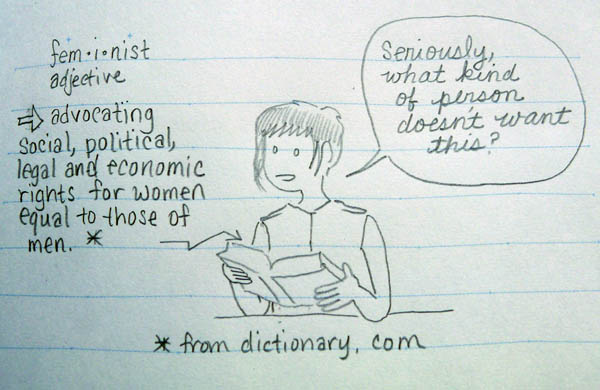
Quoting MariNaomi: “Seriously, what kind of person doesn’t want this?”
I think the trick word here is “advocating” which suggests activism. I’m in favor of feminist objectives, but that doesn’t make me a feminist; I’m against the war, but you wouldn’t call me an anti-war activist.
ad·vo·cate verb “to speak or write in favor of; support or urge by argument; recommend publicly: He advocated higher salaries for teachers.”
Krys
I don’t know, Andrew O. Dugas – it seems to me that your second sentence coupled with the initial part of the definition of advocate “(“to speak or write in favor of”) confirms your status as a feminist.
The issue, I feel, is that too many people believe that being feminist means constantly writing about, marching against, protesting, etc. practices that promote gender inequality. In reality, being feminist is all about beliefs and ideals. If you *believe* men and women should be treated equally in our society, then you are a feminist. Full stop. To me, it’s like being a part of a particular religious group – your faith is the main thing that denotes your membership.
Point taken, but shouldn’t we distinguish between “supporting” and “advocating”? I believe in equality for men, too; does that make me a masculinist?
Your position seems a bit black and white to me, a little “you’re either with us or agin us.” I think there’s room for a few shades of grey. (Way less than fifty, perhaps, but a few.)
As a lover of semantics, I appreciate your question very much.
My thoughts on this: When someone says, “I don’t advocate the use of pineapples as pillows” they are most likely stating that they don’t think pineapples should be used as pillows (not that they THINK they should be used as pillows, but aren’t taking it to the streets).
My point being: advocating equality doesn’t have to mean taking it to the streets. (Although it could…and we should!)
I guess there are gray areas as far as how much effort you’re willing to put into the cause. But the way I see it, it’s sort of a black-and-white subject, whether or not you think people should be treated equal based on gender (or race or what-have-you). Either you think they should or you don’t care and/or think they shouldn’t.
How actively you voice these opinions is an entirely different subject. (If you voice them a lot, that might make you a feminist activist!)
Thanks for reading, friends!
Love,
MariNaomi
iain
Not sure that advocating for rights equal to those of men can achieve equality or if equality is a desired end?
Clearly we agree on feminist objectives. If only we could agree on the definition of advocating!
Dorcas
Andrew (and everyone else), I wonder how you feel about the term “feminist ally”? Usually I hear “ally” referring to those who support LGBT rights, but I feel that it can be applied to this (and many other) situations as well.
Anna
Important to recognize that people may choose not to identify as feminists because of the white privilege, racism, cissexism, cis privilege, etc. associated with feminism. I choose to identify as feminist and I believe that most people would, if there wasn’t so much stigma surrounding the word. But I also think you can’t take a word straight out of the dictionary. Every word comes with context and history and “feminism” has a bad one in a lot of communities of color and queer communities – and for good reason.
Alice
My concern is the number of people who don’t consider themselves feminists not because they don’t conform to the definition but because they have a negative stereotype of what people who call themselves feminists “are like”. If this is denotation, you’ve gotta let the connotation go, I mean if the definition fits… And don’t let people who are truly opposed to this basic ideal form the public opinion of what a feminist must be like, that’s a classic destructive tactic! If you don’t like what a “feminist activist” is like according to stereotype, why not be one that is not like the stereotype. Otherwise a negative stereotype becomes a sort of self-fulfilling prophecy, leaving only those you think fit it.
Haddayr Copley-Woods
Well, MariNaomi, I DO know what I’m talking about. I majored in gender studies at the New School for Social Research. I have extensively studied radical feminism, liberal feminism, deconstructionist feminism, etc., and while the movement purports to be about what this dictionary definition claims it is, I will tell you what I have actually seen: The modern feminist movement stood on the shoulders of white women outraged that ‘colored’ men could vote and they couldn’t. They have continued to fight for upper-middle class white women to get a bigger slice of the capitalist pie. They have turned their backs on my trans sisters. No. More than turned their backs. Vilified, excluded, and scorned them. They have given lip service and not much else to my sisters of color. They have used working class women of all races to do the work they prefer not to do. The leaders of the modern feminist movement — leaders I used to worship, like Gloria Steinem — have written editorials telling a black man running for president to step aside for the wealthy white woman who wanted the job. They have fought for abortion rights while ignoring the systematic forced sterilization of black, Indian, and disabled women. They have strip mined others’ cultures and beliefs to create their own groovy spirituality bereft of its original meaning and often insulting to the very cultures and people they have stolen them from. The movement as it actually is practiced exists to lift up and further empower already privileged white women. It does not speak for me; that is why I am not a feminist. I am not misinformed; I simply disagree with you. I believe in fighting for the equal rights of all genders, but I will not call myself a feminist.
MariNaomi, you are a woman of color and you call yourself a feminist; I am going to assume you put some thought into this and that you have your reasons, and I respect your decision to embrace the word. Kindly extend to me the same courtesy for my decision not to.
Vinaigrette Girl
Haddayr, way to go with using your credentials and study as a form of privilege so you can bash your categorisation of the feminist movement. Respectfully, feminism is about a great deal more than the work that appears in the academy. Without it, flawed though its exponents might be, there wouldn’t have been local women to teach literacy and advocacy skills to South Sudanese women refugees in northeast Uganda so they could defuse local conflicts before they blew up (one of a huge number of women-to-women efforts in East and Central Africa). The messages that get through the walls of mistakes and privilege are, in fact, *literally* life-saving.
Don’t call yourself a feminist, but, equally, don’t expect people to accept your negative framework as definitive.
SE
It’s unfortunate the word feminist is now so often used as a pejorative; some even mistakingly equating its meaning with misoandrist or gynocrat. Maybe we need a newer or more modern term for the new pro-womanist? Philogynist? Gynophile? Gynocentrist? Womanophile? Womanitarian? Help me out, people…
Click here to subscribe today and leave your comment, or log in if you’re already a paid subscriber.


14 responses
I remember once being in a room full of people and the instructor asked who among us considered ourselves feminists and I was the ONLY one who raised their hand. None of them realized the true meaning of the word
Here is the entire text of ERA amendment which failed ratification in 1972.
Section 1. Equality of rights under the law shall not be denied or abridged by the United States or by any state on account of sex.
Section 2. The Congress shall have the power to enforce, by appropriate legislation, the provisions of this article.
Section 3. This amendment shall take effect two years after the date of ratification.
Quoting MariNaomi: “Seriously, what kind of person doesn’t want this?”
I think the trick word here is “advocating” which suggests activism. I’m in favor of feminist objectives, but that doesn’t make me a feminist; I’m against the war, but you wouldn’t call me an anti-war activist.
ad·vo·cate verb “to speak or write in favor of; support or urge by argument; recommend publicly: He advocated higher salaries for teachers.”
I don’t know, Andrew O. Dugas – it seems to me that your second sentence coupled with the initial part of the definition of advocate “(“to speak or write in favor of”) confirms your status as a feminist.
The issue, I feel, is that too many people believe that being feminist means constantly writing about, marching against, protesting, etc. practices that promote gender inequality. In reality, being feminist is all about beliefs and ideals. If you *believe* men and women should be treated equally in our society, then you are a feminist. Full stop. To me, it’s like being a part of a particular religious group – your faith is the main thing that denotes your membership.
Point taken, but shouldn’t we distinguish between “supporting” and “advocating”? I believe in equality for men, too; does that make me a masculinist?
Your position seems a bit black and white to me, a little “you’re either with us or agin us.” I think there’s room for a few shades of grey. (Way less than fifty, perhaps, but a few.)
Judges?
Andrew:
As a lover of semantics, I appreciate your question very much.
My thoughts on this: When someone says, “I don’t advocate the use of pineapples as pillows” they are most likely stating that they don’t think pineapples should be used as pillows (not that they THINK they should be used as pillows, but aren’t taking it to the streets).
My point being: advocating equality doesn’t have to mean taking it to the streets. (Although it could…and we should!)
I guess there are gray areas as far as how much effort you’re willing to put into the cause. But the way I see it, it’s sort of a black-and-white subject, whether or not you think people should be treated equal based on gender (or race or what-have-you). Either you think they should or you don’t care and/or think they shouldn’t.
How actively you voice these opinions is an entirely different subject. (If you voice them a lot, that might make you a feminist activist!)
Thanks for reading, friends!
Love,
MariNaomi
Not sure that advocating for rights equal to those of men can achieve equality or if equality is a desired end?
Clearly we agree on feminist objectives. If only we could agree on the definition of advocating!
Andrew (and everyone else), I wonder how you feel about the term “feminist ally”? Usually I hear “ally” referring to those who support LGBT rights, but I feel that it can be applied to this (and many other) situations as well.
Important to recognize that people may choose not to identify as feminists because of the white privilege, racism, cissexism, cis privilege, etc. associated with feminism. I choose to identify as feminist and I believe that most people would, if there wasn’t so much stigma surrounding the word. But I also think you can’t take a word straight out of the dictionary. Every word comes with context and history and “feminism” has a bad one in a lot of communities of color and queer communities – and for good reason.
My concern is the number of people who don’t consider themselves feminists not because they don’t conform to the definition but because they have a negative stereotype of what people who call themselves feminists “are like”. If this is denotation, you’ve gotta let the connotation go, I mean if the definition fits… And don’t let people who are truly opposed to this basic ideal form the public opinion of what a feminist must be like, that’s a classic destructive tactic! If you don’t like what a “feminist activist” is like according to stereotype, why not be one that is not like the stereotype. Otherwise a negative stereotype becomes a sort of self-fulfilling prophecy, leaving only those you think fit it.
Well, MariNaomi, I DO know what I’m talking about. I majored in gender studies at the New School for Social Research. I have extensively studied radical feminism, liberal feminism, deconstructionist feminism, etc., and while the movement purports to be about what this dictionary definition claims it is, I will tell you what I have actually seen: The modern feminist movement stood on the shoulders of white women outraged that ‘colored’ men could vote and they couldn’t. They have continued to fight for upper-middle class white women to get a bigger slice of the capitalist pie. They have turned their backs on my trans sisters. No. More than turned their backs. Vilified, excluded, and scorned them. They have given lip service and not much else to my sisters of color. They have used working class women of all races to do the work they prefer not to do. The leaders of the modern feminist movement — leaders I used to worship, like Gloria Steinem — have written editorials telling a black man running for president to step aside for the wealthy white woman who wanted the job. They have fought for abortion rights while ignoring the systematic forced sterilization of black, Indian, and disabled women. They have strip mined others’ cultures and beliefs to create their own groovy spirituality bereft of its original meaning and often insulting to the very cultures and people they have stolen them from. The movement as it actually is practiced exists to lift up and further empower already privileged white women. It does not speak for me; that is why I am not a feminist. I am not misinformed; I simply disagree with you. I believe in fighting for the equal rights of all genders, but I will not call myself a feminist.
MariNaomi, you are a woman of color and you call yourself a feminist; I am going to assume you put some thought into this and that you have your reasons, and I respect your decision to embrace the word. Kindly extend to me the same courtesy for my decision not to.
Haddayr, way to go with using your credentials and study as a form of privilege so you can bash your categorisation of the feminist movement. Respectfully, feminism is about a great deal more than the work that appears in the academy. Without it, flawed though its exponents might be, there wouldn’t have been local women to teach literacy and advocacy skills to South Sudanese women refugees in northeast Uganda so they could defuse local conflicts before they blew up (one of a huge number of women-to-women efforts in East and Central Africa). The messages that get through the walls of mistakes and privilege are, in fact, *literally* life-saving.
Don’t call yourself a feminist, but, equally, don’t expect people to accept your negative framework as definitive.
It’s unfortunate the word feminist is now so often used as a pejorative; some even mistakingly equating its meaning with misoandrist or gynocrat. Maybe we need a newer or more modern term for the new pro-womanist? Philogynist? Gynophile? Gynocentrist? Womanophile? Womanitarian? Help me out, people…
Click here to subscribe today and leave your comment, or log in if you’re already a paid subscriber.