

A gun is a mechanical device used to punch holes in people and other animals in order to kill them. I list humans first since “anti-personnel” weapons, as military firearms are euphemized by governments and the gun industry, comprise the bulk of worldwide production. From 1956 to 1986, China alone manufactured 10-15 million Type 56 assault rifles, their version of the Russian AK-47. Somewhere between seven and eight million M16 rifles have been made to date since the American military adopted it back in the early 1960s. By comparison, between 1936 and 1963, Winchester made approximately 600,000 Model 70s, an incredibly popular bolt-action rifle marketed to game hunters.
I cite the Model 70 as a counterexample to firearms strictly made for killing people. However, the rifle, considered one of the best-designed guns ever made, proved quite effective in dropping the most challenging quarry of all. The U.S. Marine Corps employed the M70 as its primary sniper rifle through the 1950s and 60s, most notably in Vietnam, where Gunnery Sergeant Carlos Hathcock became a legend by using it to amass 93 confirmed enemy kills. But after all, the first bolt-action rifles were designed for war, the nursery of all firearms innovations.
Having served as an infantry officer in the U.S. Army, I’ve fired thousands of rounds out of various pistols, rifles, and machine guns. I put together a list:
Colt M1911A1 .45 pistol
Beretta M9 9mm pistol
Browning 9mm hi-power pistol
Smith & Wesson .44 Magnum long-barrel pistol
Walther PPK .32 pistol
.22 rifle (various makes)
Springfield .30-06 bolt-action rifle
Colt M16A1 and A2 assault rifles
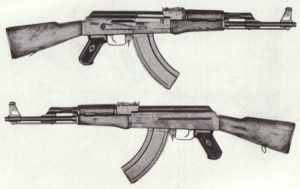
Kalashnikov AK-47 assault rifle
Uzi 9mm sub-machine gun
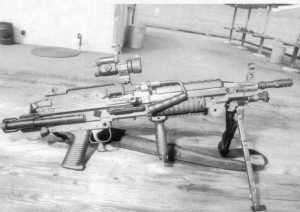
Fabrique National M249 SAW (Squad Automatic Weapon) light machine gun
M-60 medium machine gun
Browning M2 .50 caliber heavy machine gun
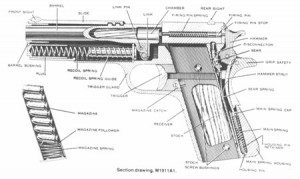 An infantry officer must be proficient with the weapons his soldiers use, as well as his own. Familiarity with the enemy’s weapons helps too. As a young lieutenant, I could disassemble and reassemble any weapon in minutes, fire it with reasonable accuracy, and recite by rote its effective range and specifications. Technical know-how will always win your soldiers’ confidence. It’s also vital to having any real sense of what your unit can do on the battlefield. If nothing else, being able to sling your M16 and work an M60 machine gun may also contribute to your personal survival.
I did most of my shooting with M16 rifles, beginning with the A1 model which I fired in college ROTC. The M16 uses a 5.56mm bullet, a standard munition among NATO forces. But standardizing ammunition with America’s allies, while practical, was not what impelled the Army to choose the round. In the 1950s, ordnance experts pored over literally millions of combat accounts from both World Wars and concluded that the greatest factor in generating casualties was simply how many bullets went downrange. Killing the enemy boiled down to quantity, not quality. Their task: design a weapon that spewed lightweight rounds, making it possible for an infantryman to carry and shoot more ammunition.
The 5.56mm NATO bullet is essentially the same as an American .223 Remington round. Early on, critics scoffed, calling it nothing but a glorified .22 caliber. But what do these numbers mean? Well, take a brand-new No. 2 pencil and sharpen it. The shaved wooden cone is roughly the same size and shape as the projectile that comes whizzing out of an M16’s barrel at over 3,000 feet per second. It’s called a spitzer round (German for “pointy”) because of its aerodynamic shape, and it weighs 4 grams; a nickel weighs 5 grams.
It’s a small round. But at that velocity it inflicts devastating wounds. Larger bullets, such as the 7.62mm, which has twice the mass, will often poke clean holes through a body. But because of its relative light weight and spitzer design, the 5.56mm NATO round bounces around in the body, ripping up flesh and organs in its path. Po-faced ballistics experts describe this effect as the projectile’s tendency to yaw in soft tissue. The bullet often fragments on impact, greatly multiplying internal damage. Enthused by these findings, the Army has recently introduced an “improved” round with an extra gram of lead to burst into shrapnel when it hits home.
When I reported to the 25th Infantry Division in 1990, the Army had moved to the M16A2, which had better sights and a more accurate barrel. It also had a new selector switch with safety, semi-(automatic), and 3-round burst. Ordnance experts – perhaps the very same ones who advocated a sheer volume approach – had studied years of firefights since the original M16 debuted. They found that soldiers tended to flip the switch to “auto” and spray lead at the enemy. Naturally, most of these rounds never hit their intended targets. To increase accuracy and conserve ammunition, they removed the fully-automatic option, replacing it with a mechanism that dispenses three round-bursts with one pull of the trigger.
The Army’s penchant for acronyms applies to shooting. Every soldier learns BRAS, which stands for Breathe, Relax, Aim, Squeeze. It works. Looking downrange with the rifle stock pressed to your cheek, take a breath and exhale. By not breathing again until after you’ve fired, you prevent movement caused by your ribcage. Don’t squint your non-aiming eye yet, just get calm. Now peer through your sights, lining them up on the target. Gently, pull on the trigger. Don’t yank it, just slowly squeeze . . . bang! The report should almost surprise you. If it did, you’ve probably made an accurate shot.
The standard Army qualification range challenges the shooter with 40 pop-up targets arrayed from 50 to 300 meters. The targets stay exposed from three to seven seconds; the closer the target, the sooner it disappears. Shortening the time a soldier has to acquire a target makes up for the relative ease of hitting a silhouette at closer ranges. You shoot 20 rounds from a foxhole position, which allows you to rest the front part of the rifle on a sandbag, and 20 rounds on your belly, with nothing to brace the rifle but your shoulder, palms, and elbows. A soldier who hits 23-29 targets earns the “marksman” badge; 30-35 “sharpshooter”; and 36-40 “expert.” Each young private who graduates infantry basic training must at least qualify as a “marksman” – not surprisingly, the most generous standard with a seven-bullet spread.
I’ve always had better-than-average eyesight, which may explain why I always qualified “expert” with my M16. Through late grammar school, high school, and college, I was always shooting some kind of gun, whether it was during one of the countless BB-gun wars my friends and I waged in the woods or on trips to rifle and pistol ranges. Once I began ROTC, I received more formal marksmanship instruction.
When you hit a 300-meter target, there is a distinct pause between squeezing off the round and seeing the target drop. There’s also a keen sense of satisfaction; to put a lead cone the length and width of a pencil point through a man-sized silhouette over three football fields away gives you a sense of earned power, a measure of rugged competence that even the most primitive hunters must have felt. Anyone might wing a target close-up, but as the distance increases, tolerances become acute, the margin for error miniscule. Luck gets ruled out; it becomes a matter of skill.
Of course, almost all the killing done with firearms occurs at close range. In war, depending on terrain and vegetation, combatants typically fire at each other between 20 and 200 yards, unless it’s urban fighting, where firefights can rage between rooms. In 1970, the New York City Police Department implemented a reporting procedure for the detailed analysis of gunfights. In 1979, they took a retrospective look at all NYPD officer gunfight deaths going back to 1854. Of the 250 officers slain, 205 were killed within six feet of their assailants. The FBI conducted a similar study of law enforcement officers nationwide killed between 1991 and 2000. Half of the 601 officers were within five feet of their killers, 71% within ten.
Gun lobbyists are fond of the old cant, “guns don’t kill people, people kill people.” It is a specious argument. No one rails against the manufacture of axes or baseball bats. There are no campaigns to ban the sale of broadswords or Bowie knives. With a bolt-action rifle and a telescopic sight, I can put a bullet through my neighbor’s chest as he crosses in front of his living room window though his house is a hundred yards away. With a Glock 17 pistol stashed in my briefcase, I can walk into a boardroom, coolly dispatch a dozen executives, and still have five rounds left in the magazine to deal with security guards.
To put it another way, Jared Loughner doesn’t kill six people and wound another thirteen, including his intended victim, Congresswoman Gabrielle Giffords, if he brandishes a meat cleaver instead of a Glock 19 with a 33-round magazine. Virginia Tech doesn’t happen if Seung-Hui Cho heaves a cutlass in Norris Hall. Columbine never occurs if Eric Harris and Dylan Klebold enter their high school wielding Louisville Sluggers. Charles J. Whitman doesn’t kill 14 people and wound 31 others if he takes up his sniping position atop the 32-story tower at the University of Texas at Austin armed with a longbow and a quiver of arrows.
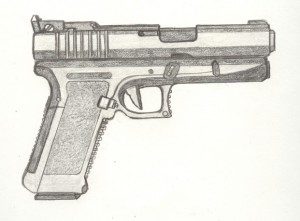 A gun’s power is arbitrary and wildly inordinate to its price, size, and ease of use. It bestows terrible sway – the ability to selectively kill at a distance or wipe out dozens close up – on any person holding it. Before the advent of firearms, becoming dangerous meant years of training, if not a lifetime’s upbringing in a warrior caste: the American Indian with tomahawk or bow and arrow; the medieval knight with sword and shield; the samurai with katana. Using his credit card, Seung-Hui Cho paid $571 for a Glock 19 pistol and a box of fifty 9mm bullets. At 30 ounces, a Glock 19 weighs slightly less than a quart of milk; it measures just under seven inches long. Its operation is simple: load, point, shoot fifteen times, reload. In nine minutes, Cho killed 30 people and wounded dozens more.
The phrase “the great equalizer” originally applied to the first revolvers, an innovation of Colt’s Patent Firearms Manufacturing Company. The slogan plays to a kind of David and Goliath sensibility. You picture a colossal brute leveled by a scrawny, Charlie Chaplin-like figure toting a silver Peacemaker. But of course, guns don’t make people equal, they make them unequal: they make them dead. And quite simply, it shouldn’t be so damned easy to kill another person.
***
When Barack Obama announced his candidacy for President, sales of pistols, rifles, and ammunition rose noticeably around America. In the days following his election, those sales soared. Gun store owners and their reactionary patrons dressed this ugly knee-jerk in political terms: they feared “overreaching legislation;” they perceived “a dangerous threat to their prerogatives;” and they worried that a liberal President would restrict what they believe is their right (often qualified with the phrase “God-given”) to own Berettas, Glocks, Uzis, and M16s.
An ominous euphemism heard repeatedly as justification for the purchase of an assault-rifle or high-capacity automatic pistol is that “it’s an insurance policy,” ostensibly against some imminent breakdown of society. For the last 230 years, the Constitution has proven a more than adequate insurance policy against all manner of catastrophe, foreign and domestic. But I can’t help thinking that anyone who buys a gun as an insurance policy secretly imagines themselves as Charlton Heston’s character in The Omega Man, Dr. Robert Neville, an Army colonel who battles murderous mutants in post-apocalyptic Los Angeles. Neville’s undoing comes when his sub-machine gun jams and he’s killed by a spear. Is there a message?
Gun sales also went up with Bill Clinton’s election. In pre-apocalyptic L.A. alone, his threat of a ban on assault rifles in 1994 did more to sell guns than the race riots that followed the Rodney King incident in 1992. But while there are always doomsdayers who re-stock their armories whenever a politician left of Attila the Hun gains office, you have to wonder how many of the recent “investors” were motivated by racism. It’s hard to imagine that these rabid consumers of AR-15s and AK-47s would demonstrate the same zeal (or at least justify their purchases the same way) if Al Gore or John Kerry had been elected President.
In the field of genetics, scientists speak of gene “expression” to refer to how inherited information in our DNA gets converted into working proteins in our bodies. DNA is a vast charter for the governance of our cells; how that sprawling code of conduct expresses itself is often a matter of interpretation. And where there is interpretation, there is error. Errors in genetic expression are called cancer.
America has a cancer, an interpretative error that originates in our government’s genetic code, the Constitution. The Second Amendment to the Constitution of the United States reads: “A well regulated Militia, being necessary to the security of a free State, the right of the people to keep and bear Arms, shall not be infringed.”
On June 26, 2008, the U.S. Supreme Court handed down an errant interpretation in the case of District of Columbia v. Heller, exacerbating the old misconception that the Second Amendment somehow grants individuals the right to own and use firearms. The Supreme Court boasts a fine history as America’s ultimate bulwark of justice, but it has, on occasion, been utterly mistaken. The court’s triumph in Brown v. Board of Education of Topeka, for example, doesn’t happen without first getting it horribly wrong in Plessy v. Ferguson.
Gun lobbyists fall back on the Second Amendment as the cornerstone of their supposed right to buy and own firearms. They recite the amendment’s second half as if it was an incantation, a spell that renders dumb all dissenters. But while the syntax of the amendment may be anachronistic, its meaning is clear. And the men who drafted the Constitution were not given to bombast or excessive verbiage.
As presented to the first session of the First Congress, the original text of what became the Second Amendment read: “The right of the people to keep and bear arms shall not be infringed; a well armed and well regulated militia being the best security of a free country; but no person religiously scrupulous of bearing arms shall be compelled to render military service in person.”
Clearly, the men who drafted the Constitution placed gun ownership solely in the context of organized military service. They wished to highlight the distinction between local and state militias as opposed to a federal army. State militias were seen as a safety measure against the possible use of a federal army to impose centralized tyranny.
The founding fathers eventually whittled down the amendment’s verbiage to the treacherous, 27-word version with which we contend today. Brevity, as Shakespeare wrote, is the soul of wit, but in legal realms it courts a sea of troubles.
 Still, if the Constitution’s authors had intended the Second Amendment to affirm individual rights to gun ownership, they would not have begun even the final edit with the phrase, “A well regulated Militia, being necessary to the security of a free State.” And clearly, a “militia” looking after “the security of a free state” is not the same as a private citizen strolling into Wal-Mart to purchase a 12-gauge shotgun and three boxes of ammunition. More importantly, it does not pertain to the paranoid fringe stocking up on assault rifles and high-capacity magazines in reaction to the peaceful election of an American President.
***
Behind the gun lobby’s smokescreen of red, white, and blue propaganda lies the heart of the matter: green. America didn’t become the world’s most heavily-armed nation by chance. Guns are big business. Even as the country recently reeled from recession–even as Detroit’s automakers, those iconic brands of American industry, faced bankruptcy, bailouts, or extinction–sales of guns and ammunition went up by more than 8%, based on federal data.
According to 10-K filings with the Securities and Exchange Commission, Remington Arms Company, the nation’s largest firearms manufacturer, had net sales of $591.1 million in 2008 (the most recent available filing.) In 2012, Smith & Wesson reported annual net sales of $411,997 million, up 20% (about $70 million) from fiscal 2011. Sturm, Ruger & Company, the fourth largest gunmaker in the U.S., saw over $328 million in total sales in 2011, pocketing $40 million in net income. Since 1990, Colt, America’s most famous gunmaker, has been a privately held company. In 1987, the last year that Colt held the Army’s contract to make M16s, the company posted $1.6 billion in total sales.
The Annual Firearms Manufacturing and Export Report prepared by the Bureau of Alcohol, Tobacco, Firearms and Explosives (BATFE) records the number of guns made in America each year by type and maker. (BATFE embargoes the data for one year, so 2010 is the most recent report available.) In 2010, American firms made 2,774,789 handguns, 1,825,774 rifles, and 743,362 shotguns. Of those, 105,327 handguns, 76,504 rifles, and 43,361 shotguns were exported; the rest remained for domestic sale and use.
To put these numbers in context, think of Busch Stadium, home to the St. Louis Cardinals. Last year, attendance averaged just over 42,000 per game; the Cardinals could have given every fan who entered the park a pistol, rifle, or shotgun for the entire season. Among the largest firearms producers, Smith & Wesson and Sturm, Ruger & Co. each made just over a half million handguns – enough to supply every current member of the U.S. Army and Marine Corps.
Unlike computers, televisions, or even automobiles, guns are simple machines that stick around for a long time. You’ll never find a rifle jutting out of anyone’s garbage can. A pistol might get intentionally chucked in a river by its nefarious owner, but it won’t end up on the scrap heap just because it’s old or broken. Even in the most innocent circumstances, a gun winds up wrapped in an old sock in a closet shoebox or stashed in an attic alongside a pair of ancient skis. Besides, you can’t simply throw out a shotgun even if you wanted to; you’d have to saw it into several pieces to render it inoperable. It’s not like leaving an outdated stereo by the curb.
As a citizen and former soldier, I acknowledge the grim necessity of firearms and their manufacture. Just as in the days of the Constitutional Convention, the security of a free nation requires a well-regulated military. But making firearms available to the military vastly differs from making them available to a public of over 300 million people. Consider the disparity of the vetting processes. In order for someone to get their hands on a rifle as a Marine, they have to join for several years and undergo thirteen weeks of a famously arduous boot camp. In Pennsylvania, a cursory felony check is all that stands between any 18 year-old and an AR-15 (the civilian version of an M16), unless, of course, the rifle is purchased at a gun show, where no background checks are required.
As public policy, the ease of obtaining firearms in this country represents a case of stunning negligence. You would think that politicians, especially those on the national stage, might literally be gun-shy. Four American Presidents have been assassinated, three with concealed pistols, the fourth, Kennedy, by rifle. Barack Obama is our 44th President, so 9% of American Presidents have been killed with guns. Ronald Reagan narrowly avoided being killed when a bullet fired by his would-be assassin, John Hinckley, Jr., missed his heart. An attempt on Harry Truman’s life in 1950 by two Puerto Rican nationalists armed with German automatic pistols (a Walther P38 and a Luger) resulted in the shooting deaths of White House Police Officer Leslie Coffelt and one of the assassins.
Between the manufacturers quietly pocketing profits in the background; their shills in Congress trying to legislate restrictions into oblivion; and strident gun-rights advocacy groups, most notably the the National Rifle Association, the industry’s Ministry of Propaganda; the gun lobby is a well-organized, well-moneyed, and well-entrenched camp. Their mandate, while flawed and misinterpreted, is, nevertheless, a Constitutional amendment.
What’s worse, the courts have often abetted the gun lobby’s reckless agenda. The Supreme Court’s disastrously wrongheaded decision in District of Columbia v. Heller is only a recent example. Thomas Delahanty, a Washington, D.C. police officer, was seriously wounded when David Hinckley attempted to assassinate Ronald Reagan. In 1989, Delahanty sued the manufacturer of Hinckley’s gun, the German company Röhm, which made what Americans would call Saturday night specials. In Delahanty v. Hinckley, the wounded officer’s lawyers made an incontrovertible argument: cheap, concealable pistols have only one real use: killing.
Nevertheless, the District of Columbia Court of Appeals ruled against such logic:
We reject application of the ‘abnormally dangerous activity’ doctrine to gun manufacture and sale. . . . The marketing of a handgun is not dangerous in and of itself, and when injury occurs, it is not the direct result of the sale itself, but rather the result of actions taken by a third party.
Despite its highfalutin tone, the court’s decision simply restates an old piece of gun lobby rhetoric: guns don’t kill people, people kill people.
 Still, the best chance to reverse the negligence of both the gun industry and our government resides in the courts. If I had suggested in 1993 that a series of class-action liability lawsuits would break the tobacco industry’s back, people would have said that I was smoking something other than Marlboros. Who could have imagined that seemingly invincible tobacco companies like Philip Morris and R. J. Reynolds would pay billions of dollars in settlements? And who could have imagined, by extension, that by the mid-2000s, every bar and restaurant in New York City would be smoke-free or that smoke-free policies would become standard in public spaces across the country?
Many explanations have been offered for America’s peculiar and, quite simply, perverse relationship to guns. They usually involve a thesis based on the brutal realities of colonial life, the savagery of the frontier, and intermittent war. As proud as many Americans may be of our violent heritage, it is not unique. Compared to Europe’s upheavals of the last three centuries, America has enjoyed unusual peace and relative calm.
No, what makes America unique is its citizens’ long-standing tolerance for unparalleled levels of domestic gun violence. Sadly, there is an explanation for that phenomenon: human beings have an uncanny ability to grow accustomed to chaos and lunacy. Even if the drafters of the Constitution really intended the Second Amendment to grant private citizens the ability to own firearms, hasn’t the price of such a dubious freedom called into question the amendment’s relevance if not undermined its legitimacy outright? How many Columbines and Virginia Techs and Auroras, how many thousands of annual gun-deaths will it take before Americans decide to dismantle the gun industry and unseat its Congressional lackeys?
Grim statistics and senseless massacres seem incapable of changing the American public’s opinion about guns. Somehow the very essence of our relationship to firearms must change. Somehow, Americans, especially those exalted arbiters of justice in the Supreme Court, must realize what this former soldier has: a gun is a mechanical device used to punch holes in people and other animals in order to kill them.
***
Top Illustration by Mike Keefe, The Denver Post.




28 responses
” a gun is a mechanical device used to punch holes in people and other animals in order to kill them.”
What makes you think we don’t realize that? Most of us just realize that’s a power far too dangerous to be left solely in the hands of government officials.
After five thousand words of technical intro jargon you have the unfortunate blindness to mention that brevity and wit go hand in hand? Wow. You join the military and then want to lecture people on morality? Nope. You missed the boat on remorseful, condescending former-military writers by about forty years amigo. No one cares that you signed some paper a few years ago and pulled quotes from wikipedia. Statism–look it up, look in the mirror.
What is the point of debating this. You live in a barbaric and uncivilized country, of course everyone needs a gun.
I think I find the Supreme Court’s legal reasoning more persuasive than yours.
I think FBH maybe misses the point of the author discussing his military background and extensive training in the use of firearms of various make and model. I believe this is meant to convince us that the author knows what he’s talking about w/r/t using and maintaining a firearm, and that’s all. The Shakespeare quote was solely in reference to the brevity of the 2nd Amendment and the resultant conflicting interpretations thereof. He’s obviously not referring to this piece, which is rather verbose. As for the Statism comment, you’ve got to be kidding. Since when is it wrong to call for a reasonable restriction on gun rights, such as limiting the types of guns individual citizens can buy and use? To argue that any restriction on gun sales is moving down the slippery slope towards Statism is to argue that the average citizen should be able to buy a frigging tank and park it in his driveway. After all, isn’t that a restriction of gun rights? I demand my right to my tank!
Sane, well-argued, and well-written. The author’s credentials are compelling, which probably annoys and throws for a loop the armchair gun-nuts. If you think the 2nd Amendment is some kind of “break in case of emergency” device, you’ve obviously watched “Red Dawn” one too many times. Probably the best article of its kind that I’ve read.
Oh, and to the chagrin of the video game-playing gun-nuts still living in their parents’ basements — thank you Mr. Walsh for serving your country and putting your money where your mouth is.
Yes, and Wooly Bully has watched Red Dawn several dozen times, only he thinks that the Wolverines could oust an invading army with cheap pistols. How romantic!
Contrary to Mr. Walsh’s contention Heller was neither wrong-headed or an outlier decision. McDonald v. Chicago clearly reaffirmed the Court’s intention to extend the individual’s right to bear arms to the individual states. This is clearly in line with the vast majority of the American Public. The Court has spoken and the Government’s hands are thankfully tied on this matter. Any attempt to do an end run through excessive regulation or selective interpretation would not only be unrepresentative of the Will of the People and the intent of the Court, it would step dangerously close to the realm of Tyranny.
The purpose of a militia is keep internal order within a community. In Colonial-Revolutionary times this most often boiled down to the citizens of a small town bearing arms to forestall crime or apprehend criminals, to defend against banditry or Indian raids. The same applies today: despite the lofty sentiment – “To Pprotect….” – emblazoned on police cars, the police have no obligation in law to protect the individual citizen. The armed citizen therefore forms for himself, for his own protection and for the keeping of order, his own one-man militia, and together with his armed neighbors he forms a collective militia of the sort formed and deployed with signal success by Korean business owners in the riots that erupted following the acquittal of police officers in the apprehension of Rodney King (for a bit of mental exercise, transplant those armed business owners into the maelstrom of the 2011 riots and looting all over England – do you not expect that the extent of damage, criminal shakedowns, beatings, and mass theft would have been curtailed had English business owners exercise the right to keep and bear arms?).
The fact that millions of Americans own millions of firearms and rarely abuse them forms the fact of our armed citizenry constituting “a well regulated militia” – self-regulated by its members self-control in abiding in vast preponderance by the law. The fact – rarely, if ever, reported by mass media – that crime is massively deterred and thwarted annually in thousands of instances by the mere ownership of firearms, by the display of a firearm, and by the discharge of a firearm – supports this fact of the armed citizenry itself forming a “well regulated militia.”
Citizen ownership of firearms – including state-of-the-art military arms – and gun sales are not going to shrink for so long as our federal government fails “to provide for the common defense” by its deliberate – repeat: deliberate – failure to shut and defend what is, effectively, our wide-open southern border, and for so long as the federal government perverts jurisprudence to subvert the power of the states to enforce federal immigration law. Even in the event that the government will act to perform its constitutional duty “to provide for the common defense,” the fact remains that the armed citizen forming himself and collectively with his neighbors “a well regulated militia” is essential to individual liberty and as a deterrent to crime and civil disorder. In times of civil disorder both the police and the National Guard most often arrive too late and take too long to gain control of disorder and to restore order – in the meantime, citizens lose their lives and their property to the criminal actions of malefactors, actions against which the police are in law not obligated to protect either the individual or his property.
I get that most of these comments would lean towards a defense of the 2nd amendment and of gun ownership. I get that people are scared about “what could happen if” they weren’t armed. I get that if you grow up in a rural environment ( and I’m from Texas) hunting is indeed a true sport and it harkens you back to your ancestors ability to survive off the land. What I don’t get is what is your answer to SOLVING rampant gun violence in our country? Or does that even matter? And I’m not talking gun usage to defend your home in case of invasion, I’m talking ” you cut me off in traffic”, ” I thought his hoodie and Black skin warranted me following him while armed”, ” I want to get back at the people and place that fired me”, ” you can’t take the kids and leave me , if I can’t have you I will kill the whole family”, “step foot on my lawn I will blow you away”, ” that’s one of them right there, oops we missed but we still shot someone in their neighborhood” gun violence that plagues the USA. Are you not for at the very least having some sort of rigorous vetting system in place to assure that the owner and operator of said weapon is RESPONSIBLE and SANE? Why not go back to duels? And not public duels but a system where the wronged would request their “assailant” to meet at a private dueling facility where there were rules?
I grew up in Ireland, a place that has had some more recent history of resisting an army of occupation. Guns were not regularly available. I can recall the psychic impact, nationally, of the death of the first policeman killed by bank robbers in 1973 (the police were and remain unarmed). Gun-related homicides were rare. I never heard a gun fired at anything but a rabbit until I lived in the US. Within 18 months I heard (and saw) a shootout in the street (cops kneeling behind cars), and heard two “domestics” — in a small Midwestern town of about 30,000 people. But I was asked regularly about gun violence in Ireland. Even in N.Ireland (part of the UK) it probably was nothing like Washington DC or East Palo Alto, but it was bad enough. Peace has only been possible with the removal of guns from society (much of the weaponry used by terrorists in N.Ireland was bought with American money raised in America by Americans who had no trouble funding terrorism overseas).
The American fantasy of fighting an invading army persists (or more often the fantasy of a tyrannical govt) and seems particularly popular with gun nuts. Most of these people are simply unhinged. Surely the very least America should do is keep crazy people from getting guns? If lawsuits are the best way to do it I wish you luck in court.
Many view the 2nd Amendment as the ultimate check on a government that exceeds its bounds. For 236 years, “we the people” have not needed to arm ourselves because our government turned tyrannical overnight. However, for decades, “we the people” have had the opportunity to bury 10,000-15,000 of our brothers, sisters, parents, and children for the dubious “right” to bear arms. Every 10 years, 100,000 Americans die for an anachronistic measure that we’ve never needed to utilize.
As for the Supreme Court, some would have us believe that once these god-like infallibles speak, mere mortals must remain silent. As the author rightly notes, the Supreme Court “spoke” in the case of Plessy vs. Ferguson, and for 70 long years African-Americans had to suffer under “separate but equal.” Plessy vs. Ferguson was a monstrous decision, as wrong-headed as ever there was.
But ah, the old “one-man militia” argument from Auntie Analogue. That’s priceless! The Rumpus really ought to charge an admission fee for such hilarious comedy as that!
BARRY ELDER: Your concerns are at best unfounded.The FBI uniform crime statistics are quite clear about the fact that gun crimes (in fact all violent crime) are at historic lows not seen since the early 1970’s. Now I understand that causation does not equal correlation but considering the liberalization of gun and concealed carry laws in the vast majority of states since that time, it is a pretty safe bet to say that increased ease of access to legal firearms and their carry has not resulted in what you call “rampant gun violence”. The simple fact is that vast majority of people willing to obtain weapons by legal means are not barely restrained psychopaths one insult away from unleashing a torrent of murderous violence. Sadly some small level of tragedy is the price one pays for living in a relatively free society in which government keeps its intrusions into the activities of the people to a bare minimum. The few high profile incidents of mentally unstable people obtaining guns and using them is not a failure of any sort of gun control solution so much as it is an indictment of a horribly broken public mental health system that knowingly allows unstable people unfettered access to society at large without treatment.
MARGAUX: Plessy vs. Ferguson is a poor comparison. Brown vs. Board of Education recognized MORE rights of the People, not the other way around. You seem to be arguing that unless the Court goes against the beliefs of the vast majority of the American Public, and delegitimizes Rights plainly recognized by a bi-partisan majority of the Court (remember the individual Right portion of the decision had only one dissent) that it is somehow less legitimate or deserving of respect in your eyes.
The simple fact of the matter is the Court is not there to address the murder rate, or any societal ills that may have contributed to it; that is the purview of the Legislature. The Court’s job is to interpret the language and intent of the Constitution as it applies to laws and actions taken by Government independent of the impact of those decisions. If other Constitutional questions arise stemming from actions taken legislatively based upon this decision and McDonald, then the Court will address those at the appropriate time.
Until that time, the Decision is what it is and is unlikely to change any time in the near future, and the People and the Law will need to make accommodation for it.
@Currentsitguy Thanks for your reply but I think I should clarify my assertion, ” rampant gun violence” did not in any way condemn or critique legal firearms and their carry. I get that some people feel safer in their environment carrying, but who really is it a deterrent to? What I was implying, and to some extent what I believe the author was implying is; “what’s the end game? If we are experiencing “historic low levels of violent crime” is that in your opinion directly attributable to more states with legal carry policies? And that’s it? And I do agree with your analysis that our failing mental health system has a causal relationship to the wack jobs that commit these mass tragic shootings, as I stated in my original post Why not then a more rigorous system that these types and others have to undergo in order to weed them out? And why wouldn’t the NRA be all for that?
Currensitguys writes: “Sadly some small level of tragedy is the price one pays for living in a relatively free society in which government keeps its intrusions into the activities of the people to a bare minimum.”
You have a real future in politics with prose like that. In 2010, that “small level of tragdy” was 8,775 murders involving firearms (source: FBI crime statistics.) That’s an appalling number. And while it may be worthwhile to keep government intrusion to a minimum, don’t you think it’s a bit of an intrusion of another order to be wounded or killed by someone with a gun?
Life in any society involves compromises for the good of the society. It’s called the “social contract.” Sane citizens trade the inherently dangerous practice of going around armed with guns for the protection of police and other law enforcement agencies. The antithesis of this scenario is the Old West, which, contrary to the gun-lobby’s propaganda, was a most impolite society.
The 2nd Amendment has evolved (or devolved) into a direct threat to American citizens’ most basic rights: life, liberty, and the pursuit of happiness.
But then, what am I thinking? Getting gunned down in a high school classroom or on a college campus or at a movie or at a political rally or in a supermarket or at a restaurant or at a red light is really just a “small level of tragedy.” And it sure beats getting audited by the IRS!
BARRY ELDER: I cannot speak to the NRA as I am not a member, nor do I necessarily support their policies or ends. I approach this from a Constitutional Rights perspective. Aside from medical professionals exercising their prerogatives to commit people against their will who demonstrate being a danger to themselves and society, I am not sure what can be done that isn’t. As I have stated in a different post, like it or not the Court has spoken and the 2nd Amendment is an individual Right. As such any attempt to significantly curtail or hinder the exercise of that Right most likely constitute Prior Restraint and would most likely be Unconstitutional.
MARGAUX: Perhaps my choice of words was not the most diplomatic but the point remains. In comparison to other accidental causes of death those attributable to gun violence is comparatively small. Let me cite a few examples in no particular order:
Motor Vehicle Accidents 2010: 32,885
Poisoning: Approx 39,000
Sexually transmitted infections: 20,000
There are numerous others, but you get the point. 8,775, by no means a small number, nevertheless pales in comparison. All of the statistics in the world are, however, beside the point. Since the Constitution grants no rights to begin with, only recognizes them; it is beyond the ability of any branch of Government to take away inherent rights it never granted in the first place.
Currentsitguy: you make good points in your last two posts–and in a civil manner (my apologies for attack-mode-tone earlier.)
I appreciate what you’re saying with the statistics you cite (motor vehicle fatalities, etc.) However, I would make this key distinction: traffic fatalities and accidental poisonings are just that–accidents. And they are accidents involving things that are not specifically designed to kill people. Unlike cars or Clorox, guns are made to kill humans: that is their purpose.
We don’t have to shruggingly accept firearms fatalities as if they were some terrible but unavoidable force of nature, like hurricanes or earthquakes. Guns are an entirely man-made pestilence and as such can be controlled and their carnage limited–if we want to make it happen.
As to the 2nd Amendment, it may be a right but it is not an absolute right. At least so far, we all agree that private citizens should not own tanks or rocket launchers or Stinger missiles. We also seem to agree that private citizens should not own belt-fed machine guns. See my point here? There are limits to what bearing arms means. So the real work is to set sane limits, such as banning assault weapons (seems an absolute no-brainer, but then the NRA’s spokemen are no-brainers too.)
And as an aside, the 2nd Amendment is just that–an amendment. It can be amended (and boy does it need it.) The Founding Fathers had the foresight to allow us to amend our Constitution; of all people, they would’ve abhorred the idea that one of their views should shackle future generations (the Three-Fifths Compromise notwithstanding….) The Founders made the Constitution a living document. They knew they were on to something great, but they also knew that A) they weren’t perfect (ahem, that Three-Fifths Compromise for example) and B) times would change.
MARGAUX: I also appreciate your civil tone. A couple of minor points first. I chose the statistics I cites with some care, as I consider all of the above, including gun violence to be at least to some extent, preventable. It is more a matter of degree on a scale in my mind, than separate categories. I will correct you one one point. Belt fed machine guns, just like full auto Uzi’s or Tommy Guns are all perfectly legal to own, so long as one goes through the application process and purchases a $200 Tax Stamp. It is by no means an easy process, but it is doable.
I would challenge you on your “Assault Weapons” contention. There is a common misconception that these weapons are somehow more powerful or more deadly in some way. In reality that cannot be farther from the truth. The average deer rifle, say a 30.06 or 30/30 is far more powerful than any AK47 or AR15 rifle ever made. Indeed, a deer rifle with a standard round will penetrate a bullet proof vest like a hot knife through butter, something your average military style rifle cannot do. In reality the Ban was more a visceral emotional reaction against “scary looking” guns, and not much more. In essence it was an attempt to legislate a 19th Century aesthetic to weapons and not much more.
As to your assertion about modifying or eliminating the 2nd Amendment, I will be blunt and say good luck with that. Never in American history has anyone tinkered with the Bill Of Rights, which I would dare say is sacrosanct in the eyes of most Americans. As I said in an earlier post, restricting or eliminating a Right which is inherent, as in not granted by the Constitution, would most likely result in open rebellion in the streets. There are at best guess 350,000,000 guns in circulation in the US, or 1 for every man, woman, and child. I live in a part of the country where every household has at least one weapon, and most have many more. I daresay that the 2nd Amendment to most people I live near is at least as important, if not more important than the 1st. Any attempt to restrict their ownership will do not more than turn previously quiet law abiding citizens into criminals, as no one is going to surrender their weapons, and many would be willing to use them on anyone who forcibly tried to seize them.
This is a huge issue to many of us in the more rural parts of the country. To many of us Rights are far more important than policies and we will vote against anyone perceived as attempting to reduce or restrict those Rights regardless of whatever policies they espouse.
That being said, I am by no means saying that we must just accept the violence. Greater law enforcement efforts are needed. I would just advocate targeting areas where the vast majority of crime and violence occurs, which is illegally obtained weapons in crime ridden poor neighborhoods, usually due to the drug trade. I am more then open to discussing how to reduce this, anything from greater enforcement, to possible legalization is on the table in my mind. Anything that would take the profit motive and therefore the violence motive out of the drug trade could only be helpful as far as I am concerned.
The reason we have guns is so that we can fight an oppressive regime, particularly in case of invasion or corruption of government. that means that someone has the right to muster similar small arms to a cop or soldier, be it a musket or M16. I’m a big old Dem, but I will not *trust* the police or the government with my freedom.
Japan decided not to invade the US because they said there would be a gun behind every tree. Also.how many people would die if the government tried to take them?
Tincankilla and Larss have both been re-re-re-watching Red Dawn again….
I applaud your effort to clarify this murky and dangerous subject. Guns affect people in two distinct and separate ways: either they are drawn to them, or repelled. There isn’t much in the middle ground. For the most part, people tend to amass guns, or leave them alone.
That’s all well and good, until the mania takes over someone’s existence, and they end up walking through a small area delivering coup shots to those they’ve wounded. Those who are not drawn to guns rarely, if ever, resort to solving their problems by delivering 140 grains of lead to the sources (or unfortunate substitutes) of their anger.
As to the merits of the M-16, I agree with your conclusions as its efficacy, although early models were highly unreliable and prone to jamming it they got muddy, something almost impossible to prevent in the monsoon season in VietNam, the first deployment of the weapon. The problem was, though, that seldom were the VC or NVA more than 100 yards away, making the M-14, the original weapon the Army was equipped with at the time, useless. Its 7.62 mm rounds flew off a half-mile or more. Also, the rifle was almost 5 ft long, making it difficult to swing around in the close jungle country.
The M-16 solved both problems: the bullets traveled on about 1,700 ft, and the weapon was less than 3 ft long, making it much easier to move in close quarters. However, a 2nd problem became evident, about the same time. In a squad or patrol of 12 men, say, only a few would actually USE their rifle. Fully 8 of the dozen wouldn’t fire their weapon at all! Some of those might fire one or two rounds, but that would be all.
Of the rest, one or two would do almost all the firing, making an automatic rifle far more desireable. When you are limited to the number of people on fire support, the MORE rounds they let loose, the better, and setting the M-16 on full auto could easily resolve that problem!
However, that brought up yet another problem. The early M-16s were good for only about 400 rounds. After that, the barrel could warp, depending on how quickly the number was arrived at. For those who fired their weapon on full-auto, the problem arose sooner than those who fired more controlled bursts.
It was hard to fire a 3-shot burst, the weapon letting loose more like 7 or 8, with a brief pull on the trigger, than anything less. I recall a visit to the firing range, where newbies were introduced to the new weapon, and given the opportunity to let loose on full-auto. Despite the warnings from their platoon sgt, and the Range Officer, the greenies cut loose on the targets about 150 ft away, on full-auto.
Everyone had been warned the gun tended to rise, on full-auto, so they should be careful NOT to let that happen. About this time, the CG decided to fly over and “oversee” the range exercise. Big mistake! Just as the General’s helo starts it’s fly-over, one of the greenies loses control of his weapon on full-auto.
Although he could have easily taken his finger OFF the trigger, thereby stopping the flow of lead, he held on, as a spray of bullets flew within inches of the helicopter, as the pilot wildly tried to avoid the deadly lead! The General was cringing backward, in clear view of the troops below, some of whom were enjoying the humor in the incident, while they could.
The helo landed a few seconds later, and the General came charging over, blood in his eye! He tore into the Range Officer’s hide, and the Platoon Sgt’s reading them out for allowing him to almost be shot down! The unfortunate green soldier was summoned and given a proper dressing-down, too, although the way his legs were shaking, he probably didn’t hear a word of it.
I had several opportunities to observe the phenomena of men responding to fire, in ‘Nam. Usually, it was the same few, with the others contributing a desultory fire that seemed haphazard at best. I always knew who to exchange magazines with, empty for full. Personally, I didn’t care to take a chance on staying in that benighted country, either as a prisoner or as a spirit.
As far as I was concerned, they’d have to walk through a wall of lead to get at me. It had nothing to do with being a hero; I was as scared as anyone, I was just unwilling to let my fear be the cause of my having to stay behind. The experience taught me, though, not to rely on others to put down their share of a covering fire. It also taught me not to rely on the M-16 any more than I had to, because it would break my heart. The rifle was nearly as deadly to those who used it as to those who faced it!
As for the purpose of weapons, of any time, they are all meant to make holes in others, whether human or animal. Holes allow vital fluids to leak out, and if enough do, the other is soon incapacitated. The problem becomes when a weapon is ONLY made for one purpose, as Saturday Night Specials are. These cheaply-made pistols are dangerous not only to mini-mart and liquor store clerks, and gas station attendants, but to the user as well. They are made to rob someone, having NO use as “hunting” weapons, unless you classify the elusive $40 as quarry. There is NO reason to allow these weapons to be made, their elimination would serve to make the rest of us safer. However, the NRA and gun nuts are jealous of any inroad the anti-gun forces might make, and therefore are unwilling to listen to reason on this topic. Thus, another 1,100 clerks will needlessly die, this year.
Time to update your essay, Mr. Walsh–Newtown, Connecticut: 27 dead, including 20 schoolchildren.
To ANARCHITEK, re “Sat. Night specials”. While it does seem like a cheap, almost throw-away pistol that is easily concealed has only one purpose, in reality it’s just like a Ryobi power tool. It allows someone who doesn’t rely on one for professional everyday use, as a living, to afford something they otherwise would not be able to budget for. A single mother in the south side of Chicago who can barely make ends meet still has the right to protect herself and her children, even though she cannot afford a $400-$500 Glock (not to mention the ridiculous cost and hoops Chicago itself imposes, which are another $150 plus).
Time to update your essay once again: 9 dead in Charleston, SC.
But we must have guns because, well, you know, it’s guns that keep us safe…. When will Americans dismantle their guns and the gun industry?
Time to update the essay again: 9 killed at Umpqua Community College, Oregon.
Oh well, you know, stuff happens….
Click here to subscribe today and leave your comment.