
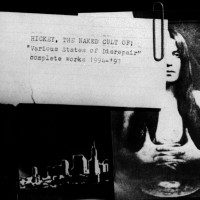
When I first heard Hickey’s Various States of Disrepair I knew I’d found what I’d been looking for. The only problem was, I’d found it too late.
It was at a merch table in the grimy-ass corner of some SPAM Records warehouse show when Corbett, of the then-defunct now-reunited Bobby Joe Ebola and the Children MacNuggits, shoved the CD in my hand. “You’ve gotta have this,” he shouted through the toilet paper I had shoved in my ears for earplugs. “Foundational shit right here.”
Of course, I’d heard Hickey before; you couldn’t be a Bay Area punk at the turn of the millennium and not have heard Hickey. Burned copies of the original 1997 release of Various States of Disrepair floated around basement apartments and the muddy floorboards of friends’ cars. References were made; lyrics were quoted; if you were really cool you got into their earlier band Fuckboyz. Bands accused each other of being covert-to-blatant Hickey rip-offs, and I loved them all.
The album was out of print, the record label now defunct, so I was left chasing scraps like elusive highs. I’d come in on the tail end of it the SF punk scene—a methed-out teenager with bad skin and worse social skills. By the time I started going to shows in 98—a year after Hickey had split—punk had been thoroughly, 100% co-opted. Hot Topic sold pre-studded jackets, faux-hawks were making their first gelled appearance, and Jello Biafara was just some old dude who hogged the mic on those torturous Spoken Word nights at Gilman.
The Dot Com Boom was also in full swing—I heard the word “gentrification” for the first time as I watched the warehouses in my native Oakland swell with refugees from SF’s rising rents. Where were all the rebellious counter-culture movements I’d heard about and wanted to identify with? Wasn’t San Francisco where all the county’s weirdos went? Why was it suddenly so white, and so bland? It seemed to me that the city was being drained of its life and color, the way my sarcoma-spotted uncle had been a decade earlier.
Hickey, though, had been the real fucking thing. At least that’s what the older, cooler kids told me. They were a melodic punk band that came screaming, sweating, thrashing straight outta the strung-out heart of the Mission. I’d discovered Hickey at age 15, around the same time I’d discovered Steel Reserve and amphetamines. They all held, I thought, some kind of answer; they all gave me something to chase.
Hickey’s songs subverted the typical verse-chorus-verse progression with sweetsick melodies that were catchy as shit. They didn’t sing about the typical apathetic disenfranchisement associated with Gen-X rock. Their lyrics and song titles read like some post-post-modern anthem: addiction (“The Prettiest Junkie in Town”); poverty (“Life is cheap but living is expensive”); fine-tuned irony (“Everything I Know About Sex I Learned From KISS”); co-optation of radical subcultures (“Revolution, $19.95″); and self-deprecating self-destruction (“Make Sure There Aren’t Any Squares at My Funeral”).
Their love songs were equally raunchy and fucked-up, the perfect lyrics to mouth to yourself when you came out of a blackout and found the boy you loved twitching in a puddle of his own piss:
“Hey cutie pie, it’ll be alright / I’ll be your Frankenstein / You can dress me up any way you like / Shoot me up with formaldehyde.”
Despite loving Hickey, I didn’t get my hands on a copy of Various States of Disrepair until the album was rereleased in 2002—a full five years after Hickey had broken up and four after I’d first heard their songs.
I’d finally found what I’d been chasing. Various States of Disrepair played in my Discman for months, as I rode public transit all over the goddamn Bay. The sounds were those of alleyways and brown bags, fog-soggy nights and stained fingers, bicycles crammed in narrow Victorian hallways. “El Farlito” became the anthem I sang while waiting in the urine-smelling, 3am lines for super quesadillas. “The Only Lesbian In Tulsa, OK” could have been written for me, I thought; I wasn’t a lesbian or in Tulsa, but its crooning, bittersweet alienation sounded like how my heart felt.
But slowly Hickey began to sound like something else—an epitaph. It was 2002; things had changed. The Dot Com Boom had burst but the folks who’d been priced out of SF still couldn’t afford to return. People had stopped even talking about gentrification in the Mission, the way they stopped debating whether cell phones could cause cancer. Friends of mine had disappeared and died, had grown razor thin and spotted with sores. That boy I’d loved died soon too. People were melting away, the same way the San Francisco of my childhood had.
I happened to be at a Mission Records show the day after Hickey lead guitarist and singer Matty Luv died. I’d only ever met him in passing, had never gotten to see Hickey perform, so I couldn’t share the malt-liquor-fueled tears of his friends. But it felt, inside that tiny BO-reeking room that day, like something bigger than just one person had died. It wasn’t long after that Mission Records, one of the last strongholds of the Mission punk scene, closed down; Balazo Gallery wasn’t far behind.
But things change and things die. They always have in San Francisco; I just didn’t realize it then. From the Barbary Coast to the “Harlem of the West” to the Summer of Love, those counter-culture scenes were always apt to bad endings in the City By The Bay. Hell, as a little girl I’d watched what was left of the 70s bathhouse swinger scene die, my young uncle wasting away in a chicken-bone-ridden bed on Octavia and Hayes.
So I’d always arrived too late. Always been chasing something.
Various States of Disrepair was the first time I understood that you could find what you were looking for and still not have it be enough. I loved that album, but it never did deliver the relief or sense of community I’d been chasing. It didn’t save me. It didn’t save any of us.
I’d arrived just in time to witness the last gasps of the SF punk scene. But what I’d missed was largely my own illusion, the idea of How Bad-Ass It Must Have Been. The album’s 2002 rerelease coincided with a time when reality came crashing in: friends died, venues closed and I got clean.
Maybe it was all a waste, all an illusion. A decade later the label that issued the 2002 rerelease, SPAM Records, has folded. There’s yoga classes now where we used to have shows; I’ve been known to go to them. Original copies of Various States of Disrepair sell on Amazon for as much as $125.
But this spring the album was again rereleased, this time by 1-2-3-4 Go! Records. As a double LP, which is even punker now. The nostalgia factor is running high—old friends from old bands have posted links on Facebook, and the blogs are abuzz. But I can’t help but wonder, you know, if it means that same thing anymore.
Secretly I hope it does. I like to pretend I’m old and jaded, but really, I’ve been imagining this desperate, fucked-up teenager trolling around SF. She’s been hearing stories of the old days—how the punks used to hijack the electricity from MUNI stops and have guerilla shows in front of the 16th Mission BART station at 2pm—and she’s been thinking, “If only I’d been born a little earlier.” In my fantasy, the cool older kids hand her a copy of the album, at some merch table wherever they’re having shows these days; she goes home and puts the needle to the black and the fifteen-year-old sounds come crackling out and I imagine her thinking she’s found some kind of answer.
I like to picture it that way, I guess cause it’d mean that Hickey’s greatness wasn’t all just some shit I made up. That even if the Various States of Disrepair is just another dot on the continuum, another relic of another by-gone era of San Francisco and, by extension, of me—my desperate, fucked-up youth—that it wasn’t all a waste.
It could be. But, hell—even if it is, we’ve still got the songs.
4 responses
How hauntingly lovely. Not an audiophile myself, nor a disciple of punk, but this piece made me regret both of those facts. To me punk has always been an enigma, like a sculpture made of smoke, but reading this let me feel what it was like to be a methed-out girl on the tail end of the SF punk scene — how different that was from my own life growing up, and yet achingly similar in many respects: namely, how all the electricity of a moment, the vital f-ing essence at the core of life, evaporates like summer lightning, leaving only a tracer of wonder in our eyes.
Everyone always thinks they were a little too late. You weren’t paying close enough attention. There was a lot of great stuff going on, but you didn’t see it. I moved here a few months after Op Ivy broke up. People said I was too late, that I had missed it all. I saw a lot of great shows by Blatz, Filth, Green Day, Victims Family, Neurosis, Steel Pole Bath Tub, All You Can Eat, and many other great local bands, even your beloved Hickey. I watched many now-famous novelists and poets read their early works at open mikes throughout the Mission. I saw comedians like Patton Oswalt, Margaret Cho, and Mary Lynn Rajskub working out new material on a regular basis. There’s still great stuff going on now. You just have to open your mind and look around. Hindsight is obvious.
Wow, Lauren. Great article. I still owe you those few more CDs from when I promised to meet you during a particularly harrowing point in my life. Thanks for this. Love and respect to you, lady!
“Secretly I hope it does. I like to pretend I’m old and jaded, but really, I’ve been imagining this desperate, fucked-up teenager trolling around SF. She’s been hearing stories of the old days—how the punks used to hijack the electricity from MUNI stops and have guerilla shows in front of the 16th Mission BART station at 2pm—and she’s been thinking, “If only I’d been born a little earlier.†In my fantasy, the cool older kids hand her a copy of the album, at some merch table wherever they’re having shows these days; she goes home and puts the needle to the black and the fifteen-year-old sounds come crackling out and I imagine her thinking she’s found some kind of answer.”
Hey, it happened for me. My friend showed me a bit of Hickey in about 2007 or 2008, when I was in high school. The first time I heard the Haps Bar recording with the whole White Zombie thing, I felt like I had found the sort of answer you’re talking about. Hickey soon became the only thing I ever listened to despite having tons of records and access to an entire internet’s worth of music.
Then it started to frustrate me that I had missed the whole thing, and began to try to relive all of the stories vicariously through the older, cooler kids, the ones who had been there once or who had an older sibling who had. I was angry at the circumstance of growing up in post-gentrification SF and not pre-gentrification SF, and adopted the belief that I was born about a decade or so too late.
But yeah, I got over that. I realized the futility of being nostalgic for other people’s experiences and times I didn’t share, and that if I wanted to know that sort of feeling of awesomeness, then I would have to make that crazy shit go down myself, with my friends and in my own time.
While I wasn’t there for the 90’s SF punk scene, I feel like Hickey’s records, especially Various States, serve as some sort of legacy to the spirit of those times. They have inspired me and at least a handful of other kids my age to get off our asses and start making cool, weird shit happen ourselves. And we are grateful.
Click here to subscribe today and leave your comment, or log in if you’re already a paid subscriber.