
Who isn’t a devotee of advice from writers about writing? One of my favorite books in this guilty-pleasure genre to come out lately is Dennis O’Driscoll’s collection of witticisms and one-liners, Quote Poet Unquote: Contemporary Quotations on Poets and Poetry. And one of my favorite quotes is by Czeslaw Milsoz: “Poetry is a dividend from what you know and what you are.”
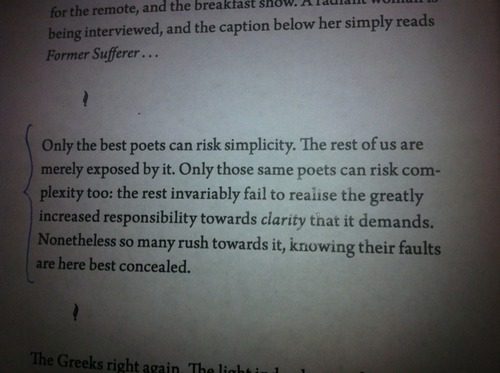
Now, the Poets & Writers Tumblr page is doing one better: showing a photograph and a highlight of some usually interesting specimen of writerly advice. Full disclosure if you haven’t noticed already: I confess, I love this kind of stuff.
Here is the post from From Don Paterson’s Best Thought, Worst Thought: On Art, Sex, Work, and Death (Graywolf Press, 2008).
And here is the first page of the first edition of Walt Whitman’s Leaves of Grass where he writes that still-riveting and still-perhaps-not-entirely-true-but-man-I-hope-it-is-true sentence: “The United States themselves are essentially the world’s greatest poem.”
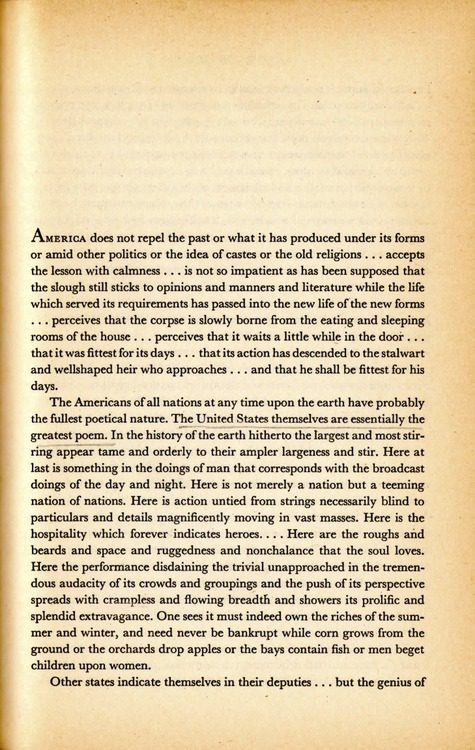
Today it would be the “United States is.” So: Got to love the “are” in that sentence, no? The ante-bellum “are.” The states rights “are.” The Gettysburg Address “are” — and, well, the Gettysburg Address is, for my money, the United State’s greatest public poem bar none.
Whitman understood that poetry is always in need of support. That’s why it’s so great to see The Irish Times assert its long tradition of publishing poetry with a new editor, Gerard Smyth. Since the 1940s, The Irish Times has published thousands of poems. I ask you, what major American newspaper can compete with that record?
Well, my hometown Portland Oregonian, for one. Each week for the last nearly ten years, the Oregonian has published a single poem in the Sunday book pages under the editorship of B. T. Shaw. Now that Shaw is headed to Vietnam, the editorial job has fallen to Kristian Rian. (And, if I may, for ten years the Oregonian has published this writer’s monthly column on poetry, as well — making it the longest-running column on poetry in the U.S., so I’m told; if there is an American newspaper that devotes more space each week to poetry than the Oregonian I’m not aware of it, and thanks be to God to Jeff Baker, a true friend of the poets and the Oregonian’s long-time books editor.)
What’s all that got to do with Bruce Lee? Well, this:
I’ve been trying to think of a poem that resembles this amazing feat by martial artist Bruce Lee playing pingpong with nunchucks because this one video does what the O’Driscoll and the P&W site do also. What we’re looking for here is a poem that exudes formal elegance and panache, physical prowess and concentration, range and definition. And: What we’re looking for is the literary message that this mind-blowing artistry lends to poets.
The poem that comes to mind — for me, at least — is William Meredith’s “The Illiterate.” The poem is both heart-breaking and heart-warming. Like the Lee tape, it defies belief. Like the Lee tape, it bridges zones of perception between mind and consciousness to expose a single idea of perfection. (Friends, feel free to nominate your Bruce Lee inspired poem in the comments section.)
And so this is what I think Bruce Lee’s advice to poets is: Like the accomplishment in the pingpong video, poetry must exude the impossible and reveal the practice that achieved it. Poetry must understate and overwhelm. Poetry must flash and entertain and, at the same time, defy your own eyes in the effort to reveal utter insight. In the effort to be, simply, utterance. The mind and music of the voice. The body and the nunchucks, one. The poet and the poem, one.
__________
A Poetry Wire Smile and Wink: Harvard Business Review calls on executives to read poetry. “There are plenty of business leaders who’ve never read poetry and have been wholly successful. But to those open to it, reading and writing poetry can be a valuable component of leadership development.” No doubt. So when you hear the old saw that there are too many poets in the world, MFA, blah, blah, blah, well, here you go. Answer with this. By God, poetry is good for business. At least, good for somebody’s business, somebody’s bottom line. And, don’t forget to add that even the Harvard Business Review says we need more poets in the world not fewer. You just know Walt Whitman would have loved this story.




3 responses
“Degrees of Gray in Phillipsburg” by Richard Hugo is my Bruce Lee nunchuck poetry selection. That first stanza is a form of martial arts:
You might come here Sunday on a whim.
Say your life broke down. The last good kiss
you had was years ago. You walk these streets
laid out by the insane, past hotels
that didn’t last, bars that did, the tortured try
of local drivers to accelerate their lives.
Only churches are kept up. The jail
turned 70 this year. The only prisoner
is always in, not knowing what he’s done.
Read the whole poem here: http://www.poetryfoundation.org/poem/171835
And then there’s Li-Young Lee’s “Immigrant Blues” that opens: “People have been trying to kill me since I was born…” What amazing reflexes this poem has…
Read it here: http://www.poetryfoundation.org/poem/182923
And finally: Emily Dickinson’s #1096 with the most nunchuck ending ever:
Several of nature’s people
I know, and they know me;
I feel for them a transport
Of cordiality.
But never met this fellow,
Attended or alone,
Without a tighter breathing,
And zero at the bone.
Great column again, David Biespiel!
Great column! My vote for a great “ping-pong with nunchuck” poem is Charles Simic’s “Errata.”
http://www.poemhunter.com/poem/errata/
The video is a faked bit of advertising. Unfortunately not the best example to draw from. 🙁 http://www.snopes.com/photos/advertisements/pingpong.asp
Click here to subscribe today and leave your comment, or log in if you’re already a paid subscriber.