
No one can know for sure what literary historians will make of it, least of all me as I pound out an editorial about poetry every week. But if I were a betting man, I would wager that the most significant literary event this month is not going to be the Poetry Foundation’s splashy new anthologies for school teachers. Instead, I’d make a wager that it’ll be the ding-dong response by America’s favorite postmodernists and conceptualists to Ange Mlinko’s brief notice about The Norton Anthology of Postmodern Poetry in the recent issue of The Nation. (It’s behind the paywall here and copied onto HTMLGiant here.)
The postmodern poetry establishment’s revulsion to Mlinko was a spark that contains, in its embers, an omen of the movement’s own demise.
Some background. Norton has been in the anthology business since the earth cooled. Their anthology, The Norton Anthology of Poetry, as well as the The Norton Anthology of Modern Poetry, have been college standards for decades. In the 1990s, Paul Hoover edited The Norton Anthology of Postmodern Poetry. A new edition came out this year. Mlinko, who has kicked up a few storms throughout poetry land recently by belittling Elizabeth Bishop in Poetry and demurring about Adrienne Rich in The Nation, this week mocked much of Hoover’s new postmodern effort. She disputes the very notion, expressed in the anthology’s introduction, that there is no such thing as transcendence in poetry anymore:
“…the same poetic universe called ‘postmodern,’ a contested notion that Hoover, in his almost thirty-page introduction, is at pains to define in terms made famous by the theorist Frederic Jameson: ‘It is safest to grasp the concept of the postmodern as an attempt to think about the present historically in an age that has forgotten how to think historically in the first place.’ What a claim to make in a poetry anthology that starts with 1953 and trumpets Kenneth Goldsmith’s “Any notion of history has been leveled by the internet”! What was it Keats wrote to Shelley: ‘Load every rift of your subject with irony’?”
Enter Mr. Goldsmith, who tweeted this week in response:
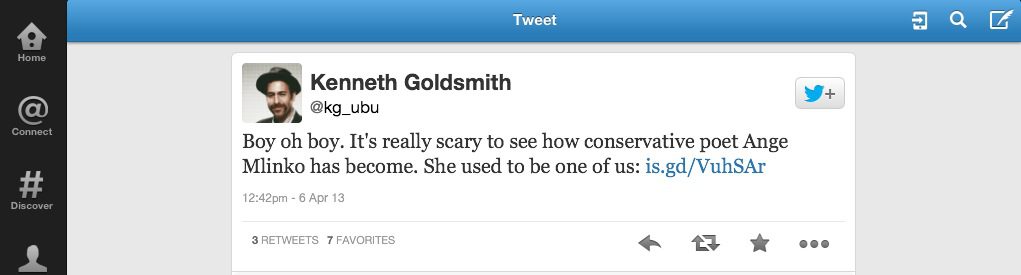
I fear I might be leaping into a postmodernist family feud even by addressing this controversy. And, to be fair, I’ll come clean: I find much of what touts itself as postmodern poetry to possess too little interest in writing, to be as emotionally conventional as a prime time sitcom, and to be formally lazy and intellectually superficial. In a word, inert. What I resist above all are apologies for postmodern poetry — for flarf, for conceptualist poetics —that fetishize mediocrity.
Meanwhile, by calling Mlinko “conservative,” it’s clear Goldsmith is attempting to affiliate Mlinko with a brand profile of conservatism in America today — as someone who must surely own guns, quilt, shop at Walmart, watch reruns of Dallas, and curl up in bed each night re-reading Atlas Shrugged. He may have meant literary conservative, but he must have known that the resonance of the brand of political conservatism was clinging to the term as well. That’s how it became the zinger that launched a thousand ships.
Responding in an e-mail, Mlinko wants to assure liberal poets throughout the land, “For the record, I have always voted Democrat. Well, sometimes Green. But I do love country music.”
What makes the latest round of postmodernist complaint against criticism of postmodernism so curious is that hardly anyone is cowed anymore. The war for legitimacy has been won. Postmodern poetry is its own Official Verse Culture, as Charles Bernstein ought to admit, and perhaps he has. The barricade of us versus them has long ago been broken and rebuilt.
And yet read on, please. Because you’ll see that our finest postmodernists have turned into purists and party base delegates. And that’s where things just get sad. The vigor and joy with which our best postmodernists attack any criticism of their aesthetic has all the hallmarks of the apparatchik.
Looking for examples? I had one for you. Several dozen people weighed in over some 60 comments on Noah Eli Gordon’s April 4, 2013 Facebook posting about the Mlinko review. Gordon praised Mlinko’ own poems but criticized her review. Other comments came from Charles Bernstein, Maxine Chernoff, John Yau, Susan Mesmer, Ron Silliman, Julie Carr, and others.
An earlier version of this post had all sixty comments, but an hour after the piece went up Noah Eli Gordon wrote politely to say that the “account is no longer public or active” and asked to have the thread removed in the interest of his privacy. So, sure. Though should anyone wish to comment below, I won’t be removing anyone’s writing.
I don’t mean to sound glib if I say I’m bewildered by the the sense of aesthetic supremacy reigning in the Facebook thread that you no longer get to read. There was an unhinged, anti-civil, even anti-intellectual ease to some of the postings (“Ange has always been rather prissy” was one of the comments). And plus now: there’s just avoiding critical scrutiny. But, hey, birds of feather, and all, eh?
And yet what troubles me is just that, the aesthetic sorting and the urge to affiliate. Goldsmith’s tweet equates being critical to being conservative. You know what conservative is? It doesn’t mean simply stodgy. It means Margaret Thatcher supporting Apartheid in South Africa or it’s Annette Funicello recreating the Mickey Mouse Club as those wretched beach blanket movies. That’s conservative. Implying, as Mlinko does, that lines of poetry such as Catherine Wagner’s “Penis regis, penis immediate, penis / tremendous, penis offend us…” is a ratty imitation of Gertrude’s Stein’s “If I Told Him: A Complete Portrait of Picasso” is nothing if not critical.
But the more we hear from the postmodernists (another comment thread here, for instance), the more we hear how much they want to eliminate comprehensibility, legibility, lucidity, palpability, and salience. They want to unrationalize lyric argument. Our postmodernist poets mean to be counter-conservative, but they now just come off as counter-poetry. Counter-art even. That’s the dullest avant-garde stance there is, dating back to Clement Greenberg attacked contemporary culture as mechanical and kitsch in the Roosevelt 1930s.
Besides, aren’t the terms ‘conservative’ and ‘liberal’ irrelevant to commentary about poetic style? Are the rhymes of Seamus Heaney conservative? Therefore: Thatcheresque? Is the laterality of Rae Armantrout leftist? Therefore: Stalinesque? The comparisons — the very semantic framework of liberal and conservative — have no legs. Mlinko again, in that e-mail: “I was reading a lot of Tony Harrison today, on the occasion of Margaret Thatcher’s death, and thinking how inconceivable it would be in the U.S. for a fiery leftist to write in elegant rhyming stanzas — precisely because somehow only ‘conservatives’ rhyme here. It’s Alice in Wonderland logic.”
Or, to put it differently: By adopting and tweeting the semantics of political shorthand for literary criticism (i.e., attacking Ange Mlinko as a ‘conservative’), it’s made the whole postmodernist movement jump the shark. This week Postmodern poetics is looking a lot like the Fonz in a leather jacket on skis.
Still: What I’m astounded by is the aesthetic that professes constant change but is so dogmatic. The postmodernist’s villification is that non-postmodernist poetry is a cancer. That invective is now fully institutionalized. I mean, at one time postmodernist enthusiasts resembled the jazz scene of the 1950s, with players who came of age when the public evaporated, and so they determined that their art must bite the hand that would no longer feed it. They tried to play faster, less harmonically, more complex and with ever more intricacy and flaunt. (Though it’s worth asking, as one has, who is the Miles Davis of this group of poets?)
And, then they got tenured. Mazel Tov! I’m all for work! Teaching is most honorable. Tenure is good. But it’s also not avant-garde. The castle has not been stormed.
Today, our postmodernist folks are armed with a deep bench of apologists, periodicals, publishing houses, and NPR, News Hour, Norton anthology legitimacy that they (like the so-called establishment they sought to repudiate) repudiate attacks with disdain for the art’s multilayers of tradition. Our most influential postmodernists argue, without irony, mind you, given their chosen art form, that the search for meaning is counter to the ambitions of the poet or the poem.
The tree of poetry, I hear someone shouting from the postmodernist halls, must occasionally be watered with the blood of formalists and confessionalists! But the clock on fashion is ticking too. I mean, look around you, where have all the New Augustans gone? The ash heap of poetry is littered with supremacy of movements.


13 responses
“People don’t go to anthologies for freaky three-ways of this kind.”
http://mainstreampoetry.blogspot.com
One has to wonder why the Gordon facebook thread was deleted from this post. Just for privacy’s sake! Because now Gordon’s entire facebook page is closed. Did postmodernist poets think their echo chamber of intolerance would never be exposed and called into question?
Editor’s note: Gordon closed his Facebook account before this was posted, so his decision wasn’t prompted by anything we did. You’ll have to ask him why he closed his Facebook page and requested that we remove the screenshots of the conversation mentioned above.
1. Gordon has every right to delete a thread from his own Facebook page and make his account private. Screenshots might be a different story, I guess. I’m no lawyer.
2. This experimental = liberal and form-aware-nonexperimental = conservative talk in poetry has been around for at least 40 years. It’s kinda time for it to stop.
3. While I agree with Mlinko’s sentiment that it’s awful we lost people like Trinidad, Violi, and others, I’m also psyched to see Flarf poets in there. I love everybody. What’s a lover like me to do in this instance? I guess read poems.
4. Happy National Poetry Month!
Does anyone even like Happy Days before that episode?
Daniel,
1. No one is suggesting that Gordon doesn’t have the right to delete threads or his account, which he did before he knew David was writing this piece. I want that to be clear to everyone, by the way–Gordon didn’t delete his account because of anything we said or did. It was gone well before we ran this piece.
2. Yeah, I wish it would too, for the reasons David outlines in this piece. It’s reductive at best, absurd in specific cases.
3. I hear you. I have other issues with Hoover’s anthology, notably the lack of diversity in the second half. But I’m also not the biggest fan of anthologies in general, so I’ll probably stick to reading individual collections.
4. I’m with you. Happy National Poetry Month!
Thanks Brian. I don’t know about the timeline or what was on NEG’s Facebook page. I guess my point is just to say I think anyone can do anything with one’s Facebook page, very valid corporate content-factory arguments notwithstanding.
David makes some great points about the equation of liberal and conservative swapping out for aesthetic schools.
How does Flarf differ from this sort of solitary parlor game of the sort social media networks spawn?
http://toulousestreet.wordpress.com/2009/02/27/be-he-ploughman-or-painter/
I actually thought my outcome was a good one. I hope to see it included in the Norton Anthology of Shit People Said on Twitter.
Thanks for passing along another interesting piece, D. Here’s a rough version of what’s become my knee-jerk response. For my money, there’s a way in which this “scuttle,†as you call it, itself has structured the of concern American century of poetry and criticism, for better or worse. In particular, I want to think more about how writers writing at any given moment have probably shared more personal-political affinities or more overlapping beliefs in art’s fundamental goals/ethos than would seem . . . more than would seem precisely because of such heated and occluding scuttles. And now I kinda want the word “scuttle†here to also mean “a deep bucket for carrying coal,” to conjure up the image of a reddening iron pail — and then this argumentative energy, rather than effectively staking out any distinct claims to the “true” value of the mining process or to what social/political capital the bucket’s contents will purchase, instead builds fires underneath the collective pot or reaches a kind of polemical stalemate over the best hand style with which to draw the bucket up before tending to what’s been mined & for what . . . or, better yet, let’s put all the poets in the bucket, and now the growing camp fire is working to make the poetry world a more hostile one for all who find themselves in it. Of course, a metaphor/diagnosis like this risks sounding like the suggestion here is that difference itself is an illusion or that all poetry fights need ending (or could ever end) via a boring “Unite the clansâ€-type password solving the tensions of difference — I really dig difference, I know not all poetry attempts the same intervention/work, and I think arguments about poetics can do their own important work. But, all the same, it seems important that we notice how often, when people start writing (either poetry or criticism), many affinities and overlaps get quickly erased (overwritten, if you will) and literary wars break out. To me, this says that, in a certain sense, the poetry wars tend to be more wars about *idiom.* To me, this says idiom is *hugely* important — more important, seemingly, than political/ideological/aesthetic/&c. leanings — and that we rely on idioms to sharpen our aesthetic assumptions about any art’s political/social potency . . . or is it to smell out our political/social allergies to the (failed) civic duty of certain aesthetics? Either way, it seems to me that, until we get a better handle on trading in & across idioms, especially those that differ from our own inclinations, our conversations and our thinking about aesthetic/theoretical difference will be marked by (if not entrenched in) uninteresting things like intolerance, otherwise frustrating/limiting what are important discourses . .
“What I call ‘idiom’ is the uniqueness of the language of the other, that is, the poetry of the other. There is no poetry and opening up without the idiom of the other . . . We must cultivate the idiom.” — Jacques Derrida
I can tell you what my comment said: Don’t tell me what working class people do or don’t need to read… Is that attacking? I don’t think so. Can’t I have an opinion? I think Ange Mlinko would think my opinion is quite fine even if she doesn’t agree with me… I think what’s hilarious is how defensive everyone is including those of you who think it’s ridiculous of Kenny to Tweet his little Tweet. Get some context.
Should poets all think alike? Louis Menand, in his “The Marketplace of Ideas: Reform and Resistance in the American University,†asks, “Why do professors all think alike?†Professors, as a group, Menand argues, are liberal. No surprise there, but the surprise, Menand says, is that they are “so overwhelmingly mainstream liberal†(136), not the hardcore liberals, in other words, we might associate with advocates of “The Nation.†(Using Menand’s “Political Orientation†list, Goldsmith’s name-calling tweet might have been a much more subtle and therefore effective “Middle-of-the-road-liberalâ€). And earlier (122), Menand has referenced Harold Rosenberg’s “The Anxious Object†(1964): “The title was a reference to the art of the sixties – Pop Art, Minimalism, and Conceptual Art. Rosenberg thought that those art objects were anxious because they were uncertain of their own identity. They kept asking themselves questions like, Am I a work of art, or just a wall of Polaroids? Am I a sculpture, or just a pile of bricks? More existentially: Am I an autotelic aesthetic artifact, or just a commercial good?†And then Menand asks, “What causes anxiety to break out in a work of art?†Of course poets should not all think alike, but neither should they be forced to choose, as Menand concludes with regard to professors, “between identities that cannot be separated. A work of art is both an aesthetic object and a commercial good. That is not a contradiction unless you have been socialized to believe that it must be†(123). One problem with reform is the implication there will be resistance, and the resistance usually takes the form of we’ve already found the meaning (even if what we’ve found is meaningless), while there’s no act more liberal and suggestive of reform than a search for meaning.
“Postmodern” is a bit of a conundrum, isn’t it– much as “modern” is. If you declare yourself to be “(post)modern” at any given point in time, what are you 10 years later? Struggling for a new identity and getting into nasty comment wars in the process, evidently. Same problem with “avant-garde.” These are reactive labels; while the reaction may have been necessary and constructive in its time, inevitably it becomes an outdated posture. Time to find a new revolution, folks.
Since “post-modernism”, or collagism as I call it, has become institutionalized, though insecure in its fierce self-defense, does that mean that someone like me, who is writing a classical epic in blank verse telling straight narrative stories, is now an outsider?
Click here to subscribe today and leave your comment, or log in if you’re already a paid subscriber.