<?xml version="1.0" encoding="UTF-8"?>
<rss version="2.0"
	xmlns:content="http://purl.org/rss/1.0/modules/content/"
	xmlns:wfw="http://wellformedweb.org/CommentAPI/"
	xmlns:dc="http://purl.org/dc/elements/1.1/"
	xmlns:atom="http://www.w3.org/2005/Atom"
	xmlns:sy="http://purl.org/rss/1.0/modules/syndication/"
	xmlns:slash="http://purl.org/rss/1.0/modules/slash/"
	>

<channel>
	<title>The Rumpus.net &#187; The Thermals</title>
	<atom:link href="http://therumpus.net/topics/the-thermals/feed/" rel="self" type="application/rss+xml" />
	<link>http://therumpus.net</link>
	<description>Books, Music, Movies, Art, Politics, Sex, Other</description>
	<lastBuildDate>Sat, 18 May 2013 14:58:56 +0000</lastBuildDate>
	<language>en-US</language>
	<sy:updatePeriod>hourly</sy:updatePeriod>
	<sy:updateFrequency>1</sy:updateFrequency>
	<generator>http://wordpress.org/?v=3.5.1</generator>
		<item>
		<title>Albums of Our Lives: The Thermals&#8217; The Body The Blood The Machine</title>
		<link>http://therumpus.net/2013/02/albums-of-our-lives-the-thermals-the-body-the-blood-the-machine/</link>
		<comments>http://therumpus.net/2013/02/albums-of-our-lives-the-thermals-the-body-the-blood-the-machine/#comments</comments>
		<pubDate>Wed, 06 Feb 2013 17:45:30 +0000</pubDate>
		<dc:creator>Tobias Carroll</dc:creator>
				<category><![CDATA[music]]></category>
		<category><![CDATA[rumpus original]]></category>
		<category><![CDATA[Albums of Our Lives]]></category>
		<category><![CDATA[Christianity]]></category>
		<category><![CDATA[Jeanette Winterson]]></category>
		<category><![CDATA[Ross Douthat]]></category>
		<category><![CDATA[The Body The Blood The Machine]]></category>
		<category><![CDATA[The Thermals]]></category>
		<category><![CDATA[Tobias Carroll]]></category>
		<category><![CDATA[Will Saletan]]></category>

		<guid isPermaLink="false">http://therumpus.net/?p=110713</guid>
		<description><![CDATA[<p>It begins with an act of divine intervention. “God reached his hand down from the sky,” sings Hutch Harris.<span id="more-110713"></span> “He flooded the land, then he set it afire/ He said, ‘Fear me again, you know I’m your father/ Remember that no one can breathe underwater.’”</p><p>The melody, already rapid-fire agitprop in the style of early-80s Billy Bragg, intensifies, and a drumbeat.</p>]]></description>
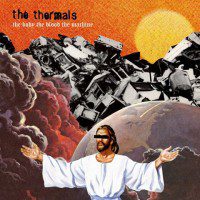
				<content:encoded><![CDATA[<p>It begins with an act of divine intervention. “God reached his hand down from the sky,” sings Hutch Harris.<span id="more-110713"></span> “He flooded the land, then he set it afire/ He said, ‘Fear me again, you know I’m your father/ Remember that no one can breathe underwater.’”</p><p>The melody, already rapid-fire agitprop in the style of early-80s Billy Bragg, intensifies, and a drumbeat. “So bend your knees and bow your heads/ Save your babies, here’s your future.” And then Harris is screaming, “Yeah, here’s your future,” and the guitars get loud and the drums get loud and if heads aren’t already nodding, they probably are now.</p><p>For me, The Thermals’ “Here’s Your Future” has one of the most riveting openings to a punk rock record I’ve heard in the last ten years. It’s also lyrically clumsy, politically ham-fisted, and rarely approaches subtlety. And I rarely go a week without listening to some part of it.</p><p><object width="420" height="315" classid="clsid:d27cdb6e-ae6d-11cf-96b8-444553540000" codebase="http://download.macromedia.com/pub/shockwave/cabs/flash/swflash.cab#version=6,0,40,0"><param name="allowFullScreen" value="true" /><param name="allowscriptaccess" value="always" /><param name="src" value="http://www.youtube.com/v/ScxrWz7DK_M?hl=en_US&amp;version=3&amp;rel=0" /><param name="allowfullscreen" value="true" /><embed width="420" height="315" type="application/x-shockwave-flash" src="http://www.youtube.com/v/ScxrWz7DK_M?hl=en_US&amp;version=3&amp;rel=0" allowFullScreen="true" allowscriptaccess="always" allowfullscreen="true" /></object></p><p style="text-align: center;">***</p><p style="text-align: left;">The core of the group, Hutch Harris and Kathy Foster, had played together in groups before this one; listening to The Thermals beside, say, the duo recordings they released under the name Hutch &amp; Kathy, it’s pretty clear that the same sensibility is at work. 2006’s <em>The Body The Blood The Machine</em>, the album that “Here’s Your Future” opens,<em> </em>honed a particular direction for them, towards more thematically focused works; the album as meditation on a particular topic. The two albums that they’ve made since then, 2009’s <em>Now We Can See</em> and 2010’s <em>Personal Life</em> have both taken on larger conceptual frameworks but done so more elegantly, without some of the ham-fistedness that shows up here. Here, The Thermals have set these ten songs in a near-future United States overtaken by a particularly conservative and bigoted strain of Christianity.</p><p>The collages that dot the album’s artwork &#8212; an aesthetic descendent of Dead Kennedys collaborator Winston Smith and the juxtaposition-prone John Yates &#8212; are not subtle as they evoke rote Christian imagery and Bush-era culture clashes. The cover features Jesus with his eyes covered by a black bar, and other art features the Ten Commandments overlapping the Capitol’s architecture, a heavily redacted document with “ATTENTION ESCAPISTS!” at the top, and a car’s rear-view mirror where surging flames are visible.</p><p>Over the course of <em>The Body The Blood The Machine</em>’s ten songs, some of them frenetic in their tempo and others content to proceed with a stately chug, the society described on the album is delineated; the narrator of several of these songs vacillates between wanting to run from this society and (in “A Return to the Fold”) embracing it. If you’re thinking <em>Nineteen Eighty-Four</em> here, you’re in the right ballpark. There’s more than a little fascism in the society described &#8212; from the references to a “new master race” in the opener to the mention of “Nazi halos” in “I Might Need You to Kill.” Listening to these songs, it isn’t clear if Harris and Foster are suggesting that this is the end point of modern conservatism or if they’ve opted to go for a worst of all possible worlds, one where a kind of Christian Identity-based state has arisen. In the end, it might not matter &#8212; <em>The Body The Blood The Machine</em> is a powerful album, but it isn’t a particularly nuanced one.</p><p><object width="420" height="315" classid="clsid:d27cdb6e-ae6d-11cf-96b8-444553540000" codebase="http://download.macromedia.com/pub/shockwave/cabs/flash/swflash.cab#version=6,0,40,0"><param name="allowFullScreen" value="true" /><param name="allowscriptaccess" value="always" /><param name="src" value="http://www.youtube.com/v/pO3_ZG7wJPc?version=3&amp;hl=en_US&amp;rel=0" /><param name="allowfullscreen" value="true" /><embed width="420" height="315" type="application/x-shockwave-flash" src="http://www.youtube.com/v/pO3_ZG7wJPc?version=3&amp;hl=en_US&amp;rel=0" allowFullScreen="true" allowscriptaccess="always" allowfullscreen="true" /></object></p><p style="text-align: center;">***</p><p>I’ve never been sure why this album has gripped me as much as it does. I have friends who experienced in their youth a give-and-take between fundamentalist Christianity and punk rock, and others who have told stories of faiths that aren’t too far removed from the borderline-fascist creed referenced here. This year, I’ve read Jeanette Winterson’s terrifying account of growing up in a repressive branch of Christianity in her memoir <a href="http://www.jeanettewinterson.com/pages/content/index.asp?PageID=611" target="_blank"><em>Why Be Happy When You Can Be Normal?</em></a> I’ve read the political writers Will Saletan and Ross Douthat <a href="http://www.slate.com/articles/arts/the_book_club/features/2012/ross_douthat_s_bad_religion/ross_douthat_s_bad_religion_faith_and_american_culture_.html" target="_blank">discuss the evolution of Christianity</a>, and the ways in which it’s been adopted by the politically conservative.<br />This has not been my experience with Christianity. I grew up Episcopalian. There wasn’t much in the way of repression to be found there: no fear of damnation, no conflict between the books I read and the messages I heard in church on Sunday mornings. And while I can remember driving home from church with a Bad Religion tape playing on my car’s stereo, I never found much transgressive about my listening habits and the faith I’d been raised in, even as I got more and more into punk rock. About the only part of this album that really resonates with any vestige of my younger self is Harris’s line in “A Pillar of Salt” about “our filthy bodies,” though that (for me) had little to do with any concept of sin and desire.</p><p style="text-align: center;">***</p><p>For all that I find some of the imagery and wordplay here heavy-handed, though, there’s no rule that punk rock needs to be subtle. For every Against Me! playing textual and narrative games with their lyrics to a smart poltical end, there’s a Team Dresch, who well understand that the best political critiques are often the loudest. (“Hate The Christian Right” is an utterly brutal attack on a specific series of conservative politics; it’s loud and savage in its sentiments, and it’s impossible to forget.) <em>The Body The Blood The Machine</em> isn’t exactly subtle, but it’s not like it needs to be.</p><p>Even so, that doesn’t explain why this album hits so close to home for me &#8212; there are plenty of punk records that hit on a visceral level, but haven’t wormed themselves into my head the way this one has. My own mild philosophical differences with Episcopalianism seem insufficient grounds for my gut-level appreciation of such a gut-level attack on Christianity.</p><p>And yet, for all that I would probably point a newcomer to The Thermals to <em>Now We Can See</em> or <em>Personal Life</em>, it’s <em>The Body The Blood The Machine </em>that I return to again and again, looking for that same thrill and that same rush. I don’t think that this is an example of the tired old “punk rock became my religion” trope, but I also worry that it isn’t far from it, that my attraction to this album suggests that its fears of the allure of an all-controlling religious devotion are more resonant than I might like to admit. Alternately, as Harris sings with equal parts elation and terror: here’s your future.<br /><h3 class='related_post_title'>Related Posts:</h3><ul class='related_post'><li><a href='http://therumpus.net/2013/05/albums-of-our-lives-bob-dylans-blonde-on-blonde/' title='ALBUMS OF OUR LIVES: BOB DYLAN&#8217;S &lt;EM&gt;BLONDE ON BLONDE&lt;/EM&gt;'>ALBUMS OF OUR LIVES: BOB DYLAN&#8217;S <EM>BLONDE ON BLONDE</EM></a></li><li><a href='http://therumpus.net/2013/05/a-zealot-and-a-poet/' title='A Zealot and a Poet'>A Zealot and a Poet</a></li><li><a href='http://therumpus.net/2013/04/authors-deface-own-books-for-charity/' title='Authors Deface Own Books for Charity'>Authors Deface Own Books for Charity</a></li><li><a href='http://therumpus.net/2013/03/albums-of-our-lives-to-the-extreme-by-vanilla-ice/' title='ALBUMS OF OUR LIVES: &lt;EM&gt;TO THE EXTREME&lt;/EM&gt; BY VANILLA ICE'>ALBUMS OF OUR LIVES: <EM>TO THE EXTREME</EM> BY VANILLA ICE</a></li><li><a href='http://therumpus.net/2013/03/albums-of-our-lives-songs-ohias-magnolia-electric-co/' title='Albums of Our Lives: Songs: Ohia&#8217;s &lt;em&gt;Magnolia Electric Co.&lt;/em&gt;'>Albums of Our Lives: Songs: Ohia&#8217;s <em>Magnolia Electric Co.</em></a></li></ul>]]></content:encoded>
			<wfw:commentRss>http://therumpus.net/2013/02/albums-of-our-lives-the-thermals-the-body-the-blood-the-machine/feed/</wfw:commentRss>
		<slash:comments>1</slash:comments>
		</item>
		<item>
		<title>2009: The Year in Music</title>
		<link>http://therumpus.net/2009/12/2009-the-year-in-music/</link>
		<comments>http://therumpus.net/2009/12/2009-the-year-in-music/#comments</comments>
		<pubDate>Tue, 29 Dec 2009 08:01:35 +0000</pubDate>
		<dc:creator>Michael Hoven</dc:creator>
				<category><![CDATA[music]]></category>
		<category><![CDATA[rumpus original]]></category>
		<category><![CDATA[Au Revoir Simone]]></category>
		<category><![CDATA[Grizzly Bear]]></category>
		<category><![CDATA[Guided by Voices]]></category>
		<category><![CDATA[Jeffrey Lewis]]></category>
		<category><![CDATA[John Vanderslice]]></category>
		<category><![CDATA[Kimya Dawson]]></category>
		<category><![CDATA[Leonard Cohen]]></category>
		<category><![CDATA[Mount Eerie]]></category>
		<category><![CDATA[The Thermals]]></category>
		<category><![CDATA[The xx]]></category>
		<category><![CDATA[Wavves]]></category>

		<guid isPermaLink="false">http://therumpus.net/?p=41532</guid>
		<description><![CDATA[<p><strong><img class="alignleft" src="http://farm5.static.flickr.com/4042/4210149742_d92e6c48ed.jpg" alt="" width="119" height="76" />January</strong>: <a href="http://www.kimyadawson.com/">Kimya Dawson</a>, <em>Remember That I Love You</em> (2006)</p><p>One route on the Metro-North railroad begins in New Haven and ends at Grand Central Station in New York City.<span id="more-41532"></span> From January to April I took that trip twice a week to an unpaid internship at a Manhattan publishing house.</p>]]></description>
				<content:encoded><![CDATA[<p><strong><img class="alignleft" src="http://farm5.static.flickr.com/4042/4210149742_d92e6c48ed.jpg" alt="" width="119" height="76" />January</strong>: <a href="http://www.kimyadawson.com/">Kimya Dawson</a>, <em>Remember That I Love You</em> (2006)</p><p>One route on the Metro-North railroad begins in New Haven and ends at Grand Central Station in New York City.<span id="more-41532"></span> From January to April I took that trip twice a week to an unpaid internship at a Manhattan publishing house. During the two-and-a-half hour ride I read and listened to music, at least I did on the morning trip into the city; bleak fantasies of my future, combined with the 24-ounce cans of beer that they sell at Grand Central, often made reading difficult on the return trip.<!--more--> Instead I would focus on Deerhoof (<em>Offend Maggie</em>, 2008), Of Montreal (mostly <em>Skeletal Lamping</em>, 2008), or Brian Eno (<em>Here Come the Warm Jets</em>, 1974). These trips could get emotional as I wondered where my life was headed, but only one album so consistently caused me to tear up in front of strangers that I had to quit listening to it on the train: Kimya Dawson’s <em>Remember that I Love You</em>, filled with songs that are the aural equivalent of firm and supportive embraces.</p><p><strong>February</strong>: <a href="http://www.gbv.com/">Guided by Voices</a>, <em>Alien Lanes</em> (1995)</p><p>I arrived at Guided by Voices late to begin with—it was only after I graduated college in 2003 that I bought my first Guided by Voices album, <em>Under the Bushes, Under the Stars</em> (1996). Only by working backwards from the Strokes, who pointed to Guided by Voices as role models, did I find the band in the first place. I was not an early adopter of the Strokes, either. By the time I was preparing to leave graduate school six years later I had long since figured I was done with Guided by Voices and their prodigious output of two-minute nuggets of lo-fi pop.</p><p><em>Alien Lanes</em> was a used-CD purchase, brought about as much by the uncompetitive offerings in the store as any resurgent taste in garage rock. Talking music with a friend, I mentioned that I had finally gotten around to buying the nearly fifteen-year-old album, and he immediately asked me, “Isn’t ‘My Valuable Hunting Knife’ the best song you’ve ever heard?” It was. It was so good that when I first heard it I went back to the beginning of <em>Alien Lanes</em> to listen to the album in the reflection of that song’s brilliance. That night we drank beer and drove to different bars, listening to “My Valuable Hunting Knife” over and over again on the factory stereo in his Honda Accord that was nearly as old as <em>Alien Lanes</em>.</p><p><strong>March</strong>: <a href="http://www.thejeffreylewissite.com/">Jeffrey Lewis</a>, Various Clips on YouTube</p><p>The music video for “Williamsburg Will Oldham Horror” (as <a href="http://www.youtube.com/watch?v=NSdZ_yZP8bk">seen on YouTube</a>) was my introduction to Jeffrey Lewis (check out <a href="http://therumpus.net/2009/08/the-rumpus-shorty-q-a-with-jeffrey-lewis/">the Rumpus interview with Lewis</a>). A friend showed it to me, and I showed my girlfriend, and she eventually bought all of his albums in the order in which they were released. I made do with the burned copies my girlfriend gave me. Most of this was in the summer and fall of 2008, when Lewis’s music formed the basic structure of my existence.</p><p><img class="alignright" src="http://farm4.static.flickr.com/3525/3843237996_f317cee740.jpg" alt="" width="300" height="300" />By the time 2009 began I had begun to move on to other music, although I repeatedly returned to Jeffrey Lewis. But then I formed a bad habit of watching YouTube clips of Lewis before I went to bed. I started with the ones I had first seen—“<a href="http://www.youtube.com/watch?v=NSdZ_yZP8bk">Williamsburg Will Oldham Horror</a>,” “<a href="http://www.youtube.com/watch?v=88QLxLHQW_M">A Complete History of Punk Rock</a>”—but moved on to others: live clips of “<a href="http://www.youtube.com/watch?v=thywnQMx7RE">Big A, Little A</a>,” the Black Cab Sessions recording of “<a href="http://www.youtube.com/watch?v=svwfR-K1h04">If Life Exists</a>,” and <a href="http://www.youtube.com/watch?v=XEnudbTDdwQ&amp;feature=related">interviews of Lewis</a>. Then it would be late and I would have pointlessly eaten junk food or drank more beer. The only consolation was that Jeffrey Lewis was amazing, even on amateur video recordings, even with bad sound quality, and even if the clip stopped abruptly before the song had even ended.</p><p><strong>April</strong>: <a href="http://www.myspace.com/girltalk">Girl Talk</a>, <em>Feed the Animals</em> (2008)</p><p>Lawrence Lessig, an eminent intellectual property lawyer, is a fan of Girl Talk for intellectual and legal reasons. As a critic of the restrictiveness of current copyright laws, Lessig celebrates Girl Talk (and others) for their innovative recontextualization of preexisting pieces of music (or art) to create a wholly new creative object. I was reading Lessig’s <em>Free Culture</em> around the same time I started listening to Girl Talk, thinking about entering law school and specializing in intellectual property and copyright law. I wanted to do my part to advance creativity in literature and the arts, to defend Girl Talk and other participants in “remix” culture. <em>Feed the Animals</em> was built almost exclusively from music I didn’t like, but was somehow cut, spliced, and manipulated into an endlessly listenable form. I’m still not sure about law school. On legal issues I’m always on the side with no money.</p><p><strong>May</strong>: <a href="http://www.thethermals.com/home.html">The Thermals</a>, <em>The Body, the Blood, the Machine</em> (2006)</p><p><img class="alignleft" src="http://farm3.static.flickr.com/2677/4209334677_996aa19bb7.jpg" alt="" width="300" height="300" />I went to a show of theirs with two old friends. Before the concert we went to a bar and played pool. We talked about dental insurance and the sorry state of our teeth. The show featured the Thermals’ newest music, and I liked it so much that the next time I was in a used record store I bought an album of theirs that I didn’t have, though it was <em>The Body, the Blood, the Machine</em> and not their most recent effort (<em>Now We Can See</em> came out in April). It was the only album available by the Thermals in the store. <em>The Body, the Blood, the Machine</em> is an allegorical attack on the Bush administration and the politicized religious culture that supported it. They were out of power at this point, but I was still angry at them, so the album seemed timely.</p><p><strong>June</strong>: <a href="http://www.johnvanderslice.com/">John Vanderslice</a>, <em>Romanian Names</em> (2009)</p><p>This album prompted me to write an extended blog post on the career of Vanderslice and what is, to me, the unparalleled achievement of his musical output (check out <a href="http://therumpus.net/2009/08/the-rumpus-interview-with-john-vanderslice-at-tiny-telephone/">the Rumpus interview with Vanderslice</a>). And while I predicted—and was partially confirmed—that this would be seen as a high point in his career, it was not. The density of sound and the gravity of meaning that had been so evident on <em>Cellar Door</em> (2004) and <em>Pixel Revolt</em> (2005)—even, though to a lesser extent, on <em>Emerald City</em> (2007)—were lacking, though his songs were as controlled and pretty as they’d ever been. But the blog post helped me get some work as a freelance writer, which in turn helped me get a day job. So this album turned out to be a real boon to me. But it’s no <em>Pixel Revolt</em>.</p><p><strong>July</strong>: <a href="http://aurevoirsimone.com/">Au Revoir Simone</a>, <em>Still Night, Still Light</em> (2009); <a href="http://www.grizzly-bear.net/">Grizzly Bear</a>, <em>Veckatimest</em> (2009)</p><p><strong></strong>I began, somewhat improbably, to write as a freelancer for a music website. It coincided with moving to New York and moving in with my girlfriend. After years of escaping roommates through headphones, I now shared close quarters with someone I wanted to listen to, and I ended up listening to less music than ever before. Also, my stereo shorted so the only way to listen to music outside of headphones was to plug an iPod or computer into the TV and listen through the TV’s speakers. Which we did. These two albums were the ones in heaviest rotation, though by the time I started writing about music the reviews and coverage of these albums had already ended.</p><p><strong>August</strong>: <a href="http://www.myspace.com/wavves">Wavves</a>, <em>Wavvves</em> (2009)</p><p>When I was in college I discovered the joys of punk rock, hooded sweatshirts, and poor hygiene. It was the sort of thing that grown-ups call “a phase,” but some of it stayed with me, like the knowledge that anger and austerity can be fashioned into an aesthetic. Wavves unabashedly took up the teenage resentment that has guided pop music for over fifty years—lyrics include “I’m so bored” and “got no car, got no money”—and ground it into caustic surf-punk. Gritty and melodic, <em>Wavvves</em> made being broke in a small apartment seem like the sign of a life well-lived, provided I didn’t acknowledge that I was 28 and not 18, that I’d already gone to graduate school, already given up on dressing in black, and started to fantasize about the pleasures of knowing where next month’s rent would come from, even if it meant wearing a tie and shaving every day.</p><p><strong>September</strong>: <a href="http://www.myspace.com/mounteerieorthemicrophones">Mount Eerie</a>, <em>Wind’s Poem</em> (2009)</p><p>Am I just getting old, and are my tastes getting stale? You could make a pretty persuasive case for it. Exhibit A would be Mount Eerie. For me, the Microphones (the antecedent band of Mount Eerie) were first a recommendation, then a concept I read about in articles and interviews, and then a band with groundbreaking music in the form of <em>The Glow, Pt. 2</em> (2001). I even liked how the album title spelled “part” as “Pt.” By turns aching, haunting, jarring, and crushing, I loved it. And though I’d be forced to describe Mount Eerie’s debut in much the same terms, and repeat myself again in describing <em>Wind’s Poem</em>, I can’t work up the same energy for those albums. Maybe it’s just too hard. Maybe I want something more cloying, something that tries harder to make me like it. I hope not. But I’m worried.</p><p><strong>October</strong>: <a href="http://www.myspace.com/thexx">The xx</a>, <em>xx</em> (2009)</p><p>When I began to evaluate the best music released in 2009, I realized I hadn’t listened to many of the albums that others insisted were among the best. Many of those albums did nothing for me; I’ve yet to decipher the charms of <em>Wolfgang Amadeus Phoenix</em> (2009) by Phoenix, for example. But <em>xx</em> turned out to be touching and wonderful, an album that sneaks up on you slowly. If no one else was around you might be tempted to play it five and six times in a row, though you would have a hard time explaining exactly why.</p><p><strong>November</strong>: Leonard Cohen, <em>Songs of Love and Hate</em> (1971)</p><p><img class="alignright" src="http://farm3.static.flickr.com/2541/4210160020_5b510e1bd9_o.jpg" alt="" width="300" height="300" />This year would have been a good year for <em>Songs of Love and Hate</em> to be released, and for Leonard Cohen in general. A musician built on pathos and charisma, the simple music serves as an excuse for Cohen to turn personal stories into epic tales. It seemed a good year for sincerity, earnestness, and unearthing the high drama that lay underneath personal and petty hardships, or maybe it’s just me. A friend visited and gave me two albums (<em>Songs of Love and Hate</em> and <em>Songs from a Room</em>, 1969) of Cohen’s, transferred from computer to computer via a USB flash drive. It reminded me of another friend of ours, in whose freshman dorm room I first listened to Leonard Cohen. That friend had better taste in music than I did, and I’d already adopted some of his favorites. He said he thought I would like Leonard Cohen, and he was right. He got married this summer, and I didn’t go to his wedding.</p><p><strong>December</strong>: <a href="http://www.gbv.com/">Guided by Voices</a>, <em>Alien Lanes</em> (1995)</p><p>In truth, I hadn’t really stopped listening to <em>Alien Lanes</em>. Even after I (illegally) downloaded <em>Bee Thousand</em> (1994), another essential album from the classic-lineup-era Guided by Voices, it was <em>Alien Lanes</em> that filled headphones and speakers. The <em>Alien Lanes</em>’ song “Watch Me Jumpstart” provided the title for a documentary of the band that I saw online for free. The documentary probed the incongruous path to musical success taken by this collection of men in their mid-to-late thirties who worked day jobs in Dayton, Ohio while they recorded groundbreaking music. Images from <em>Watch Me Jumpstart</em> (1998, directed by Banks Tarver) continue to resurface as I go to my office job. Jobs in offices, where whole days are spent with shirts tucked in, don’t lend themselves to contemplation. Too many tasks abound and soon you, too, are involved in the pitched drama of who refills the water cooler and who took the last pen without telling anyone.</p><p>But then there is the commute on the subway, where I read memoirs by writers only a few years older than me who worry about scraping together a living as writers. And I listen to Guided by Voices, who did things all wrong—Robert Pollard started with band names and album art, then developed song titles, and only last did he actually write the songs of tossed-off perfection that populate the album of the year for 2009, and possibly for every year forevermore, <em>Alien Lanes</em>. I don’t have Pollard’s talent or capacity for risk, but still he gives me hope.</p><p>**</p><p>Headphones art by <a href="http://hierroglyphic.blogspot.com/">Frank Plant</a> (check out <a href="http://therumpus.net/2009/10/the-rumpus-interview-with-frank-plant/">the Rumpus interview with Plant</a>).<br /><h3 class='related_post_title'>Related Posts:</h3><ul class='related_post'><li><a href='http://therumpus.net/2013/04/nick-cave-monday-29-avalanche/' title='Nick Cave Monday #29: &#8220;Avalanche&#8221;'>Nick Cave Monday #29: &#8220;Avalanche&#8221;</a></li><li><a href='http://therumpus.net/2013/02/albums-of-our-lives-the-thermals-the-body-the-blood-the-machine/' title='Albums of Our Lives: The Thermals&#8217; &lt;em&gt;The Body The Blood The Machine&lt;/em&gt;'>Albums of Our Lives: The Thermals&#8217; <em>The Body The Blood The Machine</em></a></li><li><a href='http://therumpus.net/2012/11/the-rumpus-interview-with-mount-eerie/' title='THE RUMPUS INTERVIEW WITH MOUNT EERIE'>THE RUMPUS INTERVIEW WITH MOUNT EERIE</a></li><li><a href='http://therumpus.net/2011/03/the-rumpus-album-review-white-wilderness/' title='The Rumpus Album Review: &lt;em&gt;White Wilderness&lt;/em&gt;'>The Rumpus Album Review: <em>White Wilderness</em></a></li></ul>]]></content:encoded>
			<wfw:commentRss>http://therumpus.net/2009/12/2009-the-year-in-music/feed/</wfw:commentRss>
		<slash:comments>2</slash:comments>
		</item>
	</channel>
</rss>