

Charles Manson is a bad man. I’ve never kidded myself to that fact, and I don’t glamorize his crimes or the crimes of his “family” one bit. He is an evil man, and his followers murdered people in cold blood. Even when I try to sugarcoat a conversation about Manson’s contribution to pop music in the form of a Beach Boys re-working of one of his songs (1969’s “Never Learn not to Love” off the album 20/20, released months before the murders), people are still put off when I mention my predilection for music created by members of The Family.
But let’s face it, I listen to a lot of music made by murders and monsters. Should I stop listening to The Ronettes or The Ramones because convicted murder Phil Spector produced some of their albums? I would be denying myself one of my greatest pleasures if I was unable to listen to “River Deep, Mountain High” by Ike and Tina Turner just because Spector is a lunatic. Is it really any different istening to the music of Manson Family associate Bobby BeauSoleil, who composed the soundtrack to Kenneth Anger’s 1972 film Lucifer Rising while in prison for the very murders that are, along with the tragedy at the Altamont Speedway Music Festival, considered the event that ended the wide-eyed optimism of the peace and love decade? And what about the haunting “Family Jams” album, with songs written by Manson and recorded by Family members after his imprisonment?
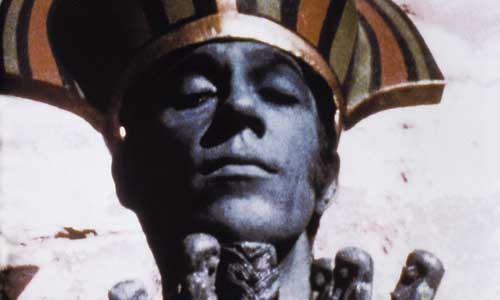 While I realize that the idea of of an elderly man who produced girl group hits in the 1960’s might not be as menacing as that of a group of drug-crazed hippies on a killing spree, I find odd and fascinating our fears of what we perceive as “cults”–specifically because of the actions of lunatics like Manson, and later Jim Jones and The Peoples Temple–and how the atrocities by these men and their followers might cast some serious doubt into the legitimacy of the music they produced. But I have an even harder time understanding doubts of the work of a man named Father Yod and his followers known as The Source Family/Brotherhood or Ya Ho Wah 13 (some of the names they were known by), whose peaceful existence revolved around an organic vegetarian restaurant with star clientele including John Lennon, Marlon Brando, and Tony Curtis. In direct contrast to the saga of the Manson Family save for one detail, they too were a communal group who created and recorded music and whose original albums fetch astronomical figures among collectors. Both groups continue to gain a following even today. As Beausoleil and the Source Family are now getting the re-issue treatment from two of today’s most well-known indie labels: Drag City is doing The Source Family’s Ya Ho Wah 13 and Magnificence in the Memory, and Mexican Summer Records is putting out Adventures In Experimental Electric Orchestra From The San Francisco Psychedelic Underground, an album of Beausoleil’s Orkustra work prior to his incarceration.
 On April 18th, 1970, Bobby Beausoleil, then 22 years of age, was sentenced to death (alongside fellow Family members Susan Atkins, and Mary Brunner) for the murder of Gary Hinman. When California ruled the death penalty unconstitutional two years later, Beausoleil was sentenced to life imprisonment, giving him more than enough time to compose and record the soundtrack to avant-garde filmmaker Kenneth Anger’s exploration of mystical and occult imagery in the short film Lucifer Rising. Behind bars, Beausoleil would create an album’s worth of music that many could consider an ancestor to the doom and drone metal played and practiced by more current groups like Sunn O))) and Electric Wizard, and the influence even rears it’s head in the work of more indie (but admitted metal fans) Mogwai. Meanwhile, the film would not be released until 1980, and an official release of Beausoleil’s composition would not be released until 2004. By that time the album’s underground legend grew, now a minor, albeit little-known classic. While an album such as the soundtrack in question could never conceivably gain an audience beyond the relatively small market of record collectors, curiosity-seekers, and genuine fans of sludgy, apocalyptic prog-rock, the great irony is that Mr. Beausoleil, who in an interview in Oui Magazine in 1981 claimed from his jail cell in California where he still sits today, that he was “not then, nor am I now a member of the Manson Family,” has developed a cult following of his own. What is showcased on this double LP is an exercise in San Francisco psych-rock far more “out there,” textured, and expansive than anything you may have heard (save for early live recordings of The Grateful Dead), and should serve as evidence that Beausoleil’s work deserves heaps of recognition regardless of his crimes.
 Where the crime of murder will forever be upon the head of Beausoleil and his connection to the Manson family established, the members of The Source Family were a peaceful people whose daily regimen of waking up at 3 a.m. to meditate, and operating the organic vegetarian restaurant would seem as far removed from what might be perceived less as cultish, more in the realm of “new age.” But in reality, the charismatic (and bearded, of course) leader of Father Yod, the communal living, and the time period (when what have been dubbed by sociologists as “new religious movements” were looked at with both total fear due to the Manson murders and also with curiosity possibly due to such disenfranchised and disconnected feelings towards “normal” society), place The Source Family directly under the category of “cult.” But unlike the Manson’s a few years prior, the Source Family do not find themselves in the history books, primarily due to the fact that unlike the Manson Family (and the People’s Temple in the late 60s-early 70’s, or the Branch Davidian and Heavens Gate cults in the early 1990’s), they were not responsible for taking the lives of their members, law enforcement or otherwise innocent people.
  Like members of Manson’s group and their associate Beausoleil, however, The Source recorded a series of albums of psychedelic rock that today can fetch nearly a thousand dollars each. Their sound–completely unrehearsed and improvised, with lyrics conjured during Father Yod’s early morning meditations–seems to have some connection to the ideas of free jazz, but is unmistakable and wholly their own. The recently uncovered tapes that make up Magnificence in the Memory work (dated sometime around 1972) as good a primer as any to understand the sound and power of what this group accomplished. Working from points that come off as stoned-funk (opener “Camp of the Gypsies”) to some songs that seem could have been created in a Berlin loft by groups Guru Guru, or Amon Duul 2. Ya Ho Wah 13 were totaly in-step with the underground of their times, and also anticpated future prog punk like This Heat, the post-rock of Tortoise, and neo-psych of Brightblack Morning Light.
 By the estimation of some people, myself included, I too have been involved in what could be considered a “cult,” which, like the Manson and Source families, was and is to this day led by a charismatic (and bearded, why are they always bearded?) man whose followers became convinced he was the Messiah. While this description could of course be used to explain the religion with our planet’s largest following, Christianity, I am actually talking about the Chabad Lubavitcher sect of Jewish Hasidim and the guys who dress like Jewish gangsters, asking passers by if they are Jewish and if they would like to “make a Mitzvah” (do a good deed). Parts of my family belong to this group which, I admit, I once turned to in a period of desperation. The Lubavitcher philosophy, introduced by the late Rabbi Menachem Mendel Schneerson (or “The Rebbe”), was to expand and be visible all around the world in an effort to attract Jews with little to no religious background, or to bring back the ones that had “strayed from the flock” to the table of Orthodox Judaism. When my own personal issues subsided and I realized that I had little to no interest in being affiliated with any religious organization, I quit cold turkey and stopped placing what I believed to be restrictions on my life that the religion I was born into set thousands of years ago.
 It was around this time, while working as an intern (slave) at a music media and marketing company that one of the publicists jokingly handed me a cd with what looked to me like a Chabnik (term for a follower of Chabad Lubavitch) with a microphone in his hand. I gazed at the name on the cover, which read Matisyahu, a Jewish name I was familiar with, and in no time the publicist told me “this guy is a Rabbi, and he’s our newest client. I thought you would like it.” And while the man born Matthew Miller was not in fact a Rabbi, he did play the sort of music I thoroughly detest: jammy, reggae-toned, white-guy hip-hop; the sort of stuff I personally dislike, but that countless young people all across the world love. Upon first listen and inspection of the lyrics, I realized quickly that this music seemed like nothing but a talk given by a Lubavitcher rabbi: the same Jewish self-empowerment ideology that, while it isn’t necessarily evil or containing of any malice, reminds me of the schtick I have heard a million times by members of Chabad trying to bring non-observant Jews into the fold. As the cd ended a shiver went up my spine, and I realized that yet another group had now begun to utilize rock n’ roll as a tool to preach their sermons and reach would-be followers.
 While sociologists have determined that the definition of a ‘cult’ is based on factors such as membership characteristics, the size of the group and types of beliefs, I don’t see it as black and white as that. An individual person having the ability to persuade others to follow them is a story as old as humanity itself. Even in the most recent American election, many noted the “cult-like” way Obama’s supporters followed him by placing the candidate upon a near holy, messianic platform, and while not directly mentioned (as far as I can tell) in his lyrics, the Lubavitcher message (and cornerstone of all Orthodox Jewish belief) that Matisyahu has tried to get across is the hope that the Moshiach (the Hebrew word for Messiah) will come in our lifetime. Putting aside your own personal beliefs, how very different is it to believe in a Hebrew Messiah, a Christian one, Father Yod or Charles Manson as being your personal savior? It’s not as much as you would think, but in the case of the last two–keeping in step with the cultural pulse of their time–the music is a whole lot better.
**
Original illustration of Father Yod by Jon Adams!



8 responses
As a lapsed Chabadnik, I can back up the fact that the Lubavitchers are indeed a cult. I didn’t go to my families house for two years because they didn’t keep kosher all at the urging of my rabbi.
Drag City just sent me this article
enjoyed it..thanks
I did the Source Family book
untold story of Father Yod, Yahowha13 and the Source Family…(go to processmediainc.com or our website yahowha.org )
the music from the family days were the best…however, I don’t honestly know if i like what yahowha13 is now doing, without the man himself-Father?
but then a lot of people seem tooooooo, so ?
xo
isis aquarian
You’ve inspired me to break out Yahowha’s I’m Gonna Take You Home, one of my all time favorite drug records.
The “Lucifer Rising 2 CD” set by Bobby Beausoleil & The Freedom Orchestra blows my mind every listen (up on Mutant Sounds now). The artwork to one of his later sets is pretty wild too:
http://www.flickr.com/photos/ajourneyroundmyskull/3068507405/sizes/l/
On a related note (or not), check out Zachary Lazar’s
Sway. A novel whose characters include Manson, Beausoleil, Anger and the Rolling Stones…
The Source Family book is such a revelation, full of kick ass satin outfits and true depth – the last page of the book is superior to a year of therapy.
They make getting up at 3am seem very attractive….
Like everything in life, Yahowha’s music was the most appropriate at a particular time and then gracefully made (attempted to make) a dignified exist. However, as with all things with the potential to be even minutely profitable, some of the less resourceful family members have chosen to preserve and distribute the music albeit in a tainted form due to an altered form of the original purpose and intention. Ultimately, the spoken word is meant only for those who are present at the time and in the place it is spoken,the ego’s need for recognition, personal profit and misguided desire to save the world notwithstanding.
I read your article and realized how the disease of arrogance is within us all. My Rabbi is Chassidic, but nothing I have ever experienced is, in anyway, cultish. It’s a growing community of people who actually care about life, this planet and the well being of people and animals. The same people, animals and planet who are swept up in the carnage created by ignorant, arrogant, self-serving humans who find pride in their own brain that they had nothing to do with creating.
There are people on this planet who have very strong and real connections to G-d, as it were and care about right and wrong. They care about life and respect it because they are aware that they are here, exist and have realized they didn’t create life, nor themselves. Perhaps you should go back to your Jewish center or find a new one and humble yourself before G-d and man. Yes, this would be good for you. You make no sense and seek to minimize, likely the most beautiful expression of love on this planet which are people who carry forward goodness and kindness.
By the way, please don’t change my words. Be man enough to let others speak their minds – you have.
David
Click here to subscribe today and leave your comment, or log in if you’re already a paid subscriber.