

“Women are bitches,” says a young man as he sits down. Apparently a woman at the bar wouldn’t give him her number. He’s talking to the man sitting on his left in spite of the fact that I am sitting two feet to his right and at the same table.
I’ve spent the last couple months in the company of writers, mostly poets, mostly men. I am growing weary. The group I hang with is large and fluid—I’m not naming names, not pointing fingers, I like these people—and yet an issue I cannot ignore has begun to emerge: when it comes to many of the men in the company, mid-thirties and younger, making conversation, even with women present (older, younger, students, professionals, I’m a grandmother for Christ’s sake), the topics frequently revolve around who is sleeping with whom, which female is more fuckable, which poop or dog-cum reference is the funniest, and what is the latest text from “the Korean girlfriend.”
It’s not that I mind swearing, not that I dislike racy humor, not that I’m a prude—the more sex the better, I say—but self-aggrandizing dick jokes get old fast. At one point, just to balance the conversation, I suggested, loudly, to another woman in the group that we begin starting our sentences with “My vagina is so tight…”
After one poetry reading and various levels of alcohol consumption (not to offer mitigation, just setting the scene), two of the younger women in the group (younger than me, that is) were repeatedly propositioned and pawed by more than one man in our company, even though the men knew the women were in long-term committed relationships and, more importantly, were entirely uninterested in a bit on the side.
My personal issues with some male colleagues have been slightly different. On reminding a colleague about a deadline, he told me not to “scold” him. This, in spite of that fact that (a) I was the project manager, and (b) it was a simple deadline reminder. If I had wanted to scold, it would have sounded less like “We need X by Y date” and more like “You are consistently lacking in follow-through, and I’m getting fed up with your inability to make deadlines, so pull your thumb out of your ass and get it done.” Yeah. That.
On the night before a poetry reading I had arranged, I got an email from a young writer saying he didn’t think he could read the next day, as his girlfriend hadn’t brought her proper ID and so couldn’t get into the reading venue (a bar) and he didn’t want to leave her alone. My email response: “Alrighty.” This writer had cancelled on me before, so really, what was there to say? In response, I received a lengthy plea asking me not to be cold and to try to understand and Would you leave [name of my husband] alone in a hotel while you read? You bet your fucking ass I would—in fact, my husband was clear across the country at that very moment, taking care of all domestic matters including a new puppy who was shitting all over the house.
I have five children. That’s enough.
Back to the weeks of concentrated writer events. One man offered as a compliment “You look rape-able.” One man seemed compelled to check out and comment on the breasts and legs of all the women we passed (or perhaps it just seemed like all) on the street, at the bar, in the restaurants. One man I was talking to opened a conversation with “You know that chick…” It turned out he was referring to the late-thirties editor we had just been chatting with, but it took me a minute to figure it out, because not in my wildest dreams would I have referred to the mature, professional woman as a “chick.”
This kind of crap went on and on. It was exhausting. Exhausting to figure out how to respond to the relentless misogyny from men who are otherwise kind and educated, who would never think of themselves as chauvinist assholes. I have heard more than once from this crew, “Most of my favorite poets are women.” If I were to guess, I’d bet that the lot of them vote pro-choice, support the Violence Against Women Act, and consider women well capable of intelligent, complex thought. I certainly don’t assume that all men under 40 would engage in the kind of language and behavior described above; indeed, I know of many who would never do so. And yet, after the past several weeks, its frequency is far beyond what I thought possible.
What is up with all this dehumanizing language? Honestly, I have no idea. But I do know this. If “good guys” feel perfectly at ease using degrading language that objectifies women when talking not only to one another but also to women they purportedly respect, then the bullshit that came out of the GOP this past election cycle (vaginas that can tell the difference between consensual sex and rape, for example) can be explained. A big pile of reasonably aware and well-intentioned people doing thoughtless shit creates a solid set of stairs for unreasonable, ignorant assholes to say and do what most of us (men and women alike) would deem shockingly destructive.
The group I was spending time with recently was mercifully spared a flood of “That’s what she said” jokes, though I have surely been drowned in them before. The only recent instance went something like this.
Woman referring to her sandwich: “That’s too big for my mouth.”
One of the men at the table: “That’s what she said.”
Me: “That’s what he is hoping she said.”
So I’ll offer this: in addition to being exhausted and discouraged by the relentless barrage of bathroom humor and frat-party antics, I’m bored. I’m in this world of poetry and books for ideas and language and beauty. Seriously. So I’ll say to whoever needs to hear it, put your shit back in the can and let’s talk about things that might actually be funny or engaging or matter once the whiskey has worn off.
Last year, a good friend of mine was deeply injured by a woman he had been in a relationship with. For his birthday, which occurred in the middle of the mess, I gave him a vintage nutcracker in the shape of a pair of women’s legs. Was this me buying into the same bullshit I’m talking about here? I’m not sure.
While preparing an essay for VIDA the other day, I reviewed the guidelines and saw the following description of one of the essay categories: “For you alpha personalities willing to be bold and opinionated, for this feature we send you five to seven provocative questions about life, writing, or current happenings.” Huh. Are women who are willing to articulate their opinions automatically “alphas”? Perhaps that’s how we are currently characterized in our culture, but surely that will not be the case in a world where opinions are valued based on merit and not based on the gender of the speaker. Even VIDA, an organization working tirelessly to increase the awareness of women’s accomplishments in the arts, can fall prey to language that protects misogynistic tropes.
So, again, here’s what I say to anyone who needs to hear it: let’s get together, knock a few back, have an entertaining conversation about literature or human nature or something hilarious one of us saw on TV. But here’s the thing: the moment you start talking about the tits of the woman at the end of the bar, or referring to grown-ups as “chicks” or start getting me confused with your mother, that’s the moment I move on. Not because I’m offended or uptight or a bitch, but because I’m bored. Get interesting (and perhaps help shift our cultural consciousness at the same time), or get out of the way.
That’s what she said.
***
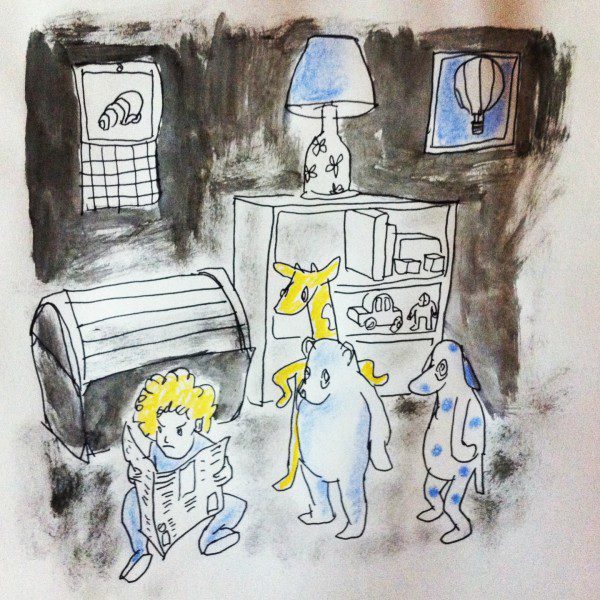
Rumpus original art by Jason Novak.
Listen to KMA read her essay:



122 responses
“A big pile of reasonably aware and well-intentioned people doing thoughtless shit creates a solid set of stairs for unreasonable, ignorant assholes to say and do what most of us (men and women alike) would deem shockingly destructive.”
i hadn’t thought of it that way. this essay is thought-provoking. i often laugh at dumb shit but hadn’t really considered the cumulative effect.
i can understand that some men talk trash with each other, but it’s strange how it’s leaked into mixed company. maybe it’s not that big a deal. we all pretty much suck some of the time.
Quit hanging out with these idiots. Be prepared to be told you’re being oversensitive. Find new friends. Having less poets as friends is probably good for you anyway.
The word brave is easy to use when responding to essays on the Rumpus, so I try not to use it, but I don’t think there’s a suitable synonym. Ovaries out, KMA Sullivan. Thanks for saying these things. I am horrified by your experience, but not surprised. I have been in situations that were much like this, and I call them “lumbercock experiences” which is a play on my general location of pine trees and chainsaws and boys clubs. It’s funny, but I have performed and done a lot of literary work in China, which has a reputation as a hotbed of misogyny and white male privilege, and I have never had this kind of thing happen to me there… not like this.
We all know how this feels. We shouldn’t. It’s not only abusive, it’s just tacky and lowbrow in a not at all charming way.
Bucky, your suggestions are great, but the deeper question is why is this going on? Why do apparently “nice” guys spew such shit. Betsy, why do guys have to “trash talk” with each other? What’s going ON? These men of poetry, poetry no less, are imagined to be seekers and explainers, and yet they fail to examine their own day-to-day obnoxious behavior concerning women. Is it just anxiety? It’s bazaar. If these guys don’t get it, which ones will? If not thme, who?
Sorry, but “the arts” are a cesspool for insensitive creeps of both genders.
Ms. Sullivan:
You articulate your point quite well, however, you not being a man leaves you at a disadvantage to exactly WHY these otherwise educated, upstanding men in your life resort to talking about tits, ass, and neediness. As a man, I will tell you why: the men saying these things are, like you, bored. Meaning they drift to the easiest, most superficial reaction to talk about in order to fill their bored space: tits, ass, and neediness. You being present for all these comments leads me to believe that you are not providing them with enough “interesting” conversation to get them involved or stimulated. Instead, they look to the obviousness of their environment. You may not be bored until they say these hurtful, asinine things – but they are bored before that.
I don’t mean to insult you, but please, look within if you have a problem with certain people who aren’t acting up to your expectations.
janjamm – yeah, dunno. maybe these men are limited. like most of us. and we can choose to walk away or confront or whatever else.
creeps can still be artists and poets. good ones. you think they all just sit around thinking lofty thoughts about beauty? and some artists who some people think are creeps still produce really great stuff. i don’t think the behavior is limited to artists, just the essay is.
I mean, what Sonja said is just real talk. Men AND women do the same thing. Period. It’s just that the main reason, likely, you’re hanging out with these people is that they’re artists too. It took a long time, and a lot of being furstrated by people, to learn that just because someone else is a poet or painter or (whatever creative act you do) doesn’t mean they are more analytical, more intelligent, or more sensitive than anyone else. We’d like to think that as poets, as writers, that, since it is a (almost) requirement we read a lot, we’re less apt to fall into the pitfalls of dumb, stupid behavior. That we’re free of the pettiness that plagues others.
Yeah right. People who are dog walkers, but are kind and respectful, would still be kind and respectful if they were poets. A poet who is a fucking asshole, would still be a asshole even if he was Superman.
This is why I don’t hang out w/ a lot of artists. And the ones I do, I am making a choice to be around. I feel no obligation due to seeing art as a career, which is what is going on these days. The majority of poets/writers these days are careerists first, and then artists second. That is not a knock, but a truth. So you end up surrounding yourself with people you kind of don’t like, but kind of have to be around. Like a real job.
That’s wack. Fuck that. I wanna be able to tell someone, “Fuck you dickbag, kick rocks!” And not feel like everyone is gonna gossip and make it more difficult to publish a poem or two if I wanted to.
The other night at work a couple of our staff members overheard a new coworker say something vaguely disparaging of one of our more effeminate gay customers. Instead of simply putting a stop to it immediately by saying, “That sort of comment doesn’t fly around here” the two staff members went to their supervisor to complain. This article is doing the same thing.
As mature people, the onus is on us to tell someone when a comment they make is out of line. Calling people out is never fun, but it can be done with grace and humor or more pointedly, but the message is the same–That shit doesn’t fly with me. Yes, people should behave better, but if we don’t demand it, if we are in fact quietly giving it tacit approval then nothing will ever improve.
(Thank you to They Might Be Giants for teaching me this lesson when I was 13 when I first heard “Your Racist Friend”.)
Oh, my. That man Scott up there explained it well. It’s your fault! I see now! If I was more exciting then I also would never have been harassed or exposed to inappropriate behavior. Also, I should not hang out with icky dirty artists. Ah. This goes hand in hand with miniskirt rape theories as well. We either ask for it by being too engaging or ask for this by not being engaging enough. Hee hee giggle!
And if someone is too shocked by a circumstance to do something that very minute, no reason to open up a discussion later! Hee hee! Haha lol. Mew.
It’s not just the arts. I have had similar experience with scientists and software engineers.
FWIW, in my experience, this stuff tends to fade out once there is a critical mass of mixed-gender company. If you’re in the minority, expect to hear a lot of it.
I think all we can do is try to raise awareness and gently (or humorously) point it out when someone is being insensitive or thoughtless in their use of language.
It’s especially disappointing when it comes from self-described liberal people who are nominally over-educated and/or work in fields where words should be chosen carefully.
Anyway, I enjoyed this piece and wanted to let you know you’re not alone.
It took guts to write that and I’m not surprised at some of the backlash I’m reading in the comments. While sitting at dinner with some colleagues in Tokyo, the conversation veered to “MILF’S, “cougars” and degenerated from there. My colleagues were all young men in their late 20’s and 30’s. I am a single mom in my 40’s. I realized they weren’t even aware of my presence. I was simply “one of the boys.” It wasn’t until I looked at one of them and said “Hey Dude!” and just stared at him that he got it. There was a bit of collective uncomfortable laughter and then a silence before another subject was brought up and the incident forgotten. But while it was happening, I thought about Ralph Ellison’s “Invisible Man.”
SCOTT SAYS: “You being present for all these comments leads me to believe that you are not providing them with enough ‘interesting’ conversation to get them involved or stimulated… look within if you have a problem with certain people who aren’t acting up to your expectations.”
Scott, why is it her responsibility to discourage men from engaging in misogynistic language and behavior?
Thanks, Scott and Bucky, for adding additional weight to the Idiotic Mansplaining Sexist stereotype. Bang up job, guys. What we men really needed was more proof that we’re whining, pouting, immature, and apparently illiterate and oblivious. Thanks.
Studies consistently indicate that men who rape and abuse women (which, statistically, at least a few of those present certainly were) often incorrectly believe that MOST other men do this and some are just more secretive than others. Which means that when the conversation turns to portray women as evil soulless harpies out to harm and exploit men, or incompetent children who cannot take care of themselves let alone lead others, or empty receptacles for sex to whom men are inherently entitled, while you might just be filling up time or at least avoiding conflict, men with abusive lives and minds hear, in your laughter or tacit agreement, someone who is genuinely sympathetic, appreciative, accepting of the conversation and its meaning. That’s what they WANT to hear, and while it might be a far sight from what you really meant, it’s not that much of a logical leap.
In the minds of those who engage in the most destructive behaviors against women (or who are in danger of doing so,) their inclinations become a bit more acceptable, a bit more justified, every time another man (even if simply being bored, ironic, whatever) laughs, commiserates with or tolerates misogynistic talk. This is how the idea of women as sub-human objects becomes normalized for those in whose minds it is most harmful to women. You are (statistically) probably not one of “those guys,” but you are comforting and enabling them if you give them an inch of conversational space in which that mentality seems okay, and your good intent does nothing to mitigate this unless it prompts you to avoid such talk and call out other men around you who engage in it. You don’t have to deliver a feminist diatribe; a simple “Dude, that’s not cool” and subject change will usually do.
Really. Scott, men don’t misbehave because they are bored. That’s what children do.
Wow, who the hell are these guys? Some of the things you mentioned I would have slapped them for.
These men need their privileges taken away until they learn how to behave.
Maybe it is boring, I don’t spend enough time with people who don’t share my values to be bored
That’s not “what she said.” That’s “what she passive aggressively posted to the internet without saying a goddamn thing in person, WHEN it happened, WHEN it mattered, and WHEN it was relevant and in context.”
She didn’t “say” a word.
Be direct.
That, is feminism.
THAT, is what she said.
I don’t blame the author for not speaking out: it’s hard for an oppressed class to speak out against a majority engaged in such behaviour, especially when such behaviour is normalized in the context of society at large. Even on a more personal level, being outnumbered by sex, gender, or even opinion/viewpoint makes it difficult to speak out, particularly when it makes things decidedly awkward socially. No one wants to 1) be the ‘Debbie Downer’ so to speak, or rain on the parade, even if it’s a parade that should be rained on, 2) no one wants to risk social ostracism by speaking out even if one is in the right.
Particularly when you’re a member of the class being oppressed in a particular situation, you may face accusations of being “oversensitive” or otherwise have their ire turned against you personally, which at the very least is uncomfortable and at worst, in certain situations, dangerous. The onus should not necessarily be on the oppressed to have to speak out about these issues, it should be the duty of those with privilege to speak out against it, because privilege comes with a protective power which the oppressed lack.
That being said, I think the author would do well to find new friends/colleagues, because that “art” scene sounds terrible. I used to be in the poetry scene back in the day, and I got back in touch with some of the poets from back then and they’re nothing like these people, and I can’t imagine any of them saying or doing the kinds of things I just read about in this article.
I think there is a certain subset of the arts/humanities and indeed certain scenes where a lot of fakers, poseurs and pretenders join the scene not out of some genuine love for the arts but because they have bought into this notion of the boho arts community being a great/easy place to get laid, and that is sad.
Certainly this idea tends to be perpetuated in popular media because within the arts, particularly in the poetry and writing scenes, there is the kind of envelope-pushing of views on sex, eroticism, etc. which was originally meant to be liberating from the shackles of a decidedly anti-sex culture and society, but has increasingly become nothing more than a place to use sex as another tool of oppression and to duplicate the kind of misogyny, sexism, etc. that exists in mainstream culture.
And of course, there’s the issue of the so-called “Nice Guy” syndrome of seemingly politically correct and purportedly feministic cis male heterosexuals who pay lip service to the causes of the oppressed, but in reality do so solely to try to look good in the hopes of getting laid.
As a self-admitted cis male heterosexual who was a former “Nice Guy” (albeit unbeknownst even to myself at the time), I have to say that it’s not even necessarily something these guys are aware that they are doing it: it can be entirely subconscious, or even a blindspot that exists where their introspection is concerned. Some of these same guys may well be Women’s Studies majors and so forth, yet inevitably they fail to realize that somewhere in the back of their minds exists an immense inferiority complex with regards to women and fear and resentment of women born of a feeling of power inequality in their relationships with women, which seems to come out only when their inhibitions are lowered and their defenses down (as might happen when one is drunk, for example) and their real feelings are shown.
I think this is a major issue with cis male heterosexuals in the arts scene all the more because they view themselves, and identify as, champions of women’s rights and the rights of the oppressed, and espouse liberal positions, and even seem to have a grasp on the kind of introspection and honest self-analysis of their thoughts and feelings regarding all kinds of issues… except their own latent sexism and misogyny. It’s definitely an aspect of male privilege that doesn’t seem to get addressed very often and I think it is a huge problem, because it can lead to the kind of cognitive dissonance where those who most claim to be feministic end up behaving in a manner entirely contrary to their beliefs, because they are so thoroughly incapable of seeing their own faults and issues with women, and furthermore react angrily and defensively if even slightly criticized regarding their behaviour towards women, _because_ they themselves have wrapped up their egos, identities, and in some cases, self-worth in their self-image of themselves as these ‘white knight’ figures, riding in to save the damsels in distress as these Liberal Liberators of Ladies.
It took me a long time for me to realize that I had within me so much misogyny that was so well-hidden from myself that I did not want to believe it, yet I was forced to confront it when I began to recognize my behaviours and attitudes towards women were eerily similar to that of the kind of men that I considered so sexist and misogynistic when they acted this way towards my sister. I honestly would not have come to this realization if I were not so close to my sister and realized that if I find this sort of behaviour towards my sister so reprehensible, how could I possibly justify it within myself regarding my deep-seated resentment towards other women?
I still wake up every day knowing that thanks to the sexism I’ve internalized from having grown up in an inherently sexist society, there are so many aspects of my relationships with women that I need to work on, to challenge the sexism I have within myself all the more because it’s much better hidden than all those knuckle-dragging members of the ‘bro’ culture that I so look-down upon, as if I’m somehow so much better than them because I can namedrop Woolf and Steinem. But when I think about how it affects the women in my life that I love and can relate to that sexism and misogyny and how it negatively impacts them, it pushes me to keep on challenging my own sexism and to root it out, to recognize it, to deconstruct it and critically analyze it so I can change my attitudes, beliefs and behaviours and hopefully inspire other men to do the same.
Scott, I feel as though you’re saying that women are at fault for being objectified and dehumanized because we aren’t entertaining enough. I expect my 6 year old to get distracted and random when he is not otherwise engaged, but he doesn’t turn into a complete asshat when it happens, so why would grown men? There are plenty of men who can entertain themselves with humor or deep conversation without abusive language or gestures, so forgive me if I don’t entirely accept your premise that men turns into barbarians when women aren’t intellectually stimulating.
Phenomenal! You are dead on. This is beautiful beautifully written, articulated..thank you! My eyes were moving quickly, I was holding my breath as every word and sentence expressed the reality of what is happening now from the point of view of a hip, cool, highly human, smart as hell, and uber aware woman. Thank you!
My definition of an artist is one who doesn’t just create in his or her work. Many times I’ve left groups of ‘artists’ in disgust, full of rage and frustration. I wonder, though, if these things continue because we accept it or because we’re outnumbered?
‘To comfort the disturbed, and to disturb the comfortable.’
— Cesar A. Cruz
The role of the artist.
To not have anything easy. To always be challenged and to challenge.
As a couple of others have pointed out, jerks come in all walks of life. Also in both genders, though the the atmosphere is much more toxic when it’s the men spewing the sexist crap.
Without singling them out, I think there’s a peculiar dynamic at work among male poets and other literary types. Some of them overcompensate for their fear that writing is a wussy, vaguely effeminate pursuit. They go out of their way to emphasize their masculinity.
You see it among male authors who like to talk about hunting and fishing and boxing and be photographed while chopping wood or shingling the roof. Talking T-and-A is the most unfortunate by-product. Sad, really. They’re trying so hard. Their insecurities so blatantly on display.
Speak up every time you hear it. It doesn’t have to be a speech. “I don’t like comments like that” in a tone of disgust.
Every.
Single.
Time.
“What the f* is your problem?” also works well.
One man offered as a compliment “You look rape-able.†This guy thinks he’s a poet and apparently does not have a vocabulary expanded enough to come up with a better “compliment” than this?
This is why I often hang out by myself – people like that, ugh. I am a prude. I will admit to being plenty misogynist when drinking occasionally though. This essay made me soul search a little.
These banal, repetitive vocalizations serve to affirm the primate’s membership in the “in-group”; members of that select group, upon hearing selections from their bank of “calls” respond with approving chatter. These bonds established, they go on to eat each other’s parasites and perhaps make an excursion to fling their poo at a neighboring tribe.
I speak up when comments are made and have been doing so pretty consistently since I was 12. What results? Silence, shunning, passive-aggression, shaming, people telling others you’re an angry or unreasonable person. Or someone comes up to you later, out of the group’s earshot, and thanks you for saying something. And then they walk away. And you’re alone. It’s not easy. You will be punished. But there’s no other way to stand up to this bullshit. You’ve got to speak up, consistently.
1) I do hope you make a point of calling people on the behavior that bores you. It’s pretty hard to change something if no one tells you it needs changing.
2) If poop jokes make me sexist, then call me Rush Limbaugh, because I think poop is funny. I’m not sure how bathroom humor got conflated with misogyny in your mind, but it’s kind of unfair.
3) The issue I take with your objection to “chick” is that your feelings on the word are not even close to unanimous. In fact, at this point, I’d say it’s one of the few examples of a word that once had a derogatory or pejorative or demeaning connotation and has now been successfully reclaimed. “Chicks” is, today, not seen as very different than “dudes.” Dudes and chicks, guys and gals, men and women.
4) Other than that, I’m on board.
Women become bitches because men act like assholes. Women are the sanity of this planet. When men stop w the warring, raping, torturing and overwhelming greed thing, perhaps women won’t be so angry. Oh yeah and when men, GLOBALLY, quit treating women like second class citizen women might just lighten up a tad.
I’ve gone through nearly identical scenes with men in the film industry and the television industry, starting about 25 years ago. I had to tell a boss that he could not call one of our producers “the California Cu..” in my presence. Back then, before legislation passed, it was perfectly legal to say this in a workplace. But it does feel like this stuff is getting exponentially worse with younger guys since they’re stewing in a culture where comedy is defined by Tosh.O, the 40 Year Old Virgin, and all the other misogynist, truly vulgar boy crap out there. Each time young men hear this stuff, it pushes the envelope of what’s acceptable out a little further. (Even the sainted Jon Stewart peppers his scripts with disgusting comments about women, and let’s not forget the way he and other supposed progressives talked about Hillary Clinton when she appeared headed towards “Mommy in Chief”. (There, I opened that can of worms.) I agree with the writer that it’s all connected — everything from the way organized religion demeans women to the anti-choice cretins to the stand-up comics who make “rape-able” the new alluring catch phrase. I don’t have answers. But I really appreciate this essay and the thread it inspired.
Just bc the author didn’t respond outright in that instance doesn’t mean she never has. I am a feminist who calls people out, but not all the time. If I did it all the time, I’d be more tired than I already am.
Kudos for writing about this experience and articulating; not all of us are as good at that!
PS I have dealt with the same things this author has, so again, far from alone
Good heavens!
The fact that I offered an explanation to Ms. Sullivan’s question (“What’s up with all this dehumanizing language?”, believing the men she CHOOSES to keep company with to bored themselves by her shrill expectations of them to be intellectually stimulating all the time) was greeted by readers with expectations that I am a misogynist!
Remarkable. It is not Ms. Sullivan’s “responsibility to discourage men from engaging in misogynistic language and behavior.” She chose to hang out with these guys. She is not a victim. It’s depressing to think that all the men she hangs out with act this way, but she posed the scenario as such in her article, so I pointed out in my first comment that the only thing that was the same among all these different men was HER. All men do not behave like this, as demonstrated by the brave (read: doormat) knights in this comment thread. So I said what I didn’t believe she had considered: that her sexualized, offensively axe-grinding persona may contribute to the sexualized, offensive remarks coming from her comrades. Again, they hang out together. Maybe, they look up to her, and are parroting the dynamic back at her. I can’t really say, since I don’t hang out with this crew, but that would be my guess since Ms. Sullivan seems to have carved out quite a persona with her convictions.
Again, look within. I am not saying when all men get distracted they become “asshats.” And I agree if there is a problem, one needs to address it, or think on it, and then address it. What I am stating is that Ms. Sullivan’s specific personality and way of looking at the world does not exist in a vacuum, and may be contributing to the specific sexualized commentary happening around her from her male peers.
Oh crap. Now I’m gonna get lumped in with Scott.
Is anyone certain that Scott isn’t just a really brilliant satire?
Because his comments seem to me wildly misandrist. He’s saying that men are so infantile they can’t entertain themselves, and will resort to infantile behavior if a woman doesn’t entertain them. He calls Ms. Sullivan “sexualized” because she is a woman, and she has an axe to grind (unlike the men who grind the rather small axe of their manhood) because she doesn’t like listening to shit-talk. So, by “his” logic, men can’t control their own behavior, and are entirely controlled by women.
I mean, really, is there a more insulting portrayal of men that a person could make?
Oh, I get, Scott! She asked for it! Well that certainly helped clear things up. And…she should change her profession because these are the men in her profession and she should just get out if she doesn’t like them. Simple. Another issue cleared up. You are a cruel rationalizer, to put it nicely.
god forbid a woman’s persona have something to do with convictions. WHELP! poor scotty poo. he must feel rull beat up.
This seems really bizarre to me. I’m attending my third creative writing program, have been involved in editing prominent literary magazines at all three universities, and have never once had to endure this kind of behavior from my male colleagues. I’m sorry you’re being exposed to it, and this is an eloquent expression of boredom and frustration, but I echo those who have said, I hope you can get better friends. My male writer friends are not just wildly creative, outstanding novelists and poets and essayists and editors, but also intelligent and clear-thinking allies. They’ve been invaluable supports in my professional and personal life and, reading your piece, I feel triply blessed.
Chester, If Scott’s comments are satire, I assure, they are not brilliant.
> I pointed out in my first comment that the only thing that
> was the same among all these different men was HER.
The same is true of you, Scott.
I could be wrong, but it doesn’t seem likely to me that the reason everyone’s acting like you’re an ass is that you’re the only enlightened person here.
Ciao Reine:
That’s a pretty deluded outlook. Reverse the ratios of men vs. women in the positions of power and I think you’ll find after even just 100 years that people are mostly just pieces of shit. Look at the behavior of women in prison–they abuse, coerce, rape, and oppress one another for gain and greed just fine without any help from men.
The rest of you:
The problem is with the distribution of privilege. If everyone enjoyed the equal privilege to comment on the imagined erogenous zones of someone sexy at the end of the bar without being made to feel like a slut, I think we’d find women just as ripe to crack the same kinds of jokes.
This isn’t a question I’d usually just post to a comment thread on the internet, but you all seem like a pretty intelligent lot (bar a few)–what can we do in the here and now to advance a world where women who are publically vocal, unashamed, and maybe sometimes even boastful about their sexuality aren’t branded “whores” and all sorts of other nasty and demeaning names, and men who do the same aren’t branded “lechers” and all sorts of other nasty and demeaning names? What can we do today to level the playing field of privilege?
Inquiring minds (well, at least one) want to know.
I’m not sure why so many people are making the assumption that because the author is writing about this topic, she could not possibly have also expressed her discontent in the moment. Do you maintain that people only write about things they’ve never said out loud? This bit of logical fallacy is astonishing to me.
Nonetheless, there are many reasons why a woman might suppress her distaste while in the company of colleagues and professional peers; others here have pointed out some of the risks involved in speaking out. And some people are simply not confrontational in nature, and might find writing about an issue to be more suitable form of communication. This is equally valid.
Regardless of whether the author chooses to express her disapproval in each of these moments (although honestly, I can’t imagine a lifestyle where I go around constantly arguing with every sexist thing I hear; that sounds like an exhausting, unfulfilling experience of life), or whether she instead observes a pattern and then writes about it after, she is well within her rights. It is not her responsibility to police the actions of grown men, and I think this piece makes it perfectly clear that she is not interested in doing so. She is not their mother. If she doesn’t want to go out of her way to correct their childish behavior, she is in no way at fault.
As to the assertion that grown men are speaking in this manner because the author is boring? I…don’t even know what to say to that. I robbed your house because you were boring me. I slapped your baby because it was boring me. Your grandmother? Bored the shit out of me, so I punched her in her sweet little mouth. Yesterday in class the students were boring me so I started shouting insults and racial epithets at them. They caused it, and if they didn’t speak up to tell me it was wrong then it was their fault and they deserve it!
Or, not. We could stick with valid logic, instead?
These sort of guys believe that this is the price you pay for joining the big boys table with them.
So, one thing that I’m not seeing too much attention to here, that I think is relevant, is age. I don’t know if i can articualte this very well, but there’s a generational difference around this kind of self/social expression of maleness that I’ve felt between my 47-year-old self and late-20s to early 30s creative/intellectual types that I found myself surrounded by during my just-recently-finished grad school career. Despite (or perhaps in some weird way due to) being part of a program and a discipline where race/class/gender analysis is foundational, once these guys had a few beers, there was a real tendency to drift, with initial irony that diminished as the beer flowed, into this same kind of conversational frame.
I don’t know exactly what explains it, but I really think that there’s a generational difference here, and that its not specific to artists, or writers, or culture studies mavens. The author here (and I) expected these guys to know better, and I’m sure that in some way they do, as that explains the way they vote and the fact that they can write, analysticlaly or creatively or both, with a real awareness of the human condition. But I think they have social habits that, on some level come out of being worried about being separated from their peers, about being seen as humorless, uptight dicks. I think they’d rather perpetuate bullshit than come across as overly strident. I think its a generationally attuned expression of the fucked up way that boys learn to be guys. I think that for a lot of these guys it feels a little subversive to act and talk this way. It’s not of course, but anyone who calls it out is in danger of being thought of as a humorless scold.
“If everyone enjoyed the equal privilege to comment on the imagined erogenous zones of someone sexy at the end of the bar without being made to feel like a slut, I think we’d find women just as ripe to crack the same kinds of jokes.”
I guess if you get enjoyment from objectifying people.
Call me crazy, but it seems possible to express attraction without using objectifying language or in this case the threat of violence: “rape-able”. Har fucking har. Spare me, all this equivocation is absurd. “Rape-able” is about as harmless as telling someone they look “lynch-able” or any other verb that refers to centuries of top down violence perpetrated by otherwise “super nice dudes.” Fuck those guys.
HEZYKIAH SAYS:
May 16th, 2013 at 7:33 pm
These sort of guys believe that this is the price you pay for joining the big boys table with them.
BINGO
SCOTT:
honestly, your comments make me wonder if you are addressing the author on a personal level, as opposed to discussing the content of the essay. You keep telling her to look within, and you keep referring to Ms. Sullivan’s ‘specific personality.’ Frankly, it sounds like you have about a dozen axes to grind. This isn’t actually about you, unless it is. If it is, your response helps me even better understand this essay. So, um, thanks for that?
I am shocked at all this smarmy “just speak up” nonsense. On a million levels “just speaking up” is not easy and can even be dangerous. It can also lead to a bunch of really pointless debate, as witnessed in some of the responses here. As a HUMAN, I can tell you that speaking up in the moment when you feel violated by the actions and language of people around you can be dangerous, discouraging and lead to very little in terms of resolution, because at the LEAST, all the Scotts pop their heads out and tell you it’s your fault, and the well-meaning women in the crowd pop theirs out to tell you that you should have behaved differently or it wouldn’t have gotten to this point – I am so glad the author wrote this essay. It reminds me that we have a long way to go, baby. All of us. Not just the bitches.
As a Korean woman, I found your Korean girlfriend comment rather unnecessary. What you claim men are doing to you, you are doing right here in that one instance. I’m surprised no one else responded to that.
If you know people who are still cracking “that’s what she said” jokes then they aren’t enlightened and educated at all.
Fan: From the context, it’s pretty clear that the author doesn’t condone that particular phrase. But sometimes we have to say the unpleasant things to illustrate a point.
This article is wonderfully written -because- it doesn’t alienate moderates (men who are otherwise thoughtful) or throw hyperbolic accusations around, while still addressing a topic that needs addressing.
More dialogue on this needs to include everyone, instead of being accusatory or inflammatory, so that we can all see where the problems in our societies lie, and so that good people who want to do their best can have some feedback on their behavior.
I might tell a tit joke just for some ironic humor, but how can I argue with her if she says she finds it annoying and boring? She’s not telling me I’m a misogynist or that I support rape, she’s just telling me I’m being an annoying douche… And I respect that.
Fan, it was pretty clear that one of the guys the author’s talking about made the “Korean girlfriend” comment. Not the author.
The title of this blog isn’t accurate.
What a wonderful, nuanced and truth telling piece. Thank you KMA Sullivan!
[and here’s a follow up … Dear feminist guys: “If you’re not going to challenge yourself to do the emotional work or to do better, why claim feminism?” It’s a piece worth reading that relates to this whole convo and calls the question. http://feministing.com/2013/05/17/on-doing-the-emotional-work-of-being-a-male-feminist/ ]
This article should be titled, Feeling Marginalized in a Progressive Community instead Women Are Bitches.Good writing is clear and concise and gets to the point. Is there a direct thesis anywhere? She should get rid of vague modifiers, passive voice and she stop starting every other sentence with a subordinate clause. It is confusing. The illustrations with article also doesn’t make sense.
chris o – your paragraph is a grammatical nightmare. it’s the only thing here not making sense.
Who IS Chris O?
Not to fan the flames, but SCOTT’s comments are sort of genius. He really seems to be the only “enlightened one” here. I mean, he’s the only one who points out that the author might be specific to the problem. Not because she’s a woman, or that it is her “fault,” or she is “asking” for anything, but because SHE is bothered by people she hangs out with. Sure, I’d be bothered by those dumbass alpha-male comments, too. But everyone else on this thread defends the author as if she is a stand-in for all women, and DENA even thinks it’s wrong for SCOTT to address the author “on a personal level,” as if commenting on an internet article could do such a thing as separate authorial intention from the content. Outrageous, DENA! This is a “personal essay”!
I say right on, SCOTT. I’ve met many people, including women, who contextualize everything in terms of their sex, and then condescendingly expect everyone around them to follow their righteousness. And, like SCOTT said, I’ve seen men “parrot” this attitude back at them. Not like because it was their fault, but because you willingly open up a door with guys when you speak more freely about sexual issues. I suspect from the “content” of this personal essay, and what the author chooses to tell us about her personal thoughts, that she does this in her social gatherings in spades.
It’s not shameful to talk freely with men about this kind of thing. It’s shameful to be righteous about it, and blame others when you have a personal problem that they don’t know you have. The differences between the sexes are the only way to lead us out of the kind of narcissistic echo chamber folks like DENA and the author seem to be trapped in. For one second, even if it’s something you don’t believe in, or something tacky like calling women “chicks,” you should try edifying yourself by thinking that other people actually exist, and they may think differently than you, rather than wrong. Then maybe you can conquer this nonsensical fear you’re perpetrating about dopey people subverting you into thinking it’s your fault. Being a woman is not easy among men like the ones in this essay, but you shouldn’t be taking blame off of a woman just because some guys are more explicitly being jerks than she is.
Hi Fan,
Read that part again carefully.
“…and what is the latest text from “the Korean girlfriend.‒
That the author put the phrase in quotes and used the article “the” subtly implies several things:
–that one of the men used the phrase not the author
–that this girl is probably not his only girlfriend AND it is some sort of badge of honor for him to have a “Korean” girlfriend alluding to the unfortunate misogynist and racist generalization that many men have about Asian females.
–that the author does not condone it at all.
I hear this crap all of the time in Japan from my otherwise intelligent, educated and self-proclaimed socially conscience “ex-pat” male colleagues. And I have vocalized my disgust. But it just becomes fodder for even more misogynistic and racist comments, with me as the target-the equivalent of children giggling in a classroom because they finally angered a teacher. It’s pretty pathetic and more common globally then you might think. And this is why I don’t hang out with them anymore.
(*conscious, *than, coffee-less laziness)
Thanx Betsy. I forgot that posting a comment means that I have an editor. Feel free to send me a check.
My criticism aren’t for grammar. They’re for style. I’m not an editor or a writer. I’m only another ignorant reader like yourself. Public education has failed me too.
Uh, Chris your comment suggested grammatical changes to the writer’s work. The “shoulds” imply you are a grammar whiz and you are ‘spailin things because the writer appears, to you, not to know better. It is you who was being the editor which provoked a justified critique of your, well, really, jumbled writing. If you are, as you say, ignorant, perhaps you should keep that grammar-nazi under better control.
Betsy, I take back what I wrote. My complaints are hypocritical. I feel this is an important topic that should be dealt with directly. I’m complaining about style, which doesn’t matter. The point is that there are men who talk the talk without walking the walk. They act like progressive artist but they’re just bros trying to score.
Jan, style and grammar are not the same topic.
Chris O I stand corrected. Keep your style-nazi undercontrol.
I don’t know what I’m talking about. Crazyness. You kknoww how it goes. Thaingadsf all over the place. In and out. All the Time. Party!
Slug slug slug
NO JOKE!!!!! PARTY PARTY PARTY. That is all I think about! Weekend 4-ever! Ruck hipster bros trying to hook up with chicks by telling them they’re not broads! AM I RIGHT! FUUUUUCK YEAH!!!! PARTY!
@Jonathan Nathan
The problem with the word “chicks” is that it equates women with baby birds. Calling men “dudes” is not the same, because it’s not derogatory. This article is great, my only problem was the author’s anger at the word “chicks” was only due to it being directed at older women, insinuating that younger women are allowed to be called “chicks” and calling any person a chick, or bird, or pussy, or any animal that is meant to degrade, is wrong.
Everyone keeps talking about the fact that they were “artists” but I don’t think that was part of her point at all, I think it was just background information. The point I took from this is: There are sexist people in every career, and it’s exhausting trying to deal with them and constantly having to say “that comment is not okay” .. you always get beaten down for it. I know we have to keep saying it anyway, and the more people who say something, the less likely we are to get beaten down for saying something.
This kind of nonsense is why Beverly Rainbolt, Monica Miller, and I founded the Women’s Poetry Conspiracy in New Orleans. Astounding how many strong, talented women came out of the woodwork to read. As for Scott’s rush to judgement about a woman poet needing to separate herself from her professional community, willful ignorance is ignorance nonetheless. There’s always one man who immediately leaps to correct (re-educate) any woman who calls out sexism in writing. Call it boring. Call it a real dick move. Hey, some of my best friends are dudes.
And I accidentally left Liz Garcia off the WPC founders’ list.
First, @diana, look up the definition of “dude” before you make such a comment. After all, what does “dude ranch” mean to you? To call someone a dude is to call them a charlatan. I think I’d rather be a “chick.” That said, I have no problem with the word in its colloquial usage, nor am I bothered by the idiomatic “chick,” as both have simply different meanings in their common implementation. I trust humans to understand that.
Secondly, I’m surprised that more people aren’t suspicious of this essay. Sure, there’s behavior depicted here that we should recognize and question. However, at least two of the anecdotes that appear early in the article, namely the “scolding” and the “no id” episodes, aren’t clearly misogynistic to me at all.
First, the word “scold” carries zero gender connotations to me. Growing up, it was my father that did most of the scolding. When my poodle pees on the rug, I scold her. More to the point, I’ve certainly been scolded by my boss. Seems to me in this instance that the author was more interested in exploiting one of her employees, one who most likely works for free already, than she was in actually establishing a line of inquiry on the topic. Seriously, shame on the author.
But the above issue wasn’t merely a hiccup; the “no id” anecdote seemed fishy too. I mean, sure, it’s easy to assume that the “young writer” in question refused to leave his significant other behind because she was female, but even from the details the author gives, that doesn’t seem to be the case. Instead, the writers asks the author if she’d leave behind her husband in a similar situation. This writer seems at odds with himself, but I don’t see this as a misogynistic act. It’s just another opportunity for the author to stab at someone she has a dysfuctional professional relationship with.
So why am I supposed to keep reading at that point? Why am I supposed to trust anything the author says? Frankly, I don’t. And I’m pissed because these issues need serious thinking and honest debate. Instead, we get this, which is what? Yes indeed, I’m bored.
A little suggestion, Sam. If someone–a person with lifelong daily experience with misogyny–tells you that an act is misogynistic, and you don’t share that experience, it’s generally wise, if you disagree with the characterization, to ask for an explanation, not bigfoot all over the claim and basically say “nuh uh!” You don’t see it as misogyny–are you the Great Arbiter of All Misogyny Everywhere? Or are you a guy, like me, who doesn’t have to deal with this shit every single fucking day of our lives?
Part of getting past the kind of crap that the author of this piece is talking about requires that men recognize that we’re not the goddamn experts of everything. Sit to the side and listen and learn about the world.
Brain, I’m a woman that wants a real discussion on these issues. Nice work on the magazine.
I am male and not of the ‘artsy’ crowd, but notice the same disrespectful and rude talk in many situations. I am strongly against it, but even so, do get caught up in it sometimes, but much less as I grow older. I think that perhaps it is just testosterone: males wanting to be the alpha dog in the crowd (read as pack), when indeed they are just little puppies yet. Maybe just imagining them as stumbling around on large clumsy feet, droopy ears, and peeing on the carpet would help to bring the situation into focus. Still not acceptable but they will not know what you are thinking and smiling about.
As a recently-minted male MFA (poetry) of the under-30 generation discussed, you pushed me to interrogate my experiences. It’s hard for well-meaning people to be shown how they perpetuate problems they want to stop (see: race, gender, sexuality, ability discrimination). It’s our job as conscientious people to suspend our egos and see if there are ways we can better support “the cause”.
I want to respond at a length not appropriate for a comment, because I think a lot about this, but I’ll stick with two quick thoughts:
1.) It’s our job to internalize complaints, but that doesn’t mean it isn’t hard, or that suspending ego and ignoring the flush of embarrassment is easy. If we’re approached with the blunt facts of the situation–that we ourselves are violating our values–our mind will race to defend us, calling up all of the ways we support those values. If the goal is venting–and everyone needs to vent–that is fine, punch the ego with the brute facts. And expect a fight. But you can reason with the feminist in the man. If it isn’t a ruse, he’ll want to square the disparity.
2.) I think there’s also a silver-lining to (parts of) your experiences. I feel like our generation has a diminished notion that members of the opposite gender are “polite company”. I’ve had the good fortune of a well-balanced peer group (unlike the mostly-male one you’ve had the delight of knowing), at least in regard to gender/sexuality. As a consequence, I’ve had the honor of blushing my way through much blunt sexual talk about all genders, orientations and body parts. We’ve often played the drinking/card game “Kings” http://en.wikipedia.org/wiki/Kings_(game) with a mixed gender/sexuality group using pornographic playing cards with nude men on the back. I make no excuses for the groping, ‘rape-able’ comment and other boorish behavior–but part of your experiences may also be an unfortunate slice of a positive trend towards parity in how our generation interacts.
Seems to me that the author simply mismatches with her social group—has outgrown them, perhaps—and needs to move on. Her remarks to the effect that she merely doesn’t find them interesting are disingenuous in light of the fact that she was inspired to put together a well-written exposition on the topic. She clearly IS interested, and she’s offended by their words and behavior but doesn’t want to say so, lest she cast herself into the Pit of Oversensitive Feminists, undermining the detached, analytical tone she’s trying to maintain.
Some remarks are inappropriate for any audience; she’s listed about two of them in this article (the leading quote and the “rape-able” comment; forgive me if I missed any), and they’re the only two that fit the article’s title. A man unwelcomely pawing at a committed woman is also inappropriate, but is a separate issue from the majority of what she addresses. Most of what she mentions, however, are remarks that can be appropriate depending on the audience. For example, “chick.” I grew up around a social group of very mixed ages, genders, sexual identities, interests, and so on. “Chick” was always a neutral descriptor for a female of any age (like, “dude,” its male analog), regardless of education, social status, or any other concern. Among those people, it was, and still is despite their all being well into or beyond their 30s, as unremarkable as the word “walk” or “vehicle.”
Then there are “That’s what she said” quips, which are only amusing anymore in the most well-placed (or well-chosen ill-placed) circumstances. Yes, it’s an immature joke; that’s what is supposed to be funny about it. It’s a four-word response that can turn anything into a sexual innuendo without saying anything overtly sexual. It’s not a turn of phrase you’d tend to use at a quarterly finance meeting or during a job interview, but it is exactly the kind of mindless laugh-getter that can be expected where alcohol is imbibed and critical thought is on hold.
I suspect that most would agree that her response in the “That’s what she said” dialogue was clever: “That’s what he is hoping she said.” And it certainly was clever. But I’d contend that it was no more or less crude than the judgments of tits and fuckability that she saw fit to describe as misogynistic earlier in the article. It was a slightly higher-brow version of male locker-room taunting—in simpler English, “Your penis is probably small, and you are insecure about it.”
And that’s fine. Men aren’t and shouldn’t be the lone purveyors of crudity and sex-organ observations. But it’s silly to pretend that we’re wrong when we do it, when women do it too. I’ve been close enough to enough women in purely platonic circumstances to be privy to things they wouldn’t otherwise say in gender-mixed company. Plenty of women, particularly as their blood-alcohol content increases, speak bluntly about men’s sexual prowess, preferences, and “endowment.” Many discuss the fuckability of particular men and “eye-fuck” men in public places just as men do to them. Yes, it’s objectifying, but how offensive is it, really, when we are basically all doing it, men and women alike? It’s not misandry or misogyny, but honest discussion of qualities that, as human beings, we seek out when deciding with whom to fornicate.
Humans are a great deal more sensitive about our sex organs and sexuality than perhaps we should be, but that’s how we are. Sometimes people get rubbed the wrong way by harmless commentary, blurring the line between banter and malice as this article does. Some things are just mean-spirited or even violent, and deserve to be called out as such, but most are variably appropriate depending on the audience. However, if there were ever a proper audience and context for crude sexual remarks, it’s at a drinking establishment. If the author has grown tired of it, I’d recommend a more polite venue.
Sam, sorry for making that assumption. It’s just that what you said is what I hear from too many men who want to define what is or isn’t sexism, much in the same way a certain class of white people, for example, want to define what is and isn’t racism. I believe this writer’s stories because they ring true to me, because I’ve seen similar situations play out in front of me, and at times, I haven’t done anything to stop them. That’s not the case anymore.
I want to hate men but I feel sorry for them. They’re so infantile.
I love the discourse this piece has promulgated.
Some from a burning emotional platform, others from the coolness of logic. And all from the lens of our subjective experience, reaching for universal understanding.
I don’t for a minute expect this issue to ever be resolved. But it certainly is a testimony to the continuance and survival of the Socratic method.
Yey humans!
@Brian Spears, I have no love for the deranged, deluded MRAs you refer to, but I must point out that the gender of the person speaking about whether or not something is sexist has no bearing on whether or not the thing itself is sexist. Something is sexist if it is intended to promote the idea that one gender is superior to another, or that the sexes must conform to certain stereotypes. If this is not happening, all the screaming and foot stomping and boycotting in the world will not make it sexist. I believe the author is being truthful about her experiences, and truthful when she says she views the experiences as sexist, but perceiving something to be sexist does not mean it automatically is. That is the beauty of words. They have definitions not based on personal perception. If they didn’t, I could say that you shouldn’t be called a human being, but instead, a suspension bridge, and you would have no real argument against it. To use an example from the article, the “no-ID” story, where is the evidence that this young man’s comments were based on sexism? Where does it state he said or did anything that indicated he believed women were untrustworthy as opposed to him being untrusting in general (a problem in itself, but not the one we are dealing with here)? He even presumed that the author’s husband would be susceptible to temptation or deception when he posed the question about what she would do in his circumstance. If he said or did something the author failed to mention, then it is possible this was a sexist exchange, but why should I assume that when I don’t know either of them and am only going on what is written in this article? I have experienced misogyny many times in my life (ranging from snide comments about my appearance to incestuous “corrective” sexual assault) but that does not mean I am going to presume misogyny in every interaction with men, because I have also had many beautiful, affirming experiences with men. My misgivings about that particular anecdote do not negate the obvious sexism in the other anecdotes presented, but it does make me question why the author felt the need to include this story among them.
@Diana:
OK, I understand what you’re saying, but I’m not finding my way over to your position yet. I don’t understand–and I’m asking for an explanation of your position so I can grasp it, not trying to refute your feelings on the subject–why the notion of being compared to a baby bird is, in and of itself, objectionable. I know that I, quite frequently, refer to other people of either gender as “cats.” As in, “Some of the cats from work are waiting for us at the bar.”
Now it’s true that I don’t call them “kittens,” because I’d probably get some odd looks if I did, given that it’s not really an accepted slang term and I’m not the sort to invent new ones. But it doesn’t seem to me that your objection is actually based on the size/age of the animal in question, because you make a point of also calling “birds” an objectionable term.
I guess what makes it difficult for me to see me way to your position is this phrase here: “meant to degrade.” That doesn’t quite seem fair to me or any number of people–including most of the women I know–who use the word “chicks.” This is not a word that’s remotely on the same level as other words that are more universally acknowledged as epithets/pejoratives. If I, a white person, were to use the N-word to a black person, there is about a 99% chance that the black person would be offended. If I, a man, were to use the C-word to a woman, there is about a 99% chance that the woman would be offended. If I, a man, were to use the word “chick” to a woman, there’s…I don’t know, like a 12% chance that she’d be offended? 8%? Even that seems pretty high to me. I feel like the only women I actually know of who object to the term are you and my mom, and even my mom has kind of relaxed her feelings on it. At some point, can we just allow for a word to be reclaimed?
Thanks for articulating what is more crudity passing as comedy and more than just some good ol’ fashioned boys-will-be-boys fun. This sort of behavior is insidious and certainly less than harmless–to people of all genders. No one with an ounce of education or empathy should tolerate this, let alone engage in it.
Just chiming in here to thank the author for finally providing us all with a good, standardized answer to the tired “that’s what she said” trope. I’m going to use it (giving credit, of course), but I’m going to modify it to “That’s what you wish she said.”
Katrina, you wrote “That is the beauty of words. They have definitions not based on personal perception.” But that’s wildly inaccurate. Words have definitions but they also have connotations, personal twists on them that are still communicative. Some words are more loaded than others. Louis CK has this great bit where he talks about the power of the word “Jew,” how it can refer to a group of people or it can be a slur, depending on, as he puts it, whether you put some “stank” on it.
For me, if a person says they’re offended by something I’ve said, my first response is “I’m sorry.” It doesn’t matter whether or not I understand immediately how I’ve offended. Chances are I probably don’t know, or I wouldn’t have said it in the first place, since I don’t go around looking for ways to offend people deliberately. Then I maybe ask a question, try to figure out how I offended, and then–the most important part–I listen. I don’t try to pick apart their argument. I just listen, and empathize. Is it possible the person I’m talking to is overreacting? Yeah, sure, but that doesn’t matter because I don’t know why that person is reacting in that way. Maybe a word that feel innocuous to me triggers a bad memory for them. I have my own triggers, gods know.
My larger point is this. For most of human history, men haven’t even had to consider what they say, because there was no downside to being insulting to half the population. That has changed, and for the better. So as a man, if a woman tells me that something is sexist or misogynistic, then I believe her, because it’s something she has to deal with and I don’t, not in the same way, so there’s a pretty good chance she’s seeing something I’m not.
The fact that this issue of groups of men spouting misogyny and grading women like commodities in a situation dedicated to poetry, and similar situations, is so often framed as individual acts is bothersome. These men’s behavior is an expression of the institution of misogyny. The idea that a single woman is supposed to tear it down in a single instance is nearly delusional.
We have to choose our battles. And, unless we really feel like dealing with some of the rest of their misogyny and privilege, it’s often best to prepare for the “battle,” or to think of the “war” and become better prepared for the war. Reconciliation is an option when the aggrieved party is being heard, which is much less likely to happen when the aggressors are drinking.
I’ve learned not to lay my frustration for my whole history of having to deal whatever brand of misogynist horseshit a man or men are peddling in any given moment, even though the man or men is taking advantage of the whole history of misogyny and its present ubiquity when exercising it, which is being more fair with them, than they’re being with me, when they’re treating me like the commodity of women and not me.
I’ve always been very vocal myself, but find it better to choose my battles carefully. For one thing, men sitting around in mixed company making sexist remarks when the whole group is there for the purpose of something other than socializing is territorial. It’s an act of exclusion. It’s difficult to invite oneself into a group from which one is being pointedly excluded and/or exploited. Winning “the war,” in a case such as this would be being treated as a fellow poet when among poets, which requires a different social model that is not going to be created by one woman speaking up in that instance. Excluding herself from such a situation could easily be doing what the men are doing and probably couldn’t do better if they tried. Taking your place, whether men want you to have it or not, in any field is often more important and more an act of assertion than addressing the behavior of members of that group in any given instance.
Preparing for battle is as important as the battling itself, so pulling back, examining the situation; talking it over with others who, having not been present for that particular situation, might offer the benefit of a little more objectivity is not capitulating.
Women could help themselves and other women more, by not judging women so reflexively and not demanding that other women handle things the way they do or think they would.
“ROBIN” First, your comment is pretty hard to make sense of. I don’t understand the use of quotation marks around “enlightened one,†for example, and I fail to see how Scott’s remarks are enlightened. From the depths of my narcissistic echo chamber do I reiterate and explain again that I don’t feel like Scott was addressing the “personal essay,” but the person. I feel like Scott actually knows the author, is offended, and is telling the author to look inside herself as a defense mechanism. Do you “understand?” Further, the advice to ‘stop hanging around these people’ within this piece might discount certain things… a professional association, perhaps, or other reasons that compel exposure to such types. It’s not shameful to talk freely, Robin. It’s shameful to throw around terms like self-righteousness when you disagree with the free talk.
You are right, Brian, words do have connotations, but it is not my responsibility, or anyone else’s, to try to figure out how someone might react to my word choice. I do not go around trying to offend or harm anyone, but yeah, it occasionally happens, and if it is brought to my attention, I will quickly apologize for causing offense, and listen to their viewpoint. I am open to the idea that I might be wrong or misinformed or ignorant about something, and I am always willing to revise my views or behavior in light of new evidence or a new perspective. If they have a valid point, I am not so stuck up that I can’t admit it and incorporate it into my worldview!
But, very often, this is not the case. Instead, you have someone whose (probably very devastating) experiences have made them perceive innocuous words or gestures as hostile or threatening. I empathize with them, I truly do, but I know just as well as anyone that devastating experiences are not an intellectual get-out-of-jail free card. I don’t care how many times a skeezy co-worker has slapped your bum, that does not mean the new intern who just started ten minutes ago is a misogynist because he asked you where the coffee maker was (an example I witnessed first hand at a previous job, resulting in the poor guy getting written up for sexual harassment) In the future, I will avoid using a touchy word or phrase in the offended person’s presence because I know it bothers them (and like I said, I have no desire to cause offense), but I am not going to betray my intellect by conceding that something is sexist/racist/whateverist if their reasons for claiming such are fallacious, lacking in evidence, and/or based on nothing other than their own personal feelings. I will simply smile, agree to not use those words around them, and continue on with my life. Frankly, I find the idea of fussing over whether or not something you say or do could be offensive to a woman as being offensive itself. We are not agitated toddlers that need coddling. Assuming that a woman can’t handle having her erroneous assumptions challenged is pretty sexist to me.
I feel I need to head off some possible freak outs at the pass, so let me make this very clear. Assuming a woman is intelligent and confident enough to have erroneous beliefs challenged is NEVER an excuse to be intentionally crude, or to go out of ones way to make her uncomfortable. Clearly, there are a lot of men who haven’t figured out that women do not exist solely to pleasure them or that they are complex, fully human, beings.
Sam
“nor am I bothered by the idiomatic “chick,†… I trust humans to understand that.”
It’s the same with using the word “gay” when we mean “stupid.” Language contributes to bigotry.
@Michelle: Wow. That’s very progressive of you.
Heather and Dina, by the time I read the thread, you both had mentioned pretty much everything I would have, so Thanks! no need too repeat it.
One additional comment, in my opinion, it’s purely lack of social skills. Honestly, I’m almost 50, I’m a female with a pretty off-color sense of humor, but over the years I’ve just noticed that very little is off limits in public (meaning, not with your brothers or at home with a group of people you know intimately enough to know who finds what offensive. I remember my mom actually teaching my brothers and I what was proper public behavior, and calling us on it if we violated it. We didn’t like it, thought she was an old fashioned prude, but when we were assumed, we had a concept of the fact that different behavior is required for different situations. How often do you see kids being taught social skills any more? And pretty much anything goes in music, TV, how are young adults going know the difference? Out seems like common sense to those of us who lived through say, the 70s or 80s, but it’s a whole new world for the people weaned on Maury, South Park, Lil Kim, Lewinsky/clinton fodder. I’m not blaming the media, but if they have the junk on one hand and no alternate input on the other hand, what do we expect? Just what we are getting… no filters
Dena, I mean, sorry
this is so great, it’s reached the 100 comments mark! is this a first for the rumpus?
jimulacrum – i appreciated your comment.
Frankly, I find the idea of fussing over whether or not something you say or do could be offensive to a woman as being offensive itself. We are not agitated toddlers that need coddling. Assuming that a woman can’t handle having her erroneous assumptions challenged is pretty sexist to me.
Katrina, did I say this or anything resembling this? You’ll have to show me where.
DINA – I get it all the time, as I bet do you. It’s in the name. 🙂
Brian, those last lines were a general statement. I didn’t say you did, though the English language lacks a decent general pronoun, and I don’t want to sound like a Downton Abbey character saying “one does this” or “one says that” so I tend to use “you” in its place.
Though, you did say that you would take a woman’s word on whether something is sexist pretty much purly because she is a woman, as if she could not possibly be projecting her own insecurities or self loathing onto you or someone else. I have empathy for people in pain, but not to the point of intellectual dishonesty. Bear in mind, I have done that myself, and I am ashamed of my behavior towards men in some of my darker years, when I was seeing sexism in everything! This is why having an actual definition of sexism (and all words) is important, one that goes a little deeper than “because I said it is.”
a brilliant essay that says all the things that i have been trying to articulate for myself. this stuff happens in many places among many types of people. not just artist types. like the author of the essay, i know people who do and say the same thoughtless things and i too am weary of it. and these are people i know, and even may love. people who in all other aspects are individuals whose company i enjoy. and for some unknown reason they do and say these incomprehensible and awful things. why do perfectly wonderful people do this? leaving them for another group of people is not always the answer as this behavior is found everywhere, and not just among artists or the young. sigh.
“that’s what she said/didn’t say,†will now officially be the come-back comment i will use for calling out the lame “jokes†and comments that get tossed around like used condoms that we wish would politely disappear after we are done with them. there was once a time they were exciting and daring, but they are now merely limp reminders of past pleasures that are now strewn about after the initial thrill has worn off and are becoming slightly embarrassing.
i only have one small comment in response to previous comments about the two anecdotes about the “scolding†and the poet canceling his scheduled reading for her event: my take on these and why they are connected to this topic was the underlying assumption by both men that she was expected to make them feel good about their behavior and themselves. in each case a commitment was made to her to either produce a product or show up. she does not need to make either of them feel good about their ability to follow through on their commitments. a gentle reminder of an up-coming deadline by your manager is not a personal insult. it’s a sign of a good manager who knows what is going on and has a handle on the project. a brief email response after backing out of a commitment (at the last minute, by email, not even the courtesy of a phone call) is not out of line. if you feel bad for backing out from a commitment learn to deal with it or show up. lame excuses, like blaming the girlfriend, are not her concern.
like she said, she has five kids, she does not need to kiss and make better everyone’s boo-boos as well. she does not need to laugh at all of your jokes or find them clever. she does not need to hear, again and again and again, your opinions about other women’s bodies, minds, abilities. and neither do the rest of us. we are now kind of over it and wish that you were too…
What I am to take as the intellectual purchase of this article beyond the observation that some younger men have been deficient in manners, even gross? It speaks to the poverty of our current dialogue on gender that one only need string together a handful of superficially gendered instances under an aura of vague (insufficiently formulated) discontent and an apparently not insubstantial built-in audience nod vapidly, moved but perhaps none the wiser for it. The “scold†anecdote is petty, deployed essentially non-sequitur, and, as a previous commenter suggested, not meaningfully distinguished from the general sense in which all interactions between human actors represent relationships to gender. I’m not suggesting that no insight might be gleaned from considering the scenarios and exchanges described herein, only that it’s not achieved here. Analysis and synthetic thinking are hardly even pursued. On a final note, it’s not clear to me what if anything in the essay’s charter is supposed to be intrinsic or unique to literature or literary community.
Brian, I was hoping someone would make this next point for me; alas, it seems that’s not going to happen. Your original “little suggestion,” made when you rashly assumed I was a man, that I should “Sit to the side and listen and learn about the world” is a recipe for disenfranchisement and oppression, plain and simple. Every single person on this planet is faced with discrimination every single day of her life—men, women, everyone without exception. As a woman, I consider myself well equipped to discuss any number of types of bigotry, but my qualification is not my gender. Brian, you and every other man should feel comfortable discussing these issues, too. And it seems you do; after all, you chose to publish this petty rant. Do you really consider your role as “arbiter of misogyny” to be insignificant? And what exactly about your experiences, in your opinion, sets you apart from the man I was to you? I suppose it doesn’t matter. If this is the kind of indolent article the Rumpus wants to publish and stand by, your website is clearly not for me.
Sam,
Now for the mistaken assumption shoe to fit on the other foot. I’m only one of many editors on this site, and I didn’t edit this piece. I focus mainly on poetry reviews and essays related to that subject.
However, while it’s true that every person maybe faced with discrimination in some form or another, the truth is that people of my demographic group–straight, white, American males–get way less of it than pretty much anyone else does, and so we are often blind to it in a way that people of other groups are not. That’s our privilege, and many–most I would go so far as to say–don’t examine it all that closely, because we’re almost never forced to.
Brian,
If you weren’t saying that you’d played a role in the article’s publication, what did you mean by,”and at times, I haven’t done anything to stop them. That’s not the case anymore.” What had you done at that moment to make your complicity “not the case anymore”? Is it possible that you meant to say, “that won’t be the case anymore”?
I think that B was being generous when she described our discourse on gender as a “dialogue.” As long as there are people in positions of power, like you Brian, who think that some people just need to shut up and learn, we’ll continue to fill those outside of this debate with skepticism and disinterest.
Sam,
I was talking about being in positions similar to that of the writer of this piece–where men are making sexist comments about women–and not calling out my fellow males.
Brian,
This is my last post. Sorry for the pedantry, but if you’d used the right tense, I would have come to a different conclusion. You should have said, “that won’t be the case anymore.” Obviously, in the future, more care is needed. Your poets and reviewers (and readers), after all, deserve your best.
Sam, I did use the proper tense. I didn’t decide to change as a result of this essay. I made that change a while back; therefore, the past tense was the correct one to use.
In defense of Brian, the context is pretty clear to me in this one:
“I believe this writer’s stories because they ring true to me, because I’ve seen similar situations play out in front of me, and at times, I haven’t done anything to stop them. That’s not the case anymore.”
Sam, you had a really interesting advantage when you were mistaken by Brian for a man. It’s disappointing that you whittled it away to a grammar point in a failed defense of misinterpreting meaning.
Great fun all the same!
Thank you for writing this! While I feel lucky that overt misogyny is truly tabu in my office and surroundings, I still remember working at a manufacturing site and feeling the pressure to succumb to putting up with the teasing and personal space invasion, to pass the “hazing” only to rise to the status of tentative engineer where the balance was easily disturbed when my male peers shared projects. While my surroundings have certainly improved (I doubt the shop floor experience is much different today), my environment still suffers from covert sexual discrimination (I’m now in the IT industry). And yes, it is tiring.
I work in the entertainment industry and I have seen a lot of this kind of behavior from men. I will admit that I have contributed to it. I have also seen this kind of behavior from women. I have been the only man in the room when several women are joking about how a certain female character “just wants to get fucked” and can’t wait to get her “pussy pounded” and wants to “get that dick” or get “fucked from behind.” I haven’t said anything in those situations because I am scared. If I intrude I will be subject to harsh words not unlike some of the very extreme opinions expressed in these comments. This is not an attempt to sway the argument one way or the other. This is simply a fact of my life. Do with it what you will.
It’s probably worse among educated, talented men because the Uber-culture insists that men who aren’t ruthless titans of financial thievery, legal chicanery, business destructiveness, or political heavies are just — you know — Pussies. Lacking in the masculinity to get out there and slug it out with the knuckle-dragging primitives who seem to have the edge in trampling their way to the top of whatever heap dominates the local landscape. Most of this misogynistic BS is spewed by men trying to impress other *men* (who are perceived by them as more dominant and successful, or else impressionable and dominable), although they do tend to fall for the notion that women just *love* guys who behave like baboons with vocabularies (limited, in these conversations). There is no way to get rid of this poisonous s*it, IMO. We as a species just have to grow out of it or die trying, and I’m talking several millennia’s worth of maturation. But I’m not even sure that’s enough.
I can totally relate as a strong fourty something female who works with many younger men. The men, and sometimes the women, don’t have any idea how to handle a woman who has ideas and opinions who isn’t afraid to share them. I typically see one of two reactions: I either get ignored or hated and called a bitch. This is not helped when our workplace supervisor while during a recent annual evaluation called me kiddo (I should mention we are the same age). I can’t help but wonder what it would be like to still be me on the inside but have the manly equipment on the outside how much different my work life would be. I am absolutely sure I would have been promoted by now with a corner office, higher pay and way more respect. The big question is, with knowing how unfair this is, what can we do about it other than keep doing what we do best with as much class as possible without submerging to this Neanderthal level? Great article!
I went on at some length trying to explain why guys can’t help it that they are such dicks. The thing is, I am not misandrous. I rather enjoyed male company at various times for various reasons. I think y’all feel it is kind of political, whereas, I think it’s anthropological.
Virginia, I don’t feel misandry either — except when the childishly competetive behavior of men in the company of other men gets to me. It’s certainly an anthropological thing, I agree (both physical and cultural anthropology), which is why I see the political expression of it as tougher to get rid of than bedbugs (not the men, the behavior). It seems to be hardwired, but that’s tantamount to saying, “Oh, well, boys will be boys, what can you expect?” which lets them off the hook in terms of even making the *effort* to grow out of the casual norm of misogyny that pervades our culture. We’ll never know whether the common bias among males toward scoring points with (or against) other males on the backs of women degraded right off the bottom of the point-scale is modifiable or not, if men are routinely excused from trying to alter their own and each other’s behavior in this respect.
I respect that you could admit that, as I myself have not always spoken out against this sort of behaviour, and when I was younger and hung out with those kinds of guys, what is often excused as “laddish” behaviour, even engaged in that sort of talk. Even now, I sometimes don’t know if I am supposed to say something when, for example, I hear a male player on Call of Duty blatantly making all kinds of disgusting come-ons to a female player that he wouldn’t dare say in person. I don’t know the protocol or etiquette to speak out against it: is the woman actually capable of defending herself, so that if I speak out for her, it would be in some kind of sexism-based chivalry? Is the woman actually flirting back and not offended, and my interjection unwanted? If I say something, will it cause the offender to get angrier and lash out?
Before, I think I would have just ignored it, just muted the guy and reported him to Xbox Live and moved on, because I was afraid of the social consequences to myself if I spoke out, but I realize now that thinking that Xbox Live will do something about it so I don’t need to say anything is just a cop-out, and in light of the notoriously misogynistic criminal harassment that so many female gamers are subjected to online solely for being female, I realize now that I have a duty to speak up, and just because it’s a game and I’m there to have fun, doesn’t excuse my apathy and selfishness in not speaking out. It’s not like the guy can beat me up over the internet or something, so I don’t know what I was so afraid of, except perhaps social rejection by people who might support the guy. I certainly didn’t hear anyone else raising any objections, but I should have known better, and I am going to try my best to say something the next time it happens.
And if I get labelled a ‘White Knight’ or whatever, that’s still male privilege that the worse thing I get called is that, when the worst thing that happens to women online, especially in the video gaming world, is that they get stalked, criminally harassed, threatened with rape and even in some extreme cases, getting hacked and having their personal information spilled all over the internet.
By comparison, as a cis-gender heterosexual male, I get off easy.
The scolding business and girlfriend without an id aren’t offered as direct examples of misogyny but as male childishness that expects to be forgiven because older women are naturally mommies. That’s how I read it.
Interesting…but believe it or not,it can be far worse when one is associating with men of low education or certain economic groups, etc. I worked one job where if one didn’t participate in the usual degrading talk about women, so over the top that a few times I had to either say something or throw up, it was often assumed that you were gay unless strongly otherwise stated. Assumed by the gay men in the group, not just the straight men.
Click here to subscribe today and leave your comment, or log in if you’re already a paid subscriber.