
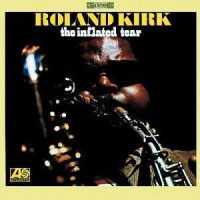
Eighteen years ago a song unlike any music I’d ever heard by someone I’d never heard of before altered the course of my life. One day in a jazz history class, amid the staples of Louis Armstrong, John Coltrane, and Miles Davis, the professor slipped on a record by Rahsaan Roland Kirk.
“The Inflated Tear” sounded like the entire spectrum of the history of African-American music rolled into one four-minute song: old slavery spirituals, work songs, field hollers, soul, modern jazz, and early blues. It was like a Duke Ellington reed section, yet more emotional, more intimate, with a sound that ached of centuries. It was like listening to the inside of someone’s heart.
***
Best known for his ability to play three saxophones simultaneously, Rahsaan Roland Kirk lived from 1935 to 1977. Despite losing his sight as a child and suffering a paralyzing stroke, he kept playing the music that came to him, sometimes through dreams, until his death at 42.
Kirk heard music in car honks and train whistles–the sounds of shattering glass, police sirens, and chirping birds were all at home in his compositions. He played everything that crossed his path, beginning with the water hose he picked up at age four, and he later commanded more than forty instruments, some of which he fabricated himself. He pushed sound and music through his battery of over-worked horns, held together by his favorite on-the-spot repair: masking tape. He was always draped in glittering instruments and wore a heavy necklace weighed down by charms and amulets he’d received as gifts. A club owner once described him as looking like “a musical Christmas tree.”
***
A year after graduating college with an English degree, I lived in a tiny, crumbling garage apartment behind the university, and my life was now a patchwork of odd jobs and indecision. That’s when I found a VHS tape of a performance Kirk gave in Switzerland during the 1970s. This was pre-YouTube, so I’d never seen any footage of him before. It was the most powerful performance I had ever seen.
Here was this blind man on stage in such complete and utter command of his surroundings that I soon forgot about his blindness altogether. Between songs he deftly adjusted mic stands, rearranged his horns, and directed the rest of the band. He played his two saxophones at once and then tossed one aside when it was time for his tenor solo. He kept time with a foot cymbal and a large gong. He demolished a wooden chair and broke it into pieces and beat the stage with its remains.
In that instant, despite my stature as a recent college grad living in Texas who hadn’t even written one article on jazz—my one published piece of music writing at that point was a small music review in a local paper—I decided that I had to write a book about him. I would track down everyone who knew him while they were still alive, I would collect their stories of him in the hopes of preserving Rahsaan’s legacy.
***
Although my minor was in music, I had only begun to learn the history of jazz and blues. The jazz world seemed vast and daunting with those in the know constantly rattling off jazz trivia as though discussing the NFL. The entire surrounding culture seemed male-dominated, overly-intellectual, and like a secret club.
Here’s where things get weird. I was writing about Rahsaan because he was calling to me. That longing to know him was so insatiable that I spent the next several years traveling around the country and beyond, scraping together just enough money and living on maxed out credit cards in the single-minded pursuit of hearing stories told by those who knew him.
This emotional quest led me from the basement of a London jazz club to his Ohio boyhood haunts and eventually to the bed where he once slept. This quest took on a serendipitous feel. Crucial leads would appear out of nowhere, coincidences became turning points, and I eventually began to trust what his widow Dorthaan had insisted from the first time I met her: “There is some connection between you two.” Days after my first urge to write a book about Rahsaan, I found out he’d died on my birthday, the day I turned four.
***
I soon learned he had this magical effect on every life he touched. Those closest to him felt moved by his spirit. Grown men broke down in tears telling me stories about him. A wisdom encircled Rahsaan that had folks believing he had something greater to say, something supreme to impart each time he spoke. Part southern preacher, part stand-up comic, part ancient-prophet—Rahsaan’s voice boomed with authority with his words always aimed at delivering the most hard-hitting truths. “He has the voice of a king,” someone once said.
***
Rahsaan never allowed obstacles, including blindness, to stand in his way. “I’m a man, first. So-called blindness is secondary. I don’t believe, that when I pick up an instrument, I’m blind to anyone.” He never faltered in his conviction, even when faced with confounded critics who continually dismissed his genius as a circus act, a gimmick, or even a blind man’s freak show.
Two years before he died Rahsaan suffered a debilitating stroke and lost the use of the right side of his body. Doctors told him that he would never play music again. After several months of therapy, it was clear that he would not regain the use of his right hand. Unstoppable even after this harshest blow, Rahsaan devised a way to play his horns with the use of only his left hand. “I felt that urgency,” he told an interviewer. Just nine months after his stroke, Rahsaan made a heroic comeback and continued to record and tour until his death.
Once you know Rahsaan, you begin believing anything is possible. Rahsaan not only showed me my path in life, he also gave me the courage to follow it. I set off at twenty-three: naive, unsure, and without a clue. All I had was the deepest longing I had ever felt and the haunting sounds of “The Inflated Tear” pursuing me. I had to know Rahsaan.


17 responses
I loved this essay and I’m excited about the book you are writing.
I saw Rahsaan Roland Kirk once in 1975 (1976?), after his stroke, at Todd Barkan’s Keystone Korner in San Francisco. He did the chanted introduction to Volunteered Slavery (“If you want to know what it is to be free/You have to spend all day in bed with me.”) with the same sly bravado he showed on the record–no need to stand any stronger to prove the stroke had not brought him down.
Thank you so much, Don! Wow, you saw him at Keystone Korner? You can’t imagine how jealous I am:).
Amazing, so proud of you May!
Hey Deb! Thanks so much for reading this! Hope to see you soon.
xo
Hi May,
My son (Dr. Gump) forwarded your essay. I loved it! Rahsaan was a close friend for many years. I wrote this poem in tribute.
REMEMBERING RAHSAAN ROLAND KIRK
Village vanguard on a Friday night
Up on the dais with your stritch and manzello
Was that an angel’s tear I heard?
Or a word whispered through the lips of god
Whirling Dervish in a black beret
Cosmic force of Olympic proportions
Blowing riffs to infinity
And charming more than snakes
I called you “Roland” back in the day
And carried you home in my Austin Healy
Your “Haunted Melody” is still haunting me
Like that Mingus-Giff Thing” in Copenhagen
Renaissance man from an alien nation
You seranaded a coo-coo and a generation
When I think of you my feet start tappin’
And I can’t stop my head from shakin’
I wrote the line “And charming more than snakes” for my friend Don Buday who was a staff writer for “Downbeat” back in the 60’s and 70’s. He referred to Rahsaan as a “snake charmer” I left-out an entire stanza after that line (getting old). Here it is;
Black and blind, course yet refined
You left the loot but brought your flute
To a three-ring-circus in a one-horse-town
The Moons of Mars were your echo chamber
Oh I love this, Sol! I’m so happy you posted it here and I do hope we can speak on the phone soon. I’m grateful to Eric for introducing us. Beautiful poem, and did you really give Rah a lift in your Austin Healy?
Cheers,
May
Many times. Rah played the Village Vanguard for one week about twice a year.I was living in the city and rarely missed a night. I offered him a ride home one night. He lived in East Orange N.J. He accepted and it became a regular thing. Many a night I would sleep over. I got to know his wife Edith and son Rory. Once, after returning from 5 or 6 months in Europe and Norh Africa, I noticed that Rahsaan was playing at the Vanguard. We hadn’t spoken in several months. As he was leaving the dais, after his first set, I approached him and said “Rahsaan”. He recognized my voice instantly. “Sol, where you been, man? C’mon, I want to introduce you to my old boss. He’s waiting in the musician’s lounge.” That night I met Charlie Mingus! A greater thrill for me than meeting Jimi Hendrix a year or so earlier. Hendrix loved Rahsaan, as did I.
If you in the Columbus, Ohio, area, look me up and I will take you to Roland’s grave. On a quiet day you can hear him blowing down under, I always visit him on his birthday in August. I think he might still have a sister here in town but she may have passed away recently.
Sol, that is SUCH a great story! Wow–Mingus and Hendrix? And Rahsaan? We’ve gotta talk.
Thank you so much sharing,
May
Hi David,
I do hope to make it back to Columbus at some point and will look you up when I do. I sure wish we had talked before my first visit to Columbus many years ago–I couldn’t find the grave and my sis and I spent a long time trying. But I did manage to find it on another visit.
Cheers,
May
Hi May,
I had to walk side to side, front to back to find him. Roland is roughly in the middle and close to the road if you pull in to the right. Look me up on Facebook, I think I have a photo of his grave in my photos somewhere. It’s dark granite with a sax engraved on it. Glad you found it, took me awhile too. I remember seeing him play in the 70s at a Comfest on N High Street here in Columbus when I was a kid. I thought, what is that sound? It was him.
May, your story about discovering Roland’s music is a moving one. I’ve been having a similar series of revelations lately, especially as I’m from Columbus and still spend a good amount of time in his native city. I don’t blame him for leaving: in his day, Columbus was not much to look at, and it still retains most of its Midwest modesty/blandness. But being from here has given me an interesting sense of the energy he was reacting against.
I can’t fathom that he didn’t cross paths with Sun Ra at some point. Perhaps you’ve learned something about that?
Anyway, I look forward to coming across your book, or other essays you might share. I suspect you might have already heard of this upcoming documentary, but if not, there’s a 20-minute excerpt on Vimeo. Look for The Case of the Three-Sided Dream, by Adam Kahan.
Lastly, if you are so inclined, I have a gorgeous image of Ronnie’s grave shot in the snow in January of 2014. I’d be happy to send you (I assume you can see my email address here, yes?). I find it funny that it only shows the one sax, where it should show three. Perhaps someone will “correct” that someday. 🙂
Hi Ed,
Thanks so much for reading the essay and for your kind words. I would LOVE to see the image of his grave (I’ve been there in person, but my snapshot of it’s not so great). Your email is hidden but mine is: mayk.cobb@yahoo.com.
I actually had the pleasure of attending the world premiere of the film and it’s incredible. Yes, Rah and Sun Ra’s paths did cross. They actually lived in Philly around the same time.
Thanks again for stopping by!
May
May,
What’s news of your book? Can’t wait!
Best, and Pedal up!
Daniel
Hey Daniel,
Thanks SO much for asking. I’ve got a wonderful agent who’s shopping the project around to publishers so hopefully I’ll more to report soon!
Yes, pedal up!
cheers,
may
of course i meant to type “i’ll have more”…:)
Click here to subscribe today and leave your comment, or log in if you’re already a paid subscriber.