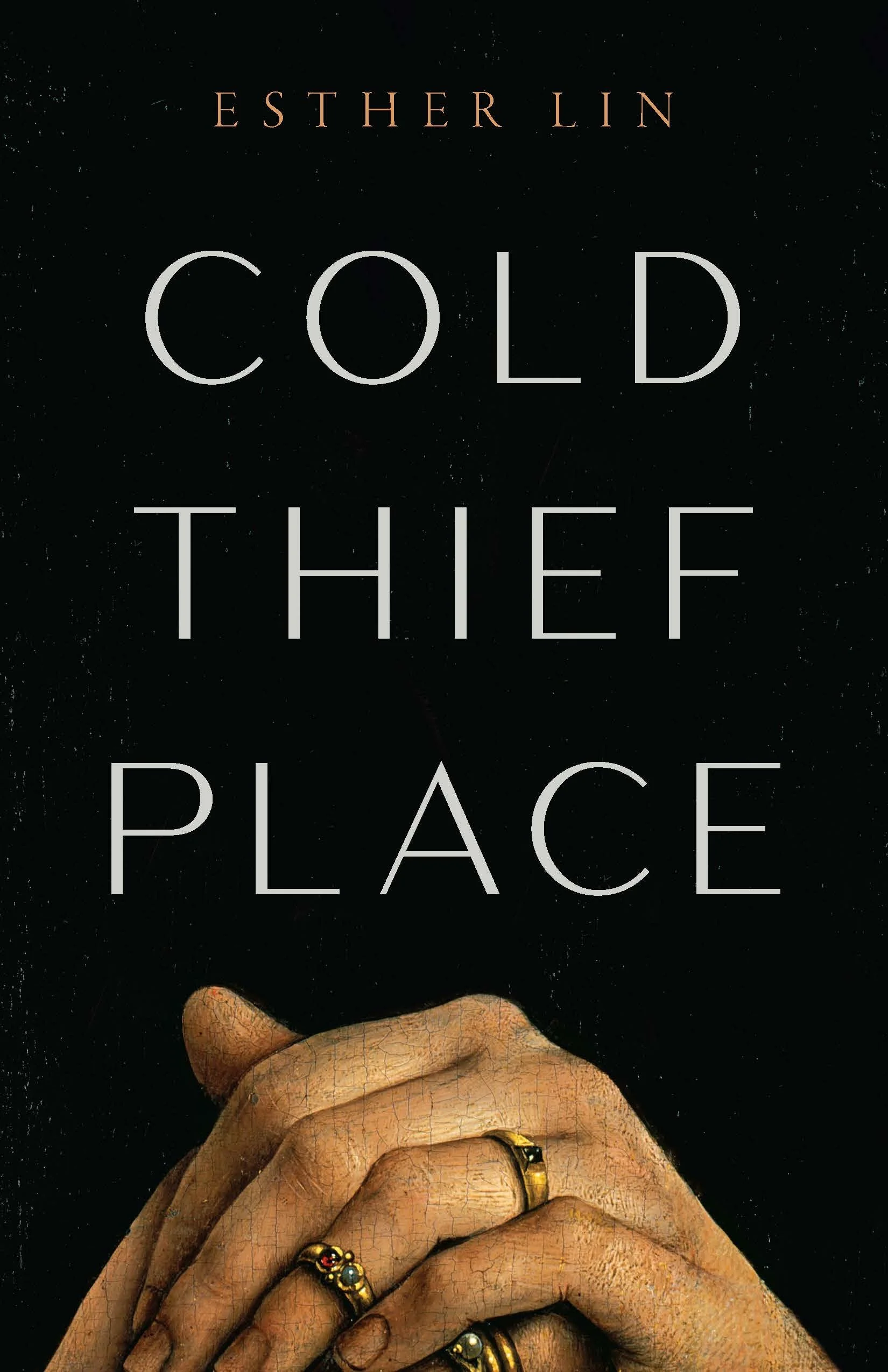
Lately, in my social media feed, I’ve seen a James Baldwin quote surface between news stories and advertisements: “You read something which you thought only happened to you, and you discover that it happened 100 years ago to Dostoyevsky. This is a very great liberation for the suffering, struggling person, who always thinks that he is alone. This is why art is important. Art would not be important if life were not important, and life is important.” Most recently, poet Chen Chen posted this quote with an emphasis on that last line: “Art would not be important if life were not important, and life is important.” It doesn’t seem universal, lately, that “life is important.” I keep asking, what is necessary of me, of others, to enter a narrative others value? But Esther Lin’s Cold Thief Place is a testament to this kind of liberation through art—the ability to find oneself reflected in the canon and to, in turn, offer that visibility to others. Lin’s debut poetry collection presents a faceted speaker: an undocumented immigrant, a daughter prophesied to be a son, and a scholar writing in conversation with a western canon. Each version of the self is at once grounded in the present and oracular, speaking as the prophet of a past life.
I’m interested in the way Lin illustrates how close the vapid may be to the vatic, which is to say, there is no moment of our lives that must be omitted. Instead, she leaves it to the audience to appraise the difference. In once such moment in “The Real Thing” three undocumented teenagers pay a dealer for drivers licences:
Your English is so good. How can you
be illegal? the dealers laughed.
I was seventeen. My brother refused to speak.
The dealers drove us to a lawyer’s dining room.
The lawyer notarized our proof of address.
4 Lachine Lane, Alexandria.
In French La Chine means China. In China
4 is an inauspicious number.
In Alexandria the poems of Sappho burned.
The dealers drove to the DMV. Don’t speak
English. We’re your translators, the dealers warned me.
If you speak English, you will fuck this up.
I passed the written exam. My brother passed
the written exam. The stranger failed.
Here the life story, “the real thing,” shares the elements of a fairy tale—the rule of threes, foreshadowing omens, the warning to disguise your talent. Like Bassanio choosing between the lead and silver casket in Merchant of Venice, we must devise value. At the end of the poem, the learner’s permit is printed on paper. What the speaker holds in her hands is neither illusory nor safeguarding: “The lawyer would forward the dealers the real thing. / The dealers would forward my father the real thing. / It’s not even the real thing, the stranger shouted.” Throughout Cold Thief Place, Lin’s poems cross between the mythology of life and the mythology of art. We’re given the inauspicious street address, the trial, and knowledge which threatens “you will fuck this up.” And yet, more important than the trial is the question, what are we seeking.
Lin opens Cold Thief Place with a childhood ultimatum:
What did I fear more?
A fire clawing
its way along my rug.
Offering me what I love best.
Or a man at the door asking
quietly my name, my date of birth.
In gesturing to “what I love best,” Lin models the way desire may hold the distance between “a fire clawing” and “a man at the door” (possibly an ICE agent), asking for identifying information. What she doesn’t name with “what I love best” is warmth, isn’t it? What every child wants most, warmth being a blend of safety and belonging. Lin’s debut is a collection that will appeal to anyone who has referred to themselves as “a reader,” those who have found literature (and fandoms) meaningful because of how they’ve offered community and a sense of belonging. I love how she places her early encounters with Madame Bovary right next to genre fiction.
Reading Lin’s “Fantasy Novel” with “[i]ts back cover / Celtic knotwork you could feel / when you ran your hand over it,” it’s easy to relate to the sense of independence and identity literature may offer. A few years ago, I might have considered such sentiment nostalgic, but as young readers face growing book bans across the country, Lin’s poems offer an act of witness. In “Fantasy Novel,” the speaker cannot tell about her novel, because the book is destroyed. “My mother was saving my soul,” she tells us, an adult logic we still hear echoed by Moms for Liberty, a political advocacy group that claims any expression of LGBTQ inclusion in books and curriculum endangers a child’s mental health. As the speaker offers glimpses of her mother as both a survivor of the Cultural Revolution and a faithful member of a doomsday cult, literature offers context. Lin writes, “If I am a prophet, I am one who divines / what has already passed. My sight is unclear, /the entrails rarely auspicious.” Maybe this is the best description of a poet’s role in society. If her “sight is unclear,” if she “divines /what has already passed,” then perhaps the past is as speculative as the future.
In the poem, “When I.C.E Came for Me,” Lin describes her displacement (as a writer, as an undocumented immigrant) through the context of art:
I was a woman out of time
and place. Illegal immigrants
do not go to France. In our history,
there is no preliterate woman
crouched right here, fingers
dipped in red and ochre pigment
she’d ground by day,
and someone at her side,
holding the light.
The “I” here is both the contemporary poet in the preliterate woman’s cave and the undocumented woman, a self whose passport has limited access, in a new country, traveling to see another woman’s rosy fingertips, a color that echoes throughout Cold Thief Place, entwined with the act of making. Like glass out of the fire, Lin defines art through its warmth. I thought America was the thief, like any cold colonial northern power, but we—poets and immigrant daughters—are also the thieves in Cold Thief Place. It’s how we come to such a country and how it remembers us back. I love how Lin cites her own theft, which is the academic tradition we’ve been indoctrinated into, but as she explains, it isn’t that simple:
rosy fingers
is a phrase
I learned reading
D’Aulaires’ Book
of Greek Myths
my brother stole
Prometheus-
style from the
school library
the goddess
Eos would
wake the world
with rosy fingers
Her brother “stole / Prometheus- / style from the / school library / the goddess” (and her description) for Lin to love and remember and reapply. (If we steal our way into the academy, when may we appoint our own pantheon?) There’s something to the act of revelation, the way Lin shows us first, in an earlier poem, what she can do with the English she’s adapted to address her mother instead of the Greek dawn:
Strange
to think of you
Mother
cheeks bright
with the nuisance
of revolution
thin hands
rosy fingertips
levering yourself
onto the train
that would bring you
to Wuping
I admit, Lin’s adulation makes me think of my own mother and the way this country doesn’t exist for me without the story of how she comes to it. I was born here, but for my mother, it’s an endless return. Most weeks we lay out the cost benefits analysis of where she’ll retire. Nanay’s advice is that if Mom stays in America, she’ll die alone. I want, from myself, the poem that will make this untrue. And I wonder, if I acknowledge the colonial nature of this medium, what change does that allow?
Throughout Cold Thief Place, Lin involves the classics, a term that despite its broad nature (so much can be classic) refers to a Greek and Roman tradition. In demonstrating mastery over the classics which predate America, Lin pulls our thoughts away from the American lens. The ancient world offers a different scale by which to measure our own country. In “Tell Me Where the Past Is,” she points to what came before:
There’s one way to talk about beauty
and it hasn’t changed since Spanish
ponies, born from wreckage, swam
to become island wildings, alone and
windblown. Feral. American. Hasn’t
changed since the vase painter of Attica
chose a flutist and dancer for her subject
in the fire. It’s twenty fourteen that I love
this girl on panpipes. She peers down
at her hands at work, one foot hitched up
as if she too were to spring to dance.
But no. The making of this music
pins her to her seat, the black behind her
not the field of the contending mind
but its best warmth, a gift to her
compatriot who works without instrument,
In doing so, she makes room for the warmth her speaker is seeking. (Or perhaps it’s this warmth that binds her to art, like “the girl on panpipes” whose “music / pins her to her seat.”) The warmth is for someone else, “a gift to her / compatriot.” and yet, of four times warmth is directly named in this collection, and I would argue, this warmth is the closest to what we can hold—the fired vase, as the speaker contemplates the warmth of her own “contending mind.” I admire how the artist, in this case, becomes the person least removed from the child of the opening poem, interested in the fire “Offering what I love best.”
Throughout Cold Thief Place, Lin develops the possibility that it’s the western canon that serves the story she has always carried. The story is absolute. The real thing, complicated and faceted and unwieldy, does not change. What art does, even art from a tradition that refuses to center her, is that it offers a frame, a way to hold a story that at first seems impossible to tell.