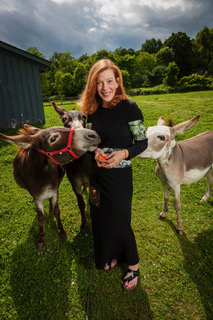
Joyride, Susan Orlean’s ninth book and first memoir, is her most personal and vulnerable work. When I spoke with her in 2021 for LARB, it became my most craft-focused profile. Tina Brown, former New Yorker editor, once described Orlean’s pieces as “tightrope acts.” Her sentences carry an innate rhythm and musicality, an experiential quality that makes her narratives feel both effortless and transportive.
A tough self-critic, Orlean discarded early drafts of Joyride for failing to meet her standards of authenticity. In this book, that balancing act of journalistic accuracy, humor and intuition is turned inward. Taking stock of her own life, she writes about what hurt, what thrilled, and what shaped her. The result is a rare behind-the-curtain view of the golden age of journalism, interwoven with glimpses of Orlean’s childhood, her evolution as a writer, and her reckoning with personal challenges and heartbreaks.
At Columbia University, I combed through Orlean’s archive: journals, postcards, news clippings, horse riding ribbons, sunglasses, countless reporter notebooks and personal letters. On several University of Michigan notepads, she had doodled the line: “Everyone must have some thought to get them through.” Given her intellect, I first assumed it was her own maxim, not a Jackson Browne lyric. Her approach to writing, whether books or features for The New Yorker, is bespoke: every option weighed, every detail considered. Rooted in her Shaker Heights, Ohio upbringing—the youngest of three, a tomboy, bookish, an animal-and-music lover—she has always felt, as she once told me, duty-bound to take readers on a ride.
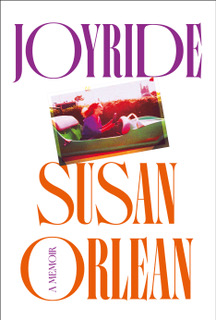
The Rumpus: When people imagine someone’s success, they can’t imagine what they’re also grappling with behind the scenes. You’ve lifted the veil, and disclosed much more of yourself. How does it feel?
Susan Orlean: In conversation with someone else I realize, “My God, I’ve told you my deepest secrets. I’ve told you some of the most personal things in my life.” Though it’s not as if I’ve never revealed myself. Everything I’ve written has either directly or indirectly addressed my presence in it. But I’ve never given the details of my heartbreaks and my challenges—like trying to get pregnant or having a sort of crazy vacation romance. Those things are really personal.
Rumpus: And also, very relatable.
Orlean: We all write first of all for ourselves, of course, and then, secondly, for an imaginary reader who is a figment.
Rumpus: Can I ask a really tough question?
Orlean: We’ve talked over the years and stayed in touch, I’m very comfortable with whatever you like.
Rumpus: I appreciate that. Is this book in conversation with Peter Sistrom, your first husband, who passed away in 2021? Sorry to ask it, but it’s a strong throughline in the book.
Orlean: It’s a hugely emotional part of the book. While writing it, at times, it felt painful taking a methodical walk through this very difficult part of my life, and the fact that there was no closure, which is, in some ways, the most painful part of it. As I said in the book, I didn’t truly believe that there would be closure. But the fact that the potential was removed forever was also the pure sadness of it. I don’t mean to suggest that all I thought about when he died was, “Oh, shoot! I don’t get to have that conversation.” This was someone I had known and been married to for a very long time. It was tremendously sad and shocking.
Rumpus: If I may, your line: “All I yearned for was some confirmation that those memories existed and mattered, because otherwise they were a broken circuit within me, as if I had the lock but not the key.”—it captures humanity and what we all wrestle with in our lives. And that’s what you’ve always done for us.
Orlean: It’s the only time I’ve ever fully explored the whole idea of our marriage in context with my work. Even if you’re in therapy, or you’re talking to your friends, there’s rarely the time when you sit down and walk through twenty years, which was our life together. I was able to see the parallels of our marriage, my work, my own personal happiness. It was my final chance to reckon with all of that, a one-sided reckoning obviously, but it was somehow satisfying seeing the two tracks in my life laid out in a timeline that way. One track was my very exciting, very forward moving professional life. And this other track, which was a painful, contorted personal life. How strange it was that they ran simultaneously and that there were undeniable parallels that, even at his most defensive, Peter would have had to acknowledge. But I had never laid it out like that before, so it was in many ways a conversation with him in absentia.
Rumpus: He was one of your best readers and best editors, and you share that.
Orlean: When the adaptation of The Orchid Thief came out it portrays the marriage of the Susan character as being very unhappy. It was really shocking to me until I thought, well, I think it probably is there in the text. It’s just embedded very deeply. And how could it not be? This is my book. I’m not a newspaper reporter. I’m telling you the story. But the story is coming through me. Whatever I was going through at the time is going to have an inflection in the way I write.
Rumpus: During Tina Brown’s editorship, you produced some of the best work of your career, but that pressure was intense. How crucial was that pressure in sharpening your writing?”
Orlean: As much as it pains me to say, I think a certain amount of pressure does work, and that was probably Tina’s philosophy. Before her, The New Yorker had prided itself on not pressuring people at all, almost to an extreme. You had people who hadn’t written in a million years, and you had people who were perfecting one piece for months and months. No book can be perfect without some parameters. You could drive yourself absolutely crazy trying to achieve “perfection”. I don’t want to put words in Tina’s mouth, but I think that she saw permissiveness as being somewhat detrimental. It’s a little like not giving your children any boundaries. For instance, the fact that, previously, we had no deadlines meant that you could work on a piece endlessly and never feel it was done.
Rumpus: In the book you mention at some point finding Brown’s pressure unsustainable.
Orlean: Permissiveness to an extreme can make it hard to get motivated and focused. Pressure to an extreme can be difficult to live with. Both philosophies have certain truths at their heart. There’s no question that the sort of rigor of expectation was responsible for me digging deep and working at the very top of my game. I apply this also to David Remnick as well. But Tina was somebody who liked to turn the screws a bit tighter, and see if you could work a little bit harder, a little bit faster. I do feel that I did some of my best pieces when I was working for her.
Rumpus: While working on the Orchid Thief you took a break from The New Yorker.
Orlean: Tina agreed to my taking a leave. I don’t love working on more than one thing at a time. When I was done, I began thinking, am I ready to go back? The Orchid Thief came with lots of pressure as well. It was my book and I was trying to meet a decent deadline, but it was my deadline and my pressure.
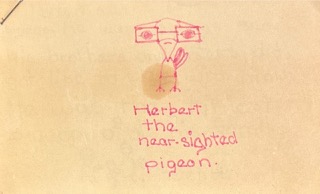
Rumpus: In the archive I also found your very first book Herbert the Near-Sighted Pigeon. What child does that?
Orlean: Years ago, Jon Karp [Chief Executive of Simon & Schuster] kept saying to me, you’ve got to find that book. I didn’t think I was going to find it. And then, lo and behold, luckily my mother was my greatest archivist, and she had it, which was pretty cute. I have trouble believing the family lore that I was five when I wrote it. It’s awfully sophisticated, but I was definitely very young.
Rumpus: I think it’s quite possible you were five.
Orlean: Well, then, I’ll go with that.
Rumpus: You were also quite a doodler.
Orlean: I was an insane, obsessive doodler. I doodled all the time and still do. If I’m listening to something, I’m always doodling. It helps me focus. But I had a small range of doodles. I did horses, spirals and three dimensional cubes all the time. And I love typography, so I would sometimes do letters and try out different fonts that I would make up. I was definitely a doodler. And even now, when I’m taking notes, if people are saying something boring, I’ll doodle while they’re talking and part of it is that there’s a silent messaging to a subject that I’m still taking notes. The moment you stop taking notes, it can seem like you’ve decided what’s being said isn’t interesting. But if your hand is constantly moving while they’re talking, they’re more comfortable.
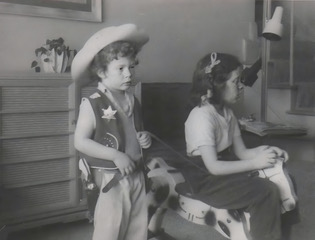
Rumpus: Do you consider this a journalistic memoir?
Orlean: That’s a tough question. Gosh! I don’t know how to answer that. Part of me isn’t sure exactly what that means. It’s journalistic in the sense that I employed the standards that I would apply to a piece of journalism. In terms of accuracy, honesty and authenticity—to the very best of my knowledge—everything that I wrote is a fact. So yes, it’s journalistic in that regard. It’s certainly not a piece of autofiction or a factish piece of writing. I worked really hard making it as true as possible. Yes, it’s journalistic.
Rumpus: In Joyride, you address that writing can be a mean business. At the National Book Awards there’s a moment when you are approached by someone that you hadn’t spoken to since a “misunderstanding” took place regarding a deadline extension. You responded to him honestly, letting him know that it was the worst experience of your professional life and that it truly wounded you. It struck me how people forget that, yes, this is a business, but it’s also a business of people. You were so graceful, especially because we’re taught to not respond, yet it was so important to say what you did aloud and on the page.
Orlean: Women are taught to not be confrontational and not say screw you what you did was shitty. My impulse would have been to not say anything. I tried to contextualize it and say: Look, the economy was in freefall, and businesses were doing whatever they could do to try to compensate. To some extent this wasn’t at all personal. I should say that differently. I don’t think it was personal at all. I think what happened is that I had a very big advance and in the Eighties, after the subprime mortgage debacle, every business around the world was in crisis. When they sat there penciling out how they could kind of improve their bottom line, they likely said Well, wait. This book is due and it’s already got one extension. Maybe she’s never gonna finish it. Let’s just pull the plug on it and get that money back. That’s just an accountant’s assessment. It’s a little like when newspapers fire their most popular writer who’s got the most seniority. You think, what are they doing? Well, you forget that they recoup a bigger amount of money by getting rid of their most highly paid writer. That’s the story of media today where you get twenty-two year olds who will work for nothing.
With my situation, I did feel that my publisher had misled me and were completely unreasonable. Also, on an editorial level, it made no sense. There was no urgency for this book to come out a year earlier. I was going to get it done. I had gotten all of my other books done. I’m not fast. I don’t pretend to be fast. The fact that they never said to me “Look, we’re really sorry. Times are tough, and we can’t give an extension.” To just give a tiny human buffer around the decision. If they had said “We cannot keep having this money on this column side of our accounting. Sorry. It’s going to be a great book. We hope you sell it somewhere else.” But it was nothing. No one spoke to me, no one said a word.
Rumpus: It’s such a great point in the book.
Orlean: This is an artisanal business. As much as I like using the idea of the widget factory when I’m trying to get my work done, this is a very bespoke business. Each sentence is a bespoke creation. Most people are doing their best. And there have been people who took book contracts and were screwing off. But that wasn’t the case. It was a difficult book to write.
Rumpus: Sometimes you do have to speak up. It had to be done and you did it in a kind way.
Orlean: I’ve had the bad habit of taking on other work when I’ve had a book to do. It’s also an understandable bad habit, which is: let me do something short and easy that I can do right away, because, oh my God! this book project is overwhelming, and I don’t even know where to begin. And also, I want to keep my name out in front of the public. I don’t want to disappear for five years working on my book. All that is understandable. The fact is there was no humanity displayed.
Rumpus: He approached you presenting it as an accounting issue despite, realizing too, that they would have made money on the book.
Orlean: I thought, This is a moment where you’re supposed to say to me, “I’m really sorry that went down so badly.” Or, “Congratulations. The book was great. I wish we had published it.” Even, “It’s great to see you.” Instead, it was this crazy thing of saying, “We would have made money on the book.” Unbelievable. My discomfort with bluntness is extreme, but this was one of the times in my life where I couldn’t not say this really broke my heart. I think he was shocked to hear me say it. I didn’t scream or say something mean. Just, “You have to take some responsibility for the fact that what you did had a human impact.”
Rumpus: I’m glad it’s in the book.
Orlean: It all turned out fine. That wasn’t the point. I do think that the pressure of the economics has made publishing a little more heartless. There could hardly be a profession where it’s more emotional than this one and where people really are trying to make something good. But you can’t just snap your fingers and have that happen.
Rumpus: The book’s dedication is to your New Yorker editor, Chip Mcgrath, and your longtime agent, Richard Pine.
Orlean: I hardly know anyone who’s been with one agent for as long a time as I have. I’ve had a really special relationship with Richard. We’re almost the exact same age, started in the publishing business around the same time, and we have journeyed in this together. This book was for the people who’ve been really instrumental in my professional and personal life. When you’ve known those two as long as I have, it’s obviously more than a relationship where you are just thanking them for sending royalty checks on time. It grows into a kind of family and it was a nice opportunity to acknowledge that.
Rumpus: You also write about your health issues — a serious spinal surgery and lung cancer. Again, it’s the peaks and valleys in your life that you are bringing to the story. Showing us that, like in a football game, when a player gets injured, they often go back onto the field, playing hurt. You did that, went back out, and did your job, sometimes playing through with aches and pains. Any response to that?
Orlean: It’s interesting because I thought a lot about whether to include these things. Why do I include it? Why is it necessary? I could have left it out, or not brought it up. The book wouldn’t have been dishonest without it. But I wrote this book taking stock of my life and looking back over the arc of my work. And, as I said in the beginning, when I realized it had been twenty-five years since the Orchid Thief came out, I thought, twenty-five years? It feels like you get an extra slice of cake at twenty-five years. Your own frailties and challenges factor into that. This is a really active profession. I’m out and about, running around. Being sidelined for physical reasons is significant. Without a doubt, going through lung cancer was a moment of thinking, oh my God. First of all, it was weird because the cancer came to my attention because of Covid, which was strange, although very lucky. But the idea of mortality, when this profession involves being physically and mentally active, caught me by surprise. At the end of the day, those issues had manageable impact for me. I included them because the book is about resiliency and how important it is. In the book, I write a lot about how many stories felt like they were about to fall apart and the temptation can be to say, I can’t do it, when things didn’t work out or a subject won’t talk to me. The key is to be tough and stick it out a little longer.
Writing always draws on resilience. It’s always drawing on your ability to keep pushing a little. Physical complications which are big challenges are an external manifestation of this. But you deal with it. Mine were manageable. I hope it’s a message of hopefulness. You can do hard things and surprise yourself with your capacity to go a little further. I’ve learned that over and over. I’m lucky that I do have a sixth gear.
Rumpus: And that’s what you shift into when you’ve had challenges.
Orlean: Illness is a bummer. I think it’s a little insulting to say it’s a gift. But with writing challenges, the kind of near-death experiences—discovering, for example, that the girls in Maui I wanted to write about had all given up surfing, or when reporting The Library Book, finding out that Harry Peak was dead and I was like, there goes my book—are a gift because it says “You thought the story was this, but it’s not.” You shouldn’t have a preconception of what it is. Now you’re here and this is what the story really is. Now start thinking. You shouldn’t have already been writing the book in your mind because you didn’t know the story yet. In that sense, those little challenges, and sometimes big challenges, are truly writing gifts. They force you to see things as they really are and not what you expected them to be.
Rumpus: Regarding your working on this book, what was surprising and delightful to you?
Orlean: That’s a great question. I shouldn’t laugh at this, but it’s funny. I don’t know why I saved all those rejection letters from publishers. I thought it was interesting that I saved them and didn’t tear them up in a rage. I was really surprised that I wasn’t completely daunted by them because certainly, as a young writer trying to get my first book contract, I was being sent polite, nice, but very clear rejections. I’d completely forgotten them. I had totally forgotten that these had come one after another. But it fits with the theme of resilience. I thought, all I need is one “yes”.
I don’t mean to suggest that I like getting rejected. But these came as little disappointments, and I was able to keep going. I took away the positive parts of them. That is what being an optimist requires—seeing what you can make of the reality that’s presented to you.
I was surprised by having kept all those letters. When I was a kid, I had my horse show ribbons hanging above my bed. Normally you save the things that celebrate and reward you for your achievements and I thought it was interesting that I saved the rejection letters. I think it was a storytelling instinct with which I thought “Well, this is part of my story of who I’m going to turn into, and these are just as much a part of it, even though they’re disappointing.”
Rumpus: Your book opens with talk about the literary giants you admired and dreamed of one day becoming. And it came true. How do you feel realizing that?
Orlean: It’s very hard for me to picture myself that way! It’s both delightful and a little bit disorienting because I feel I’m still learning and, I hope, getting better. Never having a drone’s eye view of yourself is a blessing.
If you’re a writer who is twenty-eight, my career has existed longer than your life. By the time you were in high school reading my work, I was already an established writer. It’s startling to think that’s the equivalent of me in high school reading Joan Didion or Tom Wolf. They were the Mount Rushmore of the great established, groundbreaking mold-making writers who I learned from and who inspired me. They influenced the kind of writing that I wanted to do. That’s a funny thing to appreciate.
Each challenge to me is brand new and, yes, I’ve gotten more experience and have developed instincts that help me, and those instincts have gotten better and better as I’ve grown through my career. For me, the key is staying true to my desires and aspirations while having a sense of achievements always lingering a little ahead.