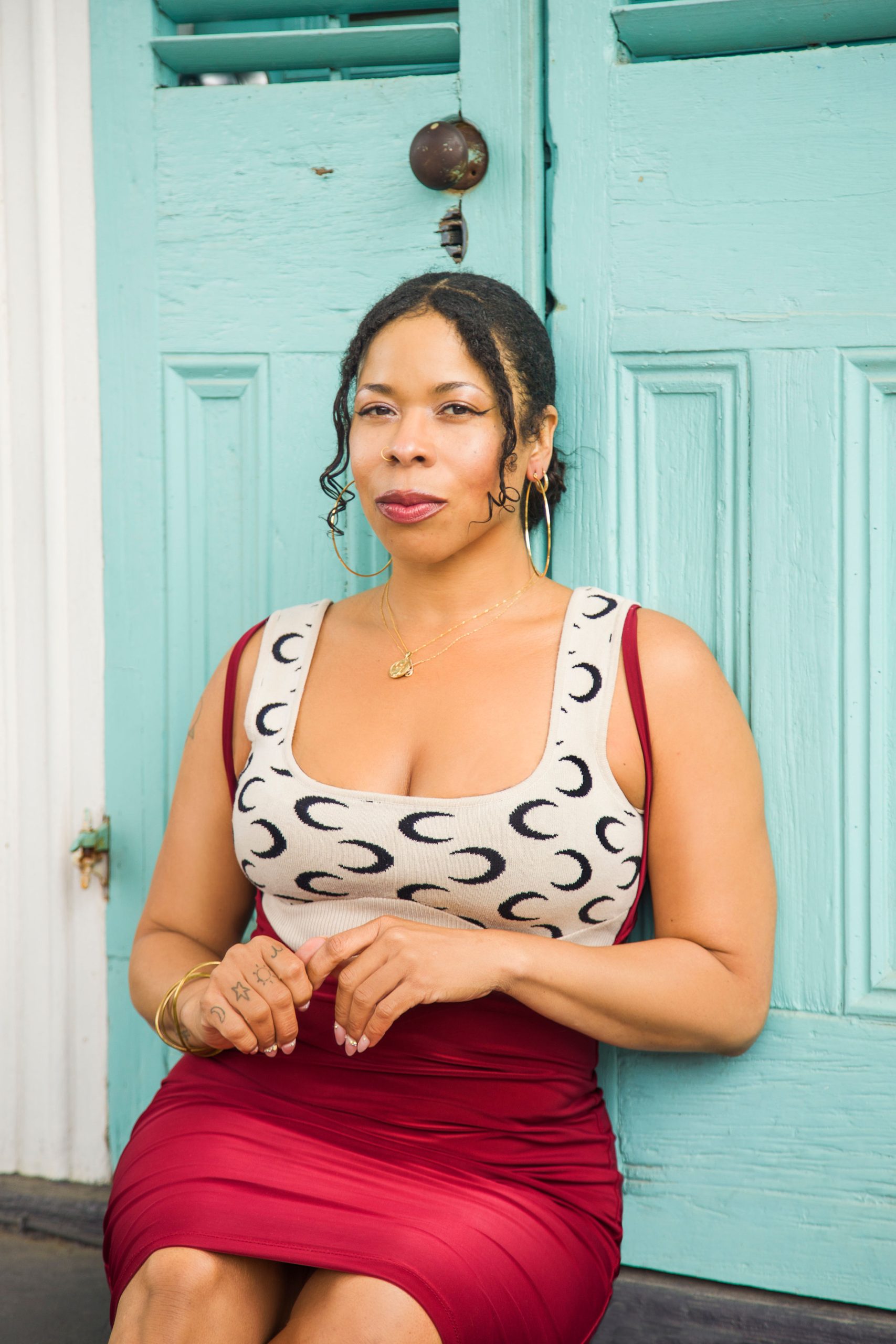
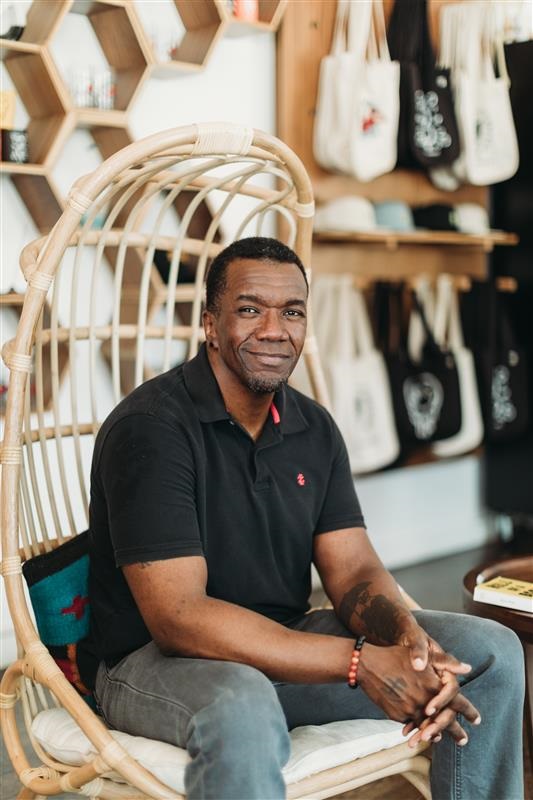
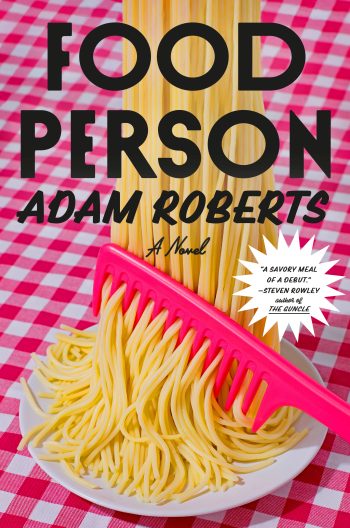
After briefly going to law school to please his parents, Adam Roberts woke up one day and figured out what he really wanted to do with his life: write about food. The Food Network was his cooking school. He was lucky that it was the early days of cooking shows where the focus was less on performance or competition and more on actual cooking. He started writing about his restaurant experiences on food forums like eGullet and Chowhound and the rest is history. Anthony Bourdain even chimed in at one point to give him a nod of support. He has been sharing his cooking triumphs, mishaps, and recipes with an ever-growing audience for over two decades, both on his popular blog, Amateur Gourmet, and in several books. After dreaming about writing a novel for years, he finally did it. The result is Food Person, a Devil Wears Prada-esque story about a young woman ghostwriting a TV star’s cookbook. It’s a page turner that is stuffed with family drama and more food references than any book I have ever read.
I was delighted to speak over Zoom with Roberts (and his dog Winston!) in his kitchen in Brooklyn, where he now resides with his husband, after living in Los Angeles for twelve years. We discussed many things including his early blogging days, his simultaneously structured and explosive writing process, and some current health issues that have shifted his focus on everything.
The Rumpus: You are one of the OG food bloggers. I thought I had you beat starting in 2009. But you were 2004!
Adam Roberts: Yeah, I mean, if they ever make a Mountain Rushmore of food bloggers, I would hope to be on it.
Rumpus: Ha! I would support that. How did it all begin?
Roberts: In the early days of my food blog, I was sort of like a rascal. I went to Le Cirque, and I wrote a post called “Only a Jerk Would Eat at Le Cirque” and I was kind of thumbing my nose at the food industry. I didn’t know anything about cooking and had a lot of disasters so my blog was meant to be a funny journal of my misadventures in the kitchen. Very gradually I got some respectability by writing for magazines and doing my own books. I lost that sense of being a misfit in the food world, and just sort of became a part of it.
Rumpus: Oh, I love that story—Going from misfit to just owning it and actually being successful in the food space. And since you started off so boldly by taking things down, calling people out, and telling it like it is, your readers could trust that you were coming from a place of honesty and transparency.
Roberts: It’s so funny, though, because today I would never ever write a nasty thing about a restaurant because I’m so aware of the hard work and the misery that goes on in those kitchens. I was just a bratty twenty-year-old and I felt so outside the food world and assumed that nobody would care what I wrote. Then I started to notice that these things would come up in Google searches, and sometimes they’d be the top results. I realized there’s a responsibility here and I can’t just write whatever I wanted to anymore. I don’t know if you saw that interview where Tina Fey went on Bowen Yang’s podcast where she basically said you can no longer say what you really think, Bowen, you’re too famous now.
Rumpus: I wonder if you could talk a little bit about your writing process. Do you sit down, and say today is a fiction day or today is a blogging and recipe day?
Roberts: Throughout my entire career, I’ve always been an exuberant storyteller. I think my blog is less a recipe resource and more just a place where people can come to hear about adventures whether it was that we went to El Bulli when it was still open or that we went to NOMA last year and I got food poisoning.
Rumpus: Oh my god!
Roberts: When I write fiction, I’m trying to write with the same exuberance and energy as when I’m writing non-fiction. I know clearly from the get-go what I have to say: “I had this experience, and here’s what happened.” The challenge is coming up with a structure. My hero is George Saunders. He’s my favorite writer. In his book on writing, he says you should write like you’re in a car with headlights on, and only write what you see in the headlights: Don’t plan. Don’t make an agenda. I tried to do that in the past and I came up with a huge mess! So for Food Person, I mapped out the whole story first. It didn’t feel different from writing nonfiction because I was doing the same thing, which is telling a story with a lot of enthusiasm and energy. I know it sounds like I keep hammering home that idea of enthusiasm and energy, but I think that’s what propels the language and the humor.
Rumpus: I think I’m more like George Saunders as in let’s sit down and see what happens.
Roberts: Sometimes I want to be more like that, a writer from the unconscious. I love Murakami. I love all kinds of things that are weird and unexpected but my suspicion is that the writers who write like that, whether it is George Saunders or Murakami, have an intuitive sense of structure and an internal sense of design, where even if they’re writing some strange interlude where something odd is happening and we don’t understand where the story is going, they’re still able to see the bigger picture in a way that not everyone can. I can’t play three-dimensional chess in that way, rewriting some strange, weird scene where I don’t really understand where it’s going. That’s why I need to map it out.
Rumpus: What inspired your novel?
Roberts: It’s pretty straightforward. I got hired to ghostwrite a cookbook for a celebrity a couple of years ago, and I signed an NDA, so I can’t say who the celebrity was, but I had a very positive experience. I was always fishing around for a novel idea and it was one of those light bulb moments where I thought, “Wait a second, this could be a great premise for a novel: a really introverted, aspiring food writer who is wanting to move up in her career, who gets stuck having to ghostwrite a cookbook for a celebrity who’s a hot mess, and over the top, and not interested in food but is doing this to resuscitate her career and the clash of these two women and how they end up helping each other.”
Rumpus: What did it feel like writing from the female perspective?
Roberts: Writing a female voice came very naturally to me, and maybe that’s because I’m a gay man. Gender is funny these days, because I feel like we talk about people’s gender identities in terms of the external world, and how they want to be seen or accepted, and I think that as a writer we can inhabit multiple genders on the page. It’s not just about identity, it’s also about whatever part of myself can channel this woman. I just went for it and if it didn’t feel right, or if it didn’t read right, I would have been the first to change it.
Rumpus: There are very strong female characters in this book who are also very broken people. We meet Molly’s mom, Candy, years after her death and via her recipes. I think many of us can relate to someone living on in their recipes, our mothers, our grandmothers, you find their box of index cards or their notes in the margins of cookbooks. That stuff is so precious.
Roberts: Well, I had to channel that, too, because I don’t come from a family of cooks! I won’t inherit anything like that, because my mom didn’t cook. My grandmother didn’t cook. I don’t even know if my great-grandmother cooked, so we don’t have family recipes. I thought that was a good twist for Molly’s character as the one who doesn’t eat and doesn’t enjoy food, that she came from such a food-loving and talented mother.
Rumpus: I vacillated between loving and hating some of these characters. Was that your intention?
Roberts: To be fair, Molly [the celebrity] is absolutely meant to be infuriating. She’s the antagonist for Isabella [the budding food writer], and challenges her in many, many ways, as does Jeannie, Isabella’s mother. This is like a hero’s journey, where Isabella is our hero. And she has to slay the dragons. But Isabella, you know, at times is a meek and mild character who doesn’t stand up for herself, so I think that aggravates some people who want more of a go-getter in this story.
Rumpus: Maybe I should backpedal a bit away from love and hate. It’s more frustration with these characters. I wanted to shake them and wake them up. But in many ways it’s no wonder life’s so difficult for Isabella. She was raised by a very challenging mother. So I think that all of these characters are very complicated, in the best way, and very human. And, I found my way toward rooting for all of them! But I did question Isabella’s sense of morality at times.
Roberts: It comes down to this. If you ghostwrite a book for a celebrity and you were trying to launch your own career and you had the opportunity to do a tell-all, I think it would be very tempting! I don’t think I would do it, but I think there are plenty of writers who would.
Rumpus: Your book made me ravenous.
Roberts: Well, I thought this was an opportunity to use food to illustrate character. I think the first time where this really becomes clear is with Isabella’s mother, Jeannie. When we first meet her, we learn that she mixes out-of-date canned soups together. Franken-soups! She’s mixing clam chowder with chili and calling it surf and turf. So I felt like that kind of revealed that her mother was a bit chaotic and that Isabella’s home life was a little unhinged, that this wasn’t a cozy, safe place, that she couldn’t necessarily rely on her mother to nurture her.
Rumpus: Food can be such a stressor and we see that with so many of your characters.
Roberts: Yes! Like when Molly orders food at the restaurant, I felt like it was a great opportunity to show how self-aware and presentational she is. She has rehearsed her lunch order ahead of time so she can impress Isabella by ordering a bunch of food. But then she also fakes an emergency to get out of there so she doesn’t have to eat it.
Rumpus: The food descriptions in some scenes are beautiful and quite touching.
Roberts: Yeah, Isabella’s sequence where we get to really know her is when she first makes scrambled eggs for herself—how much attention she pays to each tiny detail, sort of revealing how passionate she is about food and cooking, more so than the average person. And with Molly’s mom, Candy, I imagined that she was trapped in this loveless marriage with a semi-abusive husband and her portal to the outside world and the larger culture was through cooking, so her recipes were all sorts of opportunities for her to escape her life. She made coq au vin or bananas foster and they are rich, celebratory meals that gave her a little glimmer of hope and brightness in an otherwise dreary existence.
Rumpus: Have your writing and cooking shifted since you moved to Brooklyn from Los Angeles.
Roberts: Well, the biggest thing is I was diagnosed with Parkinson’s. I got diagnosed in May. It was the week of my book launch. It was an earth-shattering, complete life-changing moment. I went on my book tour and I was trying to process it all while doing events at all kinds of bookstores and going on the Mario Lopez show.
Rumpus: Wow. The week your book came out. That’s a lot to manage all at once.
Roberts: It all led to lots of changes. Exercise is a huge part of slowing the progression of the disease. So, as somebody who hates exercise, it’s hard to believe I now have a Peloton. The diagnosis has actually informed my diet, because now I’m trying to eat more fruits, vegetables, and salads. I also cut out alcohol. So things really have changed a lot in terms of my diet and my cooking. The bright side of it is that I feel so great. In my day-to-day life, I actually feel better than I did before the diagnosis. But in terms of the overall prognosis, it’s been very scary and challenging.
Rumpus: Have you written about your diagnosis?
Roberts: I put it in my Substack newsletter and my mom said you don’t need to write about this and I said, “Yes I do want to write about this.” As somebody who came out of the closet in my twenties I don’t want to walk around now with this huge part of my life a secret. So I put that in my newsletter, and I got so much positive support and it’s actually been a great experience in terms of feeling loved and cared for.
Rumpus: I am so glad to hear that. What’s next?
Roberts: I’m working on the next novel. Shockingly, it’s about a woman in the food world again! This one is about a recent law school graduate as she’s about to take the bar exam and she realizes she made a horrible mistake because she wants to become a chef. And it’s about how she’s gonna pivot in this limited time. She’s about to get married, about to take the bar, and so she’s trying to change her entire life before it’s too late. I’m on my third draft so it’s coming along.
Rumpus: What was the process like this time?
Roberts: Just like with Food Person, I mapped it out. Then I wrote a first draft, but just because I have a map doesn’t mean it’s off to the races. Almost always that first draft doesn’t work. I wrote the whole book and then spent about two months analyzing it, holding up a stethoscope. What doesn’t work? How should I reshape this? And then I mapped it again with whole new tent poles, new ideas, new concepts, and then I wrote the new version. So the whole first draft basically went out the window.
Rumpus: Wait. So you actually started fresh for the second draft?
Roberts: Yes, because writing that first draft gives me all the information that I need to make a really strong second draft. It’s a rehearsal, in a way. It was almost like doing improv in that world so that I could write the real version that comes later. So I think that’s my process! Anne Lamott, in Bird by Bird, calls it the shitty first draft. So, I write the shitty first draft and I analyze it. Then I write the second draft, the one where I am chiseling into stone, trying to make it really strong, so that when I revise the second draft, it’s not about blowing it up and starting again, it’s now about fine-tuning it.
Rumpus: It’s so helpful to hear your process. I’m wondering if you have any other thoughts, especially for aspiring writers, maybe someone who has an idea for a novel but doesn’t know how to start.
Roberts: Well, first of all, the books that I read on writing were Stephen King’s On Writing, Ann Lamott’s Bird by Bird, and George Saunders’ A Swim in the Pond in the Rain.
My first bit of advice is you have to discover what works for you: It might be mapping it out. It might be flying by the seat of your pants. It might be writing on index cards and putting them on a wall. I mean, you just have to discover your own process. And the only way you can do that is by writing. I do think the Stephen King thing of writing a thousand words a day is the best way to start because no matter what happens, if you write a thousand words a day, in four months, you’ll have a book. Then, you will look at this book that you’ve written and say, “Oh my god, this is garbage, how did I ever think this was this, instead it’s about that!” You have to get the clay on the table so that you can start pulling it apart and ask what did I even make here? What is this stuff?
Rumpus: Writing is rewriting, that’s for sure!
Roberts: I do think a very important aspect of being a beginning writer is to be kind to yourself.
Because in that moment, when you get the clay on the table and you’re reading it back, it’s very tempting to say, “This is so crappy. This is not clay. This is dog shit and I’m going to throw it all away and give up and go work at a car wash.” It’s very easy to be hard on yourself. You have to find that balance of being kind enough to yourself to keep going but hard enough on yourself that you’re going to analyze what you’ve done, and be a little bit brutal about it, and really try to shape it into something meaningful.
Rumpus: Any more books on writing that you recommend?
Roberts: There are so many great books about structure and my favorite one is called The Writer’s Journey and it uses the ideas of Joseph Campbell, looking at the hero’s journey and all the markings of a classic Greek hero’s journey, but as it applies to something like Star Wars or The Wizard of Oz. There are all these benchmarks in a good story, a hero’s journey, where you set up the ordinary world. There’s a call to adventure. There’s a refusal of the call, there’s the crossing of the threshold. There’s the meeting with the mentor. If you look at my novel, Food Person, through this lens, you will see every single one of those beats. It’s not exactly paint by numbers because then ultimately you have to read back what you’ve written and then that’s where you have to just use your intuitive sense. What feels emotionally true or untrue? And then that’s where you really get to tinker and play. But at that point, you’ve built something, and then you can reconstruct it in all the ways you think will make it stronger.