“You sure you’re okay here? I won’t be long,” he says.
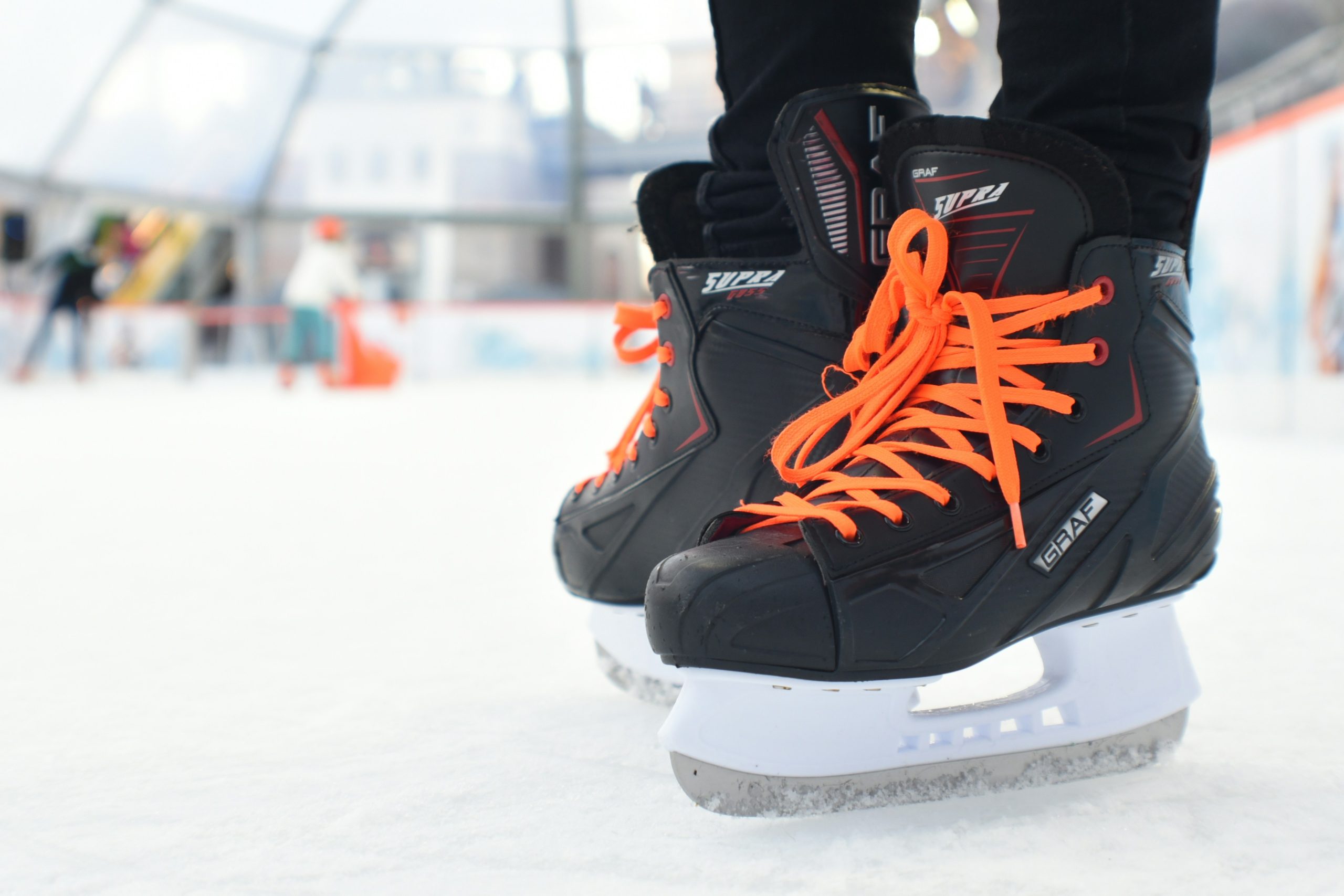
Sausage-scented chimney smoke plumes from the chalet in long exhales. I tug on my neck warmer and pick wool off my lips. The sun and cold pull my skin in opposite directions. Ethan slices the blue snow with his blades as he peels off his second sweater to make himself nimble. I feel heavier watching him do that. He’s beaming just being near the rink.
“Take your time,” I say.
He slips on his gloves and grabs his stick. I used to love carrying them to his games on nights we had off from the bookstore. The romantic gesture earned me the title, “Hockey Girlfriend.” I almost smile at the memory of the gloves’ unbearable stink, how we’d toss everything in a corner of the garage and jump in the shower, then cocoon ourselves in his room until he’d drive me home after midnight.
“Besides,” I add as I settle onto the bench with our bags, “I’m here for the sun, not for you.”
He laughs and kisses my cheek. I don’t let on that his stubble hurts my skin.
He hurries to the pond and takes off like some beautiful creature that’s just been set free after years of captivity. I focus on his hissing skates and try to ignore the shrieking children and try to refrain from computing the sizes each of our three kids would’ve been by now, had they survived.
I’ve always been good at picking Ethan out of a crowd. When you love someone, you know where they are. I can taste the roar and purr of the ice under his blades. I imagine his parents watching him as a boy—the way we would’ve watched ours, the way we never will— slitting the ice like scissors through silk.
I resent his ability to keep upright on uneven terrain.
He hasn’t changed, I think. He’s as solid as twenty-five years ago, when I first sat by him on the staff-room couch, distracted by his biceps.
There’s a flutter in my chest I can’t get a handle on, even when I fill my lungs. I unzip my coat and wedge my fingers left of my sternum to massage the ache.
His body is still his and I hate him for it.
I cross my legs and wince from the pull that echoes in my hip and groin and knee. I uncross them and stomp the snow until it’s the flattest snow around.
The balance beam used to be my favorite. I used to do cartwheels and handstands on any patch of available grass. I’d play tag on the ice, spin circles on a single skate. I’d bike uphill to my university, always late and rushing. Ethan and I used to go on strenuous hikes. I used to be able to carry parcels, grocery bags, a full watering can. Now, I’m a coat next to two backpacks on a bench.
I collect some tears with my tongue and dab the rest with my mittens.
Ethan grinds to a halt that sends snow shavings into the sun.
“You good?”
“Yup,” I say. No, I think.
I force myself to look at him. This morning he sounded hurt when he said I barely looked his way during breakfast. It’s true. He reminds me of all we’ve lost because of my body, because of the boys. I told my therapist last week the only way I can imagine surviving is by scrapping everything and starting over someplace far away, alone. His cheeks are pink and satiny, his lips a little chapped. His dimples make me want to sneak a picture to text to his mom.
“Wanna join me for a bit?” he asks for what feels like the third time.
“No,” I say. Then I snap, “Please don’t ask me again.”
“Sorry,” he says.
“No, I’m sorry,” I say, and I look at him some more.
It’s just that I’ve already told him I’m afraid of falling, that my center of gravity is off, that I don’t even want to jar myself by almost falling.
What I haven’t told him is I don’t want to be reminded of all the ways I’m not the same.
I don’t want to hold him back.
***
Sometimes, the center of gravity lies outside the body.
Sage lifts her head and grins. Her feet are in the stirrups when they usher us into the operating room in our lemon-yellow scrubs. Even makeupless and with her hip-length braid tucked into the cap, she is glowing.
She giggles when the stool rolls away from me as I straddle it, the way she giggles when I’m last of our trio to hurtle across a crosswalk, or the slowest to finish our meal. She squeezes my arm as Ethan hugs her shoulders. Ours is an intimacy the staff can’t penetrate as they swirl around us with metal trays and monitors.
We’ve left the summer sun outside of this room where beginnings are made.
“Once the embryologist is ready, you can watch on the screen,” the nurse says through her mask.
We take a selfie to pre-emptively document our success, to create artifacts that’ll ground our baby in history. Sage makes a peace sign. Ethan and I look more alive than we have since we started with surrogacy two years ago.
A bell rings at the window onto the adjoining lab and I half-expect a cocktail instead of a foot-long syringe. The sight of my name in block letters on the screen quickens my pulse; I am the mother—again, still—though I give neither genes nor womb. I try not to let myself think of Finn for more than a second; Sage deserves all my hope.
I’m reluctant to watch the screen because it means turning my back on Sage, this stranger who, in just six months, has unexpectedly become our steadying force. Her arm is linked around mine and she smiles every time I face her.
The embryo transfer is quicker than any of us remember it being.
“I’m just another cow in the herd!” Sage says as we leave the clinic.
“Ready for our fries?” Ethan’s hunger is our metronome. We’ll partake in Sage’s favorite surrogacy superstition: post-transfer McDonald’s fries allegedly make the pregnancy stick.
The air that greets us is thick with the scent of grease and childhood.
“Cheeeeers!” Sage holds out a fry for us to clink ours against, then taps her belly. “You stick, little Bean!”
I catch Ethan blinking hard the way he does when he’s moved. He has his tells—he feels safe.
The two talk about what they’re currently reading while I sit with how different this feels from our experience with our first surrogate, Margot. By this point last time, I’d already dispensed more sorries than I could stomach, too naïve to know they’d stack up and swallow me by the bitter end. I’d say sorry for having a question, sorry for coming to appointments, and for not coming to appointments, and for asking when the appointments might be, sorry for being too excited and not excited enough, sorry for eating out or eating in or eating at all while Margot was nauseous for us, for our baby, and sorry for adding to her stress and schedule, for having the luxury of slow mornings and the illusion I could still have them with Finn. I’d said sorry for hesitating to reimburse “essential” pregnancy expenses like alcohol and $300 slippers and ceramic orchids and winery dinners for six, for being so selfish and so very ungrateful. I’d apologized for begging for an autopsy, for wanting to know why our healthy boy died weeks shy of the finish line, for wanting to say goodbye.
I swallow hard and fold in on myself while Ethan laughs at something Sage says with all the lines around his eyes.
***
They say a person’s center of gravity resides between the navel and the sacrum.
It’s hard for me to believe this, because that’s where I’ve always been most unstable.
Rosie, my osteopath, studies me as I yank my pants from my feet and contort my neck to free my sweater from my hair. She sees past my skin and between my organs like in an anatomy book. For ten years, every session has begun this way. She assesses the height of my shoulders, the curve of my spine, the asymmetrical tension in my chest, the bloat of my belly, the congestion around my liver. She charts the map of this body that’s chronically off-kilter.
I lie on my back and try not to flinch when her skin meets mine.
My navel is an outie. Around it is a constellation of five long, superimposed seams ranging from brown to pink to white, and nine smaller button loops sewn shut. If you poke at them, you’ll feel fibrous tissue beneath, and spaces that are hollow but shouldn’t be. The deeper you travel from my navel to my sacrum, the more resistance you’ll meet, the way feet hook seaweed and kick through pockets of frigid ocean. This seaweed tethers everything. When it’s pruned, it sprouts back denser.
In ten years, my center has been entered seven times to excavate this seaweed, and rotten masses, and harvested eggs, and fossilized fetuses, and a uterus that bled more than a heart. So much weight has been carried and uncarried in this rattled core.
I am as protective of this center as I am terrified of it, of what it will do or fail to do next. I struggle to see it as an ally rather than an adversary when its antics have cost me my lightness, my career, and much of my independence. It has made my breathing erratic and sex unpleasant and digestion torturous. It’s forced me to outsource my body to Ethan, to pile my inabilities onto his to-do list. Still, Ethan swears I haven’t cost him a thing. Even when I pulled the plug on our fertility treatments to save myself from sinking into sickness. To some, having a surrogate before a hysterectomy makes a selfish wife. And selfish wives make selfish mothers. This, too, churns beneath the surface of my skin.
Rosie does her best to restore equilibrium for a while, until my system surrenders to its own deranged gravity.
***
Once you’re in Sage’s orbit, hours away from her feel too long. Though we speak daily across the country, the next time we share space is at our second trimester scan. We can’t wait to see Baby again.
“I’ll take my measurements first,” the tech says.
“Hey, your socks are whimsical today,” I tap Sage’s feet in the stirrups.
“Right? I can be colorful like you sometimes!” We giggle. “How’s it lookin’?” Sage asks and I realize the tech has pulled the screen close to her chest. “Isn’t my uterus beautiful?”
When Ethan’s laugh piles onto ours, I fear we’re being too loud and too silly.
“Okay!” the tech puts her hands up to get our attention.. “I have to get my colleague… There’s no heartbeat.”
My vision warps and blackens the way it had last Christmas, with Margot. My legs aren’t mine. I want to throw up.
“No. NO. It can’t be. It CAN’T BE,” I am nearly shouting. How much more can we take?
Sage’s hands fly to cup her face. Ethan links us with his hands. “It’s not your fault,” he murmurs. “You couldn’t have done anything differently. You’ve been the best surrogate we could’ve had.” All things we never told Margot.
I can’t cry.
We’re left alone in this dark room, and I don’t know what’s happening except that I can’t survive it. Later, in another room that’s much too bright, neither of us speaks of the stakes we all understand: this is probably it for us. A body has its limits, a couple does too.
Sage sniffles with her head against mine, our hands tangled in a pile on my lap, and I learn that you can still fall down while you’re being held up.
***
“Inhale…” Rosie instructs, and I realize I’ve stopped breathing again.
It’s been two months since our miscarriage with Sage and just over a year since our stillbirth with Margot. It’s like we’re a house that’s boarded up after a fire; no one knows whether it’ll be fixed or gutted, or when, or what’ll stand in its place one day, eclipsing the memory of what once was. No one can say whether the losses were a cruel fluke or connected; the hospital still denies us Finn’s autopsy results because they don’t consider us his parents. They’re right: real parents would be counselled on why their son died. Real parents get to mourn their stillborn babies with certificates and ceremonies and cremations, yet we are discarded, left alone in the dark.
All of that is wedged in my throat and I can’t lie down without choking on my own flesh.
Rosie lingers on the hardened knots in my abdomen and the waves that crash into my ribs make tears pool fast and hot in my ears. My chin is quivering and I have no way to hide it.
When she reaches my breastbone, my chest heaves under her hands. I am waterlogged and can’t stay afloat. I’m sobbing before I know that I am. I don’t have to open my eyes to know I’m ugly and drooling and uncontainable. I’m imposing my mess on Rosie whose hands have lifted from my skin.
Here I am, making mothers miscarry, inflicting trauma on their bodies to save my own from more of it, yet mine stores it all anyway.
I don’t know how I’ll find my balance once I stand.
***
They say one’s center of gravity shifts based on what you’re carrying and how you’re carrying it.
Ethan flings his knotted skates over his shoulder.
“Can I treat you to a hot chocolate?” He leans in as I study his drippy nose.
After all the storms we’ve weathered since our 20s, I never expected our traumatic experiences with surrogacy to threaten our togetherness. But grief cakes on, layer over layer. Our future has never felt so limited. While our loved ones obsess about us getting our happy ending, I’m mourning our middle. “At least we tried,” Ethan often says, and I’m not sure whether to feel foolish or proud of us for trying.
Now, every day, we try some more: we try to talk about something other than surrogacy, try never to get in or out of bed without a tender touch, try to get sun, try to cling to any fleeting sliver of joy, try to hold space for each other when triggers ripple through us.
If we are the only two people in this world who know the full extent of what we’ve survived, maybe we can be safe in that. Maybe that safety will carry us through.
I stand from the bench and smile a little at the thought of thawing face-to-face in a café.I want to carry his gear like Hockey Girlfriend. I poke at the mitts but decide I don’t have to.
There’s so much I carry for us both already.