I first read Chris Kraus’s novel I Love Dick—her examination of obsession, gender tropes, art, and class—when I was twenty-four, while on my lunch breaks from working as a substitute teacher at an elementary school. I put Post-It notes over the word “dick” on the cover and spine in case any students walked into the break room. I liked reading something sexually explicit and crass and existential and brainy while working such a caretaking and traditionally feminine (i.e. invisible) role. And it galvanized me to read Kraus transmorph her protagonist Chris’s failure, abjection, and longing into fodder for her next ambitious art project. Maybe I could, too.
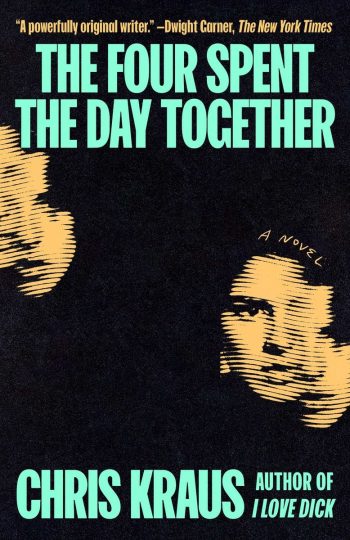
Catt Greene, the protagonist of Kraus’s latest novel The Four Spent the Day Together, also published a book called I Love Dick. Like Kraus’s book, Catt’s receives delayed acclaim, thanks in part to the rise of social media. Catt’s heightened profile, in addition to money and career opportunities, makes her vulnerable to attack—she finds herself being “canceled” and smeared across the internet for owning rental properties. Kraus writes, “Catt’s novels had always evolved from her life, but now her life seemed redundant to the grotesque image of her as a landlord.” So she decides to write about someone else. After reading front-page news coverage about a local murder—an assassination-style shooting on the same trail where she and her husband ride their bikes every summer—she finds her subject.
The Four Spent the Day Together is told in three parts, beginning with Catt’s childhood and adolescence in working-class Milford, Connecticut, following her into her adult years in Balsam, Minnesota with her husband Paul, a mental health clinician addicted to alcohol, and ending with her investigation into the murder of thirty-three year-old Brandon Halbach and the crime’s young perpetrators. The novel has been touted as Kraus’s take on true crime, and the truth is more interesting, complex, and terrifying than one murder. The Four Spent the Day Together examines the compounding chaos and consequences of a world overtaken by social media, noxious masculinity, corrupt political ideologies, and addiction.
Chris Kraus is the author of nine books and co-edits the revered independent press Semiotext(e) with Hedi El Kholti. She lives in Los Angeles. On a Friday morning in November I spoke with Kraus over Google Meet about her writing process and creative origin story, her rejection of the term “autofiction” as a descriptor for her work, the mechanics of her latest novel, and collaborating with Louise Bourgeois.
The Rumpus: Good morning. I admit I was a bit surprised when you said you wanted to meet at 8:30 your time. Do you normally take meetings this early?
Chris Kraus: This is late for me, I’m up by six.
Rumpus: What’s a typical day look like for you?
Kraus: It depends on what I’m doing. Right now I’m in the last wave of promoting The Four Spent the Day Together. Most of my days are spent doing paraprofessional things like interviews or podcasts or correspondence or blurbing peoples’ books. Every day I try to fit in something for myself that feels good, either a hike with my dog or a trip to the gym or work in the yard.
If I’m writing, my days look very different. I’ll block out time, and treat it almost like being in production for a film. Write every day, no less than four pages—or two, if it’s the first draft of a novel—and make sure that nothing else more exciting than writing is happening in the day. The atmosphere has to be tepid. But right now I’m catching up on all the real-life things that got put aside while I was touring—doctor appointments, paying my taxes.
Rumpus: You write, of Catt, “She had no writing practice. The only way she could do it was by default—the times when she was possessed by an idea too large and upsetting to formulate.” Does that apply to you as well?
Kraus: Yes, absolutely. There’s a very long gestation period for almost everything I write. I spend a long time thinking about a subject and reading related things before I start writing. I have a corkboard started for the project I want to do next, but I won’t really start writing until December. Once things get going, I’ll work for several hours every day. The rest of the time I just read, take a walk, or watch videos.
Rumpus: Where do you write—desk, bed, kitchen table? And do you have any rituals you enact to get into the right headspace?
Kraus: The material for my books often starts in my diaries, in fragments that later on I’ll find ways to expand. Diary writing happens in bed in longhand or sometimes in the car, on the couch. But once I’m working on a draft, it’s in my office, on the computer with the Wi-Fi turned off.
Rumpus: In press for The Four Spent the Day Together, you’ve spoken about Catt as if she’s yourself, or closely aligned to yourself. I see how fictionalizing your life makes Catt’s story larger, closer to readers, but can you speak more specifically, more granularly, about the choice to fictionalize versus memoir-ize your life and the process of doing so?
Kraus: I’ve never seen my novels as being about me. Catt is my avatar but I’m writing about the things, people, themes, and histories that are close and important to me, the things I know most intimately. I really can’t write about something until I know it on a very deep level. So I see Catt more as an observer, a stand-in for the reader. She’s the witness, the narrator, and her path is guiding the reader towards all these other lives, other material. I dislike the descriptor “memoir” intensely because my own life isn’t the point of these novels. It’s not autofiction; I’m not writing an autobiography. I’m writing about contemporary life.
I’m hardly the first person to do this! Look at Jack Kerouac’s books. He’s Sal Paradise in On the Road and Ray Smith in The Dharma Bums, but the narrator is only ever Jack Kerouac. Or Roberto Bolaño—he’s Arturo Belano in The Savage Detectives. Or closer to home, William Vollman. Simone de Beauvoir and Mary McCarthy both wrote roman à clefs with very large keys, everyone knew who everyone was! Or you could look all the way back to Moby-Dick. Melville’s account is completely informed by his own work as crew on a whaling ship. Actually Moby-Dick was an important influence for The Four Spent the Day Together: I went back and reread it while I was working on it.
Rumpus: What else were you reading while working on your novel? You’ve cited In Cold Blood and The Executioner’s Song as true crime influences. Are there books you continuously return to as inspiration for style, voice, et cetera?
Kraus: I always feel like I’m inhabiting the shells of other writers. If I’m writing something well I usually feel like I’m ventriloquizing other people and cannibalizing other writers. Another powerful influence for my book was Sinclair Lewis’s Main Street, an American classic published in 1920. It’s kind of a Madam Bovary of the prairie, about a mismatched couple. But it’s also about the development and the growth of the town. It covers such a big swath of time, from college years to old age in the lives of this couple. A book that covers such a big chunk of time has to become episodic, picaresque almost in terms of what you select. Main Street was an important influence in terms of realizing you have to select key scenes and link them in a poetic way.
Rumpus: Your novel opens with Catt as a child, finding part of a plastic sand pail buried in ice. She tells her father, “I found an ice toy!” and he replies, “A nice toy.” You write that at this moment Catt becomes attuned to “the elliptical meanings of words.” I also see her father trying to prettify and manage her language. What were your intentions with starting the novel here, with attention to language? And how do you see this moment reverberating throughout the other two sections of the book?
Kraus: That’s a really interesting question. There’s a seduction between Catt as a small child and Jasper, her father, that occurs almost entirely through language. The exchange and transfer of words is so intimate and sexual. And then of course language, stories, and literature were central to Catt’s family culture, even though they were all autodidacts. One of my goals in the book was to demonstrate the degeneration of literacy—which means the degeneration of thought—across three or four generations, from Catt’s parents in the Bronx to the kids on the Iron Range. By the third part of the book, which takes place in 2019, the kids barely have any language at all, it’s like intellectual poverty on the most cellular level. They communicate via DM’s on social media even when they’re together. During the kidnapping they were texting continuously. To me, this feels connected to the trajectory of American politics, and the disappearance of any sense of civic life or responsibility towards each other. Language is central to that.
Rumpus: Your writing about Catt’s teenage years is so palpable and vibrant. I found myself underlining several lines, lines like: “Smoking cigarettes and smashing the burnt meringue topping of a lemon pie with their two spoons, they were omnipotent. They felt like anything could happen.” Can you speak about your process of tapping into teenage feelings? Did you have old diaries or photos you turned to as portals?
Kraus: Yes, constantly—I was going through some old diaries yesterday and I found an early version of that scene that I started in 2013 in a diary. Adolescence is like a hallucination. I tried to access it somewhat in I Love Dick. Larry Clark does it brilliantly, and so does Catherine Hardwicke in her movie Thirteen. In that film the age “thirteen” is like a protracted hallucination. And then a cloud lifts and it’s over. I’m a million miles away from it now but I try tapping back into it.
Rumpus: One way your novel engages with the form of true crime is as a vehicle for illuminating Catt’s psyche, history, and obsessions. Can you speak about your interest in writing true crime this way, forefronting the investigator?
Kraus: Originally I thought about writing a straight-up nonfiction true crime book but I didn’t have enough material to do it on the level of In Cold Blood or The Executioner’s Song, as a literary book that accesses people’s internal lives, speech patterns, and dreams. The kids I talked to were helpful but they didn’t remember much. It was very hard to access their experience with any real intimacy. I knew the facts of their lives but I didn’t feel confident I could convey their experience deeply enough to write an entire nonfiction novel. So I decided to look back to how I came to be in northern Minnesota and hear about the crime in the first place, and that led me to writing the story of my then-partner’s struggles with addiction.
The cross-currents between generations and lives became very important to the novel. Paul Garcia, Catt’s husband, is working in northern Minnesota with teenagers in juvenile detention. And I wanted to convey how difficult that was—that the lives of the kids weren’t the only tragedy. There were also the lives of all the people up there who’ve been to grad school, working for very little, and trying to help them. Minnesota has a lot of resources and a lot of talented and idealistic people who are trying to make things better. But there’s a part of the population, these kids included, where the trauma just runs so deep that these resources fail to connect with them.
Rumpus: Bringing in Paul and Catt’s parents makes Catt’s investigation into the murder this bigger story about interpersonal chaos—and odious politics.
Kraus: It’s so important to look at the politics underneath the politics. The political pageant is just a theatrical manifestation of tensions that have existed for a long time. The complete failure of the Democratic party to recognize there is something profoundly and existentially wrong with the lives of the majority of Americans. The disconnection, the loneliness, the feeling of being completely left behind by globalization. It’s not just white rural America that feels it.
Rumpus: I’m thinking about the moment in the novel when Catt notes the absurdity of Hillary Clinton’s campaign trying to tout her as an “abuela.”
Kraus: So tone deaf. Just like all those prissy pious signs that went up during Covid in front of two million dollar houses, “All Are Welcome Here.”
Rumpus: I want to ask you a bit more about being an artist. You’ve worked in many mediums, notably as a filmmaker and playwright. When and how did you claim the identity of a writer?
Kraus: You can see from Part 1 of the novel, I was expected to become a writer. So obviously, I put that off for as long as possible! I worked as a full-time newspaper reporter in my late teens and early 20s but left it behind to move to New York and become an artist. Being a reporter was excellent training for being a writer because on some level, it’s all reporting.
The process of becoming a writer described in I Love Dick is just how it was. First, I started writing to Dick, then I started writing in my diary. And then I didn’t stop writing.
Rumpus: When you first moved to New York to pursue being an artist, what did that process look like? Did you have mentors or artists you looked to as models for the kind of life and career you wanted?
Kraus: I didn’t go to art school but I went to New York in the late ’70s, which is the same thing. I put myself around the people who were the most inspiring to me. I was studying acting but not traditional acting, not method acting. I was studying experimental theater with people from around the Performing Garage, the Wooster Group and a company called Mabou Mines.
There was no formal tuition, but I remember committing a crime to help one of my acting teachers pay her kid’s private school bill. It was the Traveler’s Check scam—an urban legend, but it worked really well. Before everyone had credit and debit cards, American Express sold Traveler’s Checks for people who didn’t want to carry a lot of cash on their trips. They were easy to cash at most stores because driver’s licenses still didn’t have photos and no one asked for photo ID. So, you’d have a friend buy maybe $3000 worth of Traveler’s Checks, catch the train to Philadelphia or New Haven, and spend them all very fast, buying the cheapest possible things in different stores, because the cashier would give you the change in actual cash. As soon as you’d finished spending the checks you’d call your friend and she’d report the checks stolen. Meanwhile, you’re on your way home with bags full of scented candles and mascara, and at least $2500 in cash. They never investigated below $3000 dollars, although I know someone who paid her entire New School tuition that way. They interviewed her several times but nothing stuck.
Rumpus: Brilliant.
Kraus: I was also a bicycle messenger and a topless dancer. And I did data entry late at night because it paid better. In my twenties, with a different body chemistry, everything was so much more passionate. It was viscerally exciting to be around certain people I idolized. Louise Bourgeois was an artist I fell into a relationship with. She was a great mentor.
Rumpus: You and Louise Bourgeois collaborated on a few projects, right?
Kraus: She was initially interested in my best friend Suzan Cooper, who she used as a kind of mascot. Suzan was a real hell-raiser, and she helped Louise bridge the gap between the sixty-five year-old woman she was and the East Village post-punk scene. Louise was a brilliant exemplar of so many things. She made posters for our performances and directed one of our plays but she was also a powerful influence. It took years to unpack but she helped us both, indirectly, in different ways.
Rumpus: You’ve experienced a lot of success in your career—what does success mean to you and has your understanding of it changed over time?
Kraus: When I had no access to anything—the time in my life described in I Love Dick and Torpor (Semiotext(e), 2015)—I looked at a career like Kathy Acker’s with great envy. But as I got closer to achieving notoriety, especially with the TV show based on I Love Dick, I realized I never wanted to be a character on a sitcom. The point of achieving any fame or notoriety is so that my writing can get to the people it needs to reach. And my hope in publishing The Four Spent the Day Together in a more mainstream way was to reach people outside the cultural hubs. Because the novel’s themes are so human and so universal—addiction, living alongside addiction, estrangement. And I feel like I’ve been able to do that to some degree. It was cool to be talking about it on NPR’s All Things Considered, where people could hear about it on their way home from work in their cars. I’m hoping the people who can get something from reading the book will find it.