
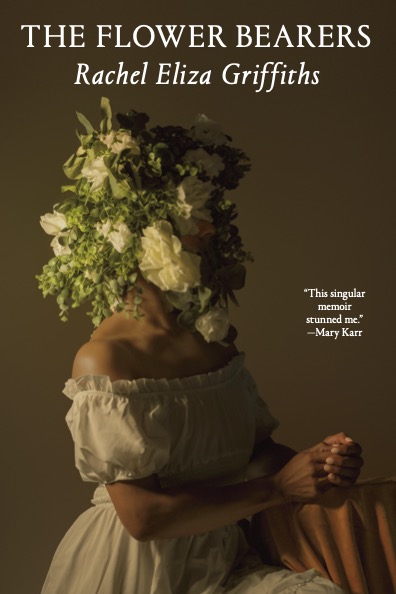
When Rachel Eliza Griffiths’ memoir The Flower Bearers (Random House, 2026) begins in September 2021, unease underlies the joyfulness of a wedding celebration. While Griffiths delights in having her hands decorated with henna and staying up chatting with her sister the night before her wedding to fellow writer Salman Rushdie, her closest friend and chosen sister, poet Kalimah Aisha Moon, has not arrived to participate in the festivities. It isn’t until after the ceremony that Griffiths learns that Moon suddenly died, and the discovery sends her spiraling into grief. Eleven months later, as she pieces together her life as a newlywed without her friend’s presence, an attack nearly kills Rushdie. During an appearance in Chautauqua, New York, the renowned writer sustained stab wounds to his face, neck, and torso, resulting in partial blindness and nerve damage.
Griffiths’ memoir is as much about commemorating her life before the compounding trauma as it is about starting over. Her lush prose stands as a memorial to the life of her dearest friend, who Griffiths calls Aisha, as they form their lives as queer Black women writers. She also chronicles the devotion that emerges between her and Rushdie as they rebuild their reality, from a month in an emergency ward to the transition to a new life Her book is a testament to the power of love, not just between two people but with oneself, a force capable of transforming the depths of heartbreaking grief into something new, profoundly changed, and worthy of fighting for.
Griffiths joined me by Zoom to discuss the importance of literary lineage, what marriage to a fellow writer is like, and how to know what to leave out.
The Rumpus: You are the author of five collections of poetry and a novel as well as a visual artist, so you are no stranger to self-expression. But I cannot think of more challenging subject matter for your first memoir, particularly as you were writing it only a few years after this portion of your life transpired. How did you decide that you needed to write this book?
Rachel Eliza Griffiths: I didn’t choose to write it. I wrote it almost against my will. I never had really been interested in writing memoir, although I love to read memoir and I admire memoirists. I was very safe in my poetry and novelist mode and my photography and painting mode. In 2021 and 2022, the loss of my dearest, closest sister and the attempted murder of my husband suddenly put me in the direct line of fire with a memoir. For a long time, I couldn’t put my experience into language. I was wrecked. I thought, “Well, I can write poems or I’ll write a novel about it.” And then it was the big pink wooly mammoth in the corner that said, “You have to pass through this. How could you write anything else without writing about this?” I was very reluctant, if not downright resistant. But then I realized that I wouldn’t be able to change as a person if I didn’t try and take a big risk. The space that helped me most was love, wanting to honor the love between myself and my sister, Aisha. Wanting that to be on the record, that relationship between two Black women, and also wanting to give my own perspective about what happened with Salman.
Rumpus: What was the writing process like for you?
Griffiths: It was awful. I sometimes thought I wasn’t going to be able to write this book, which was terrifying because I don’t usually feel that way. I remember a lot of times sliding out of the chair and lying on the floor, thinking, “I don’t have any more.” I felt like I was tying a rope around my body and leaping off a cliff. It was the kind of writing where I couldn’t talk about it or show it to friends. I don’t have closure from this book. I miss my friend. There’s some inner catharsis for me, but I would have preferred not to watch my husband fight for his life, and I wish that violence never happened to him. I tried to write to Aisha because I usually would have called her to talk about what was happening. I had little pieces of things that I didn’t want to lose, like my memories of her.
Rumpus: Friendship love often takes a backseat to romantic love in terms of subject matter. One of the most remarkable parts of this book is how we as the reader feel as if we are bearing witness to your friendship with Aisha, to the love you shared.
Griffiths: Writing about our friendship was the marrow that helped me get through the deepest parts. I could go back beyond the shock of the death, the shock of the loss, to the beginning. When I got in there, hours would fly by and I’d come out of my writing space and I would be smiling because I could see us. I could see how ambitious we were, how serious we were, how silly we were, how tender. How we mothered each other and sometimes how we challenged each other. Women’s lives, women’s stories, women’s friendship is the spine for me. If Salman hadn’t been attacked, I probably would have written a collection of poems for Aisha and used the genre that connected us most. But with the additional traumatic event, the duality bound them and it had to be a memoir.
I still remember meeting [Aisha] at Sarah Lawrence, and I was like, “Oh my God, I’m in love with this woman. We’re going to be friends.” A very deep loneliness in me shifted because I have this sister and I think that happened in certain ways for her. I love reading stories about relationships between women. I admire the risk it takes to offer that vulnerable and complex space and it deeply moves me. My intention in the memoir is to hold that up, to lift it high because if we hadn’t loved each other so beautifully, the grief wouldn’t have been so devastating.
Rumpus: How do you decide what to leave out in a memoir?
Griffiths: There are a lot of things that I couldn’t even put in the memoir. My dog died. A former student committed suicide. Once I had a draft, I could step back and some of what I do love in the writing process—revision and craft, and rewriting, rewriting, rewriting—could come and help me. Writing this book felt like using guerrilla tactics to get it onto the page. But once that happened, I had to make space for craft and not just have this trauma porn book.
Tomorrow, the physical copy will show up here and I will be in a crying ball on the floor because the person I would love most to call up and say, “My book is here,”—she’s not here. Hopefully, everyone who didn’t get the opportunity to love her and experience her will go find her poems. Then they can experience her, too.
Rumpus: As your relationship with Aisha develops in the book, you detail your literary lineage and how you both found inspiration in the works and lives of Lucille Clifton, James Baldwin, and Audre Lorde, among others. After Aisha’s death, you take a pilgrimage to Lorde’s and Alice Walker’s archives. What role has paying homage to these writers and having a literary lineage been for you?
Griffiths: It’s always been central in my life, even before meeting Aisha. Across genre, I bring past, present, and future into one space because I feel that’s how my body is organized. Historically, politically, as a queer Black woman, all these things are coming together in me. When I was young, I was probably too mature, which had to do with being like a parent as an eldest daughter. Now there are a lot of memes and gifs and conversations about eldest daughter syndrome and parentification, but it is true. When I was younger, I looked to these women as mothers who could raise me in a way my mother couldn’t.
When we were younger, it was part of [Aisha’s and my] education to place ourselves in spaces to learn, absorb, share, witness these phenomenal women. My first experience at Cave Canem was with Rita Dove and Lucille Clifton. It was great that I had someone that I didn’t have to explain it to, that it mattered to me. There is something useful for a writer to make the intention and take the time to go beyond the page, to engage with the very real aspects, which is the archives. To be at an archive and they bring out Audre Lorde’s hair, I was on the floor. Or to look at her journals in different colored pens and see her vulnerability, her pain, but also her devotion to her calling. I read the cancer journals, and I weep at the power. Aisha and I believed going to show us a map
of how to continue because it’s easier to surrender or easier to let the kind of external noise convince you that your voice doesn’t matter. I think of Audre’s line about it’s still better to speak even if you are afraid. It’s still better to speak.
Rumpus: Now that you are a few years removed from these profound, traumatic heartbreaks, how has your grief changed? How has the process of writing this book changed you?
Griffiths: I’m very different now. I had to change so much and put my life back together. I have to take time every day to deal with a complex trauma disorder. I really shut down after my husband’s tour for his book, Knife. That literally knocked my legs out from under me. I stopped walking. My body broke and I had to be carried around. I thought, “All of this can kill me. I’m going to have a heart attack. I will be the person who doesn’t wake up.”
I was fortunate to have therapists and healers. I love a good sound bath now, and I took a lot of breath work. I had to start all over, realizing the person I used to be, a lot of her died. That began a deliberate, intentional process of taking care of myself and loving myself and trying to remind myself that these two offenses are not my entire life. I’m probably stronger now than I’ve ever been, and that is allowing me to do interviews, to celebrate the book. I have to do movement every day. I’m into yoga and Pilates. I do dance and movement and I love it. I take ballet. I’m almost 50 years old, but no one cares. I have fun. I’m with 70-year-old ladies at the Alvin Ailey Center who have spiky purple hair and cool-ass leotards and we do our plies. I’m grinning the whole time like a child and I’m looking in the mirror and connecting with my body. I take time with my relationships. I sleep. There was a time that I had to take so many pills to get through the day. Now I’m not on any pills. I had to start from ashes and realize that it’s not too late. There’s so much ahead. I’m also grateful for the care so many people have shown me. I’ve always done that for others, but I would write it off like it didn’t matter. It does matter, especially in these times, it matters.
Healing is an in-progress action. It’s not like one day I’ll ever be healed or I’ll ever have closure. As I evolve, my grief, my healing, my love evolves. Sometimes when things come up that seem hard, I look backwards and think, “Look what you just came through. Are you really going to get upset about this thing or this person?” And I’m like, “Oh yeah, girl. No, I’m not doing that.”
Because of my dissociative disorder, I used to be very veiled. There are a lot of reasons, good, valid reasons for that. I was in survival mode for years. I was so terrified to ask for help because sometimes when trying to ask for help, I’d receive the response that this is too much—you’re too much. That’s been a refrain since I was a teenager. And now I know that I am too much, and I’m happy about it. I’m good with my too muchness.
Rumpus: The literary world doesn’t always value that kind of care and support. One of the most heartbreaking parts of the book is where you invite someone you hope will be a mentor to you into your home, only to have the person respond cruelly towards you. You follow this scene with a beautiful and raw depiction of what happens to your person after you receive the response.
Griffiths: When you’re young, those kinds of experiences happen and you ask, “What did I do wrong?” You’re silenced in every way, and you feel the shame of having to keep a secret. When I was a teacher, one of my core beliefs was that I would never, ever have a student walk away feeling this way. Never on my watch. When I was writing the memoir, I went back and forth. I thought, “Oh, my God, I don’t know if I can put this in here, I’m really putting in some tea.” Then, I realized, “No, it’s not even about who it is. It’s about what it did to you. You stopped writing for a long time, you were so devastated.” During the dissociative episode from that, I was in the woods on my knees like a dog. And I thought “I can never, ever allow any human being to do that to me.”
I would see that person at other times and literary events and I would freeze. I would be so triggered. But they weren’t. I wasn’t memorable. I was just one more person. And I realized, “Oh, it didn’t even matter. I had a blackout, but this person was fine.” When you’re younger, though, you don’t have context to put around it. As a writer, I knew that if I didn’t put that scene in, that would be disingenuous of me. Elder women would tell me stories of having old-school teachers treat them like filth and it affected their entire careers and perspectives about themselves. It mattered that another woman did it to me, that was what hurt me the most. Because we also could have just had a nice time and that person could have just said, “Hey, I’m really busy.” It really broke my spirit for a long time, but it seems like I’ve turned out okay. It’s important for people to know that those experiences happen.
Rumpus: How has being married to another writer affected your own work?
Griffiths: It’s really wonderful to have a partner who I don’t have to explain or justify or apologize to when I need to disappear. At the same time, if I want to talk about ideas, it’s reciprocal. He’ll say, “I’ve got a few pages, do you have time?” I feel like I would annoy certain friends of mine if I always wanted to talk about writing, but for us, it’s fun. We talk about books and then watch [the Apple TV show] Slow Horses and go have adventures. We laugh a lot. Our friendship is so special, and I think that’s because we’re not contemporaries in a certain way. We’re not similar writers and our backgrounds are very different.
I’ve been astonished to see someone whose heart stopped, who was almost dead, get up and write a whole-ass memoir, then turn around and have a short story collection come out. He is so full of vigor and curiosity. I married Salman, and a few months later, he was almost murdered. We got the hard stuff out of the way. We don’t take time for granted. There are a lot of things that have changed his physical body, what he can do, as well as what I can do with my stress, trauma and anxiety. We give each other space. We’re both quite independent. And at the same time, we’re always connected. I love hanging out with him, laughing and dreaming, going places and talking about writing—being immersed in the time that we have together for however long it is.