
Body modification practices have existed since the dawn of time—from foot bindings to piercings and tattooing to hair removal procedures. With the advent of GLP-1 medications like Ozempic and Monjauro, an increasing number of people are seizing the opportunity to “enhance” their appearance, or in some cases, to morph into someone new, someone almost unrecognizable.
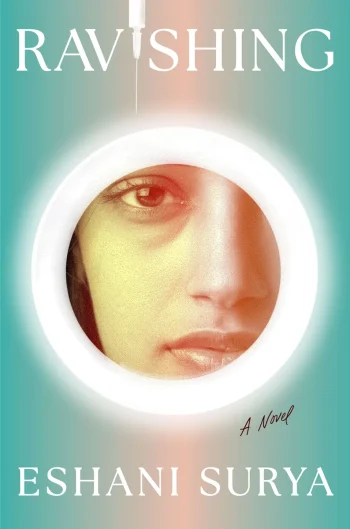
In Ravishing, Eshani Surya’s debut novel, readers are introduced to Kashmira, a teenage girl desperate to alter her face. For Kashmira, the issue isn’t simply a matter of beauty but one tied to her mental discord and emotional trauma. When she looks in the mirror, Kashmira sees the features of her abusive father lurking underneath the surface. Wanting to banish her father from her life, Kashmira decides to order ReNuLook cream, a new cosmetic product with cutting-edge nanoparticle technology that shifts a person’s appearance. This costly and in-demand item is hard to acquire, leading teenage girls and adults alike to brainstorm schemes to obtain it. As this magic bullet grows in popularity, a portion of users begin experiencing undesirable side effects. Surya’s novel investigates what people are willing to tolerate, at what price, and for how long to be the so-called best version of themselves.
Told in dual perspectives, this astute book explores the links between white beauty standards, wellness, mental health, and capitalism. In October, Eshani Surya and I communicated electronically to discuss these themes as well as her literary influences and what it means to be a writer living with chronic illness. This interview has been edited for length and clarity.
The Rumpus: What were the obsessions or fixations rattling in your brain when you decided to write this novel?
Eshani Surya: I like to say that a person’s debut novel likely includes all the things that they’ve been obsessed with and wanted to talk about in all the years prior to publication. Or, at least, that’s true for me. This is a book that’s about a lot of things, including, but not limited to: first, being diagnosed with and contending with chronic illness, and then how we understand beauty, complicated family dynamics, the aftereffects of trauma, the rise of technology, what’s the best way to take care of yourself and others, and the variety of ways that South Asians exist in American society. And, as my close ones know, these are the very topics that I continuously talk about.
I find writing about a wide variety of topics gratifying, though, as I’m interested in what brings those topics together. The linkages are the best part—but only after you write the whole thing and then discover what they are! And in that discovery, you really do learn something about yourself as a person. Because, of course, there are a million types of linkages a person could make between all these things, but what’s fascinating and gratifying to see is the ones you decide matter as the writer of this story.
In the case of Ravishing, I learned what I believe brought these pieces together: Everything that’s beautiful also has room for ugliness and everything that’s ugly also has room for beauty. We just have to figure out what it means to love it all.
Rumpus: One of the most consequential characters in the novel, Kashmira’s father, never appears in the flesh, only in memory. Did you know from the start that the character would act as a ghost?
Surya: I tend not to outline my work at the start, so what comes out can be a surprise. As I wrote the novel’s first draft, I uncovered the trauma that these characters had experienced with and because of their father. However, I wasn’t sure how present he needed to be.
When my editor, Roxane Gay, and I talked, I realized that this narrative required a more in-depth discussion of the grief. After all, this book is so directly about the impact of generational and individual trauma on the body, and readers need to understand what happened in the past in order to understand how it affects the present. In [later] drafts of the book, I included more memories about the father. This gave him more presence but also imitated the ways that in real life painful memories can interrupt the flow of life and sometimes take over.
There was some discussion at one point about having the father reappear in the second half of the book. Some readers felt that it would feel like catharsis to have him return. But that was precisely why I decided not to have him come back. We don’t always get a straightforward catharsis moment with trauma. Instead, we have to work with it, around it, in spite of it, to keep going.
Rumpus: When reading about the nanoparticle, the active agent, in the ReNuLook cream, I was impressed by your willingness to veer into the scientific realm. Did that element of the writing make you nervous, or did you undertake some research?
Surya: Oh, absolutely nervous! While the beauty product in this book is a vital component of the plot, it also allows for metaphors around trauma. Because of that, I came up with the idea of what I wanted the product to do before I came up with an idea for how the product would do it. So, I knew that I needed to investigate some recent technologies.
At the same time, I’ve always been interested in scientific research. I’m the type of chronically ill patient who will spend time reading medical papers (I’ve really enjoyed bonding with my gastroenterologist over his papers!), and the book draws from research that’s in-progress around trauma and chronic illness as well. When Roxane suggested I consider something like nanoparticles/nanotechnology as an underpinning to how the product worked, I got excited about looking into them more. And what I found is that these nanoparticles are very interesting, and have been used to improve medical imaging, improve drug delivery, and even aid in bone regeneration.
Of course, my version of nanoparticles is still fiction, but there are nonfictional ways that the nanoparticles we know in our world are able to affect the body in shocking ways. I felt that extrapolating them to a beauty product was a natural next step.
Rumpus: I’ve seen this novel labeled as literary fiction, suspense, and science fiction. Do you embrace the last two labels? Have those genres influenced you?
Surya: One of the reasons that I’ve allowed my book to exist in so many genre containers is because I’ve often felt like my own life is simultaneously a coming-of-age story, along with a surreal fabulist story, along with a medical drama, along with a sweet romance, along with—you get it. Basically, the way I write mirrors the way I exist: in multitude. Because of that, I really do appreciate any genre that anyone wants to put this book in! It’s a recognition of how I wanted to tell a wide-reaching story where the body, chronic illness, racial identity, and trauma can touch all the parts of a person’s way of being.
In terms of writing influences, absolutely genre fiction has helped me grow as a writer. I’ve learned a lot about worldbuilding by reading sci-fi/speculative and fantasy. I loved Michael Crichton growing up, and now appreciate authors like Octavia Butler, Emily St. John Mandel, R.F. Kuang, and Naomi Novik. These [writers] have also taught me a lot about plot, which I appreciate as a tool in my fiction toolbox, as I believe movement can create a lot of pleasure in a book. If a book is a question being asked, movement allows us to look at the question from a lot of angles.
Rumpus: It’s not often in contemporary fiction that readers come across an older brother as sensitive and loving as Nikhil. In many ways, he is the parent Kashmira never had. Do you feel the book is Kashmira’s story or half her story, half Nikhil’s?
Surya: One of the concepts I was really interested in while writing this book was “what’s inside versus what’s outside.” As someone who has an invisible illness, there are so many moments in my life where how I look doesn’t match up to what I feel. This is an experience that Kashmira also has in the book, but I wanted the idea to be present not only in the content of the book, but also in its structure.
There is a reading in which Nikhil represents “what’s outside,” as in he markets the product and creates its face. In this case, Kashmira represents “what’s inside” as she uses the product and experiences it in private. But there is also a reading in which Nikhil represents the “inside” as he knows the internal operations of how the product comes to be, whereas Kashmira—representing the “outside”—knows little of this and only buys into her manufactured perception of it. In this way, both characters inhabit themes of knowing and presenting. Their presences in the narrative are equally important to hold this structure up, and so I see the story as both of theirs.
Rumpus: When in the drafting process did Ozempic, Wegovy, and Mounjaro hit the scene, and did the shape-shifting qualities of those drugs influence any aspect of this book?
Surya: I came up with the initial idea for this book when I was in graduate school, around 2017 or so. At the time, it was a flash fiction and the product was an awful razor. While the piece was technically finished, I didn’t feel done with it, and I returned to it in 2020, after some complications with my ulcerative colitis, which led to two hospitalizations and the loss of all my hair. So, the first drafts were done prior to the GLP-1 boom.
I was revising and editing, though, when GLP-1s became more popular with the general public. And though the novel also isn’t explicitly about these drugs, there’s a resonance. Just like with the product in my book, there are questions about how the GLP-1s should be used and who should use them. There are also reported side effects that are tolerable to some and totally intolerable to others. We’re in a moment where body modification is becoming more common, and wellness and beauty have gotten tied together. Many people are trying to work through their relationship to what it means to be beautiful/well physically and mentally, which, of course, is a large part of what my book is interested in, too.
Rumpus: Along those same lines, I’m curious how being chronically ill informed your writing of this narrative.
Surya: There are two ways to answer this question, I think. The first is how being ill informed the content and structure of the book itself. In response to that, I’d say: I wrote this book deeply out of my own experiences with chronic illness diagnosis, treatment, and hospitalizations. The way in which Kashmira gets four parts to her story, in which she discovers her illness, denies it, experiences it at its worst, and then accepts it, is a mirror to my own life and I’m deeply grateful for the chance to share this story with the world. Writing it was an unburdening and an opportunity to explore how chronic illness has shaped my perspective and way of being. I’m hopeful that it resonates with others with chronic illness, while also being cognizant that there’s no one narrative that can encompass all the various experiences of being sick. But hopefully this narrative can create more opportunities for conversation and discussion.
The second way to answer this question is to consider how being ill informed the physical and mental process of writing the novel. Traditional writing advice often doesn’t work for disabled and chronically ill writers (see Sarah Fawn Montgomery’s essay in Essay Daily about the ableism writers face in all aspects of the literary world), and I’m bothered by advice like “sit your butt in your chair every day to write.” What’s a writer supposed to do when that’s physically impossible for them due to fatigue or brain fog or pain? Are they supposed to consider themselves a failure? In the process of writing early drafts of Ravishing, I ignored a lot of traditional advice. I learned to make manageable and flexible goals/deadlines for myself, and informed my agents about needing this accommodation, too. And even then, I couldn’t fully protect myself from the publishing process, which often stole my energy. Looking back on writing this book, I see both a creative and destructive process at play, which perhaps has informed its themes as well.
Rumpus: Speaking of chronic illness, this novel so accurately portrays the body as a sometimes uncooperative, imperfect but worthy house. I’m thinking of when Kashmira is prepping for a colonoscopy and feels filthy and in need of a shower. How did you decide how far to dial in the bodily descriptions?
Surya: As someone with a chronic illness that literally requires me to be aware of my own poop, it’s often difficult to recognize when a bodily description is “gross.” A lot of the writing I did about the imperfect body was simply the reality that I experience, and so it just came out on the page.
That being said, my editorial team and I did discuss these descriptions. For example, one of our conversations was how often to talk about using the bathroom. People with digestive illnesses (like Kashmira) have the repetitive experience of always needing to use the bathroom. I wanted that represented in the writing. But also, I wanted to tell other parts of the story of chronic illness, including the emotional experience of it and how it affects our relationships with others. In order to do this, I needed to make decisions about how much page space various aspects could take up. So, there were some places where I did cut those bathroom scenes in order to allow room for other equally important moments between the characters.
Similarly, we also talked about how “explicit” to get about body descriptions. My team understood the necessity of being honest to the experience of illness, so for the most part we were all in favor of keeping the descriptions in, even if they might be uncomfortable for abled readers.
Rumpus: Kashmira and Roshni’s relationship is one of my favorite book friendships of the last couple of years. Talk about your inspiration.
Surya: Oh, thank you! Their relationship came naturally to me, because I was drawing from my own teenage and college years. My friendships with other girls/women at that time were complicated. We were all learning to navigate the world and our emotions, which meant that we didn’t always know how to handle taking care of each other and loving each other wholly. At the same time, we knew that we did want to—did need to—take care of each other. This led to a lot of circumstances where we set out to coax each other into dangerous situations through some misguided sense of “togetherness.” I’ve found that a lot of those friendships haven’t lasted, unfortunately, as they were so volatile and intense.
Outside of my personal experience I’ve also found great models of complicated girlhood friendships in [novels by] Julie Buntin, Susan Choi, and Emma Cline. These authors have shown a great interest in showing readers how the pressures that girls are under can affect their relationship with each other, and that’s something I’ve done my best to emulate.
Rumpus: Ravishing deals with how internalized racism can manifest for some women of color. What do you hope readers will consider or learn while reading this novel?
Surya: As I’ve mentioned, the major theme in this novel is reconsidering definitions of ugliness and beauty, as well as creating space for both ugliness and beauty to exist—because that’s a step toward a better version of wellness. In terms of internalized racism, this may mean stepping away from definitions that white supremacy and capitalism provide women of color about physical, emotional, and cultural beauty/ugliness. It also may mean rethinking the definitions that our families, friends, and loved ones suggest to us, as their values may be rooted in different thinking than ours.
In short, we are allowed to create our own unique relationships to our history, our bodies, and our communities. We are also allowed to change those relationships as time passes or we acquire new information. And we are allowed to find joy in this exploration.
Rumpus: Kathak, a form of Indian classical dance, plays an important role in Kashmira and Roshni’s cultural and social lives. As a writer, do you have that sort of outlet that feeds your creativity or provides you with community?
Surya: Writing certainly has. The first thing I do when I move to a new city is figure out how I can plug into the writing community there. In New York and Tucson, much of that came through academia. In Philly, I was lucky enough to get hired at Blue Stoop, a local non-profit that brings writing to the community and beyond. That really allowed me to meet people and eventually join a wonderful writing group that meets monthly and discusses the wins and woes around creativity and publishing. I find that type of space very nourishing, and it often has led to breakthroughs when I’m stuck in a draft.
Outside of writing, though, I also enjoy going to visual art classes, usually for eight- or ten-week stints. I love thinking about how we can add color, form, and shading to our descriptive writing, and learning about how it’s done in a drawing or acrylics class opens that thinking up. Additionally, it helps ground me, both because of the physical nature of this artmaking, and because process is so starkly visible when creating visual art. Whenever I am in a visual art class, I become very aware of how ideas have to be revised and drafted, how often I’m using the eraser, how the last iteration differs in interesting but not necessarily better or worse ways than this iteration. [It] always reminds me art is about play and discovery.