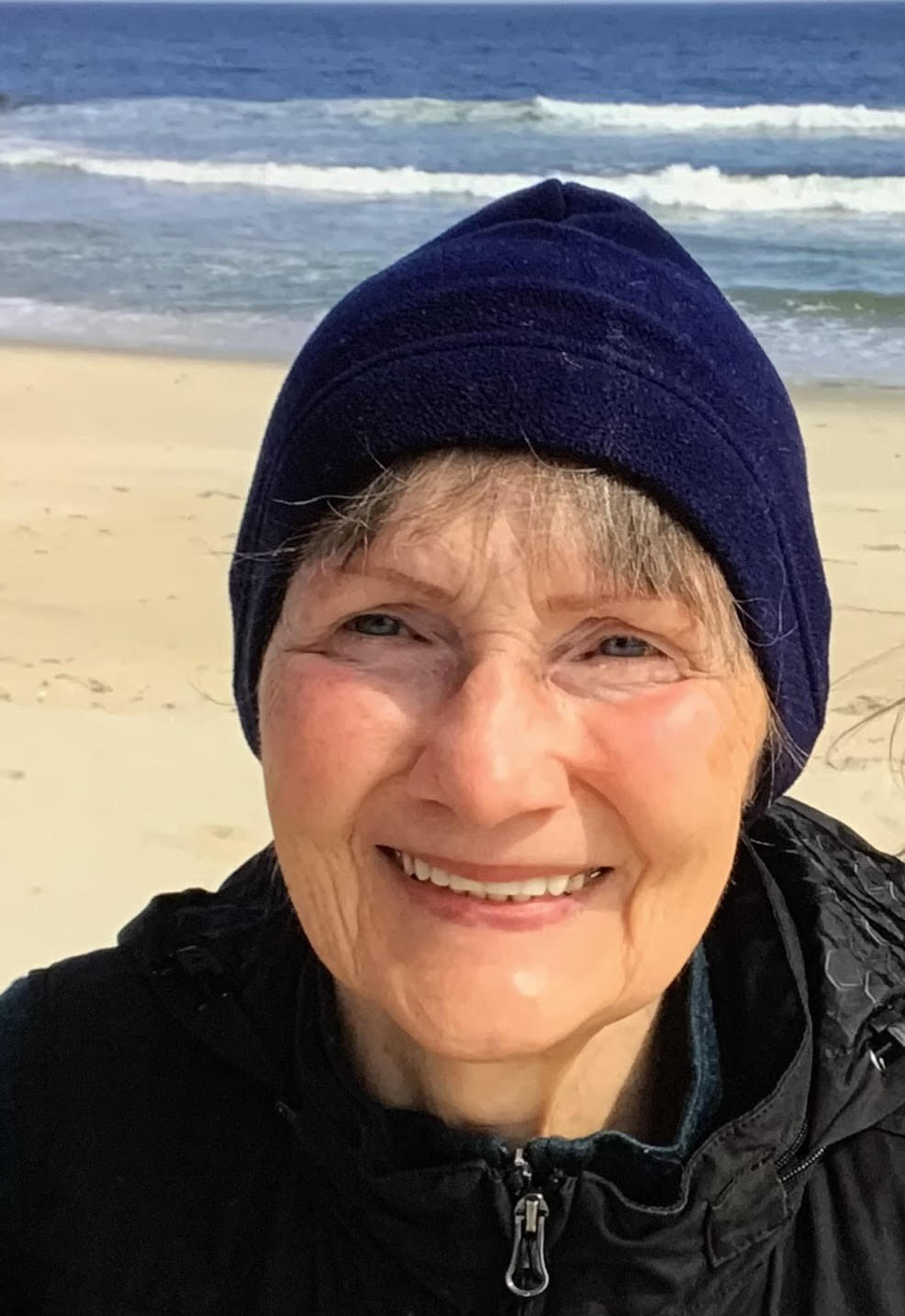
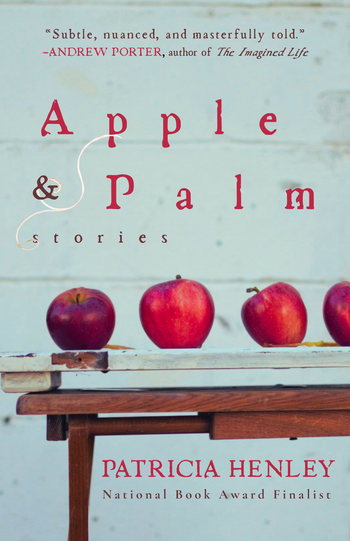
What came first, the character or the place? Novelist, poet, and playwright Patricia Henley’s just-published story collection, Apple & Palm immediately makes clear we’re in the hands of a master of the form. There are no shortcuts, no plot hacks or gimmicky tropes—each of the eight stories in this collection is as immersive and rich as a novel.
Linked by setting and character, Apple & Palm chronicles the private and public attractions, obsessions, reunions, crimes and misdemeanors of her vibrantly imagined, complex characters, who range in age from the centenarian Roxy to children still far from independence from their parents’ contentious households.
In an interview the author did for Novel Ideas: Contemporary Authors Share the Creative Process, she stated what she considers non-negotiable traits of a fiction writer, “A compassionate heart seems to me to be very, very important. A willingness to really look closely at human beings and their motivations and their foibles without judging them is really important.”
Perhaps best known for her novel Hummingbird House (reissued by Haywire Books in 2019), a National Book Award and a New Yorker Fiction Prize finalist, Henley is also an accomplished poet and playwright whose play, If I Hold My Tongue, was performed at the Kennedy Center in 2015. She is likewise a recipient of numerous awards and honors, including the Montana First Book Award and a Pushcart Prize, and her writing has appeared in The Best American Short Stories, Willow Springs, South Dakota Review, and many other publications.
I had the chance recently to correspond with Patricia Henley about Apple & Palm and the craft of fiction-writing via Google Docs.
The Rumpus: One of the great pleasures of reading this collection is how immersive and specific each story is. I’ve heard beginning writers say, “I didn’t include many details because I want everyone to be able to relate to this story.” Exactly the wrong way to go about it! Do you often begin a story with a specific image or detail about a character?
Patricia Henley: I usually begin with place. The elements of my sense of place, geography, the flora and fauna, the climate and seasons, the culture of work in a particular place, the leisure—all that—keep me grounded. I start with a place and add a character. I believe it was Barry Lopez who wrote that landscape shapes mindscape. Where we are shapes who we become. It’s the details that engage readers emotionally and allow them to enter fully into the world the writer has created.
Rumpus: Most of the stories in Apple & Palm are set in Whistle Pig, a small town in the Appalachian region of Maryland. Some of your characters have left for bigger cities such as Chicago, but are drawn back for various reasons. Others have lived there much, if not all, their lives. I see that whistle pig is slang for groundhog and it’s also a brand of whiskey. What is your Whistle Pig based on?
Henley: I don’t like driving. I’m often a passenger in a car and that gives me the chance to take note of the names of roads and streets. For several years, while riding through a remote area in Allegany County, Maryland, I’d spy a narrow street named Whistle Pig. I’m sort of fascinated by the choices people make when naming roads. It stuck with me. I decided it might as well be a small town, too. Whistle Pig is not based on a particular town. It is a work of fiction.
Although I love cities, and have my favorites, I seem to be pulled inexorably to small towns and rural places. I wanted to write about the small-town people I knew and loved, not the stereotypes. Philip Roth said that fiction is the exploration of private lives. And I saw the small town people I knew having creative, authentic, exploratory inner and outer lives.
Rumpus: Your characters are filled with desire for friendship, sex, and beauty, and in some cases, regret and nostalgia too. Aging and memory are also central themes. Would you share a little about what motivated you to explore these subjects?
Henley: Many years ago I asked the poet Gerald Stern what the difference was between being his age and my age. I think I was around forty and he was almost sixty. He said, “I live in memory more.” I stole that line for one of the stories, in fact. I’m there now, almost two decades past sixty. I’m a woman of a certain age, as some people like to call it, a crone. Hence, my memories are plentiful and worth diving into. I’ve lived a full life. And about regret: it’s always there, lurking. I poke it like a bear. It’s more powerful than I am. But once in a while I can befriend it, make sense of it, by writing.
Aging is a ubiquitous topic among people I know. I think perhaps we discuss it more readily with friends who are experiencing aging, figuring it out, weighing our options, maintaining agency. I can’t speak for other writers, but I have written fiction that explores the particular concerns of my age. In my thirties, I wrote often about romantic connections and relationships; in my forties, I was concerned with family life, both past and present. In my fifties, I realized that my wider concerns could be incorporated into fiction. I wrote the novel Hummingbird House, about the lives of women and children in wartime in Central America.
Rumpus: The centenarian Roxy in “Currency” and her granddaughter-in-law Lulu, for example, are more like girlfriends than elder and child. Roxy subverts societal stereotypes of older women, i.e. that they don’t have a lusty appetite for life, carnal or otherwise. Are any of your characters based on family or friends or people you don’t know but admire? And whether or not that’s the case, do you occasionally fictionalize real people and events?
Henley: I’ve been writing for over fifty years and I always try to follow the advice of Henry James: Be the kind of person on whom nothing is lost. Maybe it comes from growing up with trauma and being hyper-vigilant, always alert to trouble, signals, unspoken signs. It is a writerly habit to notice all the small and large things that comprise characters or potential characters.
By the time they reach the page, I may not even recall the source of a snippet of dialogue or a gesture or a bit of clothing. A tiny detail might come from sixty years ago. My characters tend to be amalgams of all I have observed in the world, with a generous dose of imagination folded into the mix.
Rumpus: Jill Zebrak, orchard owner and longtime Whistle Pig resident, appears in or is mentioned in many of the stories in Apple & Palm. Elizabeth Strout’s Olive Kitteridge came to mind as I read—both how Jill and Olive K. share a few personality traits and how Jill struck me as your book’s presiding spirit, i.e. on the periphery when she’s not central to the story. Was Strout’s Olive an inspiration and what were others—books, films, other media?
Henley: I did not intend, at the start, for Jill to be the presiding spirit of this collection. But she kept resurfacing. She made the decision early in her life to accept her asexuality and fly solo, without a romantic partner.
Questions about sex and gender expectations are in dispute for some of the characters in Apple & Palm. The women in Jill’s orbit intuitively understand that Jill fully owns who she is. Without being entirely aware, some of these characters yearn to be strong like Jill. I saw a meme recently that purported to quote Margaret Atwood, I say “purported” because who knows these days whether quotes are accurate. Supposedly, Margaret Atwood said or wrote that the desire to be loved is the last illusion. Once that goes, you are free. That’s Jill Zebrak. She is a north star guiding the other women, even when they resent that.
As for books, films, media—we don’t have to go far these days to read a news feature or a post on social media that depicts women questioning the role of romantic love in their lives. It’s in the air we breathe. I admire the brilliant Melissa Febos and the books she has written about desire. Febos writes in The Dry Season: “… I craved time. I wanted more time to write, to dance, to sleep, to read, to meditate, to exercise. I marveled at people who had hobbies. It’s hard to have a hobby while juggling multiple obsessions.”
Jill, in Apple & Palm, decided long ago to eschew the obsessions of desire, love, lust, attachment—all the drama. Doris Lessing once wrote that love has turned into a kind of illness, a madness that destroys everything else. I hope this collection will be part of that public conversation.
Rumpus: The Lessing quote mentioned above certainly is borne out in the title story when Jill comes to the rescue of three young girls who lose their mother and father suddenly and violently. Would you say more about this, specifically in regard to the posts you mention above made by older women?
Henley: Jill is free. In “What Goes Around,” she is free to offer shelter to her niece Harper who is recovering from a disfiguring car accident. In “Apple & Palm,” she doesn’t hesitate to take in the three girls who have lost their parents. She doesn’t have to negotiate it with a partner. She doesn’t have to persuade someone else to agree to open a home they share.
That’s what living solo is partly about. If you are straight, you don’t privilege a man over others. There is no man constricting Jill’s life, making it smaller. I’m not saying that flying solo is the right decision for all women of a certain age. I’m saying that it’s not a choice to denigrate; it’s a choice to be honored when a woman chooses it. You can be whole without a romantic partner.
Rumpus: Art and artists are plentiful in Apple & Palm. Roxy lives in a building, the Tansy, with other women artists, and the ladies’ man Jack Norman, whose ties to Roxy I won’t give away, is a painter. Other characters make art or work with their hands. When starting a story, are POV characters’ trades often front of mind?
Henley: Once in the eighties, while visiting friends in Iowa City, I was introduced to Frank Conroy, who directed The Iowa Writers Workshop from 1987 until 2005. Stacked on a long coffee table in his office were hundreds of applications to the workshop—piles of ambition and appeal. And Frank told me, “There’s something missing from most of these writing samples. And that something is work. Writers neglect the work lives of their characters.” I never forgot that. Jack Kerouac had a sign above his desk that read: Work, Love, Suffer. Work is central to our lives, whether you are a bartender at a casino like Lulu or whether you teach high school English or whether you are a potter like Adele Pratt or whether, like Mike Bosko, you have made a living from illicit activities. Whatever you do. It’s central to identity. And the search for identity and the recognition of identity markers is key to writing memorable stories.
Rumpus: You’ve published several acclaimed story collections and novels, and presumably are comfortable moving between the two forms (along with poetry and nonfiction). Do you prefer the short story to the novel, however?
Henley: To commit to a novel, it needs to be a story that I feel called to tell. I need to be motivated by a passionate curiosity. With Hummingbird House it was the demise of the Mayan people and the lives of women and children in wartime. With In the River Sweet (Anchor Books, 2004), a novel set partly in Vietnam, I wanted to write about a woman who had a long-held secret that was finally coming to light, and I wanted a political backdrop because that allowed for several lines of tension. I enjoyed doing research in Vietnam and Guatemala for these books.
Writing short stories feels like sculpting a clearly defined head out of clay. It’s visible right in front of me. It is a finely made object that may be completed in a few weeks or months.
When asked by a student what she did, when she couldn’t write, Grace Paley said, “I visit my sister.” I loved her answer. It epitomizes the short story lifestyle. A novel requires enormous patience and diligence over the long haul.
Rumpus: Over the last few decades, you’ve taught and mentored many fledgling writers. How has teaching creative writing informed your own work?
Henley: When I started teaching creative writing, there weren’t many craft books and certainly little mentoring done by more experienced teachers. It was necessary to interrogate my own work and process and to closely examine the work of writers I admired. I figured out what was most important to me as a writer, elements such as place, depth of character, specificity of details, internal arguments my characters are having with themselves, to name a few, and I discovered language I needed to break down those skills for students.
Finding the language for craft allowed me to move beyond writing solely guided by intuition. I loved teaching and still teach the occasional workshop. To last in teaching and feel good about it, I think you need an abiding interest in the growth of other people, and that is a gift that’s inhabited my psyche for a long time. Maybe because I grew up the eldest of eight children. I’m lucky.
Rumpus: Beginning writers often want to leap into novel-writing rather than learning how to write short stories where character rather than plot is often foregrounded. Do you encourage some, if not all, of your students to start with stories, even if the novel is the more respected form, deservedly or not?
Henley: There’s so much to learn from short stories and they are more readily adapted to the typical workshop schedule. If a story goes awry, it’s easier for the writer to put it away or delete it. I always tell students, “There’s more where that came from.”
A successful story is more likely to be written in the course of a year-long workshop. But working on a novel before you have developed some basic notions of craft can make you feel as if you have failed and wasted time if the project ultimately doesn’t work. Voice of experience here.
Rumpus: Please describe your revision process for a short story. Do you use different tools or techniques with short fiction than you do when revising a novel?
Henley: I will sometimes hang on to a draft of a short story for months or longer before I have the feeling it’s finished. The sentences may be lovely; the characters may seem genuine; there may be inherent tension. But something is missing. To find its final form, I sometimes wait until a larger context for the story arises intuitively. This was true with “Pivot” in Apple & Palm.
The story was solely GT Diggs’s story of the losses he’d recently experienced and his return to family life. I wanted there to be another layer. Eventually I settled on the first person voice of Fiona, a massage therapist, as she is giving GT, her friend, a massage. He needs to confide in someone. He hasn’t a clue, really, that she harbored an attraction to him when they were younger. This adds another line of tension or suspense to the story.
Rumpus: You’ve been writing and publishing short stories with distinction for many years, but is there an element you still find yourself wrestling with as often as not when writing a new story—point of view, the balance of scene and summary, time?
Henley: The question of time is one that needs to be resolved early on. How much time in the life of the characters will the story cover? The shorter the time span, the easier it is to write, perhaps. But I’m keenly interested in how the past informs the present, like a therapist, I suppose. Students are frequently advised to keep the story in a present time storyline.
A better rule is this: If you switch time frames, make sure there’s sufficient tension in each time frame. For that tenet I can thank Rust Hills, former fiction editor of Esquire and author of the craft book Writing in General and the Short Story in Particular. Figuring out the role of the past, and then figuring out how to economically reveal it—that is always a challenge.
Rumpus: What are you working on now if you don’t mind sharing a few words about it?
Henley: I am at the start of developing stories set in my new locale, the Seattle region, and the Kitsap Peninsula. There’s so much to learn about the subcultures and history. A couple of characters have come knocking at my door. I’m listening to them. But getting the new book—Apple & Palm—into bookstores and into the hands of readers takes time and energy. With a university press book or a small press book, it takes a village.