
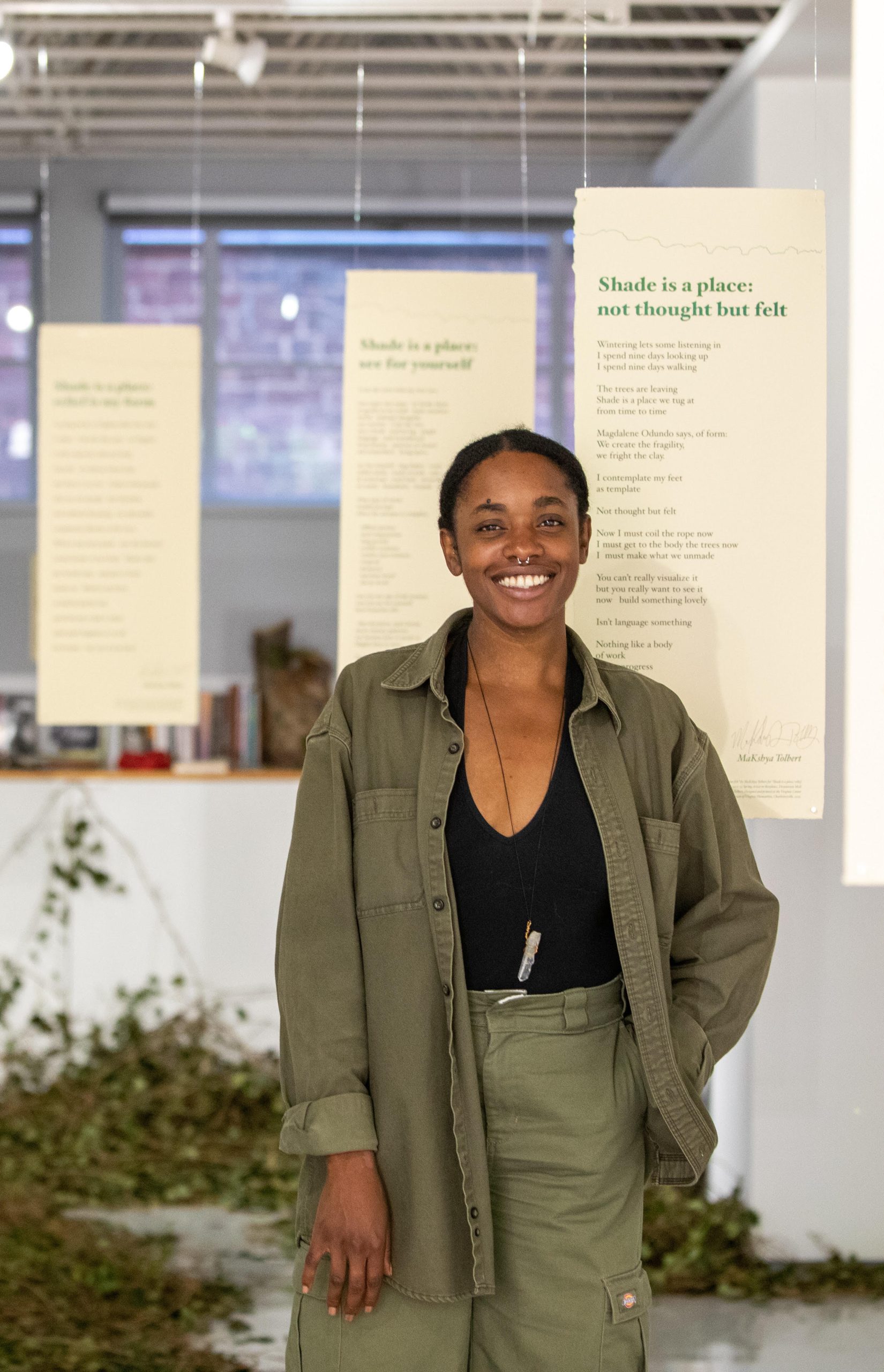
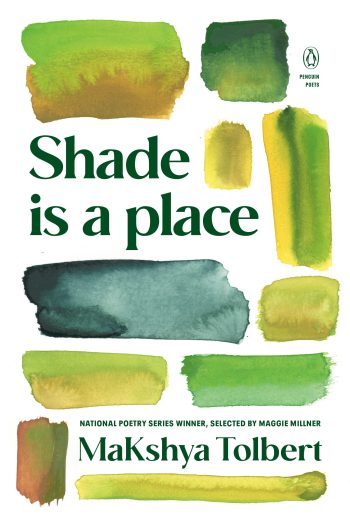
In Shade is a place, MaKshya Tolbert draws us into the environment with perceptiveness and mindfulness, and asks us to pay attention to the world around us. Written during her time serving on the Charlottesville Tree Commission, this debut poetry collection was inspired by the arboreal and design history of the city’s Downtown Mall as well as Tolbert’s interest in ecological inquiry. A “brave” advisor once told them to “quiet down and write the work” so they would have something to talk about. The work has been done, and I’m simply thrilled to have been on the other side of waiting, reading, and finally getting to talk about this brilliant collection, winner of the National Poetry Series.
Tolbert and I communicated over email about the role of ecopoetry, the practice of tree walking, and the capacity of language to hold admissions of fear, failures, and resentment.
The Rumpus: I was struck by your connection to the natural world and the way your writing takes on an environmental urgency. What is your earliest memory of paying attention to trees, of being lost in them, and growing in arboreal wonder?
MaKshya Tolbert: In my earliest memory with trees, it’s not wonder so much as worry that comes to mind. I went to trees to be alone, to try to make sense of what I didn’t understand. I think I was under them, crying. My memory of being a child is hazy, but I don’t remember playing in trees, or even looking up at them. When I was looking up at them in anything like wonder, I imagine I was asking for things to be different: wondering how long that might take, wondering where my parents were. It means so much to be here talking with you, honoring how much has and has not changed about my motivational forces. But I can say my earliest memory of arboreal wonder was in 2018 when I learned the basics of fruit tree pruning. My teacher introduced us to pruning as a practice committed to “the reclamation of form.” I would circle trees and practice seeing their integrity. And when Lyric, a dear friend, died that summer, trees gave me something to do with my hands. The wonder is new, and makes me so glad for the things that change.
Rumpus: That’s quite a beautiful way to rethink the practice of pruning. When I hear the word “shade,” I think of refuge, covering, safety, shelter. What does the word mean to you? And can you share with me some delights of being a shade walker?
Tolbert: What shade means to me is, as I experience it, constantly in flux. When I first began setting out towards “shade studies,” shade was an incitement for relief. I was compelled toward shade as in a propensity for ease, breath, for some way to loosen the grip–if I could see it? Where was that, where was that place where I could set down the grip, or loosen my fists? It was and remains a riddle, in that sense: the more I embody and practice ecological inquiry, the more shade and its phenomenology morphs out before me. Shade was an invitation to put my attention somewhere vigorous–albeit transient–when I couldn’t put that attention on myself, or on my then-waning appetite. In some ways, it was a place with integrity where I could put my attention when I couldn’t extend that attention onto myself. In terms of shade walking: the desire and the delight is being with each other, with making room for more of us. Shade has been a form of grace, which shows itself in both the walks and the poems that attempt to both archive and blueprint those walks.
Rumpus: The collection is strongly grounded in the town of Charlottesville with a focus on the Downtown Mall designed by Lawrence Halprin and Associates in 1973. Can you describe this movement and what drew your attention to it?
Tolbert: After I began following shade and its properties, which lent itself to my studying entanglements between shade and property, I couldn’t look away from the city’s history of urban renewal, or “negro removal,” as James Baldwin called it. The 1960 vote by white residents of Charlottesville to raze the homes of 158 families across the Vinegar Hill neighborhood (which Black residents could not cast votes to prevent, due to then active poll taxes) led to the displacement of 500 people, and over 30 businesses including “five restaurants, four grocery stores, three barbershops, two furniture stores, an appliance store, a music shop, a shoe repair shop, a jewelry store, a taxicab stand, a tailor shop, a drugstore, an office equipment store, a printing shop, a dry-cleaning firm, a laundromat, a hat-cleaning shop, a gas station, and two second-hand and antique shops,” (Vinegar Hill Magazine). After that, the city left the tract vacant for twelve years, before a tense vote in which the majority of city council members decided to recuse their individual votes. I couldn’t stop looking at the mall’s willow oaks and its traces, at the development projects that emerged out of the city’s displacement projects. The resentment–my own–both stifled and sprouted new questions about placemaking, about the precarity of what’s possible.
Rumpus: In the poem “Cuttings from Jena, Louisiana” you write about Jena Six, a group of Black teenagers who had been charged with attempted murder in the beating of a white classmate in 2006. What I see here is poetry as resistance, as documentation, as politics.
Tolbert: The events in Jena, Louisiana, were the entry point for Shade is a place. A Black teenager asked his principal that August if he could sit under a white oak tree, and was told he could sit where he liked. The next morning, nooses were hanging from the tree, and a fight broke out between Black and White teenagers. The Black children were accused of attempted murder, the tree was cut down, and what began as seeking relief ended in punishment and trauma for those children. I think you’re right that I sought out to do many things, among them shifting my attention so I might look differently at what was before me. Because Kimberly Ruffin chose to begin her book, Black on Earth, with a recollection of the “Jena Six,” and because my professor Brian Teare chose to assign it, I was put in an incredible position to be both humbled and led by a poetics of shade. I think poetry is always an opportunity to attend to what it is to live only for a time. I believe that poetry–perhaps like “attention”–is in part a manifestation of one’s inner environment, for better and worse. The questions that move through me and toward poetic form are various iterations of looking for breath, for answers to “How will I live?”, for ways back to the earth and closer to each other. It’s become an instrument for me to measure the density–this clear quality of thickness–of our aliveness.
Rumpus: “Letter from an arbor in my mind” and “Tree walk with worry” points out our lack of attention, our failures to see what’s happening all around, what you call “accidental violence.” What role do you believe ecopoetry plays in shifting our gaze and insisting that we practice noticing?
Tolbert: I’m grateful that you found something to come back to in those poems, which are both poems where I admit my own capacity to disappoint others, perhaps even myself. Can we disappoint trees? Those poems come out of a time when trees structured my sense of practice: I could look up and look down at them amid my refusal to look at myself. I wrote about feeling “beholden to accidental violence” to account for the brief moment where I didn’t recognize what was happening, i.e. why the willow oaks were losing so much of their bark at the same spot. When I came to see–with help–that the heat lamps which warm us while we dine outside were burning the bark off trees, I had to mourn my role, and my lack of attention. I think the accidents ceased there. And also gave me a wider space to consider what ecological inquiry and poetics could look like across these “shade studies.” Ecopoetry’s role keeps changing for me, is as much in flux as I am. I wonder if one role of ecopoetry can be to mark that flux, to find a language that honors the transience and ongoingness of the environment, and our lives, so embedded into the environment. Whether we honor the intimacy, or not, my own noticing keeps taking turns. When I began the book, I thought so much about mimicry, about trying to be more tree-like; especially when I was terrified of being “myself,” which I could barely hear. Now, I wonder what it means to mimic our environments given our own fundamental belonging to them. Being made up of much of the same things, the same stresses, the shared air. Ecopoetry offers a method for inquiry and for what it is to be in the midst of things.
Rumpus: I want to circle back to the phrase “tree walk.” I came across it many times as I read. I imagined taking a walk in a place surrounded by trees or to walk in search of trees. And perhaps there’s a kind of close attention to one’s natural world than usual. Am I close? Is this something you do often? What have you learned on your tree walks? How have they changed you, if at all?
Tolbert: You’re as close as I am. I really mean that. Sometimes a tree walk looked like walking the three blocks to the Downtown Mall; other times it was a walk along the mall’s trees themselves. What I loved about them was that they changed; perhaps that’s why the book has multiple Shade is a place title poems. That, and I’m greedy. But Tryphena, thanks for this question, which is helping me find a language to talk about practice. And about the many tree walks I took which were both a form of practice as much as excursions themselves. I have been loving the word’s etymology, which points at both “running out or forth,” and also at “extension.” I’m drawn to the word’s animacy, and to its length, you could say. The tree walks were opportunities to step out of my apartment–really, out of my resentment–and to push myself just beyond my comfort zone. I was also mid-residency at New City Arts–my heart outside of my literal heart–where I’d tasked myself with “embodying my writing,” to try to find the capacity for togetherness or intimacy or even for myself in the work. It was one of the few things that stimulated my appetite, when I let it. I’m beholden to the people who made sure I stopped walking, at some point. The loved ones who helped me to eat and sleep.
Rumpus: I am curious to hear about your approach to writing the haibun, “Shade walk.” It was my first time coming across this form, and there is something about the blend of prose and poetry as well as the intimate voice of the speaker that makes it a truly striking piece.
Tolbert: The two continuous haibun in this book that make up its second and fourth sections were a listening experiment. Between the differing work of management and care, when it came to the mall’s turning willow oaks and to these poems, I looked for a form that could be both attentive and also wander, could be a bit wayward, and could change as it goes. Poet Nathaniel Mackey reflects on the long poem too, and talks often about his “Song of the Andoumboulou” as a “rough draft of a human being, the rough draft we continue to be.” Sitting with my capacity for ecological care and ecological violence, I was drawn to this roughness, to the sense of revision and practice I felt was in the fabric of Mackey’s “Andoumboulou,” and maybe in me. This might be when I began thinking about duration, and about writing a poem that took its time, that wasn’t over until the reader made their way from one end of the mall to the other, walking along the shade. I was attempting to write at shade’s pace–shade’s changing pace–and found myself trailing Fred Moten’s inquiry about Renee Gladman’s moving sentences: “is there refuge in a sentence?” And how far or for how long would I go looking? Like I asked in one “shade walk:” How much would you pay for relief?
I was drawn to Bashō’s senses of place and movement, to his insistence that if one wants “to learn about pine trees, go to the pine tree; to learn of the bamboo, go to the bamboo.” I wanted to move at the pace of ecological attention and self-inquiry, and wondered if the ambition, patience, and process of writing long poems could take my full attention for a while.
Rumpus: In the poem “[Shade walk,]” the speaker admits feeling fear in writing “Shade is a place.” Did you feel it, too, in putting together this collection? What made it easier to show up page after page, despite how you felt?
Tolbert: Shade is a place begins with an Amiri Baraka epigraph, from his poem, “The Liar”:
What I thought was love
in me, I find a thousand instances
as fear. (Of the tree’s shadow
winding
I needed Baraka’s courage to take a step back and start to see the motivational world where my discernment and decisions came from—where they were taking me. That was massively challenging, and heartbreaking. Like Halprin, my projects were full of emotional failures, failures of care; I was starting to see differently: to see the fear, the anger, the resentment, the patterns (my own). I had a language and it was structurally coming together as a book of poems but it also hurt, a little… The fear was always there, always asking me for more or at least to look at it.
This reminds me of your question about my tree walks, and how they’ve changed me, which feels clearer as I think about what happened when I admitted the fear, when I could take a deeper look at myself. On my walks and in my writing, my attention kept changing. What I learned and what made it easier are making me think right now of my relationships, and my heart. I learned and keep learning just how much my heart–its porousness–dictates my attention, ecological and otherwise. My first year of walking, all I saw were problems: problems in trees, problems in me–that’s what I saw. I think I was driven then more by worry than by curiosity (as “Tree Walk with worry” knows). My tree walks teach me just how much the stories I was telling myself dictated my experience of the earth, of you, and of each other. They have been teaching me to try loosening the grip so I can let more in.
Rumpus: Throughout the collection, trees are linked to people: A mother returns as ivy. Woods are autopsied. Trees go missing. Willow oaks are weary. Leaves have scars. Shade undresses. I would love to hear about your intention with language in these poems and how you wield it as a tool to have people re-see and re-think environments that seem so familiar to them.
Tolbert: It’s been nice thinking about these poems as linked to each other, through your question. The etymology of the word link refers to a series of rings, and seems chain-like; eventually the word breaks down as having come from the PIE root *kleng- “to bend, turn.” I’m intrigued by the knot(s) these poems make among each other, and by the turns not only within the poems and from one poem to another, but also the ongoing and turning material states of trees—ivy, and even one’s own inner life embedded into the linkages. So many of our stresses are the same–humans and trees–and I was curious about cultivating the discipline and also the humility to take a clearer look at some of these shared stresses and shared needs.
I was really unwell while writing the poems you’re brave to mention, and was refusing myself food, light, and water in many forms. And there I am, in my own furious exhaustion, looking at trees not necessarily having their needs met either. I saw in language the capacity to wield some amount of control over my environment, and to what end? Will I use the words to hide or to live? To see problems or see practice? And meanwhile, as the “ivygrown” poems attempt to express, tendrils and trees and the appetites of others seemed to find their strides before I could. I also wanted to admit (at least to myself, so I could write these poems) that there were moments where ecological attention and my own inner life blurred into each other, for the fearful. I couldn’t understand my own projections into the environment. Revision was a place where I could try to step back and take note of what I was noticing, and slow down the stories I was telling myself.
I think a lot of the language in these poems is about admission: of my failures, of the resentment, of trying to provision something akin to shade equity while failing to take care of myself. I struggled constantly with Shade is a place, wondering… “How do I get back to myself, to my family, to my heart? Can a poem take you home?” I felt like language in these poems was a way to consent to be rearranged by my environment, again and again. And when I couldn’t look at my changing self, what could I look at? I could look up and down at these stands of willow oaks and let little parts of my heart break, as the “ivygrown” poems let in, a bit. I link trees to give way to them, and also to admit I need something from them, even if something I barely understand. And the distances between us and them–in form and in language–confounds me day after day and makes space for this project of poems.


Click here to subscribe today and leave your comment, or log in if you’re already a paid subscriber.