
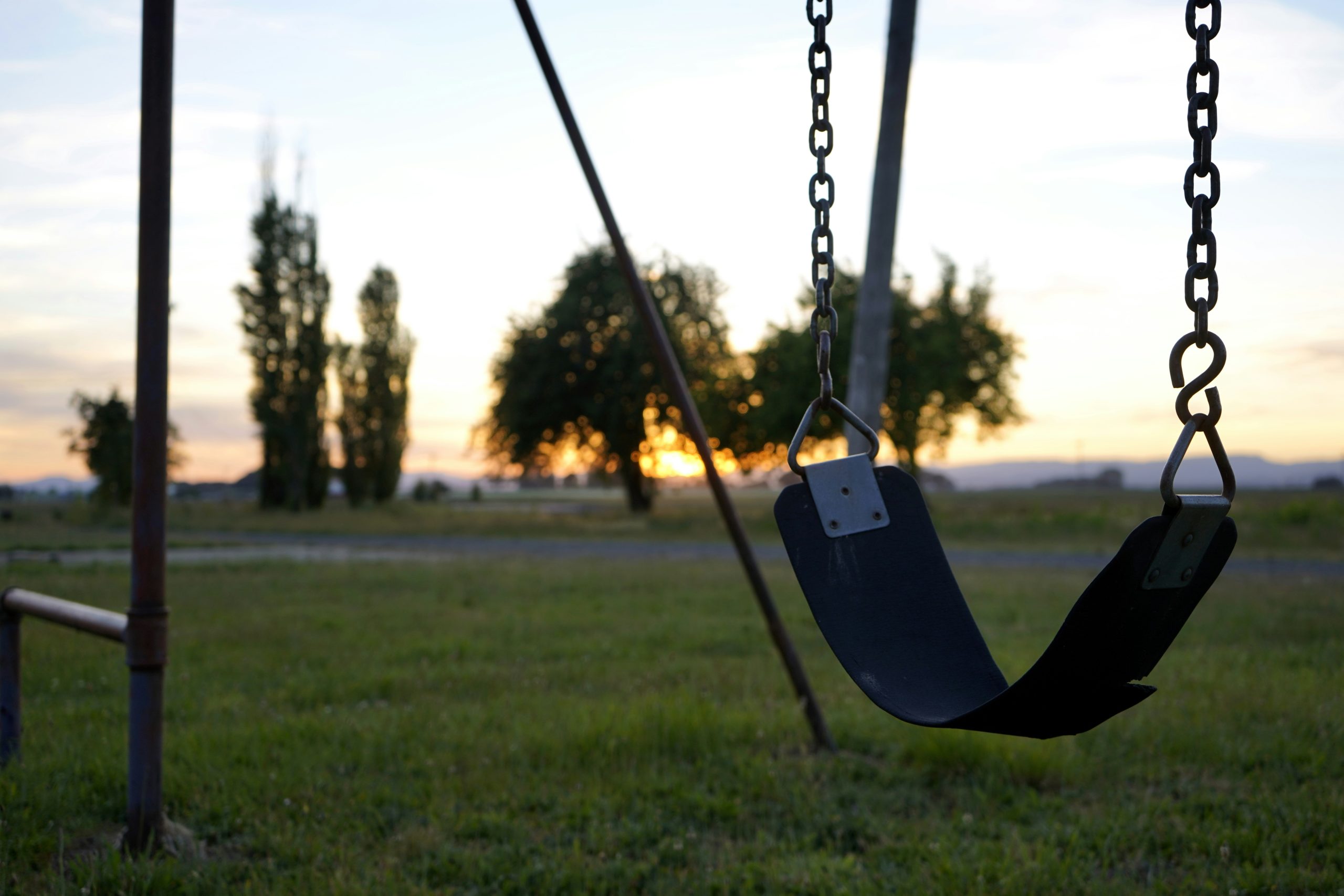
I am four years old, standing on the playground of the Jewish Community Center where I go to nursery school. My best friend Alice is not here today. Alice is my only friend. She lives in a bigger house than I do, with two whole floors, and a basement that is a playroom filled with her toys. When we’re together, she decides what we will do. Sometimes during our play dates she has her ice skating lesson, and I sit with her mother on the hard benches beside the skating rink while Alice glides over the shining white ice.
Now I watch the other kids swinging on the monkey bars and lining up to go down the slide. They seem like creatures from another planet. I cannot imagine how I would go up to one of them and speak.
***
On the playground during recess, one of the girls in my kindergarten class whispers something in my ear. Whispers: the language of secrets, of things that only a few people know. Her voice in my ear doesn’t sound like words. It sounds like a radio spitting static, like dry leaves crumpling underfoot.
I want to understand her so badly, but I can’t. I have my own secret that I won’t share with anyone. I wear hearing aids. They are clunky and ugly, and I hide them beneath my curly hair.
I turn to the girl, put my mouth by her ear, and say, “Do you mean—” I do my best to repeat the meaningless noises I heard. Maybe they will magically become real words for her. Or maybe I want her to know what it feels like to be bewildered by something as simple as a whisper on the playground.
“No, that’s not what I meant,” the girl tells me, and she walks away.
***
Chuck is not like the other adults at our school. He is the janitor, and when he stands near our principal he looks as small as I feel when I’m standing next to one of the second graders. Chuck doesn’t like kids, and we don’t like him.
I watch a few of the first and second graders teasing Chuck on a dull Monday afternoon after school. We’re here because our mothers, who work at the school, are at an all-staff meeting. Chuck doesn’t go to these meetings. I know this means that he matters less than the other grown-ups.
The older kids form a loose semi-circle around Chuck, chanting his name. “Chu—uck! Oh, Chu—uck!” I walk towards them, hovering just at the edge of the group. I wonder what it feels like to talk back to an adult. I am always the good child, afraid of doing anything wrong, terrified of being caught breaking the rules.
***
All the kids have heard the stories of children who ignored their parents’ warnings and swung so high on the swings that they went clear over the top of the swing set. I try to picture this in my mind. Would they hang upside down for one brief moment before falling to the ground? Or would they sail in great big circles, the chains that hold the swing wrapping around and around the high metal bar?
Every time I swoop up on the swings, the chains give a little hitch at the very top. I hang suspended in the air, weightless. Then the swing plunges down and my stomach drops. My body becomes heavy and drags through the air until I soar upwards again. It’s like playing hide-and-seek with gravity. At the top of each arc, I might fly into space.
***
In second grade, during the long recesses when I don’t know how to talk to the other girls, I imagine aliens landing in the school yard. I am the only one who can save my classmates. I rescue everyone, and they love me forever. Sometimes I change the story: the aliens are actually my people, come to take me home. I was simply on the wrong planet this whole time.
One day I tag along with a few girls in my class as they walk to the far end of our playfield. A tall chain link fence separates us from a tangle of weeds and brambles. One of the girls points through the fence. When I look, I see a round, reddish thing buried in the weeds.
“It’s E.T.’s heart!” she says.
The other girls seem excited. I’m doubtful. I saw the movie E.T. when it came out in the theater, like everyone else. It’s about an alien who gets left behind when his spaceship visits earth. He becomes friends with a boy who helps him go home. So what would E.T.’s heart be doing here? Still, I feel the electric buzz of being part of a secret when the girl warns us, “Don’t tell anyone else!”
After recess, my friend Miriam asks me what we saw. Our leader has been telling everyone that we found something mysterious and important.
“I can’t tell you,” I say to Miriam. Her face fills with hurt. Now I don’t know whether I did the right thing. In order to keep a secret, you have to shut others out.
***
Eventually the first and second graders grow bored teasing Chuck and wander away to find something else to do. I keep trailing Chuck as he pushes a heavy garbage can towards the gym. I imagine what it would be like to call his name, to cross the line from silently watching others to being the one at the center of attention.
“Chu—uck! Oh, Chu—uck!” I sing, pitching my voice like older kids. He ignores me. I dance a little closer. “Chu-uck!”
He turns around. Now he looks much bigger. “You’d better leave me alone,” he says. “Or else I’ll tie you up.” His voice sounds creaky, the way mine does when I go for a whole school day without talking. Being able to do this shows that I’m special; none of the other kindergarteners can stay quiet.
I am delighted by Chuck’s threat. Of course he would never tie me up; adults don’t hurt children on purpose. He’s saying it to scare me.
I run to find the other kids. They’re under the maple trees by the edge of the playground, gathering the winged seeds that we call helicopters. They throw them up in the air and watch them whirling down.
“Chuck says that if I don’t leave him alone he will tie me up!” I announce. This does not seem to impress them. One of the boys says something to another boy, who laughs. So often, when people say things, I can’t hear them. So often, when people laugh, I think that they are laughing at me.
I race back to the gym to find Chuck. He is sweeping the cement walkway with a wide broom. “Chu-uck!” I cry. He sweeps harder. “Chu-uck!”
Chuck lets go of the broom, and the long handle streaks downward and thuds against the concrete. I watch it fall. A rough hand closes around my wrist, like the hand-cuffs I see police using on bad guys on TV. I am yanked forward.
***
One day my friend Miriam and I find a large slug in the wilds of her backyard. We can’t bring ourselves to touch its slimy, rubbery skin. Miriam goes inside her house and comes back with a round container of salt, the one that has the picture of a girl in a yellow dress walking in the rain, carrying a jug of salt which spills behind her.
Miriam opens the small metal mouth of the jar and pours salt on the slug. The skin changes instantly where each grain of salt lands. The slug turns from dark brown to white—hundreds of tiny white flecks, like little bits of snow covering its body.
I tell my mom about what we did to the slug when she drives me home. Her eyebrows scrunch up and she puckers her mouth. “That’s not a nice thing to do,” she says. “We don’t do that to living creatures.”
***
I am lying sideways on a stack of neatly folded blue gym mats placed along the back wall of the gym. Chuck is gone.
My wrists and ankles are tightly bound with jump ropes. They are the ones that we use at recess and in P.E. class, long thin cords with red plastic handles. On the playground, we practice spinning the jump ropes so fast that they whip underneath us twice in one jump. The rope stings our legs if we don’t jump high enough.
I try wriggling my hands free, but I can’t. One of my hearing aids starts shrieking. My ear mold has slipped in my ear, and the hearing aid is screaming. My father says it’s called feedback. The noise seems loud enough to fill the whole gym, but I know that it’s a faint sound for everyone else. It’s a wailing baby that I only I can hear.
The gym door swings open. Two teachers walk across the floor, which is as big and smooth as a skating rink. Their voices are loud and cheerful. Staff meeting is over. I can hear one of the teachers laughing. She turns and sees me.
I can feel my face burning, like salt biting into scraped skin. I am certain that she knows what happened. Grown-ups know everything. She thinks it’s funny that Chuck tied me up. She thinks I deserved it.
I watch her brown shoes walking toward me. They have low heels which strike against the floor, echoing with each step. Finally she reaches me. She sits down on the gym mats and unties the jump ropes. My wrists have thin red lines wrapping around them, like bracelets.
As soon as I am free I am running across the gym, hurling myself against the heavy door, pushing my way outside. I will never tell anyone else about what Chuck did. I will not let them laugh at me. I will swallow this secret like the bitter aspirin that my father crushes for me so that it will dissolve faster in my body, easing the pain.
I run past the classrooms and the playground. The school grounds are suddenly too small. I want to keep running. If I could, I would never stop. I would run forever.
***
I can play by myself on the merry-go-round, but it’s more fun when others push it and I can sit on the edge of the wheel. If I hold on tight, I can even close my eyes and lean my head all the way back while it’s spinning, to get that belly-flop feeling as I straighten up again.
The little kids just hold onto the metal bars on the outer circle, but some of the bigger kids let go and walk to the middle of the merry-go-round. Finally I decide to try this. At first I am thrown down. I get back up and stumble forward. As I approach the center, the winds grow quieter. It’s easier to plant my feet and stand firm. At the very center of the wheel I reach a spinning stillness. All around me people are tossed by whirling forces that only brush by me, the lightest of breezes on my cheek.



One response
Such a well-told story – both completely relatable and yet painful to imagine. I found myself wanting to protect this little protagonist. The kind of writing that stays with you.
Click here to subscribe today and leave your comment, or log in if you’re already a paid subscriber.