

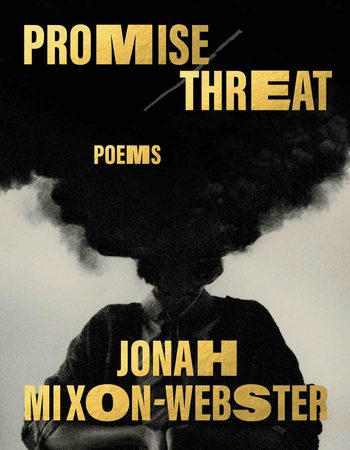
Jonah Mixon-Webster’s second collection Promise/Threat is an often-candid meditation about how incalculably the mind, through the imagination, converts life experiences and prospects into what we offer ourselves and each other. Readers witness a wide range of ordinary and fantastical settings and how, subject to these settings, the variable human resolve results in powerful escalations and reductions for Mixon-Webster’s speakers.
Writers are often praised when they use imagination to powerful effects. His use of the lyric “I” complicates a simple assessment of writerly artifice relating to imagery. Rather than just placing images in poems to enhance a reading experience, his speakers describe how their imaginations transform their surroundings and experiences, such as “Inchoate Chatter,” where the speaker discloses “the veil is thin here as the total dark / and stone ramble against the rush / of tree whisper and the trees / draw me to their memory.”
Originally from Flint, Michigan, Mixon-Webster’s debut collection, Stereo(TYPE) won the Sawtooth Poetry Prize and the PEN/Joyce Osterweil Award for Poetry and was a Lambda Literary Award finalist.
Our discussion, over email, inspired me as we delved into hopes, dreams, and the precarity of the imagination.
The Rumpus: Escapism as a topic of discussion or critique orbits any writer who employs aesthetics that can be considered dreamlike or surreal. If the implication of escapism is a bypass of reality for an easier alternative, the poems in your collection largely negate that idea. Often the dreamlike or surreal presents compounded conflict. Rather than escapes, the poems seem to present endings as a feasible substitute, as in “A Regret of Newness” when the speaker says, “to be alive, though dead. To be. To know / that something is not complete until it is complete.” Regardless, elsewhere, there remains a complicated longing for escape. How would you characterize your collection’s relationship to escapism?
Jonah Mixon-Webster: Absolutely. Promise/Threat essentially argues that there is no escape— that to leave one place is to arrive or return to another. When we sleep, we go aloft to some other place, though we do not truly escape the reality we will arise in. Neither can we fully escape the place we enter into when we dream. It’s a never-ending cycle, one that I believe isn’t even precluded by death itself. There’s never a true ending or escape, just a different beginning or arrival to elsewhere. Surely, the poems do engage with escapism through dissociation, sensuality, love, even, but hopefully through craft, and affect the poems render these experiences as new beginnings as well. In the poem “Moreover, Does the Truth Still Speak” the speaker makes a counterfeit statement by saying “escape is what I know” but truthfully this is just a mere device of desire against the backdrop of a trap or an inescapable existence.
Rumpus: You write, “I deny / the invitation. I also deny the beauty / of this place made a place only / by the history it must conceal. / Hidden absence, moreover presence / undone,” in the poem, “Inchoate Chatter. One way to discuss how imagination works here in the lyric “I” is in speculating on the relationship between author and speaker. Yet, your collection makes a commentary on what enables your speakers’ unique perceptions and their resulting imagination. Can you speak to how imagination and perception work alongside each other throughout your collection?
Mixon-Webster: Very strong question, I appreciate this so much because I often think through the power of presence and absence (moreso negation) in the lyric. And the relationship this dichotomy has with the lyric “I.” Often the lyric “I” makes an image evermore present through the concerns of the speaker’s sensorial positions.
In “Inchoate Chatter,” I wanted to see how the lyric “I” could present an image and negate it in the same breath, the same line. I think that produces a certain tension that renders the image more present/urgent due to the ephemeral station produced by an utterance of denial or negation, as if the speaker is hallucinating it all though it’s there or the speaker sees something beyond what is present in the image. This is actually the primary ethos, logos, and pathos of the whole collection, really. Simply, what is “real” and how can a subject or a witness be sure?
Considering the question about authorship and speakership in “Inchoate Chatter,” it is derived from my time at the T.S. Eliot House where I actually enjoyed myself and the space and the community. But the speaker finds something amiss. The speaker is made expressly aware of where they are and of the knowledge of T.S. Eliot describing his voice as having a “nigger drawl.” Whereas as a visiting author I wanted to be a good guest, the speaker is much much more critical of the space, celebrity, and history of it all.
Rumpus: I like the implication that the positive consequences of your time at the T.S. Eliot House are predicated, at least in part, on your desire to be a good guest. Your poetic speaker, then, becomes a means of negating the repression that results from an evasion or displacement of thought applied to Eliot’s critique. In one way, between your real-life desires and your speaker’s diversion from those, you gain some perspective on two somewhat oppositional realities, even if through speculative methods. If you agree that your real-life desires and actions resulted in a more pleasurable experience at the T.S. Eliot House, how would you describe the value of what your speaker enables beyond an artistic practice?
Mixon-Webster: I truly appreciate this follow-up because it allows me to think through the dissonances between these two ostensibly opposing or overlapping realities. As a guest, I’m partially displaced. This wasn’t my home so I had to be concerned with the nature of this guest/host relationship and I just wanted to enjoy the experience of being among other writers and have some time being in a secluded area to think and write. The speaker however is not displaced; the speaker knows exactly where they are and the implications of the environment. I believe the value is, in some ways, the speaker can’t leave because of the stark reality of their surroundings which haunts the speaker and the speaker remains in Gloucester to continue in this haunt. I’m back in Flint. I also find the value in this resonates with the station most Black Americans experience: being haunted by the placiality of America while also haunting the place in return.
Rumpus: When it comes to the title of your collection, Promise / Threat, a promise, though capable of being broken, is more concrete, while a threat is more speculative, conditional, or ambiguous. Promise can mean potential. Potential can be threatening. So much of the scope of promise and threat plays out in your speaker’s head, as in your poem, “Weapons a Thought Could Wield,” when readers are left to consider “in the word of the mind, the mind of the word—murder, a simple premise, quick utility, pistol or cane, a wood or any metal, new money for old rope” and many other possibilities. How do you see the relationship between the workings of promise and threat in your collection?
Mixon-Webster: This a great question and really hinges on why the title was chosen. You’re right about how the implications of the two words are grappling with each other in this collection. Where I grew up, if someone wanted to let you know that violence upon you is impending, they would say, “That ain’t a threat; that’s a promise!” Otherwise, to promise someone a good thing (like love) or a helping hand is this verbal contract that can threaten the nature of a relationship. So I’ve always thought about how promises and threats both toggle between what’s concrete or certain and what’s a bit more hollow or unsubstantial. To go further, the collection is always questioning this. Whether if it’s a question of violence, paranoia, self-defense, self-love, alienation, et cetera. What is the more concrete thing or the more hollow thing these speakers believe in? In “Weapons,” the speaker (who is like this disembodied internal scream a la Kaufman or Beckett) believes the constant promise in our time is violence and seeks to argue that, interrogate, then negate it as a fallacy of desire.
Rumpus: My mind keeps snagging on the idea that a promise of something good can threaten the nature of a relationship. A change can be transformative, and transformation could be a cause for celebration or mourning, but I suppose I could be wrong to more readily associate “threat” with mourning. I believe you’re pointing to how the chaotic nature of promises and threats when relayed by human beings can provoke a powerful or energy consuming contemplation maybe in everyone involved but especially the intended recipient of those promises and or threats. The speaker you reference fixates on violence. There’s a catalogue of violence embedded in the history of human existence, and so I suppose the survival of human beings is an easy way to affirm your speaker’s argument, but if your speaker ultimately negates his argument as a fallacy of desire, I wonder if you have specific thoughts about how promises and threats are related to the possibility of non-violent human desires. It seems to me that promises and threats often imply a sense of severity of the expression of human desire.
Mixon-Webster: I feel that because I get so caught up on that as well. I think the obsession with them is what created the collection, to be honest. Haha. Yet, I don’t intend to reduce both addresses to the same terminus of something “bad.” Threats could be good too, they create boundaries. I think of them as orbiting around the centers of desire. Humans desire to pronounce both at certain times to certain ends.
I’m now considering your observation of “the intended recipient of those promises and or threats.” That’s what I think this collection points toward, especially in “Weapons.” This disembodied speaker (or now I’m thinking it may be speakers) are concerned about the omnipresence of violence. The last utterance of “No Reason” attempts to point out, through negation, that often the logic of violence is a counterintuitive slippery slope fallacy. It says we must use violence to prevent violence or that since violence is so prevalent the only remedy is violence. Survival is the evidence of this argument against this reasoning and also as you say “the possibility of non-violent human desires” can be evidentiary as well. I would probably say that promises and threats show urgency as well as severity of human desire. Self-preservation dictates that we need the promise of access to resources or connection and we must be avoidant and adverse to any threat. I think here is where the imagination must contend with how to fulfill these desires non-violently.
Rumpus: While reading the poems in your collection that were more reality-based, I was reminded of how sometimes it is much harder to dissociate from language that documents reality than reality itself, even in a poem like “An Attenuated List of Things I Find in My Bed upon Waking” which catalogues some arguably mundane things like “.half faces buried in cotton,” “.blood from the back of my head on the pillow” and “.leftover cake.” Confronted with these images in writing makes their occurrence so much more noteworthy or upsetting. Do you also sometimes find it easier to dissociate from day-to-day happenings as they occur than when reading an account of them in writing? If so, was impeding dissociation one of your goals for the writing?
Mixon-Webster: That’s a tough one right there! Haha. Yeah, like this list poem, which I think is a form that can make the quotidian extraordinary or extra-meaningful, really made me face the fact that I hate sleeping alone. Even though the last line of the poem is a direct admission to waking up alone, all the animate or inanimate objects I found in my bed told a story that I cannot look away from. This is a poem where I myself, as the speaker, narrates this simple, sad, complex, narrative fact. Even in the line that implicates, in this story the speaker hates sleeping alone so much that they would aid someone in committing adultery to avoid that experience. It’s an indictment of the self as with most of the “realistic” poems in the book. It’s an indictment of need also. Did I really need to eat a pork chop and a piece of cake in my bed before I went to sleep? Maybe I thought I did at the time but now I’m not so sure. Haha. Maybe those things, non-human or already dead and cooked, kept me company for a time. So yeah, impeding dissociation is definitely a goal in this collection as well. I think that wrestles with the feeling of feeling like a different person in your dreams, writing through different speakers in your poems. This collection is advocating not admonishing that see-saw kinda experience.
Rumpus: I love your answer because of how it frames permission and the overlapping nature of reality and dreams and productivity and insight relative to the practice of writing. It’s not uncommon to encounter people who feel writing is a willful dwelling in fantasy, sometimes even in the context of nonfiction. Part of what I think you’re saying is that regardless, fantasy has the potential to affect change in the real world, so by that metric, fantasy and reality also are constantly overlapping. Reality inevitably becomes fantastical in the process of being perceived. Your list poem is in some ways reportage. It documents, organizes, and consequently assembles context. There’s an element of subjectivity to that process, but the process and result shouldn’t be underestimated or dismissed because of the correspondence it has with entities that both shape and are reality. Do you agree? All things considered, what do you use as a compass to keep the process productive? What is your criteria for determining whether that process is ultimately productive?
Mixon-Webster: Exactly! What you say right here I vehemently agree to—worth repeating, “fantasy has the potential to affect change in the real world, so by that metric, fantasy and reality also are constantly overlapping. Reality inevitably becomes fantastical in the process of being perceived.” I think this is why genres like fantasy, horror, speculative fiction, and Afrofuturism will remain en vogue. Reality and fantasy are refraction mirrors which shape endless images and experiences between both. I like your thinking of this poem as a document because it grounds the lyricism and imagery in things that are very much real.I didn’t use any metaphors or abstractions at all, yet a line like “.animal eyes atop my head” could sound like there were really animal eyes above my head. Haha. I think the productivity of the mundane lies in what seems hard to believe or striking in a way that these ordinary things in a bed aren’t ordinary in that context. A poem that can bear that tension is productive to me.
Rumpus: What hopes do you have that your poetry helps you feel closer to?
Mixon-Webster: I hope to be back in community, to be back in The Great Conversation of Poetry like Vievee Francis talked to us about. It often feels like if you’re not on tour or have a current project out that you are out of the conversation. It’s been 5 years since my last book and that’s starting to feel like a long time. I hope to learn more about forgiving myself and others through my poetry. Forgiving life for being life. I hope to keep dreaming even though it terrifies me most times. I also hope to wake up.
Rumpus: What’s the relationship of your current writing to Promise / Threat?
Mixon-Webster: P/T really showed me that I don’t have to write with a singular voice like what seems to be the goal with poetry. Having a signature voice or style. I feel more open to finding different approaches to my writing. Different voices. Ai and Bob Kaufman inspired me so much with this project (a major oversight of not including that in the notes of my book) that I hope that I can carry forward the traditions I learned from them. My next project, The Hauntology of Slavery, really learns from P/T as far as lyricism and the toggle between what’s present and what’s absent. I have so many other works including more poetry, more nonfiction, and fiction that I think P/T is ushering in what’s vital to my work overall, a visceral somatic experience of concatenating voices.




Click here to subscribe today and leave your comment, or log in if you’re already a paid subscriber.