
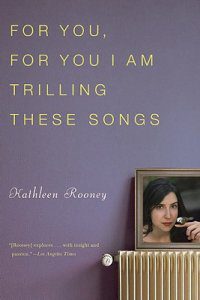
 The essays in For You, For You I Am Trilling These Songs explore the many successes and admirable qualities of their author.
Kathleen Rooney is admirable for what she has accomplished at such an early age. She is a founding editor of Rose Metal Press, a published author, a Senate aide, and a professor. Her most recent book, For You, For You I Am Trilling These Songs, is a collection of essays that deals with that epoch of time recently coined the “quarter-life crisis”—that painful period in your late twenties when you are still bumping up against the world and coming away bruised.
In For You, Rooney touches on a variety of subjects under the quarter-life umbrella—from the notorious Brazilian wax process to new-wave feminism; from what it’s like to work for a senator to what it’s like being a professor in her twenties. All the while, she proves she is well read and still questioning the world around her.
The most successful essay in the collection is perhaps the final one, “However Measured or Far Away”—an essay about her cousin, Jennifer, who is about to become a nun. Rooney’s writing shines as she explores an interesting figure in her life, a young woman with a doctorate in engineering who has decided to enter the convent. “Jennifer is so practical, yet at the same time so mystical with her migraines and her early bedtimes and her oft-uttered blessings, so delicate in body yet so strong in conviction,” writes Rooney. “She makes me afraid for her life, sometimes, because of the intensity of her belief.” This essay is a pleasure to read. It looks outward and then it looks inward, exploring Rooney’s feelings of jealousy for her near-nun-cousin; exploring, too, a competitive spirit, friendship, kinship, faith, and filial bonds.
If only Rooney’s editor would have told her, “This last essay, this is wonderful, start here, put the other essays away for a while…” Because adding to the pleasures of reading “However Measured” is the diversion it gives readers from the narrow road traveled by many of the other pieces, which linger in trite, almost adolescent, experiences, and vanity.
Vanity is, in fact, one of the book’s central characters, as well as its cardinal sin. In “Fast Anchor’d, Eternal, O Love!,” Rooney discusses the period when she worked for the senior senator from Illinois—who goes unnamed—and under whom she directed interns and tried to teach them how to write. The essay is written in a crushy, precocious-schoolgirl voice, with an irritating third-person narration running through the whole thing. “She was a nostalgic dresser. Her clothes expressed emotions,” Rooney says of herself, before going on to describe her “gauzy” scarf and “dark hair swept up and back.”
Apparently Rooney wasn’t the only one noting her appearance. “How do you manage to look so good all the time, especially on what I pay you?” says the senator’s Chief of Staff. Or: “A-plus. You look like a million bucks.” When she wears an outfit she’s had since high school, he says: “Can you believe that she’s the same size she was when she was sixteen?” Repeated frequently, this self-congratulation comes of as a tic, making the essay difficult to plow through. [Editor’s note: Senator Dick Durbin’s office contacted our reviewer to attribute these remarks to the Illinois State Director, not the senator’s Chief of Staff. Kathleen Rooney writes that, “the senator… never conducted himself in any but an appropriate fashion.”]
In “All Tomorrow’s Parties,” Rooney writes about her job as a professor at a small religious college. She mentions that she is a “professor” so many times one loses count. This time it is not a senator who is taken with her, but a student named Charlie, with a crush. Rooney takes this very seriously—in fact she revels in it, and gets drunk with her students at a student party. “All the girls in class were crazy for Charlie, but Kathy had suspected and recently confirmed that Charlie was crazy only for Kathy,” Rooney writes, again, in third person, while her husband buzzes around the party in the background. “You look fabulous in that,” said Kirsten, snapping her photograph. “You look fabulous in anything,” said Joslin. Kirsten and Joslin are her students as well—though they don’t have crushes, Rooney again finds it important to mention people’s impressions of her appearance, though here at least she gestures to modesty: “Kathy wanted to correct them,” she says, “wondered how such smart young people could be so wrong.”
It is perhaps this obsession with surface and self that does not let Rooney’s narratives progress, this constant sinking into the superficial that does not allow her to move deeper. In addition, Rooney seems always be avoiding one food or another, always dancing around eating—a possible disorder that goes begging to be touched upon.
Rooney’s most successful writing comes when she looks outside herself, sharply, at the world, as in the essay about her cousin, or the moments when she talks about her relationship with her sister. For You serves to remind readers that it can be dangerous to be published in your twenties, when you are still finding yourself and your voice. One hopes Rooney survives all her early success and keeps writing essays like “However Measured or Far Away.”



25 responses
How does one ‘sink into the superficial’?
The use of ‘schoolgirl’ strikes me as a textbook infantilizing/female-on-female move.
Kathy Rooney wasn’t “superficial” even when she actually was a “schoolgirl.”
Her continued play with inside and outside, movement and reflection, surface and all those glittering implications hiding beneath the surface continues in this newest text.
Instead of concluding that it is dangerous to be published in one’s twenties, the author might have considered the temporalities and trajectories of authoring poetry and prose across one’s life. Rooney is art unfinished, precisely what makes her work art.
This review upsets me. Those two essays are two of my favorites from the collection, and I think Garcia completely misses their point — they are not abt vanity, but about crushing on and/or developing more intense bonds w/ others when already committed to someone else, and abt the loss that accompanies the choice of any particular life path over another — it’s classic “road not traveled” stuff that happens at any age, and I actually think that marketing Kathleen’s book as being abt “people in their 20s” (as its back cover flap does a bit) really sells it short. Those two essays are gorgeously crafted and really striking in their emotional honesty — and I think that Kathleen writes them in the third person, which elsewhere in the text, her husband suggests automatically transforms something into fiction, provides a provocative meta-commentary on said honesty by hinting at the ways Kathleen herself is compromised not only within those narratives, but also by her own construction of those narratives, what she chooses to tell and withhold, calling her own authority into question, which I think is quite fitting considering the topics at hand — desire, imagined infidelity (what some might even call emotional infidelity), regret, etc.
This: “a possible disorder that goes begging to be touched upon” is particularly insulting. Really, Rumpus? Ad hominem attacks?
What’s to say about a review that chooses to psychologically diagnose a persona the reviewer doesn’t like, rather than to engage substantively with the essays the reviewer is purportedly reviewing?
Here is a list of the book’s admirable attributes, which the reviewer chose not to notice in print:
1. The play with form and point of view. It’s not often we see such formal restlessness in a book of narrative essays, and watching Rooney tell stories in so many different ways is part of the book’s pleasure.
2. The reckoning with power. In essay after essay, the subtext is a young woman of ferocious intelligence whose power and position have not yet caught up with her talent and ambition. We’re getting, in other words, the dispatch from the trenches that literature ought always to be offering up, but which the contemporary personal essay so seldom does. We’ve got, in other words, the private report from the public sphere, as opposed to the essay of high ideal or private report from the private sphere. We need more essays of this sort, and this book is full of them. Good ones, too.
3. The ferocious honesty. I think Rooney has said things in this book that aren’t uncommon to experience — particularly the experience of a young, highly educated, and highly competent woman moving through professional environments whose donnee was cast a century ago or more to the advantage of middle-aged men — and she has spoken of these things not in the whiny voice posited by the reviewer, but rather with a cool appraisal that isn’t cowardly enough to exclude the personal response of the teller of the tale. The result is we’re not getting the distortions of straight ideology, no chaser. We’re getting instead the clearer picture: What it really felt like, then, in all its complications, including the emotional ones.
I knew Kathy Rooney first as a writer, then as a tourmate, then as a friend, and perhaps that acquaintance makes me feel defensive about reviews like this one. But I want to say to the reviewer that, even in the ad hominem attack, she got it wrong. In person, in the professional setting, or on the page, the pejorative “schoolgirl” is not only a petty and mean-spirited (dare a male writer say anti-feminist?) term to use in describing a writer of such accomplishment, but it is also, in this case, about as far from being accurately descriptive as it could be. “For You, For You” is prizefighter prose, twelfth round, with no time or energy left for the prettied-up, the airbrushed, the rope-a-dope.
The responses to this review have been very interesting, and point up the problems with the terribly vexed literary form of memoir/personal essay. When a writer such as Kathleen Rooney publishes personal essays, she implicitly asks to have it both ways – that we read the text as an accurate, authentic glimpse of her “true self” (if we don’t read it this way, we reject the work as fiction), AND that we appraise it as a literary product, i.e. objectively, assessing some disembodied, depersonalized idea of its “admirable attributes” that is hermetically separate from those of the author herself.
How, in other words, to avoid the “ad hominem” when reviewing a text that presents itself as pure, unadulterated “hominem”?
What’s strange about these comments is how “ad hominem” they are, how upset with Vanessa Garcia for doing exactly what Rooney asks her to do – respond to the words and feelings of Kathleen Rooney. It’s fairly easy to dismiss Kyle Minor’s comments, since he admits to being the author’s (and not just the book’s) friend and defender. Rebekah Silverman has a point, though one might be generous enough to ask if what Garcia meant to say is that the book deliberately brings up food-dysfunctional behavior without its author commenting on or contextualizing it, leaving the reader to wonder why it’s being brought up so frequently. Tim Jones-Yelvington and Sara Murphy are certainly entitled to their opinions, which are of course no more or less authoritative than Vanessa Garcia’s. And Daniel Nester’s comment is just as nasty and presumptuous as anything he claims to abhor in Garcia’s review – but one should remember that a memoirist ASKS to have her motives analyzed, which is not true of a reviewer.
Maybe the biggest problem with memoir as a genre is exactly this urge to place it off limits to criticism, to shield the writer from honest response to her work. I can’t help but observing – for the commenters who accuse Vanessa Garcia of being anti-woman – that The Rumpus has published critical reviews of memoirs by men, and I’ve never seen such an ardent (dare I say “chivalrous”) rush to defend the author.
This thread really is interesting. Beyond the question of what “ad hominem” means with respect to a review of a memoir or book of nonfiction essays, it raises the question of the relative value of comments on a review. I am staunchly pro-comments in general, but I’ve seen a lot of this type of thing lately — either friends of the author or the author him- or herself responding (defensively) to a review via comment — and there’s still something a bit unsettling about it, though I guess it won’t be long before it feels totally normal. Somehow responding on your own blog or in another publication with a link back feels more “appropriate,” and I realize this sounds absurdly old-fashioned, and like a double standard, because I don’t think the same is true of a regular old blog post.
No disrespect to any of the above commenters, but as Kathy’s friend, I don’t feel any need to defend her against negative reviews. I don’t think she, as a person or a writer, needs me to do that. Her success stands for itself and can withstand a few negative reviews. In fact I’m sort of of the opinion that until you start getting negative reviews, you haven’t really “arrived.” You’re still stuck in the small-time world of mutual ass-kissing.
Elisa, an interesting point. I’d say that my concern with this review was not so much that it *is* negative (and I’d agree that Kathleen can certainly hold her own) but rather that I didn’t find it to be a particularly compelling *review.*
The writing of a book of memoir or nonfiction or autobiography isn’t an invitation to delve even further into a person’s psyche, and I found the above to be short on consideration of the book and long on consideration of Kathleen.
The point of a review, most times, is to show potential readers why they might want or not want to read a particular book, not why they might or might not like a writer personally.
Speaking only for myself, I think memoirs should be reviewed, sure; it’s a red herring argument to suggest otherwise. I am referring to Stephen’s Daily Rumpus summary of these comments as addressing the question, “should memoirs be reviewed”? Of course they should be, and they are.
This is not a good example of a well-written or well-considered review, but I am not saying the endeavor of memoir-reviewing should end entirely.
And Elisa, although I will concede a comments box is not the best forum for talking about pretty much everything, we have been living in a participatory culture now for some time, so perhaps reviewers should get used to this whole literary review culture as being a two-way street. The comment boxes are here for a reason.
But Andrew Altschul, where is my “ad hominem” argument to the reviewer? The “female-on-female”/”infantilizing” two-sentence comment? It’s “nasty and presumptuous”? Set aside that you just admitted that Garcia’s review is same; am I really being “chivalrous” by coming to a female writer’s defense? So you’re saying that because there’s 4-5 comments here because the writer is a woman? Whew. I’d hate to think that every time I want to criticize a review that just happens to be of a female writer, I’d have to get my old codpiece on. How very gendered.
Bottom line: People think the review is a shitty one and are reacting to it. We’re having a pretty smart comments conversation–smarter than anything the reviewer said in the actual article–over why and how such a shitty review would be written and how it could be published. We can only guess to the reviewer’s motivations, but my guess is that it’s not an entirely unsophisticated reviewer, one who knows all the implications of genre and gender yadda yadda yadda, and went ahead and wrote a shitty review anyway.
Perhaps as Rumpus, Books Editor, Stephen, you should address and approach this conversation with a bit less defensiveness and rush-to-judgment and take these criticisms more seriously with an eye in improving The Rumpus’s stable of reviewers.
I’m afraid I don’t quite agree with Ms. Silverman. A memoir is very definitely an invitation to “delve into” the author’s brain the way he or she has written it. Like it or not, the publishing of a memoir can be an invitation to media to upturn parts of the author’s world that they never intended to reveal. Once a book is out in the world, even a memoir, an author loses the ability to control the way they or their work are perceived or criticized. It’s just the way it is. Control is overrated anyway. Luckily, as Elisa points out, negative reviews are key!
Elisa makes a great point. I am also tired of this childish friend- and self-defending in online book reviews in general. But I do agree that this particular review is problematic — speculating about the author’s eating disorders which aren’t mentioned in the text, in particular, has no place in a book review, regardless of genre.
And Andrew’s argument is deeply flawed. He presupposes a few things that range from dubious to just plain wrong. First, the assumption that a “true self” exists. Second, that most readers assume that to be true. Third, that even if the “true self” existed, it could be accurately represented in a text. Nonfiction doesn’t present itself as “pure, unadulterated hominem,” because the self presented is not a “true self” — it’s a constructed self, a performative self, a narrative self. Do you assume that a photograph is an “accurate, authentic glimpse” of a true and unchanging self? How about a painting? How about this blog comment — am I presenting my “true self”? Of course not. Each just represents a certain aspect of selfhood constructed for a certain context. It’s only possible to believe otherwise if the reader has the most reductive and naive conception of the self. And if that’s the case, don’t blame the author.
The distinction between fiction and nonfiction isn’t in the “trueness” of the narrative self. It’s the trueness of the material: the facts are true, the events happened, and the people exist.
I meant Andrew above, but I suppose it’s food for thought for Stephen as well.
While I’m hear, I might as well ask why is it that while we are “invited” to “delve into the mind” of the memoirist, whatever that means, we are not when it comes to a reviewer’s mind? I agree with Britt that once a memoir is out into the world, readers do with it what they will. But why can’t readers of criticism in turn react in kind on the critic? Whole wings of English literature classes are based on this very practice. So this is all fair game.
Sorry for typos.
@Britt, I agree that it’s an opportunity to delve into a writer’s brain. It’s not an opportunity to delve FURTHER (which is what I said) into the author’s brain than what they’ve committed to the page.
Andy’s points about the “self†presented in nonfiction being a “constructed self, a performative self, a narrative self†are well spoken and well taken. I would still maintain, though, that the average reader – that is, one not enrolled in a Ph.D. program or versed in Lacan and Foucault – does indeed think there is a “true self†and that communicating it is the point of personal writing. How easy it would be if any nonfiction writer could hide behind postmodernist psychology and thereby abdicate their responsibility to present themselves honestly! At the Rumpus, though, we’re still going to take them at their word, however naïve that makes us.
As for Daniel Nester’s followup comments, his earlier accusation that Vanessa Garcia has committed “a textbook infantilizing/female-on-female move†invokes an ugly, unfortunate anti-feminism, the compulsion of some women to defame or destroy other women, to take them down a peg out of jealousy, self-hatred, or false consciousness. To accuse Vanessa Garcia of indulging such an urge is the intellectual equivalent of the long, sarcastic “Meeeeowwwww!†one might hear in a frat bar. This reduction of Garcia’s review to a literary “catfight†is accentuated by the phrase “female-on-female,†which smacks of the porn phrase “girl-on-girl,†terminology designed to place the gender of author and reviewer at the forefront, rather than engaging substantively with their ideas.
With all due respect to Nester’s codpiece, I’m not asking him to don it but rather to lay it aside and allow this delicate flower of an author to stand up for herself – or, more likely, to shrug off negative criticism as part and parcel of the publication process. I’ll say again that I haven’t noticed Nester, or anyone else, getting so personally offended when the Rumpus has published negative reviews of male authors.
But for all his fulminating, Nester never really lays out what he finds so “shitty†about Garcia’s review, beyond the fact that he apparently disagrees with it and suspects her motives in writing it. As for the “stable of reviewers†who write for the Rumpus, we’re quite happy with them. By and large, they do an excellent job, for free, and don’t deserve to have their motives impeached. Generally speaking their reviews are quite intelligent and their critical vocabulary is not limited to useless words like “shitty.â€
wow all these comments and not a word about the firing
I dislike the review because I think it’s a shallow review, and seems based upon a shallow reading of the text, for all the reasons Kyle Minor mentions (I also disagree with the idea that a friend’s perspective should be automatically dismissed or that friends are unable to read one another’s work critically or “objectively.” In some cases, I think we are actually better equipped for deep and substantive reading — I think Matthew Stadler’s thoughts on this issue are at least worth considering: http://www.thestranger.com/seattle/jaccuse/Content?oid=552). If Garcia seemed a little more aware of what Kathleen’s attempting formally and thematically, yet still came to a different conclusion than myself about the book, that would be one thing, but I found her reading cursory and dismissive. And I’m with Rebekah — I don’t believe nonfiction is an invitation to evaluate anything more than what’s on the page. I think it’s great for the Rumpus to make your reviews broadly accessible or accessible to the “average reader” (whoever/whatever that actually is), but I think that’s distinct from catering to said reader’s baser impulses. As a critic, I think Garcia should reflect on the text (or the individual reflected in and through the text), not the person outside our beyond the text.
I don’t see what the problem is with this review. For one, as negative reviews go, it’s pretty tame. The reviewer cites “However Measured or Far Away†as an essay worth reading and notes all the good things about the book and Rooney the writer before leveling some complaints. The reviewer’s main problem with the book is its self-congratulatory tone – which is a criticism also noted in a very brief review in the Washington Post.
Andrew, you’re not acquitting yourself too well here, either as a books editor or as a critic. I’ll stand by the statement that it’s a classic female-on-female move for a female reviewer to insult a female writer in ways that are heavily gendered and beyond-the-pale insulting; it’s been written about in other places as a sort of mini-phenom in book reviewing and I don’t need to rehash it here. That “female-on-female” to you “sounds” like “girl-on-girl,” and that that is a porn term, ewwww, that just sounds like an excuse to call me a “frat boy,” and that just sounds, well, desperate. That’s a “technology” you assign to my term, not I.
I have every write to call this a shitty review. Since when can I not say “shitty” in a comment box? All the sudden I have to go back to Rutgers-Camden and pledge Tau Epsilon Phi instead of writing record reviews for the college paper because I have a potty mouth?
You want reasons why it’s shitty? I echo pretty much everything that’s written here, along with my own observation that your own reasonings and reckonings over the implications over this debate are in and of themselves extremely problematic.
— Is it automatically “chivalrous” to leave a comment on a book review? Maybe this review is just so bad that people want to comment on it, regardless of gender. I know my conscience is clean, that if this review was just as bad and it was by a dude, I’d have something to say.
— Impossible to review memoir? Like, ever?
–Discount another person because he’s friends with the writer?
–You have to be a PhD student to understand that what one writes in memoir is not a writer’s “true” self? Anyone who’s seen episodes of the Real World or read a David Sedaris essay knows a certain persona is involved. Don’t have to read Lacan to know that.
So what I am hearing, Andrew, is that you are not allowing any criticism of this review to heart, that everyone is wrong and you’re right? And what’s more, you feel compelled to insult people who do bring up these issues.
“I would still maintain, though, that the average reader – that is, one not enrolled in a Ph.D. program or versed in Lacan and Foucault – does indeed think there is a “true self†and that communicating it is the point of personal writing.”
As an “average reader”–as defined by you–I find this insulting. Believe me, the amount of contempt I have for literary theory of all kinds is way up there, and all I have is a basic 4-year bachelor of arts degree. I’ve never read those guys and I don’t plan to. But even I think it’s pretty obvious that a story is a story, even if it’s “true”, and it’s pretty darn inevitable that any writer can’t help skewing things one way or another, just due to the limits of language. You can get close, but there’s always a gray area. Same reason Pi goes on forever.
If I had known this would turn into a conflagration of this order, I probably wouldn’t have responded, or, if I did, I would have written my own 2,000 word review of the book, which is something I probably don’t right now have time to do, anyway. But I don’t like the way the comments got so heated and personal, and I also think that while the reviewer probably could have done a better job, she’s probably a bright, smart person who dashed one off quickly and for free, and she isn’t due the level of derision that got whipped up in the comments section. Bottom line seems to be that she didn’t like the narrative persona, and she made her review mostly about that, without making any kind of serious argument about narrative persona in conjunction with the complaint. So the review feels knee-jerk and half-formed, and since I’ve published my share of knee-jerk and half-formed reviews, I implicate myself while implicating the reviewer.
For the record, too, I think the Rumpus’s books coverage is better than what I find in most print magazines, my reservations about this review aside.
I love The Rumpus, too, for the record. Perhaps because of that, and because I’ve been published here and feel at home, I felt I could speak my mind. My wife just told me to get off the comment threads. Her advice is always best. Later.
It might also be, though, that there is just something about leaving comments on a website, that unavoidably makes them sharper or more strident than the writer intended. The problem may be with the form.
I’ve left a few comments on this site, and on HMTL Giant, and I try to make my posts sound reasonable, and yet they always end up feeling angry to me. It’s like they become possessed of a certain tone. There is a relationship between form and content, after all. Maybe, in the long run, the critical blog comment is simply doomed as a literary form.
I’ve struggled with this question. What to do? Stop leaving comments on literary blogs? Labor over every one, putting in just enough self-deprecating disclaimers to sound reasonable, but not so many as to sound insufferably condescending or neurotic? Employ the dreaded Hello Kitty avatar?
In the meantime, I keep writing out long posts in the comment sections of this site, and of HTML Giant, reading and re-reading them for tone, changing words and phrases here and there, and then, after further consideration, deleting them.
Sean, I think the fact that comments so often sound pissy or defensive or aggressive (even to oneself) is part of the reason that it seems like a better idea to write a full post or response rather than a comment when you really want your argument to be taken seriously.
So I think this review and the comments are a success: I am definitely picking up this book to see what I think of it myself. Sean Carman, I agree that there is a form issue with website comments . . . they do end up becoming predictably confrontational. You could almost create a mathematical formula to capture the offense/defense tide of emotion.
Click here to subscribe today and leave your comment.