

I used to believe that collapsing the Venn diagram-space between the public and private self was the best way to ensure authenticity. Like how we know we’re not our food porn, party pics, and pouty lips, that we are in fact the clammy hands smearing the camera phone but sometimes we need a reminder.
I’ve changed my mind.
I’ve come to think that the interplay between our constructions and realities are, in fact, the metaphor for what makes identity meaningful. You got me at this angle, and that doesn’t make my image a lie any more than passing does.
Online, people say IRL—In Real Life—the distancing code of it hiding the underbelly of need. In Real Life is where awkward pauses live. I’m in real life with onion breath and too many drinks. I’m a million failures per revelation; I’m not just constructing myself but absorbing each reflection of who I am – divided by all of your eyes, spinning like a disco ball.
In real life I’m a man, a trans man, an invisible man, walking among you. Is it any surprise that it was a passing queer poet Walt Whitman, who wrote, “Do I contradict myself?/Very well then I contradict myself,/(I am large, I contain multitudes.)”
***
In real life, today I smell of talcum. I’m with my barber in Jamaica Plain shooting the usual shit. He’s a big-bellied Italian guy, a little leather, a little bear, a little old-school New England. Picture the accent, the gruffness.
“What do you do?” he asks, and I say I write.
“About what?”
“Gender,” I tell him, struck by the simplicity of the word, how it can hold me, the man getting his hair clipped and the me here with you.
“You know what would be a good story? Trans guys have been coming in by the dozens, wanting men’s cuts.”
My mind pinwheels. Which me is he speaking to? The writer, the trans man, the guy in glasses with a fine spray of glimmering grey hairs and a day job at a magazine? You can Google a pristine version of my depths, or you can take me at my face value and in both cases you’d be wrong to think you know me.
Here’s what I think passing is: that moment when one reflection eclipses the rest. The party pic that doesn’t reveal the panic attack, the scruff that doesn’t tell the story of the needles and the hormones I’ve metabolized to produce it.
He’s still talking. “I work hard to make them feel good about themselves,” he says.
Them: I hear who I am to him in the pronoun. I look at my face and see the many truths of it.
“It breaks my heart,” he says, shaking his head. “These guys, being trapped in the wrong body?”
It’s a question and it hangs there. I’m a man, a trans man, a considered man, a man who doesn’t know, in real life, what to say.
***
Something important: at the University of Chicago last month I gave a talk about taking control of trans narratives and the importance of diverse masculinities in general.
It was called, “Born in the Right Body.”
Here’s what I told the students and not my barber: My body’s never been wrong. I’m suspect of such a simplistic translation.
After, here were my two favorite questions:
Do you ever worry that being trans will define you?
How can I, as someone who’s not trans, tell a counter-narrative about gender?
***
The barber asked if he could find my writing online and I said yes.
Hello, if you’re reading this.
***
 This is not a joke: a trans friend goes to the same bar after work most nights. He’s a blue-collar guy among other solo blue-collar guys and they talk about work and relationships, and if they’re sloppy enough, maybe about their disappointments or (similarly) their fathers.
He says later he wishes he felt right telling those guys he’s trans. He says he feels like he’s betraying them. This bugs me – sits heavy in my gut. The word betrayal, of course, but the scene in my mind: this guy eating peanuts with some man who wants to know him, and my friend doesn’t see his reflection in the other guy’s affirmations. I know because this is how it happens: a guy calls you “bro,” he says, “Being a man, I…” Guys really do say these things. My friend, though, he doesn’t see a refracted version of reality, a facet of himself looking back at him.
He sees a betrayal. I want to tell my barber that that’s what breaks my heart. Not a guy just starting hormones whose sideburns aren’t square, but the sense that that we need to warn the world of who we are; that because we have always been defined by the force of our difference we must now announce it ourselves.
***
There’s another way to tell this story.
I had the best conversation with a guy I interviewed for an article about masculinity a few weeks back. He was friendly and smart, and he called me “brother,” not knowing I was trans. He said something about grappling with negative role models growing up and how tough it was to break out of masculine expectations.
“You’re a man,” he concluded, “you know.”
And the thing was, I do. No fucking question.
The shame of passing is a shame of deferring: you either are or are not the monolithic identity projected on you.
I think that we need to quit feeling obligated to trumpet our multitudes at the start of every interaction. We’re all angles anyway, and there’s one I might be missing in someone else’s interpretation.
***
In real life, I cannot possibly keep up with the construction I’ve made here for you. I may pass as compassionate or contained. I may be this story but it’s important to note that I’m another one, too.
So, the answers are related:
Do you ever worry that being trans will define you?
No. I define myself. All I can hope is that you’ll stick around.
How can I, as someone who’s not trans, tell a counter-narrative about gender? By understanding that you too, have a gender and a story to tell. Tell it, because if you’re not a singular self, then none of us are.
***
There are as many ways to tell this story as there are many ways to know me. In real life, my sideburns have grown square. In real life, I’m the only man I’ll ever be.
And if you are my barber: I’m no more trapped in my body than you, brother.
***
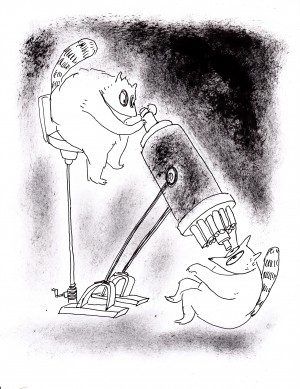
Rumpus original art by Jason Novak.




11 responses
What a stunning glimpse inside and outside of ourselves this provides.
Online, people say IRL—In Real Life—the distancing code of it hiding the underbelly of need. In Real Life is where awkward pauses live. I’m in real life with onion breath and too many drinks. I’m a million failures per revelation; I’m not just constructing myself but absorbing each reflection of who I am – divided by all of your eyes, spinning like a disco ball.
I think that betrayal is a complicated word. I think it’s “I want to tell you who I am but if I do, this magic of being myself, a man among men, will disappear because you have made an assumption about who I am.” That reflected idea-the disco ball.
Thomas Page: I’ve been following your self made articles and this one is particularly articulate. You have always been such a beautiful writer- you are always just you- trapped or not trapped,man or woman, gay or straight, black or white- we are all so simple and complex in our humanity- the important narrative you bring up is the relating on that level.Thank you for writing it so well, to have your voice in the world is a gift:)
I have been following your articles since the beginning and have found them quite warm and well written. That said, as a trans man I also find them slightly off-putting. I respect your point of view and agree that there are more narratives for trans-ness than 1. However, you speak only from one narrative yourself. The born in the wrong body narrative is narrow, but, could use some delving into. You seem very open minded and compassionate, and, are a very good writer. Maybe you could use one of the forums you write for to interview other trans people on their narratives and use your strengths to really open the conversation to a wide breadth of narratives. I’ve read your pieces about trans people being mis-reported and reported on by people who don’t quite have a baseline understanding of the issue. Clearly you are doing your part by reporting your own very different narrative and that is commendable. But, you’re smart and you’re reporting in the media, how about you report on the many narratives you speak about? No disrespect, brother!
This one floored me. That is all. Thank you Thomas.
Thank you for reading and talking to me, folks. I really appreciate the time you take in writing these comments. Bob Doe, to your point: I know how frustrating it is to not see your story out in the world, and that’s why I tell my own–I didn’t connect with any of the narratives about my body available to me. I know some trans folks really feel that “born in the wrong body” is their story, and that’s great! I just don’t, and we live in a culture that’s latched onto that one perspective above all else, which is always detrimental–we need diversity in narratives. Overall, I’m inclined to the personal–it’s my nature, as a writer and a human being. I don’t speak for anyone else, and I try to be very clear about that. As an editor and journalist, I’ve certainly covered issues important to trans folks, but as an artist I’ll always be wired this way–I see from the inside-out, and that’s how I tell my story. I hope everybody sees a little of themselves in it, and I hope that doing this work does makes even a small amount of difference to someone who, like me, didn’t see themselves anywhere. I hope that you feel even a little seen here–and if you do, I feel I’ve succeeded.
All net, Tommy, from the top of the key.
It’s not that I didn’t see myself in your narrative, that’s not what upset me. The only thing that upsets me about any of this is the fact you felt a need to change your actual body and posing body changes as a valid way to approach gender expression. I think that’s really dangerous. I also feel that as a MOVEMENT, the transitioning f2m queers are reinforcing the sex/gender conflation, undermining the work of feminists, and betraying other dykes who need them. It seems so me-me-me, and it seems so White. Like, privileged. Like, ya’ll have all this time on your hands, all this education, and money too… so it’s all an interesting game to you, and a journey. Whereas women are born into oppression, and are fighting something they didn’t CHOOSE and can’t escape. So, you feel you’re doing good in the world to tell your narrative, and maybe you are. But good intentions aren’t everything.
Just one thing (about a fragment of your great piece): I’m a woman (biologically born as such), and I can tell you that almost every time I was told something like “you’re a woman… you know”, I’ve felt really uneasy. Those are stereotyped phrases, used mostly between strangers and-or acquaintances. And I’ve often thought that the persons who utter them do so because they feel that you can’t actually relate to them. They cling to the only, basic and shallow common ground they can think of. I see your point: if ‘you’ link your uneasiness to your gender identity, your gender identity is linked to your uneasiness. But maybe – in this case – a non-trans narrative could help a bit: non-trans can feel just as discomforted having to pretend to “know” what one means just on the basis of shared biological gender… anyway: thanks very much for your writing, is enlightening!
To Bob: I am not a dyke. Never was. And transitioning has made me so much happier in my body. It has also made me a better feminist, since I’ve had to learn to be more active in how I support feminist concerns (instead of just having the world assume I’m a feminist because I was a masculine-looking woman). I don’t see how my transition hurts lesbians, or feminism.
Forgive a stupid question, but is there a Self Made Man #18? I would like to collect the full set. Skipping a number is cool, OuLiPo messes with my head way worse than that, but if it’s just an internet glitch (or “user error”) that I can’t find the essay before this one, please help.
(I will also deal with the content, but process comes first with me.)
Stunned by Thom’s writing and thank you all in advance!
Click here to subscribe today and leave your comment, or log in if you’re already a paid subscriber.