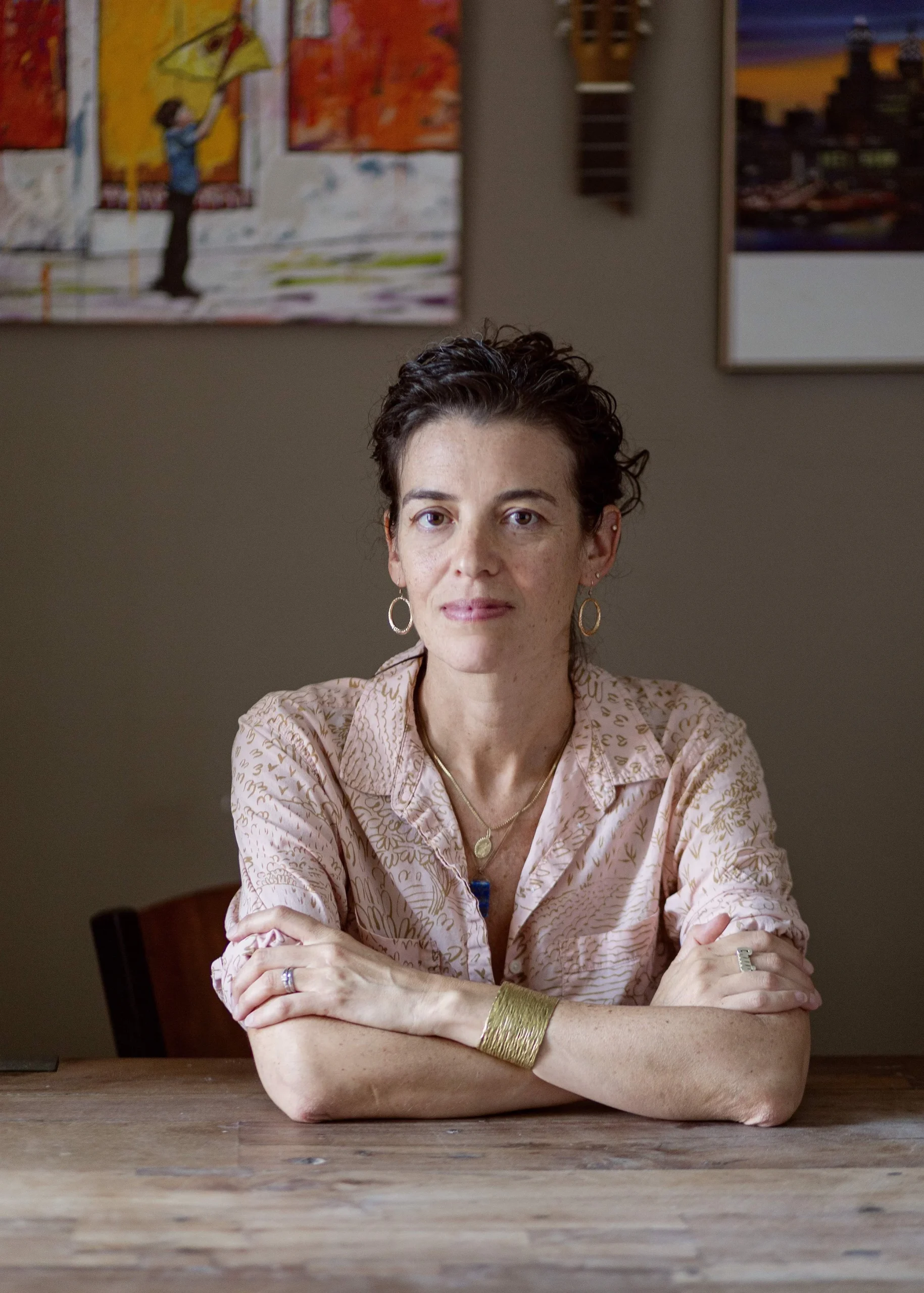
Chances are Quiara Alegría Hudes’ work has graced your cultural radar. A Philadelphia native, she’s a creative who wears many hats—as a playwright, musical producer, memoirist, and now novelist. In 2012, her play, Water by the Spoonful, won the Pulitzer Prize for Drama. The musical, In the Heights, which Hudes wrote, and Lin Manuel Miranda scored, received critical acclaim, thirteen Tony nominations and won four, including Best Musical.
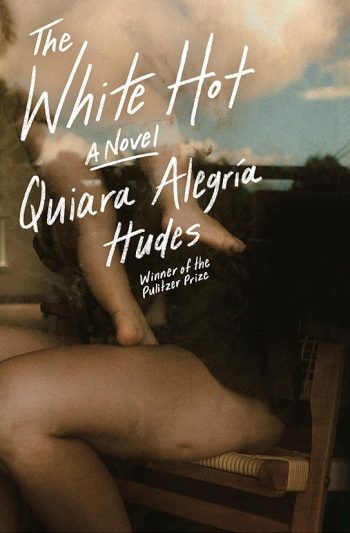
Regardless of the format, her work deals with themes of womanhood, family, Latinx culture and identity, often focusing on the strength and determination of women and their fierce bonds to one another. Her unflinching lens never shies away from the female body in all its glory and squalor, which makes the cover of her latest book all the more perfect.
Her debut novel, The White Hot centers on April Soto, a young single mother, who leaves her ten-year-old daughter and takes off without a plan. Though a slim book, this compelling story testifies to all the varied turns a life can take and the unexpected intersections with strangers that can change a trajectory that once felt irrevocably stagnant. It’s a story that challenges traditional ideas of what loving a child looks like and what it requires of a caring parent.
In early September, I had the chance to converse electronically with Quiara Alegría Hudes. We ruminated on creative instincts, the role of music, time as a luxury, and what it means now to be an American.
The Rumpus: You’re such a creative person who has worked in so many different forms and mediums. Can you talk about your process in deciding The White Hot would be a novel and not a play?
Quiara Alegría Hudes: Plays deal with how people behave, but on the page, there’s access to a vast interiority. Plays peddle in what people say to each other, centering fleshy human bodies onstage. That’s the form. Novels address perception, how people experience the bodies and behaviors, the world around them.
April’s moment of spiritual revelation would be tricky to dramatize. In The White Hot, there’s a levitation—it’s not confirmed, but it is… felt. April has a consuming, if transient, glimpse of the divine. I don’t know how to stage that without mocking it or making a spectacle of it. But on the page, a reader can take April’s accidental spiritual discovery on their own terms. I was thinking about [James Baldwin’s] Go Tell It On the Mountain’s floor sequence—a sacred fire ripping through her. April describes how it feels rather than stating what literally, physically happens. It is very hard to dramatize something tiny onstage. But on the page something microscopic can contain magnitudes of consequence—not to mention time.
The playwright’s basic unit is time. You’ll have two hours of the audience’s time. You are forcing an audience to experience the play at the same rate, together. On the page, the reader can step away, pause, reread. The experience of time is personalized. This was also helpful in the passages that deal with violence and spirituality because I think it’s something readers might want to take at their own pace.
Rumpus: Once you knew it would be a novel, how did you land on the epistolary form? Was it a case of trial and error, or was it more instinctual?
Hudes: April gets into street fights. Despite her intellectual talent, she dropped out of high school. With a third person narrator telling the story, I would’ve felt obligated to balance April’s perspective against others, to contextualize her thorniness, especially in light of Noelle, the daughter she abandons. The letter format allows April to be an unreliable narrator; in fact it capitalizes on her wild and intense point of view. It’s immersive. The reader is put in the position of the daughter—the recipient. Really, it was a challenge to myself: “Can I write a ‘bad mom’ that I still root for, that I even grow to care for?” I was curious to see how different people would react to April. My husband read it and felt strongly that April had saved her daughter. My daughter read it and was more conflicted about April’s abandonment. The letter format allows for this wide range of readings.
Rumpus: Speaking of instincts and intuition, the reader learns at the novel’s opening that four generations of Latinas are living under one roof. It’s captured in Noelle’s drawing Our Family Homes. Talk about the choice to focus on four generations in such a slim book.
Hudes: In the Philly [Puerto] Rican community of my youth, there was no standard family structure. Multigeneration households were common. Single parent households, too. A cousin might come from the island and live with you for a year or five. And, of course, you saw traditional two-parent households, though admittedly I regarded those as unicorns. The benefit of multigenerational homes was that gatherings were lively with kids and elders dancing together, plus childcare, financial planning, and elder care had a collective structure and workload. The downside was that one’s individuality could be subsumed within the collective. So, in The White Hot, April is a young woman who’s never gone on vacation or even spent a night away from home, whose development is arrested, because she has been completely dutiful to her elders to the point of self-erasure. Their tight quarters haven’t allowed them space to process the violence in their history—they’re too cramped together, too closed in. They’ve borne witness, but they surround trauma in an almost sanctified silence. These ladies need to throw open the windows and breathe a bit.
Rumpus: April’s journey once she boards a bus is so wildly unpredictable. You take the reader on quite the escapade. Did her character tell you where she wanted to go?
Hudes: Bits and pieces are repurposed from my own travels. The blisters—I’m an avid walker and the wrong footwear—sandals—on a hot day have shredded my feet. The waterfall—that was inspired by an Italian geologic feature I saw where water gushed into a subterranean abyss that struck me as nothing less than the earth’s gullet. The bears—I have seen them climb trees just like April sees. Cubs with cute round rumps high up in the branches, gazing curiously down at me as if I, the wild creature, was quite a sight to behold. The sounds and light before sunrise. I experienced that while camping in New York state, before dawn. I woke up and the sky, seen through my tent’s mesh roof, was still dark yet silvery with a glow that seemed alien and sentient, and the bugs and birds around were riotously loud. The volume shocked me.
[Some are g]limpses from my own travels, but I didn’t plan those stops on April’s path. I followed her feet, just as she followed her own. As April heads into the woods—the first nature walk of her life—it’s as if her feet are compelling her deeper in, rebelling from her brain, which wants her to turn around and head home. She’s taking directions from a part of herself she’s unacquainted with, her instincts. Her domestic duties have cut her off from her more primitive instincts.
Rumpus: A tenderly explored aspect of this novel is April’s understanding that she didn’t have access to time in her youth to develop herself or her interests. She learns this when she meets Kamal and begins to while away hours listening to Charles Mingus albums. Did your experience with In the Heights inform April’s relationship to music?
Hudes: Honestly, I think In the Heights sits on one end of my work’s spectrum and The White Hot sits on the other. They both explore family and multi-generational living, a common theme across my work. But In the Heights centered and celebrated collective spirit and striving. Whereas The White Hot explores the urge to strike out on one’s own, to escape home and define yourself away from the collective.
Music is my training and background. I grew up a composer and pianist. The second I got home from school, I threw down my backpack and sat at the piano. The mailman could come about an hour later and knock on the door and give me a thumbs up. I might be playing Mozart or plunking out a Phil Collins ballad on the radio. Now, any empty space strikes me as a practice room, full of potential music. All those hours alone thrill me. Writing is a natural extension of this.
Musical forms have influenced my approach to narrative structure. For instance, I wrote a play about the history of Puerto Rican men and women serving in the US military. I was imagining a Marine in Vietnam—his experience placed side by side against a Marine in Iraq. Where would these two storylines join in unison, and where would they diverge in inversion or variation? It struck me that Bach had already created a form like this with his fugues. Bach stated a musical theme, and then echoed it above or below the original statement in an additional voice, and these parallel threads clashed or lined up. That’s the form.
[In] The White Hot, April goes on an intense and improvised journey, one filled with rage, spirituality, sex, curiosity. So, I’m in creative mode, the whole narrative’s knocking around in my head and Mingus comes on the radio. Because my daughter’s a bassist and she’s studying it, I thought, “Bingo, this is the musical form.” Mingus really walks a tightrope between chaos and control, and at the moments when his ensemble becomes unhinged, the song is the most thrilling. I tried to structure April’s narrative as a Mingus album, but you’d never know it reading the book. Those are just secret process tricks that gave me ideas about variation, tempo, emotional temperature.
Rumpus: This isn’t within the pages of the novel, but which musicians would April be listening to as she matured, away from her family, working, and finding herself?
Hudes: Karol G. Ivy Queen. Chuwi. Joni Mitchell. I suspect April’s love/hate relationship with Mingus continues to this day. But I think what’s really playing in April’s headphones now is audiobooks. On her journey, she meets a librarian and reads the first feminist book of her life. This is crucial for April to find her artistic mothers. This unlocks a freedom. It gives her permission to go her own way, even though the price tag is steep.
Rumpus: Kamal says, “Yes, April, you are American.” This affirmation comes as a shock to her. Can you talk about that exchange, both your thoughts while drafting it and perhaps what it means now in the midst of sweeping ICE raids, impacting the Latinx community.
Hudes: Kamal’s casual observation—that April is American—shocks [her]. She’s never been accused of such a thing! He’s born and raised in India, so he thinks, “She’s born here; this land is hers.” But in April’s experience, being a first-gen Puerto Rican born in segregated Philadelphia, an invisible border has always separated her from the broader culture. Then, the further west she travels on that Greyhound bus, the farther from Philly she gets and the whiter the landscape grows. On the road, she passes a pickup truck with four large, hand-sewn (not printed) Trump flags, one poled to each corner. She takes their glistening presence as a form of warning. Is she safe here?
Kamal proposes a different definition of being American, one that shifts the center toward Blackness and migrant communities, one involving Mingus’s musical confrontation. To Kamal, Mingus’s jazz critiques and counters America’s history of racial violence. It plants a different flag, a wild sonic one, claiming here lies this nation, truly. He’s an Indian immigrant who truly understood this nation, his adopted home, when he studied Mingus. As April and Kamal grapple, a seduction happens.
A passage from Jamaica Kincaid’s Autobiography of My Mother comes to mind. The young Xuela Claudette Richardson says, “Whatever I was told to hate, I loved and loved the most.” She is rejecting the colonial interpretation of her body as vile and repugnant, as a source of shame. She’s taking pleasure precisely where she’s told not to.
April is taught to hate so much about herself. At school. At home. On the news. She is taught to fear. So, her decision to journey inwards, to get to the bottom of who she really is, it’s a refutation of this country’s bigotry, sexism, and violence. For Xuela, this rebellion comes naturally. For April, it’s hard work and costs her nearly everything. But it’s still worth it.
Rumpus: One of the most interesting parts for me as a reader was April’s interaction with a librarian. She comes away learning about other mothers who have left. Did this historical lineage give her tacit permission to continue her solo journey?
Hudes: April has no idea if mothers have ever left their children. She comes from a neighborhood where fathers leaving is so commonplace as to be mundane. Then the librarian tells her of Joni Mitchell putting a baby up for adoption. Of Sethe murdering her own child in Beloved. Of Xuela Claudette Richardson [narrator of The Autobiography of My Mother] self-aborting. April learns of Medea killing her own children in a misguided act of revenge. These “bad moms” give April a new lineage. Perhaps a scorned one, but she knows she is part of something, that her taboo urges have been felt by others.
Rumpus: When April first encounters her ex, Edgar and his new wife, Joanna, she says, “I want a decade.” This relates to her sense of lost time. You give her eight years initially, which is more time than Siddhartha had to wander before his enlightenment. Was there a parallel in their journeys for you?
Hudes: Ooh, that sentence was so hard to write! “I want a decade.” Four words, but damn did they rock me! I ugly cried. I said, “Here we go, she is getting to the meat of it, she is saying the single most awful thing a mother can say.” But the honesty—I wept for April as I wrote that, because I realized that she has never voiced a true desire, not once in twenty-six years. Therefore she’s never developed the muscle memory to even recognize a desire in the first place. I knew the book at that moment. That it was about what happens to women who no longer recognize their own desire, about the stunted ability to yearn at all. And then suddenly April musters the courage; she holds herself to a high standard of honesty. I know those four words took everything for her to say. And Edgar can’t deny her because the demand is warranted! April wants what he took so easily, with no social repercussions. She wants time. He got plenty of it; he got years. He left her with a baby to raise.
Rumpus: The phrase “the white hot” appears nearly a dozen times throughout the novel. April’s journey sprawls out into uncommon locales and yet this phrase pops up again and again like poetry. Why was the repetition important to you?
Hudes: April refers to her recurring episodes of rage, stress, and overwhelm as white heat, or white hotness. A bright burning sensation of electricity flows through her, nearly blinding her vision. She’s used this tremendous energy to protect herself on the streets at times when she’s been threatened or bullied or humiliated. But April’s eager to transcend this cycle of anger.
This morning, I met a bookseller at Oblong Books named Frederick Rossero, who shared their interpretation of April’s white-hot rages, which they felt were her suppressed sorrow manifesting as incandescent rage. Indeed, April’s most destructive tendency is bright and energetic, so her quest is to see if that power she carries within can be harnessed, can be put to new and better use.
I had a debate with my Buddhist neighbor, because I said that anger can be productive at times. I believe April’s anger is a misguided experience of, and expression of sacred energy. My Buddhist neighbor said, “No, anger is never productive.” I wonder. I thought about this debate a lot while writing.
Rumpus: The White Hot and My Broken Language are undeniably in conversation with each other. For readers who might be encountering your books for the first time, describe them in five words.
Hudes: The White Hot: escaping in order to live
My Broken Language: my Philly Rican multilingual grrrlhood
Rumpus: The ending of the novel is tense and evocative. It includes this heartbreaking description: “The daylight created a mirror effect, so she had to look through her own face to see inside.” Were you carrying that ending with you for a while, or did it surprise you?
Hudes: I rewrote the ending a number of times, but that sentence remained through each draft. A woman looking through her own face’s reflection to see into someone else’s apartment. That was the DNA of the conclusion. The rest of the ending had to match and honor that simple image.
Rumpus: Can you leave us with a fun fact about your process or inspirations that readers might find amusing?
Hudes: Twelve years ago, I was asked to write a stage musical to Alanis Morisette’s Jagged Little Pill album. I dreamed up the story of an angry young woman who falls in love and goes on a spiritual quest in the wilderness. When the director came on board, she wanted to go in a different direction, so I left the project, took my story with me, and kept developing it. Over a decade, it became The White Hot, pretty unrecognizable from the original source of inspiration. A failed musical became something deeply personal: my first novel.