
My family was recently out of town for a five days, leaving me home alone with over 800 pages (no exaggeration) of student work to read and comment upon. My reward for getting through a day of writing about free indirect style and character arcs was to watch a lot of movies, both in the theater and at home, cranked up loud on the home system and with a fuckin’ beer in my hand. Here’s how those five days went.
Saturday:
Inglourious Basterds. 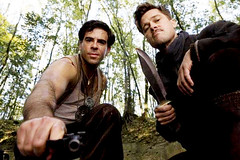 By now you’ve probably read lots of commentary on Tarantino’s latest. My two cents is that I could listen to those characters talk all night. It felt like a 5-hour movie in a 2 1/2 hour movie’s body and I wanted it to go on and on. A few weeks ago I happened upon a Sirius/XM radio broadcast in which Tarantino guest-deejayed. He played songs that he’d listened to while making Basterds. Here’s the complete set list.
Wu Tang Clan, “The Rulez”
KT Tunstall, “Hold On”
Bob Dylan, “Political World”
Barbra Streisand, “Stony End”
Robin McNamara, “Lay A Little Lovin’ On Me”
Sir Douglas Quintet, “Mendocino”
David Bowie, “Cat People (Putting Out Fire)” – from Bowie’s Greatest Hits (not Cat People Sdtrk)
Jay Z, “S. Carter”
Roy Orbison, “There Won’t Be Many Coming Home”
Jason Mraz, “I’m Yours (Acoustic)”
Maroon 5, “Wake Up Call”
Steve Poltz, “Waterfalls”
Britney Spears, “My Prerogative”
I happened to tune in at the end of the Roy Orbison tune. I can respect people who like Roy Orbison, though to me he was always little more than an immobile wax dummy who occasionally purred. Wow, rock and roll, man. As someone who lived off the Pulp Fiction soundtrack for years, I am, like a lot of people I suppose, inclined to give Quentin Tarantino the benefit of the doubt when it comes to music. But there’s really no other way to say what I felt except that I thought his playlist sucked. That “Waterfalls” song is an acoustic cover of the TLC hit from the mid-nineties. I’m going to stop writing about this now because it’s starting to make me upset.
Sunday:
Waltz with Bashir.  Animation is a great medium in which to explore the elasticity of memory. And even though both Basterds and Bashir are both about war, I think it’s fair to say that only the former one is a cartoon. Waltz with Bashir was a sobering plunge into repressed memories of war, and of the strange juxtapositions of cultures in wartime. Amid animated sequences of bombings and ambushes, the voice of John Lydon suddenly erupted on the soundtrack, singing “This Is Not a Love Song” from his PiL days.
Paprika.  Another animated feature, this one from director Satoshi Kon, based on a story by–I didn’t realize this upon renting it–Yasutaka Tsutsui, whose story collection Salmonella Men on Planet Porno I picked up not long ago. While Bashir uses animation to illustrate untrustworthy memories, Paprika seeks to do the same with dreams. There’s so much crammed into the frame with this film, my favorite sequences being a procession of animals and objects marching along through various characters’ subconscious minds.
Monday:
The Holy Mountain, by Alejandro Jodorowsky.  I’ve blogged about this film before, and about Jodorowsky in general. For my second viewing of this film I invited my old friend Nate over. We drank Corona and tequila and kept an armchair commentary going through the Chilean auteur’s steady unveiling of wonders. I was impressed again by how ballsy the film is. In my head I’ve been attempting to reverse engineer the directions Jodorowsky must have given his crew. Like, “I want the amputees dressed like Roman soldiers to assemble in the Jesus factory.” Or, “Let’s make sure each toad has a firecracker under it.” Or, “Let’s get some climbing gear for the prostitute and her chimpanzee.”
Tuesday: Death Proof, by Quentin Tarantino. This was the only Tarantino film I hadn’t seen. So I watched it. It was cool, whatever. Great car chase at the end, one of the best I think I’ve ever seen. The bonus features are worth checking out, particularly the featurettes on the stunts and those who performed them.
Wednesday: A Scanner Darkly. My animation streak continued with Richard Linklater’s rotoscoped adaptation of Philip K. Dick’s paranoid drug novel. I think this movie helped me figure out what the problem is with Keanu Reeves. 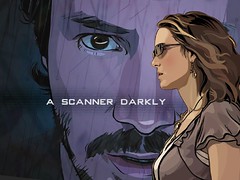 In any movie in which he’s required to get all fired up he ends up looking ridiculous. He is not an actor made for big, hysterical speeches. That actor would be John Malkovich. What Keanu does best is simmer and lope through a movie. I’m thinking of his great performance as Scott Fortune in My Own Private Idaho, which he’s never matched in my book.
Man on Wire: My five-day movie binge came to an end with this documentary about Phillipe Petit, that French dude who crossed the chasm between the World Trade Center towers on a tight rope. Completely riveting and unexpectedly emotional, and the perfect note with which to end five days of student fiction and movies.




3 responses
Just a correction: Keanu Reeves’ castname in My Own Private Idaho was SCOTT FAVOR. It doesn’t sound good using it wrong towards your students….. 😉
Gaia: You are absolutely right. Lousy fact checking on my part. Scott Favor it is. –Ryan
Ryan, that list of songs from Tarantino is just shocking! Shocking! Jason Mraz is everything that’s wrong with music! However, instead of wasting time on that subject, I want briefly to attempt to rehabilitate Roy Orbison. It took me a long time to get it, to get him, but then I really got it, and the turning point, for me, was the “In Dreams” section of BLUE VELVET. Since you are a movie-drenched human, I suggest rewatching the sequence (it’s the part where Dean Stockwell lipsynchs to Orbison). I had heard Orbison many times before (and I remember puzzling over Springsteen’s obsession with him, when I heard “Thunder Road” for the first time in my teens), but when I saw this film, or when I was first bludgeoned by this film, I suddenly got the surrealism (and I mean the word literally) in what Orbison does. What’s upsetting and fascinating about him is how much is going on underneath the spooky countertenor passages. It’s all dark. Very very dark. And very vulnerable. A falsetto is meant to be angelic, of course, but often the guys who sang those lines, in doo wop, let’s say, or in the Beach Boys, ended up being the darker scarier guys, as if to compensate, and that’s sort of how I think about Orbison. The slightly unnatural voice is out of character for the material, and “In Dreams” is a good example. He doesn’t mean, you know, romantic dreams. He means the violent, disjunctive chaos of real dreams, which is why Lynch used him in BLUE VELVET. I say go back and watch that passage, and then try listening to “Running Scared,” which has to be, by my lights, one of the very greatest early rock and roll singles.
Click here to subscribe today and leave your comment, or log in if you’re already a paid subscriber.