
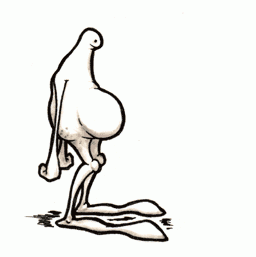
According to your average weight-height chart, I’m “obese”: six feet tall and 250 pounds. I should be, according to these charts, somewhere between 140 and 180 pounds. I tell my wife this and her look askance suggests that either I am what they say, and she’s worried; or “they” are crazy. I think the latter is more likely, because if you were to ask my relatives, friends, and doctors throughout my history, I’m “big boned,” “barrel-chested” “chubby,” “chunky,” “heavy,” and “husky.” But whatever “they” call it, I have been what I call “fat” all of my life.
I’ve also always been active and have not had abnormally bad eating habits. My parents were athletic, and stressed the importance of exercise. They were joggers. Between the two of them they’ve completed seven marathons. My sister’s finished two, just like my uncle on my mother’s side. I started running regularly when I was fourteen. I’ve yet to tackle the marathon, but I’ve run plenty of 10ks and 5ks, and the farthest I’ve ever run at one time was I think nine miles. I played baseball, football, threw the discus in track and field, and even played a little youth league basketball. My brother was perhaps the most talented of us Iredells in team sports, as he stole bases off pitchers routinely, and Rickey Henderson was his idol. And my brother should have been such a good athlete: he’s lanky and slender, all legs, and he highlights the difference in genetic dispersion among my siblings and me. Our sister occupies a kind of middle ground. In a family home video at the pool circa 1985 my mother remarks to my father that my sister looks to be “getting a bit of a tummy,” and she should “start jogging with mommy.” Before you get your hackles up about girls and body image, know that the same was suggested to me: in a photo I am about six years old, and I’m running down the street with my mother, in my own little “running outfit.”
I’m still a jogger. I run between three and five miles per day, at least five days a week, and this seems to do nothing but ensure that I’m in relatively good athletic health, compared to even some of my skinnier friends. But I struggle—as I have since I became aware of my own body—with who I am and what social pressures and medical experts say I ought to be.
My frame and proportions and goatee make me look like a stereotypical motorcycle gang member, but I do not own a motorcycle and even included a clause about never riding one in my wedding vows (there’s a whole other thing about my propensity to hurt myself that I won’t get into here).
My “heaviness” has to be due, at least somewhat, to genetics. On my father’s side my relatives are the clichéd tall, dark, and handsome—as I described my brother above. They’re all limbs and abs and strong jaws and dark hair. On my mother’s side it’s a different story. My aunts are obese: squat and round, topping 250 pounds a piece. My mother, contrariwise, is very normal: five feet, five inches tall, and for most of her adult life she’s probably been near 130 pounds. My uncle, my mother’s brother—the one who has completed two marathons, and whom I most resemble—has a propensity toward chubbiness, and recently endured double bypass surgery.
Whether or not this family history had anything to do with it, my parents did not feed my siblings or me unhealthy foods. We learned the virtues of a healthy diet and lifestyle. We lived in California, birthplace of fad diets and the health food craze. I’m convinced this is one of my mother’s reasons for salad-eating. I’ve heard mom ask a server what salads the restaurant serves and she adds to this, “We’re Californians,” as if statehood explains why she would like a salad, as only Californians prefer such fare. Once, here in Atlanta, on a visit to famed BBQ restaurant Daddy D’z, my mother, glancing over the menu, queried our server regarding the lack of salads. The server, a woman I’d known for some years at this establishment, and with whose wry humor and unabashed coolness I’d become familiar, looked unsmiling at my mother and said, plainly, “You don’t come here to get a salad.” However, that salad-eating habit passed my way and it is a foodstuff I’m drawn to. Still, I suppose that my genetics, despite any salad-eating, are what they are, and I remain “husky,” even if it’s true that I have lost weight before, though that was only because I starved myself.
People always talk about the “obesity epidemic” and getting up off the couch and getting fit. It’s like the First Lady’s social campaign, or something. And some brave women have talked about what it’s like to be fat, but hardly anyone talks about what it’s like for men. Recent Nike ads feature jogging fat kids—or try this: Google image search “plus-sized male models”—but still, there’s little talk by fat guys about being fat guys, and hardly anything at all about fat guys trying their fat asses off not to be fat.
***
Most fat people don’t get that way out of nowhere; they’ve been fat for years, if I use my own case as one example: I have been fat since toddlerhood.
I’ll never forget the first day of kindergarten, when I was afraid to leave my mother’s side at the door to the classroom, and she pointed out the other children, already playing and learning and doing the things that kindergartners do. I found Ben Wellesly, and we became best friends in elementary school. One of the reasons for that—I know it to be true—was that he looked like me: same pudge, same chubby cheeks, same dirty blonde bowl-cut hair. Other elementary school kids would call us the Fat Boys, or the Chubby Duke Boys (since The Dukes of Hazard was a popular show at the time)—anything they could think of to make fun of us for our weight, and the fact that we chummed about at recess and lunch, a chubby duo.
I also cannot forget standing in assembly at this same elementary school to pledge allegiance to the American flag, and when I stumbled and stepped on another boy’s foot and he said, “Watch it, fat ass.” The shame and embarrassment that welled up in me must’ve made my chubby cheeks redder than they already were with the freckles that freckled them. I wanted nothing more at that moment than to go home to my mother who loved me, who would hug me to her and tell me that I was fine, that I would grow out of it.
My crushes on girls began in the second grade, and I cannot forget being shunned and unnoticed, knowing that I was undesirable (I admit that this is somewhat ridiculous, since I’m talking about the second grade, but it was there, a palpable feeling of non-inclusion). I remember my own parents, talking to my doctors with concern (rightly so), but also admonishing me for my heft, encouraging me to exercise more and more and more. And, yes, my parents were telling me to exercise, because exercise went beyond “play,” this latter of which I did in abundance.
Then there were my siblings, both of them lean and tall, who also called me “fat” and “fat ass.” I was not only larger, of course, but older and stronger, and I used my mass to my advantage, saying things like, “If you don’t shut up I’ll sit on you.” But my siblings predictably turned this threat against me, making fun of the fact that my recourse to their teasing was to use my weight. And they ran faster than me, the skinny little shits.
Also, in the second grade a boy named OJ ran up to me on the playground, reached between my legs and squeezed my balls as hard as he could, and damn did that hurt. I don’t think he did this for any reason other than he was mischievous (he was always sent to the principal’s office, and had behavioral problems through to high school), and he made a sinister face at me while he squeezed and I gasped, and then he ran his skinny little ass away, far too quickly for my chubby legs to catch him.
I did have girlfriends, and I can safely say that—in retrospect—my lady luck has come as a result of overwhelming desire and perseverance despite my physical limitations. I’m not “hot,” as everyone seems to describe it these days. I am freckled and hairy and fat and big and I drink a lot of beer. I’m like a Viking. But in the third grade there was a girl named Marisol whom I wanted to hug and whose hair I wanted to run y fingers through. I hadn’t any clue about sex, but I knew I wanted these simple things and that was enough. My parents had bedside lamps that had cut-glass “crystals” that screwed in atop the lightbulbs, and this fixture I unscrewed and took to school, a sparkling gift to my Marisol. Marisol looked at this appliance-detached gift, from where she sat directly in front of me in our row at Castroville Elementary (Mrs. M’s class), and she looked bewildered. She didn’t know what this piece of glass was, or what she was supposed to do with it. I recall that she said thank you, but maybe she did not. Anyway, I have persevered and to this date I am successfully married and have produced offspring—proof that in life, at least from a Darwinian perspective, I am successful, even if I am fat.
In the fourth grade I migrated to a new school, a Catholic school in Salinas, twelve miles from the town in which I’d spent my previous elementary school years. I was the new kid, and I was white, and I was fat. I got made fun of for these things in reverse order: the first thing anyone noticed was my fatness; secondly my whiteness (most fellow-students were Mexican); thirdly, my newness. I spent the entire year at lunch and recess leaning against a pole at the edge of the yard in which the other children played.
Everyone farts, but it’s like a cliche, or something, that fat people fart a lot. I once had to fart in the middle of class. This was no usual fart; I could do nothing to contain it, and my theory was that I could cover up the sound with my voice. We had read John Steinbeck’s The Pearl and my teacher, Sister Martinez, asked for a student to describe the titular jewel. I leapt from my seat, arm in the air. I was called upon. I yelled my description, and since I was a dork it was probably something like, “A pearl is a piece of rock or silt that has invaded a mollusk and the oyster has coated the grain with layers and layers of calcium that makes it smooth and shiny,” and throughout my loud explication I also emitted a continuous and enormous fart that no matter how loud or eruditely I talked could not be masked, and my classmates giggled. Sister Martinez tried not to, but did anyway. So you can understand that in the fourth grade, as often as was possible, I was sick or faked it so that I didn’t have to keep going to school, and at the end of that year my parents agreed when they asked me if I’d be happier back at my original school, and I said yes.
Looking back at my experiences at that school where I thought I’d be happier I see the extent of my appetites. The schools in Castroville were public schools and so had school lunch programs and cafeterias, but I was not on a school lunch program and my mom packed my lunch into a lunchbox (ones that depicted The Dukes of Hazard’s “General Lee” and assorted characters, or the Millennium Falcon, Han Solo, Luke Skywalker, etcetera) and later, as I grew up from using those, plain brown paper sacks. And I remember the thermos-fulls of milk that came with those lunchboxes, and the lack thereof when I toted a sack lunch. The milk in those thermoses was beyond room temperature by lunchtime—not very refreshing, and not at all appetizing. I always wanted something cold to drink, besides water, and those school lunch kids each received, as part of their lunch tray, a cup-sized carton of milk, and many of those kids never drank it. I could’ve bought my own milk for a quarter, and I often asked my mother for this allowance before school each day, and sometimes I fished it out of the jug my father kept atop his bedroom dresser for the change he dispensed there.  But, more often than not, there was no quarter in that change jug, and mom hadn’t one to give, and also she asked me what I needed the quarter for, when I had a thermos of milk already. I always asked. I never stole, or took the milk, and I never pawed it out of the trash like some bear cub. But I remember more than one boy, tired of me asking every day if he was going to drink his milk, pushing it to me across those cheap formica-covered cafeteria tables, and saying so that all his friends seated around him could hear it: “Just take it, and leave me alone. God! You ask every day!” And my face burned with shame at those times because I knew already that I was fat, and that this was an exhibition for these boys, because they laughed.
When I did get that quarter, it quickly cha-chinged up to two quarters. This was in the sack lunch era, when I would not have a thermos at all and mom provided for said desired milk purchase. But, then at the morning recess when the lunch ladies provided more milk (plain and—ooh, chocolate), and some days tapioca pudding, some days donuts, some days cinnamon rolls, I wanted that, too. My begging a quarter from my parents got to the point where my mother gave me a talking-to, explaining that when I did that everyday it was coming out to $2.50 each week, when my parents had already budgeted the week’s groceries that were where? At home. And I was at school, I reasoned. “You don’t need all that,” my mother said. “It would do you some good to eat what we give you.”
My father is a men’s clothier and, due to my fatness, I grew out of the kids section at the local department store earlier than expected. Dad brought home jeans for me to try on and which he marked with chalk for the hem. What always happened, though, was that he asked me to put the jeans on, then he told me to turn around so he could examine the fit. Then he’d put his fingers in the waistband and tug to see how much room I had there, and sometimes he’d say something like, “Up to a 32 now,” and this was what made me hate needing new clothes, and made me hate my father just a little bit.
I also hated going to the beach, which was inconvenient since that was where I lived, growing up as I did on California’s central coast. It wasn’t only baring my shirtless girth. My legs were chubby and rubbed together at the thighs, and when sand got up in there, well you can imagine; the chafing was awful. It was so bad once I had to walk with my legs spread as far apart as possible when we were leaving Sea Cliff Beach near Santa Cruz. We were walking the boardwalk back to the trail that wound up the cliffs to the parking lot, and some teenaged surfer dude passed me by and said, “You walk like you got a stick up your ass.” I almost broke down bawling then. Dad was walking ahead of me, carrying the beach towels and cooler and whatever else we’d taken with us. I wonder if he heard that boy, and if he did why he didn’t say anything. I remember complaining to him about the pain between my legs, but dad was always stoic (when I was sick all those times in the fourth grade Dad would force me out of bed, saying “Just get up and brush your teeth and that’ll make you feel better; you’re not missing school”) and he told me that I had to walk because he wasn’t carrying me. I was too heavy for that. Maybe dad hadn’t heard that teenager. Or maybe he had, and he was walking ahead of me to distance himself from his walking-like-he’s-got-a-stick-up-his-ass son, because my dad was embarrassed to be with me. Maybe.
Even with my parents encouraging me to keep a healthy diet the house was not without its entrapments. There is a sweet tooth gene buried somewhere along the strands of our DNA. There was a cookie jar, kept on the counter under the cupboards. Sometimes packages of individually wrapped cupcakes sat in the pantry cupboard. It was around this time, between fourth and fifth grade or thereabouts, that I stopped staying after school with Jeanie Larsen, the old woman who provided aftercare, and I began walking home from the bus stop on my own to a house without adults, for my parents would still be at work. And so those cookies and cupcakes sat there waiting for me and I would gather them up with glasses of milk (2%) to watch my Scooby-Doo and GI Joe and Transformers cartoons before I started my homework. Upon looking into the nutritional information for a single Little Debbie chocolate cupcake I see that they are loaded with four and a half grams of saturated fat, eighteen grams of sugar, and six percent of the day’s allowance of sodium. All packed into 180 calories. It wasn’t uncommon for me to scarf down two or three of those suckers in an afternoon, and along with glasses of milk (at 122 calories a cup), my afternoon “snack” could easily be more than 600 calories.
By the sixth grade physical education was required, and one of the first things my PE teacher did that year was take all of the students’ measurements. I waited in a terrifying line that ran out of the trailer that served as the PE teachers’ “office,” set aside from the school’s regular buildings, and butting up against the basketball courts, courts into which this line snaked, and I waited interminably as my teacher called out each student’s height and weight to a student assistant who recorded the info in a ledger. It’s predictable, of course, what would happen, and I knew it then: my turn came, and the PE teacher called out my height and weight, made no comment or face, and said nothing more, but my classmates got a giggle out of my 160 pounds. I turned red with embarrassment and left that trailer, and—obviously—never forgot about it.
***
You can see that, with my parents’ and PE teachers’ exercise and insistence thereon to me and my siblings, their language (like my mother telling my father about my sister’s “tummy,” and my father once told me to watch what I eat because otherwise I’d get really fat, like those people [and here, wherever we were, he indicated said people as an example of what I could become and this example was someone morbidly obese] and I didn’t want that to happen, did I?), but with the temptation of foods that would assure not only the persistence of my chunk but contribute to its expansion, I developed the requisite shame that accompanies the carrying of extra weight, and this shame carried over into other emotions.
My fatness has propelled me to violence. Times when someone has uttered a “fat ass” or a “tubby” my way and all the pain and frustration and embarrassment I experienced in childhood welled back up again. As I’ve said, I’m not immobile, and I’ve hurt people: broke an arm once, nearly asphyxiated my brother, pummeled a frat boy, and once told a bum in a park in Midtown Atlanta, when I was jogging—my finger pointed inches from his nose—that if he didn’t want the cops trying to identify his stinking homeless ass that he’d better just shut the fuck up.
When still a kid, older boys who lived in my neighborhood, teenaged boys who drove and rode in pickup trucks, who had greasy long hair, and who ollied on skateboards at the end of my street, called out to make fun of me as they passed me by in their pickup while I was walking home. I guess I’d had it with people calling me fat ass, so I threw a rock at their truck, with my aim meeting its mark. The brakes lights flared up, screeching of tires, and teenage boys leapt from the pickup’s bed and ran towards me. I was scared, but defiant, as they circled me. The driver was the kid who lived at the end of my street, and he had buck teeth and long, stringy hair that fell to his shoulders. He always wore a nylon parka vest, or a jean jacket plastered with heavy metal bands’ patches. These boys shoved me around, and this kid with the teeth spat on me. They called me the typical: fatty, fatso, tubs, pussy. While they didn’t beat me up, after that encounter I started carrying knives. And it happened again, just like the first time: those same kids drove past me on my walk home from the bus, and more insults hurled my way, and I hurled a rock back. I missed this time, but they had seen me do it, and they again jumped from the car to confront me, and this time I was ready. The looks on their faces when I pulled the hunting knife from my backpack: most of them just ran back to the pickup truck. That leader kid seemed stunned for a moment and didn’t move. Maybe he didn’t want to back away from a thirteen-year-old. But eventually he did, and the power it gave me was a drug.
In high school I grew taller and played football, which required more exercise than any sport I’d ever played. I lifted weights, and dated girls. I was popular. I didn’t get into many fights. There was only the one, my freshman year, the fight where I broke the kid’s arm; what caused the fight is beside the point, but in the course of smack-talking, this kid called me a “fat piece of shit,” and some unbridled rage drove up from deep inside me, from all the years being called fat by people I didn’t know and by people who were closest to me, and I pushed this kid hard away from me and into a wooden fence post, hard enough to snap one of the bones in his forearm.
In high school I intimidated people, and friends said it was because I always looked pissed off. I’ve always been a brooder, not necessarily dwelling on bad thoughts, just thinking all the time, and that’s what I did as I walked the halls from class to class, or to my group of friends at lunchtime. But in person I was friendly.
Due to my heft my football position was of course on the line. I was never good enough to be an all-leaguer, or even a starter. Some of that was due to my timidity. Whenever I got into a fight I was scared, just like I got scared when playing football, because the game’s real violence occurs in what we called the trenches on the line. My line coach instructed me to pass block by getting the heels of my hands under the shoulder pads of my opponent, so that I could shove the pads up into said opponent’s throat in order to choke him. On defense they taught me to punch my opponents’ helmets near the earhole so I could “get their heads ringing,”  and knock them to the grass as I swam over them in my attempt to make the play. We cussed at each other across the line, made fun of each other’s moms, and—of course—called one another fat ass. At least on the line, though, we were all pretty big boys. The sting of an insult is lost when the person insulting your physicality looks more or less like you do.
While I ran and ran and ran and lifted and did innumerable exercises both while playing football and in the months leading up to the season to train for it, I never quite lost my gut.
***
In college I dated a woman who was probably bi-polar, because she had very erratic periods of happiness, irrational anger, and depression. On top of that we were both drinking heavily. Anyway, when we got into fights one of her go-to insults was my weight. She knew that I had once slept with another girl long before my girlfriend was my girlfriend. This other girl was also on the heavy side, and my girlfriend, who was skinny, athletic, a rock climber, would say, “I can’t believe you two fucked. That must’ve been quite a sight: both of you rubbing up on each other and grunting around.” You can tell that she also had insane jealousy issues. She also called me fat and a fat ass, and when I threatened to leave her she said things like, “Good luck. You think you’ll ever get a girl as good as me? Not with your fat ass. Who would want your fat ass?” And I lived with this woman. Once, as she berated me I begged her to stop yelling, literally on my knees, then the ground, as she stood over me in our kitchen and yelled insults and obscenities. When a friend happened by and rescued me, he took me to a bar, and we had beers and chicken wings and I felt much much better. Thanks, fried food and alcohol.
I broke up with that girlfriend and moved to other side of the continent. For the first six months of my relocation I was depressed, missing my west coast friends and family, so I spent every day in a bar, drinking Pabst and Jaegermeister, and eating burgers and tater tots. By New Year’s, when I looked at the family photos from Christmas, I realized that I’d blown up to the heaviest I’d ever been in my life. I had a visible double chin. I’d recently bought a new jacket, size 3X. I had not exercised in all that time. And, as times go, it was time for a change.
I starved myself, ingesting no more than one thousand calories a day. Morning: a bowl of Special K Red Berries with skim milk = 196 calories. Lunch: one apple and one orange = 157 calories. Dinner: a baked boneless, skinless chicken breast and a can of black beans or Bush’s Vegetarian Baked Beans = 620 calories. Each week I allowed myself one day when I could have whatever I wanted, and I allowed myself to drink alcohol. By the second week, when I went out for a big steak dinner, with a martini and glasses of wine, I couldn’t get through even half the meal. In three months I lost forty pounds.
I leveled out: started eating a little more each day and began jogging again. I started to date women. But I still never got to what I would consider “skinny.” And this is where I have to come clean and consider whether or not I have an eating disorder, body-image issues, both, or the potential thereof. Part of me wonders if I should have kept going with that lifestyle of less than a thousand calories a day. Would I have ever achieved what I think is “skinny,” or would I have starved myself to death? Or am I addicted to bad food and exercise and the combination keeps me in this chubby state of limbo?
It doesn’t matter. What matters is that I can’t stand it when those closest to me laugh about my weight, or my eating habits, or other bodily functions, and that’s probably a worse psychological condition. In a home video, watched at my grandmother’s wake, we’re eating a family dinner (looks like the Christmas prime rib), and I make a joke out of eating like I’m starving, shoveling the forkloads into my gaping maw. My brother, my childhood friend, even my wife, all laughed, said, Jesus, Jamie. And I was left burning inside, saying, “It was a joke.” And everyone was all like, Ah huh, a joke, right. You know you wanted to scarf down that meat slab. Truth is, I did want to scarf down that meat slab, but I don’t need you telling me that, because i already know, and apparently you do, too, so let’s all just shut the fuck up about it. But while I sound like I’m complaining about all these people who are close to me, I know it’s not their fault. They really are poking fun of me, and I know they do this because they love me. I’m the one who’s fat, and I’m the one who struggles with it, and that’s no one else’s problem but my own. Sometimes the requisite hurt that comes along with being fat has propelled me to drink, which of course packs the calories in, but makes me feel better. I know that I could lose probably twenty pounds quickly if I just stopped drinking alcohol. But I’m fat, not insane.
***
I mentioned my wife. We met, fell in love, married, reproduced. Here we are. I have a daughter now, and I think about those genetics of mine that I’ve poured into making her. My wife and I reiterate that we are committed to an active lifestyle and healthy foods. We try to get our one-year-old to eat as many fruits and vegetables as possible. But I can tell that the fruits are a lot easier, because the little one’s got a sweet tooth. I jogged four miles today. So far I have ingested a half a cup of nonfat Greek yogurt with about fifteen blueberries and a chicken salad sandwich. Dinner looks like it’s going to be homemade bean tacos. I’ll probably have a couple beers, and with the last sips I’ll take my low dosage of Lisinopril for my high blood pressure. Already the results of my heaviness have crept in on my health, though I continue to battle. It’s ten milligrams, and at my last checkup my blood pressure was so low the doctor thought I might be able to go off the medication completely. We’ll see. My day is fairly routine. Nothing outrageous. Probably around a two-thousand calorie diet. There’s a mirror on the sliding doors to the shower in my bathroom, directly opposite where I stand at the toilet to take a piss. It’s impossible not to notice my profile. I poke and pull at my gut, trying to see what I might look like if I were skinnier. I wash my hands, return to work. It’s like this every day. Part of being fat—or at least the kind of fat that I am, although I doubt that many other fatties haven’t experienced this—is everyone else, especially your loved ones, telling you that you’re not fat. Even my sister, when I mentioned that I wanted to write this, said, “But you’re not fat, Jame,” which is what she always calls me, “you’re just big.” Always “big,” “big boned,” “husky,” “hefty,” “barrel-chested,” whatever. Maybe to them I’m really not fat, even if, to me, I am. I’ve always been one who is great at lying to others, but likes to face the truth about himself. And that is that, plain and simply, I am fat, and I know that, and—I think, or at least I’m thinking right now—that’s okay.
***
Top image © Creatures in My Head.

22 responses
Jamie, an autobiography with refreshments – thanks for this. You are okay AND loved. And food issues are really world issues. So with your daughter try this – plenty of sleep and exercise. Cut down on the whites – flour,sugar,
and genetically modified grains ( even whole wheat).
Well, you already know the deal with alcohol but she shouldn’t be sucking down much beyond whiskey at this point (:>) Lots of water. Hopefully by the time she’s old enough to have high blood pressure the words healthy food aren’t an oxymoron.
Jamie, oh Jamie. Thank you!
Wow. This is great. And man, can I ever relate.
It’s the beer. You write repeatedly how it’s the one constant that you haven’t changed in all these years of trying so very hard. You’re running, eating healthy, and drinking beer. It reminds me of the Sesame Street song, “one of these things is not like the other.”
Bless you for writing this…absolutely loved it and related to it in so many ways…
It’s not “the beer.” It’s no one thing. The latest studies on obesity show that once you’ve gained weight, it’s not just difficult to get it off, it’s hard to keep it off, no matter what you do. As someone who is about Jamie’s size–two inches shorter, five pounds heavier–if I knew I could drop 20 pounds and keep it off by giving up beer completely, I’d do it. I’ve tried. It didn’t work. I got from 285 to 255 by changing my eating and exercise habits, but I started that 3 years ago, and I’ve plateaued. I’ll keep at it and get down some more, slowly, but what I’ll never be is thin. If I got down to 180, which is what those charts say should be my upper limit, I’d look like I had something terminal.
I know you didn’t mean this to come off as snippy, Linda, but that’s how it sounded to me. Don’t you think a heavy person has tried cutting things from their diet in order to drop some weight? If it were easy, we’d all be thinner.
You are awesome. Please ignore ANY comment that tries to tell you why you’re fat. It’s like reading about why you have the eye color you have, or why your fingernails are shaped the way they are. So, those of you here to comment about that, STFU.
You’re on a body-acceptance journey. It’s awesome. I totes recommend fat-positive blogs. They’re mostly female, but there are some guys taking part of the movement, too. Here’s one: http://itgetsfatter.tumblr.com/post/30963166224/asam-discusses-his-personal-journey-to#notes
Hugs, a female, 240-pound, hot, fierce & fat comrade
I’ve been working on an essay on this very topic for a couple of months, was kind of stuck but you nailed it.
And I’m with Brian…it’s not like we are lacking for well-meaning advice from people. We’ve lived with and have been trying to fix these bodies for decades. We’re not stupid. Weight gain/loss is very complicated and involves a lot more than just calories in/calories burned. We don’t need advice from skinny people or from people who once lost ten whole pounds, any more than an alcoholic needs advice from a non-alcoholic on how to cut back a bit.
“It’s the beer”…I completely gave up alcohol, hit the gym hard, watched my diet obsessively, and lost 50 pounds in a couple of years. Over the following 5 years, it all came back. Telling us the “simple” things we’re doing wrong is just reinforcing (at least for me, a skinny-boned guy who is now fat) that I did this to myself and I should be ashamed and should know better. It really doesn’t help.
I loved this essay, Jamie. Thank you.
And of course, in response to this personal, realistic, beautifully written and heartfelt essay, the writer gets, out of nine comments, two with tips from the possibly well-meaning, definitely smugly ignorant (of the writer and what he’s tried—one essay can’t include everything, you know—and of what it is to be in a particular situation you just assume is like yours or that you know better about or that you think you can related to) know-it-alls:
“So with your daughter try this – plenty of sleep and exercise. Cut down on the whites – flour,sugar, and genetically modified grains ( even whole wheat).”
“It’s the beer. You write repeatedly how it’s the one constant that you haven’t changed in all these years of trying so very hard. You’re running, eating healthy, and drinking beer. It reminds me of the Sesame Street song, ‘one of these things is not like the other.’”
I wonder if Jamie joins me in thinking, “Go to hell, you smug preachees, one of whom didn’t even comment on my writing and candor.”
I am fat. I follow all the health studies and news and am drawn to memoir pieces such as this. I know more about health and fitness than most thin people. I exercise vigorously. Different from Jamie, I happen to have an issue with overeating and binge eating, though the binge eating has come a long, long way. “Just stop!” Oh, thank you! I had no idea that was such a great option.
Every article I read on weight has comments like this. Fat or overweight people are lazy or ignorant and need tips and epiphanies from the peanut gallery.
Jamie, great piece. It really resonated for me. And from me, at least, I say, “Go to hell, you possibly well-meaning but utterly ignorant preachees. Go find someone else to condescend to and fix without their asking for it.”
Mention fat in an essay on the internet and the comments will fill up with folks trying to help you solve your “problem”. There’s no way around it. Sure, body size tends to fluctuate a bit on its own, sometimes in accordance with behaviors and habits, sometimes not. The logic of eat less, exercise more can sometimes work on a small scale but doesn’t always apply to larger amounts of weight loss.
But none of that even matters, because Jamie isn’t asking us to help him figure out how his body works. He’s merely giving us a rich, inviting, honest peek into what his life is, what it has been.
Responding to this memoir essay with diet tips is like reading Cheryl Strayed’s gorgeous essay The Love of My Life and telling her “gee, you really should see a therapist about that thing with your mom.” It misses the point completely.
Oh, Jamie — I was ready to open my mouth and let it all pour out — but now I cannot even think of a single well-crafted sentence to tell you how much I loved reading this essay, and how exactly you are like me (except my poverty prevents the drinking part — and I’ve never been able to run. I walk instead) and how ridiculously pointless — but powerful! my god! — this longing to be smaller is. Thank you. I am like you, wanna start a club? I hope your grown-up life is comforting your younger self, whose voice I could so clearly hear, and whose tones I recognized in my own memory’s ear, anyway.
I loved reading this, thanks for your story.
This is powerful stuff. I’m super impressed, and will share it widely. Thank you for writing it.
Great, heartfelt essay. Liked the advice givers. Ever so helpful. It’s not the beer or the white flour, it’s the aliens and they are living in lamp posts all around us waiting to take over the world. Sigh.
Thanks everyone, for the kind wordzzz. It’s all write thing
This was a truly beautifully written article, Jamie. I’ve always been dumbfounded at the way that people seem to react to other people’s weight-like it’s their place to judge, to admonish, to help “change.” I’m a 5’2 woman who weighs about 150, I’m curvy and voluptuous and very comfortable in my body that will NEVER be stick thin, I have a man in my life that revels in my body-and last week a complete stranger walked through my office and told me to put down the sandwich because I would be a lot prettier if I wasn’t fat. And in that moment, I became ugly and fat, if only for an instant. But it’s our culture, it has forced the idea of physical perfection down our throats for so long that not only do we have ridiculous expectations for ourself, we feel as if we can force feed that perfection to everyone around us. Thank you for writing something that really seems to be resonating with a lot of us.
Great, candid essay, Jamie. I think all of us know this deep down, but it’s worth repeating out loud: when people get mean about issues like weight, they’re projecting more information about themselves than about the person they’re criticizing. And it’s usually wrapped up in their own feelings of self-worth and identity.
From one chubby runner to another (I just finished my first marathon two weekends ago – couldn’t run a mile two years ago), just keep on keepin’ on. And just try to recognize and adjust the source of your self-impression as you go. It should always come from you and you alone.
Thanks for writing this, Jamie. I think you’re amazing.
Also, I’m weirded out by some of these comments that are offering, essentially, diet tips. Really weird, people.
Hi.
Technically yes, you are obese, but that’s not the end of the world you are around a BMI of 34. Your BMI would recommend that you should be at most around 180. (80ish kg).
Yes, you can say it is just an average and everyone is different that is correct, but it’s a good general guide. There are some studies saying a bit of fat might do you good long term… But the majority say if you are over your BMI then if you want to and can it’s worth lowering it. Maybe not down to the good range, but any lowering is good in the long run, As a runner when I lost 70 lbs this year it made such a different to my running, way easier. So, it’s not easy to do but loosing weight is something you might want to consider looking at.But, it’s entirely up to you, and you must have been thinking about it in the first place, why else do the post in the first place?
We don’t have football here, not in schools or in a national scale in any way. But other than that, I’ll be damned if you haven’t written my life’s story.
Please, allow this fat 27-yer-old to thank you. You have shown me I am not alone, nor am I the only one thinking these thoughts and feeling those feelings. Thank you, brother.
Jaime, thank you for this heartfelt, confessional, honest essay. I am with you brother, beer belly and all.
My weight didn’t appear until I was 30 and finally got a desk job. Before that I was skinny, scrawny, emaciated and other embarrassing terms. I did not consider myself attractive and I did not feel good about myself. I also developed some incredibly bad eating habits because my metabolism was high enough to burn off anything. When I did start keeping the weight on, I considered it a blessing. Now I see my belly in the mirror and again think I’m unattractive. But here’s the kicker…inside, I still THINK I’m 150 lbs though I’m almost twice that. So I think I’m scrawny and unattractive until I look in the mirror and realize that I should be thinking I’m fat and unattractive.
In my head I know these feelings of self-hatred are not “truth”. I have a girlfriend who is lovely and she thinks I’m pretty handsome. She struggles with her own body image, though for the life of me I can’t understand why. I guess that’s the thing, in’it? There is no why, at least not a rational one.
You sound like a healthy man with a good relationship with your wife and a wonderful daughter. And you apparently write for a living. That seems like a very good life. I have a good life too. We just gotta remind ourselves and tell those old voices in our heads to shut up.
Click here to subscribe today and leave your comment, or log in if you’re already a paid subscriber.