
In October 2010, I quit my job at Facebook. After I quit, things changed. I drank and I didn’t drink. I stopped remembering things. I went to a bar in the Castro, by myself. I blacked out and woke up the next day, naked, my ass sticky with lube. I searched my room and bathroom for a used condom and didn’t find one.
In the four years I was at Facebook, I had been promoted twice. I got in early and stayed late. I excelled. In the beginning, at one point, I was the highest performer at my level. It was customer support, at first, and then it was more than that. It was challenging. I conducted hundreds of interviews as the company grew. We only hired the brightest of us, when we were young, when we would do anything.
I was twenty-two when I started. I was just out of college and not making any money. Drinking six packs in my apartment in San Pablo, in the East Bay, near the casino. Next to Richmond, next to the train tracks, where we didn’t go outside except to walk to our cars, quickly.
Near the end of my time at my job, my manager would say: The work you do, when you do it, is excellent. She would also say: Do you even own an alarm clock? and throw her hands up in frustration. Or, more simply: Where were you?
I told everyone I was leaving to pursue my writing. Everyone was excited for me. I had talked about leaving for a long time, since I started. I was grateful for the job, for the whole thing, the people I met, but I needed to leave. I needed to talk about leaving. I needed to talk about writing.
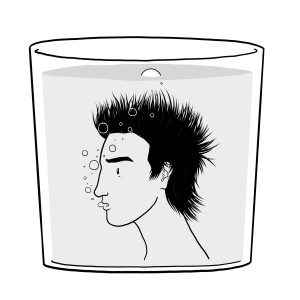 I left to pursue my writing and I left because I was living my life underwater. I was working twelve-hour days in the office and going home to work more, after mixing a tall Grey Goose and tonic. After mixing two. I was passing out and waking up and running to the bus to the light rail to the train, canceling any meeting that it was my call to cancel. I was throwing up in the bathroom.
I left my job at twenty-six in order to incite a major change in my life. And it worked, but not right away. I was still drinking. I was still blacking out. Even when I met someone. Even when I loved him.
The first New Year’s after I quit my job, I went to Puerto Rico, where my boyfriend was from. As we walked through Old San Juan at night, the walls of the Spanish fortress, four hundred years old, crawling along the shore, the ships in the harbor, my beautiful boyfriend smiling at me, in the warmth of his childhood home, his shirt unbuttoned more than I was used to, it occurred to me that I had everything that I had ever wanted.
We went out to clubs in San Juan and I bought everyone drinks, top shelf, like I always did, even when they didn’t ask. Even when they said no.
We drove out of San Juan to spend New Year’s Eve at the nicest hotel on the island, El Conquistador, on the east side, in Fajardo. We were hungover and taking it easy for New Year’s. That night, I looked over at my boyfriend and asked him if he really loved me and how could he. I told him why he shouldn’t. What I was like – about drinking, about sex. Everything I didn’t want to say. Even though he was tired, even though he said he didn’t want to talk. I fell asleep scared.
When I woke up, I was somewhere else. I looked over and I saw a bald man, not unlike my father, not unlike another man I had slept with months before, lying naked beside me. He looked at me and smiled, sneered. And I knew, deep down, that he had come to kill me.
This was a dream, of course, but I was not really asleep. I was hallucinating. I was in withdrawal. The talk we had before bed, intense and unwelcomed, had seeped in and mixed itself up with the past. I was seeing things.
I sprung from the bed. I screamed over and over: Who are you? And backed up onto the balcony, knowing I had no other option but to jump. Until I heard my sweet boyfriend’s voice: It’s me. I saw he was about to cry.
Months later, back in San Francisco, my therapist said: It seems impossible for you to stop drinking without help.
Two weeks later, I went to rehab.
It was in Minnesota in April. It was still snowing. In my group therapy, in meetings, I talked about my family history. About nights when I was nineteen, when I’d drop out my window and wander to the highway, in the cold, in only shorts and a vest, when I’d stand in the middle of the road as cars whipped out of Santa Cruz at eighty miles an hour on their way to San Francisco, with my thumb out.
Now, I go to therapy. I listen to talks about self-acceptance by Tara Brach. I make schedules for my day.
The schedules look something like this:
8am Meditate
10am Gym
1pm Therapy
3pm Writing
8pm Meeting
I made that schedule in therapy. I cried when I made it, thinking: What am I doing making a five-word schedule with a paid professional?
After my first year at college, I went home for the summer. I was eighteen. I got a job at a warehouse in Ontario, CA, filling orders for a school supply company. I worked all day and rarely took breaks for food. I lost forty pounds.
I looked in the mirror and said: This is your chance. I ordered myself to never be the feminine, awkward kid I once was. Maybe I never was feminine and awkward, but I believed myself to have been, and I believed that was unacceptable, either way.
In a way, it worked. I changed. I excelled by reminding myself that I was worthless unless I excelled.
When I was young, I lived with my mom in Rancho Cucamonga and saw my dad every other weekend in Corona. Before my dad came to pick me up, I would cry for hours; after he brought me back, I would not talk for at least two days.
One time, a friend called me at my dad’s house. I spoke freely and did not realize that my stepmom was listening in from the other room. I didn’t even know she was awake. I was thirteen.
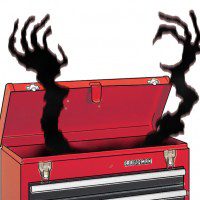
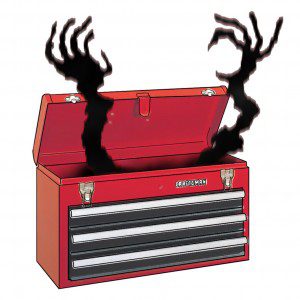 Later, my dad called me into the garage. He lit a cigarette from his workbench and took a long drag. He began: I guess it takes a phone call to find out what your kids really think of you.
I remember the smoothness of the concrete in his garage; the red Craftsman tool chest; the stacks of transparent plastic boxes. The rolls of wrapping paper. He loved Christmas.
His words:
Stop crying.
I’m not yelling.
You think you have it so bad. You don’t know how good you have it.
I remember my stepmom calling us in for dinner halfway through. The sun was setting over the wall in the backyard. This was tract housing on top of old dairy farms and there were bugs everywhere, and so birds, darting around the fence. My half-brother was sitting at the table, looking confused or maybe relieved that he wasn’t involved. My sister was glad her turn in the garage was over and I was glad for her, too.
He said: I love you, son, but I don’t have to like you.
He asked: Do you love me?
I said: I’m afraid of you.
He said: Good.
Now I am an adult. I remind myself of that when I wake up. I look around my apartment in San Francisco and tell myself how it’s different. I have a boyfriend and he is an artist. He paints and draws and designs. He is talented and beautiful. He and I make lists and mission statements about our work. We have to. They look like this:
-Writing helps me make sense of the world around me and of my inner life.
-Committing to writing is the first step in a process of building a life of acts that are born
out of love.
-Even the partial and unfinished and discarded pieces count. The work I have already done counts.
Sometimes he turns to me and says: I would never bring a kid into this world. He looks so sad when he says it. Sometimes we are walking somewhere, to lunch, past the fountains in Yerba Buena in the sun, or the posh storefronts on upper Fillmore, and he says: People are so fucked. Our society, man. The world is so fucked up. With that same sad, faraway face. Often I nod my head or I pat his shoulder or I do nothing at all. Last time, I simply said: We’re here, too.
He was forgetting.
***
Rumpus original art by Sam Geer.

20 responses
“We’re here, too.”
And while so many of us take that as innate and proceed on a daily basis, it’s a pretty vital reminder in the moments of question/doubt/uncertainty/fear.
Thank you for the reminder and your thoughtfully honest point of view.
You’re writing is so powerful and brave. Don’t stop, keep going.
I loved this. Thank you for sharing.
Absolutely wonderful.
really intriguing essay ry. nice work.
very moving, ry. you’re an inspiration.
Knife-sharp.
“Now I am an adult. I remind myself of that when I wake up.”
That line kills me. This one makes my heart swell:
“Even the partial and unfinished and discarded pieces, count. The work I have already done counts.”
Really powerful piece, Ryan, thanks for sharing!
“I was grateful for the job, for the whole thing, the people I met, but I needed to leave. I needed to talk about leaving…”
“We’re here too”
The tangibility of those words in my own life… each one of them. Thank you for courageously sharing. XOXO
I read this and then I read again and now I’m exhausted…in a good way. You share your life in a such an open and honest way that it always elicits a visceral reaction. You write. I feel (and always cry). So, thank you.
This is gorgeous writing. Understated and devastating. Wow.
Excellent, moving piece of writing. I could read your work all day.
Having worked as a Rehab paid professional, I was moved by your schedule. Great work… it’s all about substraction, then the joy of addition comes. Seems like you’re experiencing this now. Beautiful essay. Best to you.
Wow. Each comment makes me cry. I can’t tell you how empowered I am by this support. I feel free. Thank you.
Very fine work, thanks for it..
Thank you for sharing this. Your writing is beautiful and heartbreaking and hopeful all at once. I am in awe of your courage, your talent.
That’s one of the best pieces I’ve read in a while. Thank you.
I have read your work before. But none that I could relate to like this one. None that inspired such raw bravery as this one. None that made me cry like this one, and none that have made me love you, and myself, as much as this one. I’m glad I somehow just stumbled upon this. Thank you
Ry, your work is courageous, raw, powerful. I am always inspired by it, and you. Please don’t ever stop writing. I can’t wait to start reading 22%.
This is beautiful, Ryan.
Click here to subscribe today and leave your comment, or log in if you’re already a paid subscriber.