

I’m pretty mediocre. I’m ashamed to admit it. I’m not even being sarcastic or self-deprecating. I’ve never done anything that stands out. No “Whoa! This guy made it into outer space!” or, “This guy has a best selling novel!” or, “If only Google had thought of this!” I’ve had some successes and some failures but never reached any of the goals I had initially set. Always slipped off along the way, off the yellow brick road, into the wilderness.
I’ve started a bunch of companies. Sold some. Failed at most. I’ve invested in a bunch of startups. Sold some. Failed at some, and the jury is still sequestered on a few others. I’ve written some books, most of which I no longer like. I can tell you overall, though, everything I have done has been distinguished by its mediocrity, its lack of a grand vision, and any success I’ve had can be put just as much in the luck basket as the effort basket.
That said, all people should be so lucky. We can’t all be grand visionaries. We can’t all be Picassos. We want to make our business, make our art, sell it, make some money, raise a family, and try to be happy. My feeling, based on my own experience, is that aiming for grandiosity is the fastest route to failure. For every Mark Zuckerberg, there are 1000 Jack Zuckermans. Who is Jack Zuckerman? I have no idea. That’s my point. If you’re Jack Zuckerman and you’re reading this, I apologize. You aimed for the stars and missed. Your reentry into the atmosphere involved a broken heat shield, and you burned to a crisp by the time you hit the ocean. Now we have no idea who you are.
If you want to get rich, sell your company, have time for your hobbies, raise a halfway decent family (with mediocre children), and enjoy the sunset with your wife on occasion, here are some of my highly effective recommendations.
 Procrastinate. In between the time I wrote the last sentence and the time I wrote this one, I played (and lost) a game of chess. My king and my queen got forked by a knight. But hey, that happens. Fork me once, shame on me.
Procrastination is your body telling you you need to back off a bit and think more about what you’re doing. When you procrastinate as an entrepreneur, it could mean that you need a bit more time to think about what you’re pitching a client. It could also mean you’re doing work that is not your forte and that you’d be better off delegating. I find that many entrepreneurs are trying to do everything when it would be cheaper and more time-efficient to delegate, even if there are monetary costs associated with that. In my first business, it was like a lightbulb went off in my head the first time I delegated a programming job to someone other than me. At that time, I went out on a date. Which was infinitely better than sweating all night on some stupid programming bug (thank you, Chet, for solving that issue).
Try to figure out why you’re procrastinating. Maybe you need to brainstorm more to improve an idea. Maybe the idea is no good as is. Maybe you need to delegate. Maybe you need to learn more. Maybe you don’t enjoy what you are doing. Maybe you don’t like the client whose project you’re working on. Maybe you need to take a break. There’s only so many seconds in a row you can think about something before you need to take time off and rejuvenate the creative muscles. This is not for everyone. Great people can storm right through. Steve Jobs never needed to take a break. But I do.
Procrastination could also be a strong sign that you’re a perfectionist, or that you’re filled with shame issues. This will block you from building and selling your business. Examine your procrastination from every side. It’s your body trying to tell you something. Listen to it.
Zero-task. There’s a common myth that great people can multitask efficiently. This might be true, but I can’t do it. I have statistical proof. I have a serious addiction. If you ever talk on the phone with me, there’s an almost 100 percent chance I’m simultaneously playing chess online. The phone rings, and one hand reaches for the phone while the other hand reaches for the computer to initiate a one-minute game. Chess rankings are based on a statistically generated rating system, so I can compare easily how well I do when I’m the phone compared to when I’m not on the phone. There is a three-standard-deviation difference. Imagine if I were talking on the phone and driving. Or responding to emails. It’s the same thing, I’m assuming: phone calls cause a three-standard-deviation subtraction in intelligence. And that’s the basic multitasking we all do at some point or other.
So maybe great people can multitask, but since, by definition, most of us are not great (99% of us are not in the top 1%), it’s much better to single-task. Just do one thing at a time. When you wash your hands, hear the sound of the water, feel the water on your hands, scrub every part. Be clean. Focus on what you are doing.
Often, the successful mediocre entrepreneur should strive for excellence in ZERO-tasking. Do nothing. We always feel like we have to be “doing something,” or else we (or, I should say, “I”) feel ashamed. Sometimes it’s better to just be quiet, to not think of anything at all.
Out of silence comes the greatest creativity. Not when we are rushing and panicking.
Fail. As far as I can tell, Larry Page has never failed. He went straight from graduate school to billions. Ditto for Mark Zuckerberg, Bill Gates, and a few others. But again, by definition, most of us are pretty mediocre. We can strive for greatness, but we’ll never hit it. So it means we will often fail. Not ALWAYS fail. But often.
My last 16 out of 17 business attempts were failures. I made so many mistakes in my first successful business I’m almost embarassed to recount them. I remember one time I was trying to pitch Tupac’s mom a website for her dead son. I had a CD (what’s that?) of all my work. I went to Tupac’s manager’s office and he said, “Okay, show me what you got.” The only problem was: I had never used a Windows-based machine. Only Macs and Unix machines. I honestly had no idea how to put my CD into the computer and then view its contents. And I had gone to graduate school in computer science. He said, “You have got to be kidding me.”
It was a $90,000 gig. It would’ve met my payroll for at least two months. It was a done deal until I walked into his office. I left his office crying while he was laughing. When I came back to my office, everyone asked, “How did the meeting go?” I said, “I think it went pretty well.” And then I went home and cried some more.
Then I bought a Windows-based PC for myself and learned how to use it. I don’t think I ever bought a Mac again, actually. It’s possible to learn from successes, but it’s much easier to learn from failures. Ultimately, life is a sentence of failures, punctuated only by the briefest of successes. So the mediocre entrepreneur learns two things from failure: First, he learns directly how to overcome that particular failure. He’s highly motivated not to repeat the same mistakes. Second, he learns how to deal with the psychology of failure. Mediocre entrepreneurs fail a lot. So they get this incredible skill of getting really good at dealing with failure. This translates to monetary success.
The mediocre entrepreneur understands that persistence is not the self-help cliché “Keep going until you hit the finish line!” The key slogan is, “Keep failing until you accidentally no longer fail.” That’s persistence.
Be unoriginal. I’ve never come up with an original idea in my life. My first successful business was making web software, strategies, and websites for Fortune 500 companies. Not an original idea, but at the time, in the ’90s, people were paying exorbitant multiples for such businesses. My successful investments all involved situations in which I made sure the CEOs and other investors were smarter than me. I wrote a TechCrunch article on this titled “My Angel Investor Checklist.” One hundred percent of my zeros as an angel investor were situations where I thought I was smart. I wasn’t. I’m mediocre.
The best ideas are when you take two older ideas that have nothing to do with each other, make them have sex with each other, and then build a business around the ugly bastard child that results. The child that was so ugly nobody else wanted to touch it. Look at Facebook: combine the internet with stalking. Amazing! Twitter: combine internet with antiquated SMS protocols. Ugly! But it works. eBay: combine e-commerce with auctions. The song “I’ll Be There”: combine Mariah Carey with Michael Jackson. If Justin Bieber sang John Lennon’s “Imagine,” it would be a huge hit. I might even listen to it.
Exercise poor networking skills. I’m that guy. You know, the one at the party who doesn’t talk to anyone and stands in the corner. I never go to tech meetups. I usually say no to very nice networking dinner invitations. I like to stay home and read. When I was running businesses, I was often too shy to talk to my employees. I would call my secretary from downstairs and ask if the hallway was clear, then ask her to unlock my door, and I’d hurry upstairs and lock the door behind me. That particular company failed disastrously.
But many people network too much. Entrepreneurship is hard enough. It’s 20 hours a day of managing employees, customers, meetings, product development, and “the buck stops here” sorts of things. And then what are you going to do? Network all night? Save that for the great entrepreneurs—or the ones who are about to fail. The mediocre entrepreneur works his 20 hours, then relaxes when he can. It’s tough to make money, not a party.
Do anything to get a “yes.” Here’s a negotiation I did. I was starting stockpickr.com and meeting with the CEO of thestreet.com. He wanted his company to have a percentage of stockpickr.com, and in exchange, he would fill up all of our ad inventory. I was excited to do the deal. I said, “Okay, I was thinking you would get 10 percent of the company.” He laughed and said, “No. 50 percent.” He didn’t even say, “We would like 50 percent.” He just said, “50 percent.” I then used all my negotiating skills and came up with a reply: “Okay. Deal.”
I’m a salesman. I like people to say yes to me. I feel insecure when they say no, or even worse, if they don’t like me. When I started a company doing websites, we were pitching to do miramax.com. I said, “50,000 dollars.” They said, “No more than 1,000 dollars, and that’s a stretch.” I used my usual technique: “Deal!”
But the end results: In the first case, thestreet.com had a significant financial stake, which gave them more psychological stake. And in the second case, miramax.com was now on my client list, so my next client, Con Edison, had to pay a lot more. I’m a mediocre salesman and probably a poor negotiator, although I try to learn from the best. But consequently, I get more deals done, I get the occasional loss leader, and ultimately, the big fish gets reeled in if I get enough people to say yes. It’s like asking every girl on the street to have sex with you. One out of 100 will say yes. In my case, it might be one out of a million, but you get the idea.
Be a poor judge of people. The mediocre entrepreneur doesn’t “Blink” in the Malcolm Gladwell sense. In Gladwell’s book, he often talks about people who can form snap correct judgements in two or three seconds. My initial judgement when I meet or even see people is this: I hate you.
And then I veer from that to too trusting. Finally, after I bounce back and forth, and through much trial and error, I end up somewhere in the middle. I also tend to drop people I can’t trust very quickly. I think the great entrepreneur can make snap judgements and be very successful with it. But that doesn’t work for most people.
 At this point, when I meet someone, I make sure I specifically don’t trust my first instincts. I get to know people more. I get to understand what their motivations are. I try to sympathize with whatever their position is. I listen to them. I try not to argue or gossip about them before I know anything. I spend a lot more time getting to know the people who I want to bring closer. I have to do this because I’m mediocre and have a larger risk of bringing the wrong people into my circle.
By the time I’ve decided to be close to someone—a client, an employee, an acquirer, an acquiree, a wife—I’ve put a lot of work into thinking about them. This means I can’t waste time thinking about other things, like how to put a rocketship on Jupiter, but overall, it’s worked.
***
“I thought being mediocre was supposed to be bad,” one might think. “Shouldn’t we strive for greatness?” The answer is: “Of course we should! But let’s not forget that nine out of ten drivers think they’re above the median in driving skill.” People overestimate themselves. Don’t let overestimation get in the way of becoming fabulously rich, or at least successful enough that you can have your freedom, feed your family, and enjoy other things in life.
Being mediocre doesn’t mean you won’t change the world. It means being honest with yourself and the people around you. And being honest at every level is really the most effective habit of all if you want to have massive success.
***
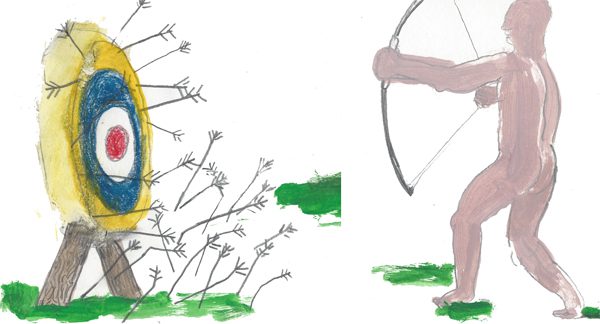
Rumpus original art by Liam Golden.
***





31 responses
The problem with this piece is that it’s not mediocre.
“My initial judgement when I meet or even see people is this: I hate you.”
Freaking love it, all of it.
So, so relatable, all of it.
Thank you so very much for this! It was very sobering
“My initial judgment when I meet or even see people is this: I hate you.”
Ha. Sounds to me as if you are a excellent judge of character!
*AN* excellent judge…
Good Lord. Back to procrastinating now.
Holy mother of god James…you continue to nail it every time. “And being honest at every level is really the most effective habit of all if you want to have massive success.” This is exactly why I keep coming back to what you write – because it’s some of the most honest content on the internet. You make me wanna be a more mediocre person.
Great one, you had guts to say it and this is “Whoa! This guy made it”. Keep it up!!
It was a very, very mediocre article and highly enjoyable.
While I agree with the gist of this article (and _love_ the honesty) let’s be clear about one thing: one becomes less mediocre the more times one fails. This is because: “It’s possible to learn from successes, but it’s much easier to learn from failures.” Think about that one: it’s _easy_ to learn from failures. The hard part for most people is that they’re afraid to go out and try to succeed because they might fail, YET by failing they’re going to be handed the greatest thing: a lesson from the school of hard knocks.
And then true wisdom:
“Keep failing until you accidentally no longer fail.â€
Notice the “accidentally”. The point here is that even with repeated failures success may still not be graspable, but the entrepreneur has learned enough things (hopefully) so that the “accident” might become more noticeable?
This is me down to the last detail. Except I was in a totally different service sector. If I ever write a book about myself I will cut and paste the whole article into it. Maybe embellish a little bit. Thanks J.A.
This article made my day. I especially liked this line: “Keep failing until you accidentally no longer fail.â€
Personally, I say I’m “intermediate” in my accomplishments. Somehow sounds better than mediocre.
“Keep failing until you accidentally no longer fail,” sounds a lot like an audio engineering maxim – “Luck is merely when opportunity meets preparation.”
Funny, witty, awesome.
Thank you!
I have a friend who’s mediocre at everything, at playing the piano/being a “musician”, at painting/being an ‘artist”, at cooking/being a host, but she saunters through her life: as a “pianist”, giving piano lessons to 5 and 6 year olds, as an “artists”, teaching painting at adult community schools, as a “cook” and a matron host, inviting 50 people at a time to her house and cooking up 30 different mediocre dishes and sending everyone home w/ leftovers!! Even her friendship is up and down, here and there, “mediocre”, and I shall remain forever in owe of her!!
Start failing early. Otherwise you will not have much time to learn from failures.
James continues to be beyond mediocre at what he does best. Being himself and being authentic and owning what he does. That’s what I see he describes here not being mediocre but being authentic and owning yourself
Does a team of mediocre people add up to a mediocre team or an extraordinary team? Fascinating…I think perhaps teams of great people don’t measure up. Now I’m in search of other mediocre people with whom I can get in cahoots!
Never read such an honest article in my life before. Very “real” which makes it very relatable. Please write more awesome articles!
Thank you for this awesome article. You get it. We should all aim intelligently at the right targets and think for ourselves. I like some of the ideas you assassinate, but they probably do better in selling books than in application. However, the Seven Habits of Highly Effective People is a pretty solid book. I’d say those principles actually work.
Wow! Honest & modest!
Stop calling yourself mediocre, mister. You are making the rest of us look bad mister 9 books author and 20 business owner. But, congratulation and may you inspire us all – though it is false hope and advertising.
Funtastic article.
It is like I almost want to fail now, then I will accidently succeed. Till such time, I m procrastinating!!
Amazing article…so funny yet entirely revealing !
You sir are no mediocre.
You are absolutely right about most people rating themselves very highly…especially young people…there was even an article on BBC about it. We have all become borderline narcissists.
Time for me to procrastinate now…back to playing backgammon on my iPhone.
There is nothing “Mediocre” about this article…very clever and honest
Thanks for the kick in the head that helped me refocus what I thought I’d always seen so clearly. Really good tonic for what was ailing me.
This article actually had me laughing out loud – and not the kind of LOL you write to someone when you were really just chuckling quietly to yourself, or not paying attention and just writing LOL because it seems to apply to anything that’s funnier than cancer or a bus accident these days…. Very insightful as well….
Awesome article. I generally don’t read articles in detail. But in this case, right from the start, I couldn’t help but relate every piece of this article to myself and my adventures in life till now.
if you’re mediocre, then…
wow..I found myself choking up as I read this. I guess it’s ok to be in such good company. Tanks for moving my world this morning.
Brilliant, loved it.
Click here to subscribe today and leave your comment, or log in if you’re already a paid subscriber.