
There has never been a great movie adaptation of a novel. This isn’t to say that there’s never been a good movie that was first a book. And this isn’t to say that Baz Luhrmann’s The Great Gatsby isn’t good. It’s just to say that movies are different from books are different from plays are different from songs are different from every other art form. When a movie adaptation works, it’s because it works as a movie, and the fact that it’s an adaptation is incidental. As LA Times film critic Sam Adams recently tweeted, “I don’t want a movie to be great literature any more than I want a novel to be a great salad.” The best adaptations go their own way, have their own vision, are brave enough to forget their sources when they need to.
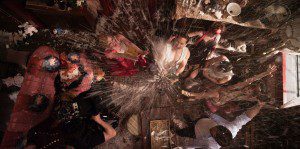
Luhrmann approaches Gatsby with his usual visual excess. The whole affair looks like a View-Master slide crossed with the kind of toy town you find on model train tables: meticulously arranged, brightly colored, essentially inert, and totally artificial—visually, it’s somehow deeply layered and utterly shallow at the same time. Nevertheless, The Great Gatsby’s main problem is too great an allegiance to the novel—to its plot, yes, but more problematically to its scope and reputation. Gatsby (Leonardo DiCaprio), the mysterious new-money millionaire, throws but never attends huge parties in his massive Long Island mansion. The parties, like the movie itself, are vast, ambitious, orgiastic affairs that fit our idea of how the rich lived in the Roaring Twenties without really shocking us (after all, anything above a PG-13 rating hurts box office). But what of the lonely Gatsby himself? The narrator is, as always, Nick Carraway (Toby Maguire), the young bond salesman who rents a small cottage next door and sees the great man lurking at his windows, and wants to know more. One day Nick receives an invitation to one of the parties, and we’re off into the story of lost love, self-invention, class ambition, and lots and lots of expensive wardrobe.
 If you can’t remember the book or never read it in the first place, you may wonder if Luhrmann is taking liberties with the plot, if this Great Book can really be such a potboiler. But the movie is faithful, and its main points are all taken directly from the novel: the awkward afternoon tea, the scene at the Plaza, Gatsby’s trite psychology, Tom’s (Joel Edgerton) cartoonish slattern of a mistress (Isla Fisher). In truth, Fitzgerald’s novels were all melodramas, and his relevance is in his precise, crystalline prose and his observations, not his plotting or even his characterizations. When it comes to the flavor of his stories, Fitzgerald and Luhrmann are hand-in-glove. They both tend toward bombast and melodrama, and Luhrmann has always been the kind of filmmaker who’ll show you—not once, but three times—a giant pair of eyes on a billboard (reminiscent of the book’s classic cover) along with a voiceover saying, “God is always watching.” If there’s a significant difference between their artistic sensibilities, it’s that Luhrmann’s crude, crayon vision takes itself less seriously than Fitzgerald’s. If you can let yourself go with it, it’s gaudy, ridiculous fun. Gatsby is not Luhrmann at his best—this is no Moulin Rouge—but it has the courage of its soap opera convictions.
Even for Luhrmann, this movie is large and loud. It’s as if, mindful of the critical and writerly reverence for the book, he’s trying to build a big enough container to hold it all: its reputation and heritage; its ideas about America and ambition, about youth, about regret and stasis and the nature of romance; and of course all of its sudsy happenings, every cool glance, every “Old Sport,” every leering flapper and candy-colored roadster and jazz number; all the spectacle and energy and profusion. He stuffs all these things into his ornate palace of a movie, but in no particular order and with no particular care.
 Where his focus does lie is the plot and the characters, but it’s a problem. Novels and movies can both hold mystery and grandeur, but it’s generally nontransferable from one form to the other. When a novel’s scenes appear on a screen, they often become diminished, smaller, more visually real but less emotionally real. And in a movie this big, things seem only smaller. In the novel, the Plaza confrontation between Tom and Gatsby is a revelation, full of shadows and nuance and hints at larger things. In the movie, it’s a roomful of sweaty, rich people yelling at each other. In the novel, Gatsby’s past feels tragic and grand. Here he’s just an insecure striver. Daisy (Cary Mulligan) is no longer a beguiling Jazz Age muse, she’s a simpering, callow Southern Belle. Luhrmann is so busy rendering them all faithfully that he forgets to have his own idea of how to convey them on screen, and he certainly never gets around to making them interesting or likable. At one point, late in the film, all the main characters are piled into a pair of convertibles and speeding through the streets of New York, and I had a brief but intense longing that Luhrmann might simply dispatch them all in one huge, 3D, exploding car crash, and roll credits.
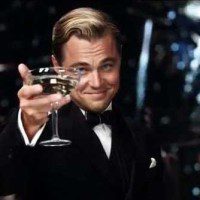
Somehow, in all this, the actors almost all hold their own, or better. DiCaprio trades on his perpetual boyishness and movie star face to capture Gatsby’s blend of vulnerability and vacuity. Whatever you think of DiCaprio, perhaps only Tom Hanks is more adept at choosing roles that suit him. He’s not the actor’s actor it seemed he might become in early roles like Arnie in What’s Eating Gilbert Grape or Toby in This Boy’s Life, but he’s at worst dramatically reliable and he’s always keenly aware of the importance of casting.
Joel Edgerton, meanwhile, gives Tom a dimension and texture that sometimes makes us forget the movie’s shortcomings. What success the Plaza scene has is largely because of him: though he’s the sort of sneering, mustachioed movie villain we’re often allowed to hate thoroughly, there’s real pity when Daisy tells him she never loved him, and his short, barked laugh of triumph when he finally pushes Gatsby to lose his cool sends a lightning bolt of authentic emotion through the scene and shows how a single dramatic detail can make a character come to life.
I never thought I’d say this of a Luhrmann movie, but The Great Gatsby is too restrained. It’s tantalizing because Luhrmann has the right idea, or at least a right idea—an interesting notion of how to approach the material. It just doesn’t seem to go far enough. It lets in a trickle of anachronism when it might have been better off throwing open the gates, Marie Antoinette-style. It flirts with self-parody when it should have kissed it full on the mouth. And most problematic of all, it asks for deep involvement with characters and events that are too small to seem significant. In short, it never quite stands on its own vision, which in an adaptation is the kiss of death.




10 responses
Great review, Mr. Fahey. Looking forward to seeing the film. I’ve never had much of an opinion either way on the book. But for some reason your review makes me want to see the movie.
I think there are many great adaptations of books to movies. Two of Nick Hornby’s books, Fever Pitch and High Fidelity, were made into good movies. (See the British Fever Pitch, not the US version) Requiem for a Dream was really well done. I could also argue that Chuck Palahniuk would not have a career without the movie of Fight Club, and that may be the best adaptation ever. That’s off the top of my head. I’m sure there are many more.
“No Country for Old Men” was a killer movie and a killer book!!!!!!
The movie’s sanitarium framing story with Nick Carraway as a recovering alcoholic is a significant departure from the novel insofar as it’s nowhere to be found in the book, nor, really, suggested anywhere by Carraway’s character on the page. It does, however, work pretty darn well in the movie. I was especially interested to read that Luhrmann was inspired to add the material by way of dovetailing “Gatsby” with Fitzgerald’s posthumous autobiographical collection, “The Crack-Up,” edited by Edmund Wilson. The movie’s broken Carraway seeking redemption through composing a narrative also nicely parallels Fitzgerald’s final (sadly unrealized) struggle to get his shit together through writing “The Last Tycoon.”
The number two film on AFI’s list of The 100 Greatest Films of All Time is The Godfather, which was most emphatically a novel before it was an inarguably great film. So that that puts the lie to your opening assertion. I would also classify Jaws (author, Peter Benchley) and Jurassic Park (author, Michael Crichton) as great films. The list is longer, but I think I’ve made my point.
What about The Shining? I think of that as being a perfect adaptation – an interpretation by the filmmaker rather than a regurgitation of the book.
“Children of Men” was a superior novel by P.D. James, and Alfonso Cuaron’s film was every bit as promising. Otherwise, excellent piece.
The Shining – definitely. And No Country as well. Gone with the Wind. Wizard of Oz.
Everyone posting your examples must have missed or forgotten the second line of the review: “This isn’t to say that there’s never been a good movie that was first a book.” What Fahey is saying–and none of you are arguing against–is that a movie adaptation, no matter how faithful to its source material, is not a novel. And he’s right. The two are absolutely different. You can’t have the same gut reaction to a film you do to a novel and vice-versa, 1) because you experience them differently, with different senses–hell, with different parts of your brain–and 2) because more people have their fingers in the making of a film than do a novel, and each person leaves their own fingerprints behind on a film. Even when the novelist (or playwright in some cases) writes the screenplay, the film is not the same as the original, because the media make different demands on the text and use different tools to carry the emotional weight of the story.
I guess I wasn’t using the correct drug when viewing this movie (as opposed to film)…and WTF was with the soundtrack?
Click here to subscribe today and leave your comment, or log in if you’re already a paid subscriber.