Though, a witch was a witch and could give no gift without a blade.
–Carrie R. Moore (from “When We Go, We Go Downstream”)
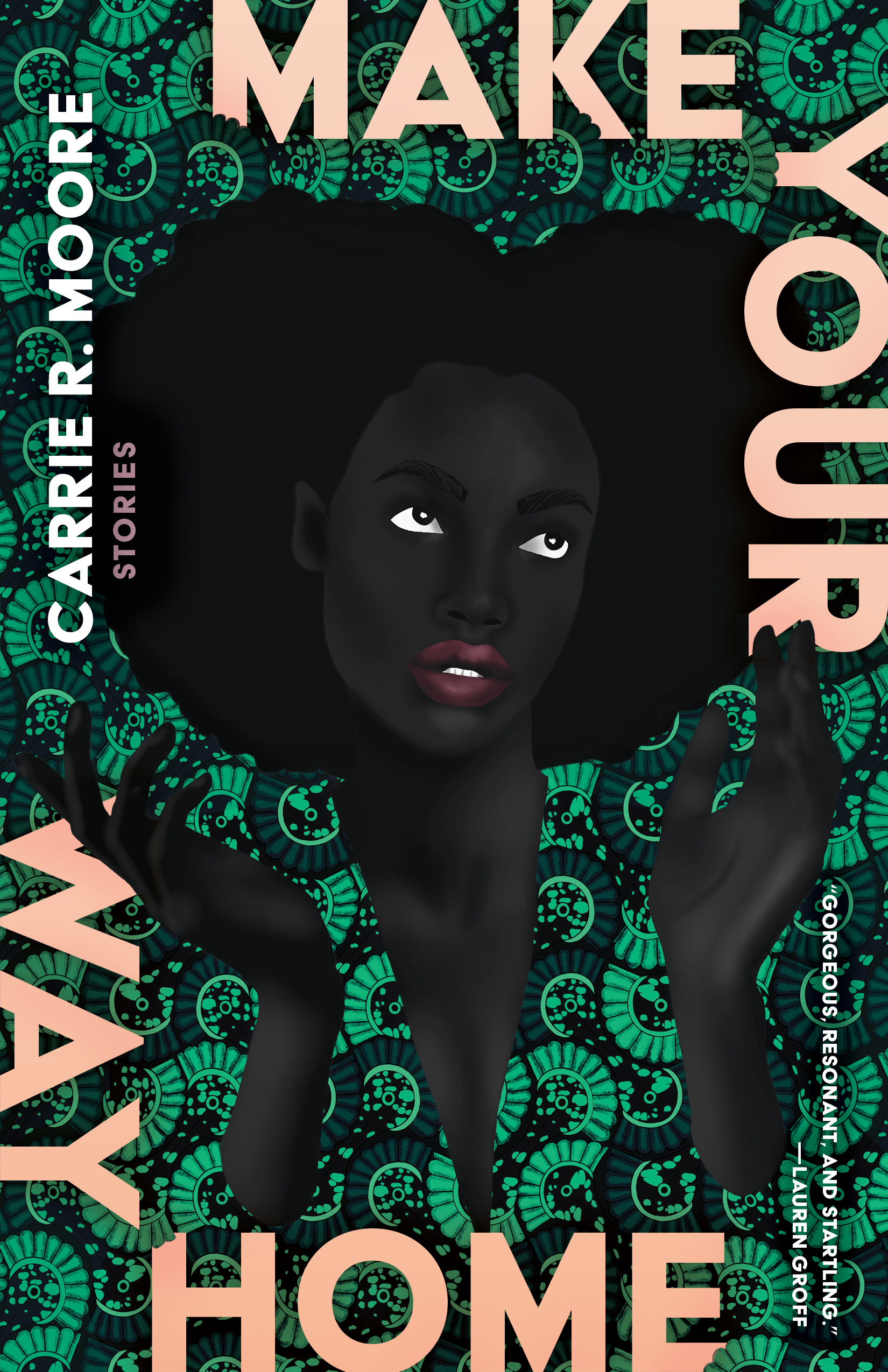
I stopped when I reached this line in the first story of Carrie R. Moore’s Make Your Way Home (Tin House, 2025). I reread it. And then again. It lingered; in the background, along with my playlist accompanying Moore’s evocative storytelling—croaking bullfrogs, chirping crickets, a cicada’s distress and nights black as ink as we enter Elijah’s story: a man who is many things—a blacksmith, singer, lover of russet pears. Elijah and Evaline, both enslaved, are in love, but Elijah escapes one day and abandons Evaline.
Following his desertion, Evaline visits “a witch who lived in a grove of bald cypresses, making her way there on a night when no birds sang.” She commissions a curse that will cause all his lovers to, eventually, leave him and his descendants. Unknown to Evaline, the price for this commission is her pregnancy with Elijah’s child (hence the blade). Ever, a 21st-century descendant of Evaline and Elijah, burdened by this legacy, standing on the precipice of something new, makes the mistake of retelling the tale of this curse passed down through the generations.
This story made me think of a mystery that shrouds my patriarchal bloodline—a sort of family malediction passed down like a flawed hand of cards in a high-stakes poker game: a mind that plays tricks on you, daring you to uncover its truth. Moore’s collection drew me back into an unsettling thought: what if a certain kind of “madness” troubles the bloodline I am from? And even with Ever, teetering on the edge of a new beginning with Amari, recounting the tale of the curse, questions linger: is it only a curse when you give it life, allow it the space to breathe, to settle into existence—or is it a force you must learn to live with, hoping it somehow misses you? Moore sends us spiraling through the tangled branches of our own family trees while pulling us ever deeper into the story of Elijah, Evaline, and Ever.
“Every woman had some hidden part of her…”
–Carrie R. Moore (from “Naturale”)
Moore’s stories act as short films projected onto my memory’s big screen, resonant, awakening old wives’ tales and family lore from my mom’s Eastern Carolina people, surrounded by tobacco farms alongside bats, bears, copperheads and, of course, the cottonmouth Moore so adeptly turns into a mini-horror film.
It was the North Carolina lilt of my Grandma Air (or the deeper snuff-filled drawl of “C’un-Pearl”) that I would hear say, “Chile, you can’t let er’ body wash yo’ head” as I imagined Moore chuckling to herself, knowing how readers like me might react to “Naturale.” I found myself talking back to the pages, first when Cherie invites Simone to her hair salon to get “hold her scalp…and feel what [her] husband knew,” so she can let go of his infidelity. And then, even louder when Simone dares to show up and recoils after Cherie washes her hair, revealing Cherie already knows about her affair with her husband, Oriah. In the story, Moore creates an analogous relationship between infidelity, marriage, and hair. This sacred trust is as holy as a Black woman letting someone’s hands in their hair.
These decisions are not taken lightly. I have to trust my hair stylist as much as I trust therapist. Moore’s ability to navigate the raw truth of Black, Southern, multilayered characters feels like reading the autobiography of my family tree—disguising the past as the present and back again. Her collection is a brilliant painting of the American South, capturing all its complexity: beauty, trauma, adversity, and relief. Family, lovers, enemies, and the land itself are all woven into an identity as unshakable as eye color.
Moore’s tales are transcendent in many ways—filled with wisdom, soul, and blues. At times, her writing reminded me of when I was a young college student, borrowing my mom’s brand new copy of The Color Purple and reading it in a sitting. Or Gloria Naylor’s unforgettable description of Luther Nedeed in Linden Hills. Or Toni Morrison’s Sula and Nel. Here I am, certainly near twice the age of Moore, yet she took me back more than half my lifetime ago on this trip through Mississippi and Alabama to Georgia and North Carolina, by land and sea, so to speak.
One recurring theme connecting the character’s lives is water, whether a swimming pool, the Atlantic Ocean, thick marshes hiding cottonmouths, bayou, or creeks. There’s the river Elijah may have followed to find his freedom and the creek in “All Skin Is Clothing.” There, a boy named Nelson, grieving his brother, convinces his friend Cadence’s little brother to pretend he’s drowned. In return, Cadence, still traumatized by a near-miss with a stray bullet in her home, teaches Nelson that he does not own grief nor the specter of death. Moore’s stories are like bodies of water, reflecting back to me as I floated, waded, and sometimes drowned in them.
Other moments made me want to throw my phone across the room, like when Twyla disobeys her mother and runs to get someone to kill the cottonmouth snake holding her hostage. Moore builds so much tension around the ever-present cottonmouths that I found myself tiptoeing around my house or on the edge of my seat near the story’s climax.
The story triggered a memory from when I was about eight years old, when a giant snake slithered into our backyard. My mom wielded a garden hoe and took down the copperhead while my father, my sister, and I watched safely from the porch. That image resurfaced in my mind—my mom slaying the serpent while my father observed quietly.
In Moore’s “Cottonmouth,” Twyla and her mother, both pregnant, struggle under the weight of men who are absent for different reasons. However, Twyla’s confrontation with the snake becomes a turning point; by asserting her independence, she transforms into her mother’s savior and a serpent-slayer, proving she doesn’t actually need the men her mother so vehemently urges her to pursue.
“It is utterly exhausting, trying to run toward your old life and your new one.”
–Carrie R. Moore (from the Happy Land)
Around 2018, I started recording my mom’s stories about coming of age on a tobacco farm with her colorful and raucous female relatives and teaching pre-Brown v. Board of Education. They were revelatory, filling in so many gaps and misunderstandings I had about my uber-strong mom—who needed my help but hadn’t quite figured out how to let me give it. Listening to these stories, before my mother’s dementia stole them from her, I finally began to fully understand her. As I read Make Your Way Home, I found parts of my mom in so many of the characters—Moore somehow ensures we can relate to even the portrayals we have the least in common with.
Mom was Cadence, who fiercely protects her younger brother; Twyla and her mom; Grace, who hides her physical pain from her husband and others to shield them; Cherie, who handles infidelity somewhat subversively; Claire in “How Does Your Garden Grow,” who suffers from something familiar to many Black women including my mom and me—fibroids.
When I finished Moore’s lush collection and prepared to organize my thoughts, I turned on my laptop. My mom’s voice piped out of nowhere from a recording I’d made years before. I would have believed it was merely a weird tech glitch, except it was her birthday—the first since she passed in January. This was the first time I had heard her voice so clearly in years— as dementia had silenced it a few years before she passed. The story she told, like one of Moore’s tales, was full and vibrant.
Moore’s final story in the collection, “Till It and Keep It,” follows two sisters who make life-changing decisions that ultimately separate them. In the last few lines, Brie reflects on her sister, Harper, who has moved on with her life: “It’s long enough to remember how eternal a love she had once. How difficult a time it’ll have finding a way back.”
Moore’s profoundly transformative collection of 11 short stories explores themes of identity, belonging, ancestral legacies, the complexity of love, and, of course, our pasts and future. Hers is a Balm of Gilead for any reader trying to find their way back home—and for those who sit and wait.