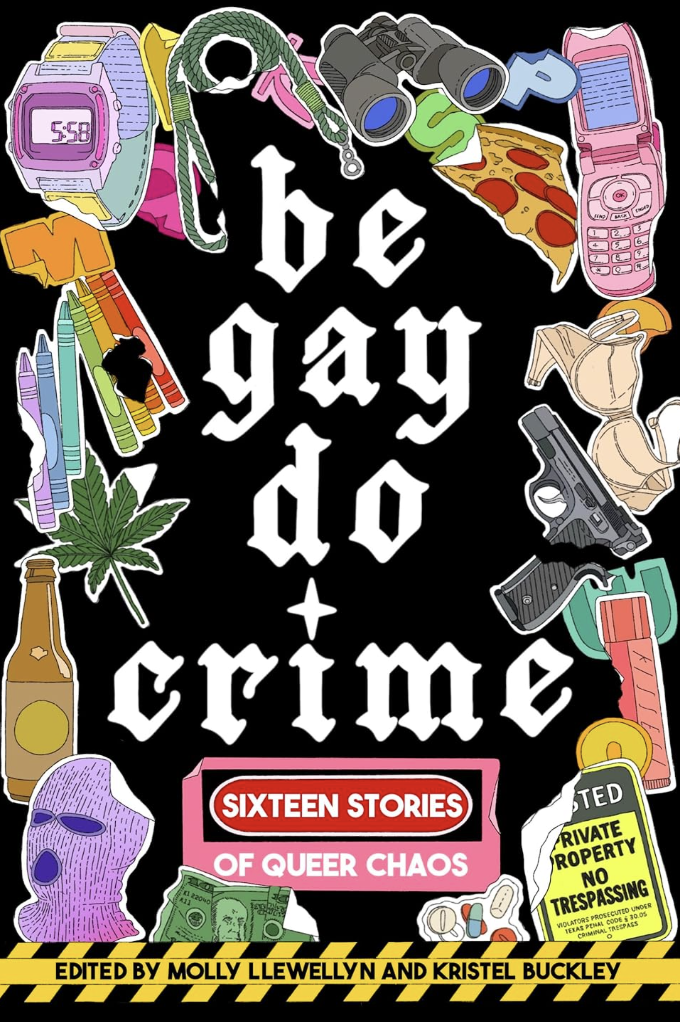
The first time you read this book, you’ll play a matching game with the stickers on the front cover to pick which ones go with which story. Hint: not all the stories are represented, and some of the pictures relate more to crime in general than to any story in the book. If you’re like me, you’ll want to read it twice.
A ski mask. Gun. The crayons are obviously the best medium for ransom notes. I can think of a few dastardly ways to use the lanyard. If you glance over the pictures you may wonder how a slice of pizza is used to commit a crime. Made with vegan pepperoni? The rest should be obvious, even the bra, although it might interest you to know that the criminal nature of the beer is that it’s home-brewed.
The title is a slogan that’s been floating around a while: “Be gay. Do crime.” Or, “crimes,” plural, if you go from the graffiti credited with the slogan’s origin. It’s associated with anarchism. Not anarchy, as in chaos and lawlessness, but anarchism, the idea that people need no centralized government because we govern ourselves, peacefully, without designs on world domination.
To utter this slogan is to speak against the criminalization of identities. Its power comes from the abject unfairness of being marked an outlaw for merely existing as the person you are. How being charged with wrongdoing without having committed any action is injustice, and enflames our sense of free will.
Be Gay, Do Crime: Sixteen Stories of Queer Chaos (Dzanc, 2025), edited by Molly Llewellyn and Kristel Buckley, is not about that; not about wreaking havoc on an unjust society. There are no uprisings or revolts, no riots in the streets. No genocide. No brutality. There’s barely a police presence in these pages. We hear a knock at the door in one story that might be the cops. The president’s security detail plays a minor role in one scene.
There is plenty of legit crime in this book—lots of stealing, some swatting, some breaking and entering—but many of the crimes depicted would be unlikely to attract the attention of law enforcement. Like watching the neighbor’s TV through their windows while squatting in their garden, night after night with a bowl of popcorn. Impersonating one’s twin to mess with their romantic relationship. Entering children’s art contests, and winning prizes, as an adult.
Some of these crimes are not even illegal acts.
Kissing a picture of Jesus. Revising the Ten Commandments in Nana’s family Bible with White-Out and Post-It notes. Videostreaming a sexual liaison so the dog can watch. Actually, there may be some questionable legality on that last one, but even the multi-state bank robbing spree has the feel of a spring break road trip. Robbery is the correct term, but here it’s more like collecting money from places called “banks” where money accumulates—like hummingbirds collecting nectar—with their little pink laminated card that says, “I have a weapon,” instead of using a weapon.
Some of these stories might make you pause and think, Oh shit! I guess I’ve done me some crime. Two of them feature protagonists peeking in their neighbors’ backlit windows.
Once, on a walk with my partner at dusk, I asked, “Why do we allow ourselves to peek in other people’s windows as we pass by, when we’d be irritated at someone doing the same to us?”
Her answer— “Because we know what we’re up to”—is how I assume most people feel.
So why that title? Why that politically charged “Be Gay Do Crime” banner over this procession of mostly mundane acts of queer chaos?
To be clear, I apply the word “mundane” only to the potential for chaos in these acts, not to their literary value. Definitely not that. This book is a gem.
On your second read, you’ll want to slow down and immerse yourself in the innovative storytelling of these sixteen exceptional writers, their zig-zagging plots, thrilling arcs, rich rich settings and backstories, and especially in the characters, as heterogeneous as the 64-count box of crayons on a canvas of ecru. There are BIPOC women, transladies and transgents, even a few straight, white gays. Their stories take us all over the world, into a compendium of cultures, up and down class strata, from a future-dystopian White House (that looks a lot like the one we’ve gotten used to), to an indoor family waterpark called the Giant Vagina Resort—I mean, the Grand Beaver Resort (I deserve neither credit nor blame for that joke; I stole it from the book).
A lot of thievery in this book. A pinch of pickpocketing. A dash of blackmail. Some shoplifting. These stories show how a police blotter might read when people be gay and do crime, rather than be crime ‘cause they do gay. On display here are the foibles and follies of, mostly, just regular people.
A mother too overwhelmed by her abusive, drunk husband to care for her baby. A woman seeking advancement on her merits from a boss who’d rather reward avarice. A couple trapped under pandemic lock-down, moldering in the froth of domestic toxicity.
We have people seeking love, or recognition, or a way out of a controlling relationship. A wronged lover lifts a curse against her ex. A lesbian couple struggles to communicate to an unimaginative hotel desk clerk that the one king-size bed in the room they’ve been assigned is suitable for the two of them. In one story we see the extent of cosmetic fuckery it takes for a twenty-something woman to look like her identical twin—a scene I relate to very well as a transgender woman in her fifties.
My third reading of this collection was in service of this review. Yours will be because it’s delightful. The endings are happy or satisfying; some are cathartic like primal screaming. The book offers a literary alternative to the real-world chaos we face these days. I will keep it on my shelf and return to it from time to time. Not for a diversion or distraction, but as a view of hope. The people in these stories have nestled into their societies without assimilating, intact and free to experience their humanity.
If they use illegal means to achieve their ends, they are subjected to typical consequences, rather than overblown ones. Their misdeeds are not treated as evidence of incurable depravity; none of these stories play on the fictional fears of the political right. Conflicts are settled in ways that affirm the humanity of victim and villain. Resolutions lead more toward actualization than incarceration. These are just people living their lives, although never far from the awareness of what it takes to achieve an inclusive, if unideal, utopia.
Hint: What it takes is anarchism.
Because perfection is not the goal. Adaption is. The story of Man is about monetizing the wilderness, where humanity came from. It’s about inscribing lines around us that become cages. Because Capital is a disease, humanity would evolve an immunity to it, so to prevent that we are held within boundaries and restrictions that define what humans are permitted to be, like those plastic boxes they use to grow watermelons as cubes.
Like in the story about a couple transfugitives-from-the-law who have stolen an experimental snake oil. A pharmaceutical, in the state-sponsored narrative, that “cures” gender dysphoria, but it’s more likely just some ground up jimson weed or psychedelic shroom, which leads them to the vague recollection of dysphoria as that panicky feeling a person gets when they artificialize themself as a “gender”. Its true cure is lifting the delusion that human nature comes only in two flavors.
Anarchism. She runs like a rabbit through these stories. Leaving pellets: a question on the meaning of life, the suggestion that it’s probably love. Her face pops up in the hedge along the path. You see her reflection in the corneas of the bathroom attendant at the presidential palace.
Anarchism. A concept of governance in which people live according to an ethic based on the best impulses of human nature, rather than the force of law and commoditized goods. She comes screaming to the front of the pack in a scene in which Nana smacks the shit out of the protagonist of Black Jesus for smooching a picture of Our Swarthy Lord and Savior. As our hero lays it out: “Nana belongs to the generation of obedience…I belong to the generation of choose your own adventure.”
Anarchism. The freedom that permits the natural inclination of humanity to express itself, and the expression is Love. Unlike that purposeless hare that lost to the tortoise, this bunny shows up at the finish line to reveal it was about her all along.
Love is what’s reflected in the bathroom attendant’s eyes. Five slugs of it in the chest.
Love conquers. Love pops a cap in the ass of the motherfucking Powers That Be hurting people.
The final story begins and ends in a resilient commune, and tiptoes into the Beyond, with a carnivalesque cast of characters who seem more concerned about each other’s personal welfare than the goal of their mission. In fact, they fall all over themselves attending to each other’s personal welfare, while carrying out their mission as an afterthought—like it’s a game of cribbage on the sideboard.These are some talented editors. Molly Llewellyn and Kristel Buckley. I’m going to get a copy of their first collection, Peach Pit: Sixteen Stories of Unsavory Women, and read it six or seven times.