“Hateful”
“Well, I got a friend who’s a man,
Who’s a man? What man?
The man who keeps me from the lonely.”
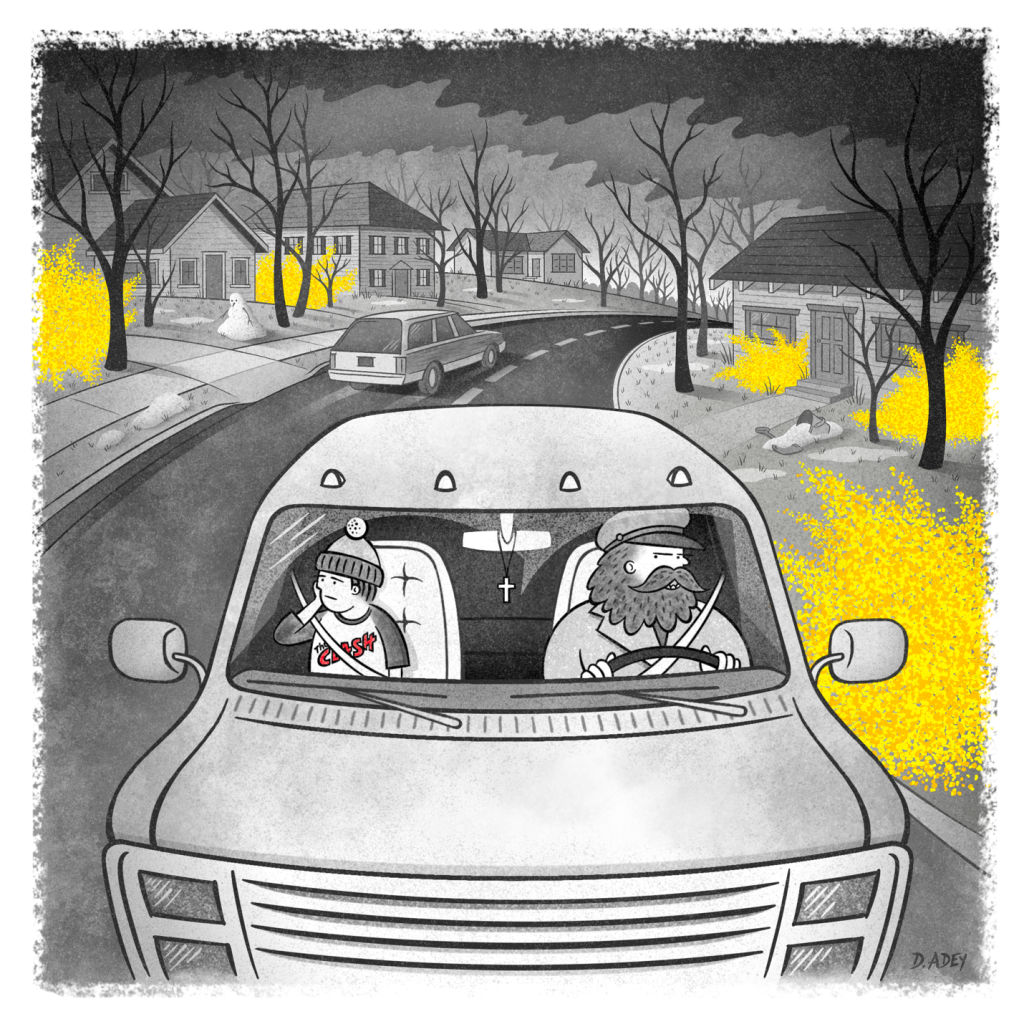
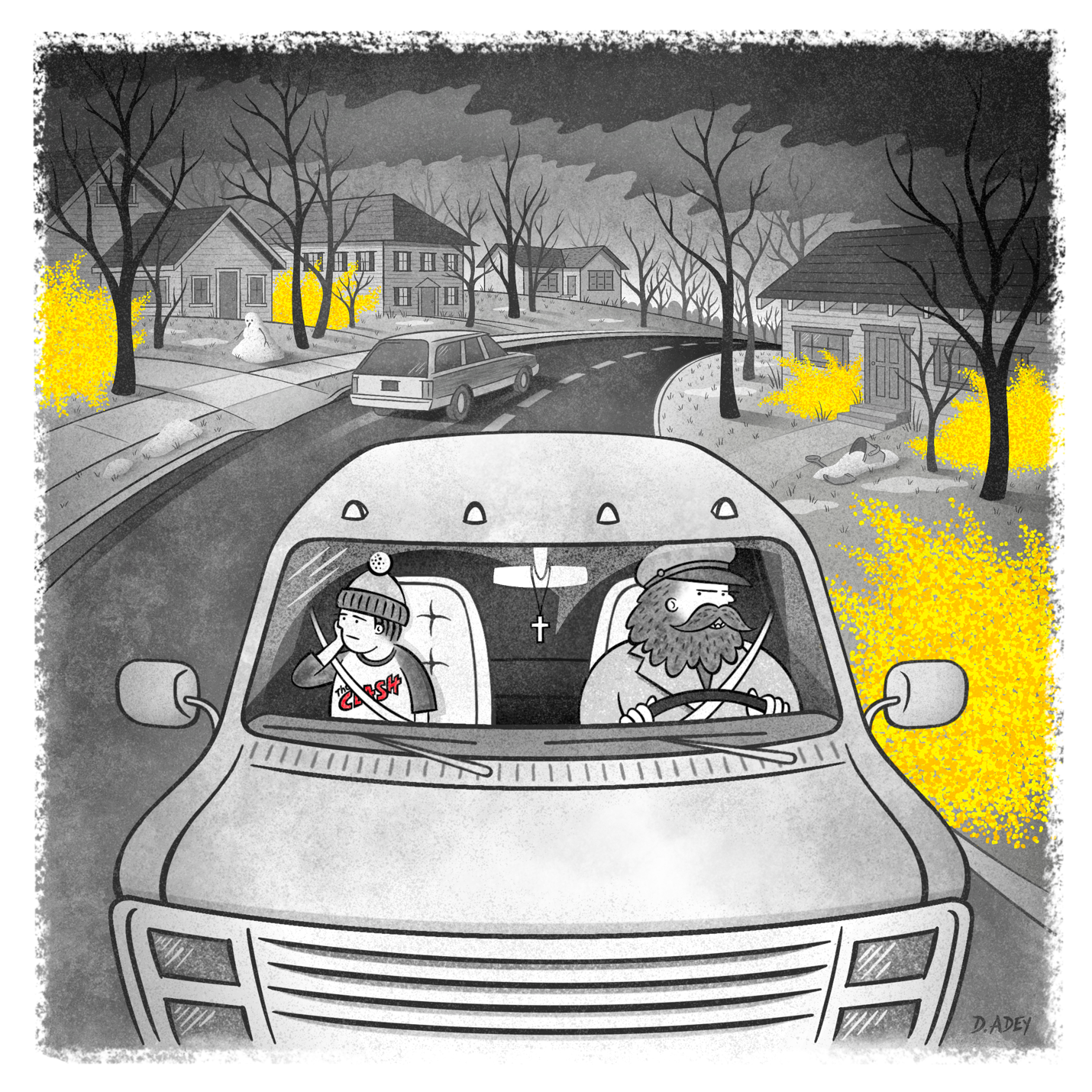
It was a typical early spring afternoon in New Jersey when the weather can’t seem to make up its mind. I was riding along in The Fiddler’s van for an errand he invited me to join him on. The few remaining snow plow piles passing by my salt-frosted window were the same ash gray as the gathering storm clouds overhead. Everything was dirty and colorless except the forsythia, which had just arrived. Its bare branches were invisible the week before, but it’s brilliant yellow blossoms were now enjoying their annual fifteen minutes of fame against the dormant trees, mud-splattered houses, and swampy front yards with scattered toys not seen since the first big snowfall. As we pulled into the back of the empty church parking lot, a sudden deluge pounded the van roof, ensuring that, for the moment, we weren’t going anywhere. A Keith Green cassette was playing, and The Fiddler lowered the volume just enough so he could take the lead vocal. He turned toward me in the passenger seat and sang the remainder of “Your Love Broke Through” directly to me with a piercing sentimental gaze. It felt awkward and disrespectful to look away, so I froze, and we locked eyes for what seemed like the longest song ever written. By the time the song finished, the windows were fogged over, and the damp air was saturated with the smell of cologne and diesel fuel. I didn’t know what to do, so I said “Thank you,” as if I was supposed to feel grateful, like he had given me a gift.
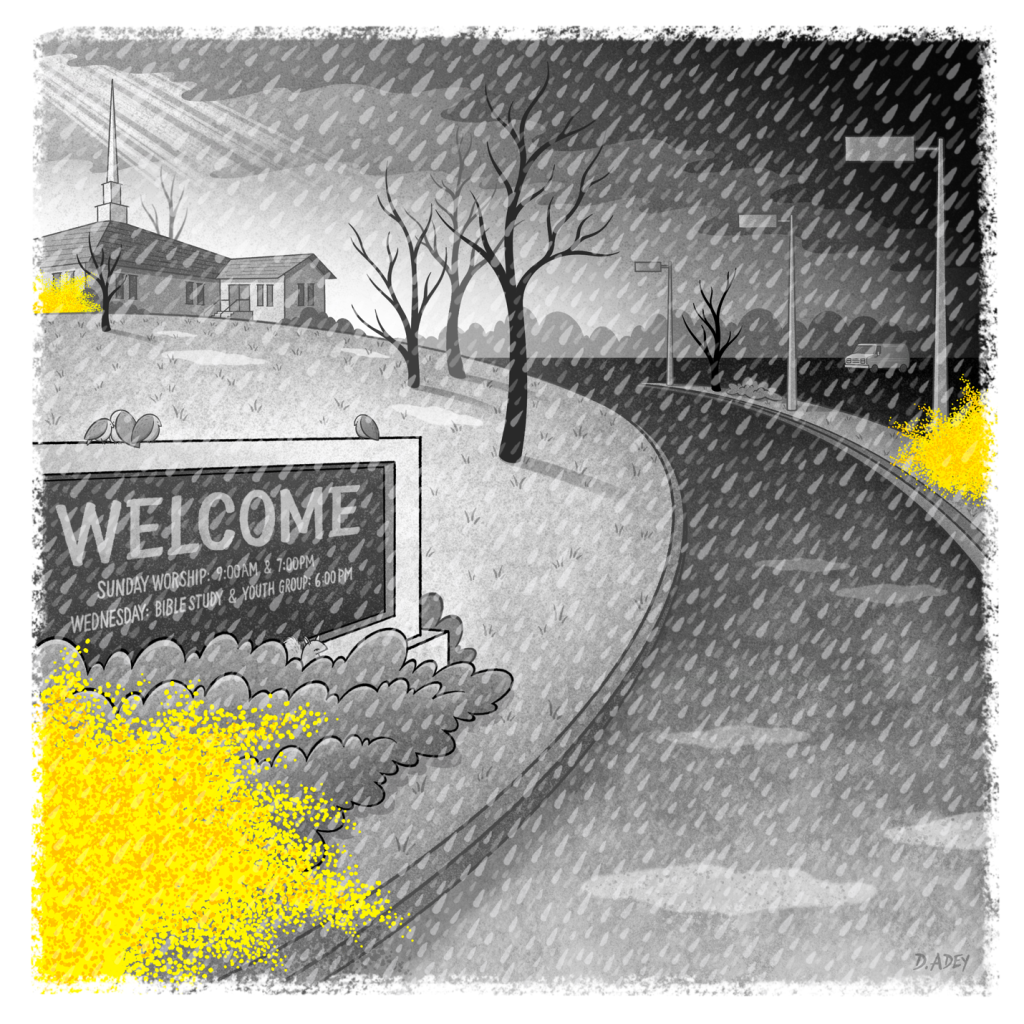
He was a traveling gospel singer, and he was our friend. He modeled his persona as The Fiddler on the Roof after playing the lead in a college production and it stuck. In a few short years, he became a regular dinner guest in our home and a presence in our lives. At the height of my junior high awkwardness, when it felt like every girl on the planet was repelled by me and everyone else was just annoyed with me, The Fiddler offered a different narrative.
Our local church was The Fiddler’s home base when he wasn’t on the road. His intermittent sojourns would last a few days to a couple of months and were announced by the sudden appearance of his van and travel trailer in the back of the church parking lot. He was like our part-time youth pastor and music minister in one. He’d perform a song for the Sunday morning offertory, often followed by a special Sunday evening performance of evangelical favorites. He was a story-telling crooner, singing to backing track cassettes as he slowly walked the aisles with his mic. He sang to individuals in their pews, where he would pause to take a hand or place his hand on someone’s shoulder. Tissue boxes lined the altar where people would come forward to kneel and repent, often accompanied by conspicuous displays of emotion. The show typically concluded with the congregation favorites, “People Need the Lord” or “Wounded Soldier,” as they passed the velvet-lined brass plates for a “love offering” to help keep his diesel-fueled ministry on the road. He sold cassette tapes at his other church gigs, but like our own small-town celebrity, he gave us autographed copies for free.
“Revolution Rock”
“This here music mash up the nation.
This here music cause a sensation.
Tell your ma, tell your pa, everything’s gonna be alright.”
I grew up in the high-hair eighties in northern New Jersey when heavy metal was at its mainstream peak, but hair metal was never my jam. Music was one of the primary social identifiers of the era, and tribal lines were rarely crossed. But you didn’t have to be a metalhead to dig “Paranoid.” Black Sabbath were the unholy forefathers of demon-conjuring wizard rock and, like all great supervillains, aroused some curiosity. I prefer the Ozzy era, although Ronnie James Dio deserves credit for elevating the Satanic Panic of the eighties to new heights as he soared into our homes on the wings of a demon. Amidst a flurry of rumors of secret Satanic rituals and sacrificial murders spreading throughout suburbia, he was genuinely terrifying.
Our little hometown church embraced the national hysteria with a bear hug. The Fiddler and a few adult youth volunteers devoted several Wednesday night sessions to exposing the covert demonic influences of secular music and presented their thesis as ordained rock scholars. They had us convinced that “Hotel California” was a seductive Satanic bordello that “…you can never leave,” and that Satan himself penned the words to “Stairway to Heaven” and produced an impressive list of hits in the 1970s. They interpreted each song line by line, like a Rosetta Stone for Satan’s master plan. We were junior high boys who loved Star Wars, Dungeons & Dragons, and Lord of The Rings. So, very soon after learning that I could hear the voice of Satan on my parent’s Beatles records, I invited some friends over after school to show them my new parlor trick, ruining my dad’s copy of The White Album playing “Revolution 9” backwards. In contrast, Black Sabbath were anything but covert with their occult-inspired lyrics and operatic anthems of Heaven and Hell. Just holding my friend’s copy of Sabbath Bloody Sabbath felt dangerous, as if the cardboard and vinyl were infused with some demonic force, and like Sauron’s ring, might cast its spell when you slipped it over the turntable spindle.
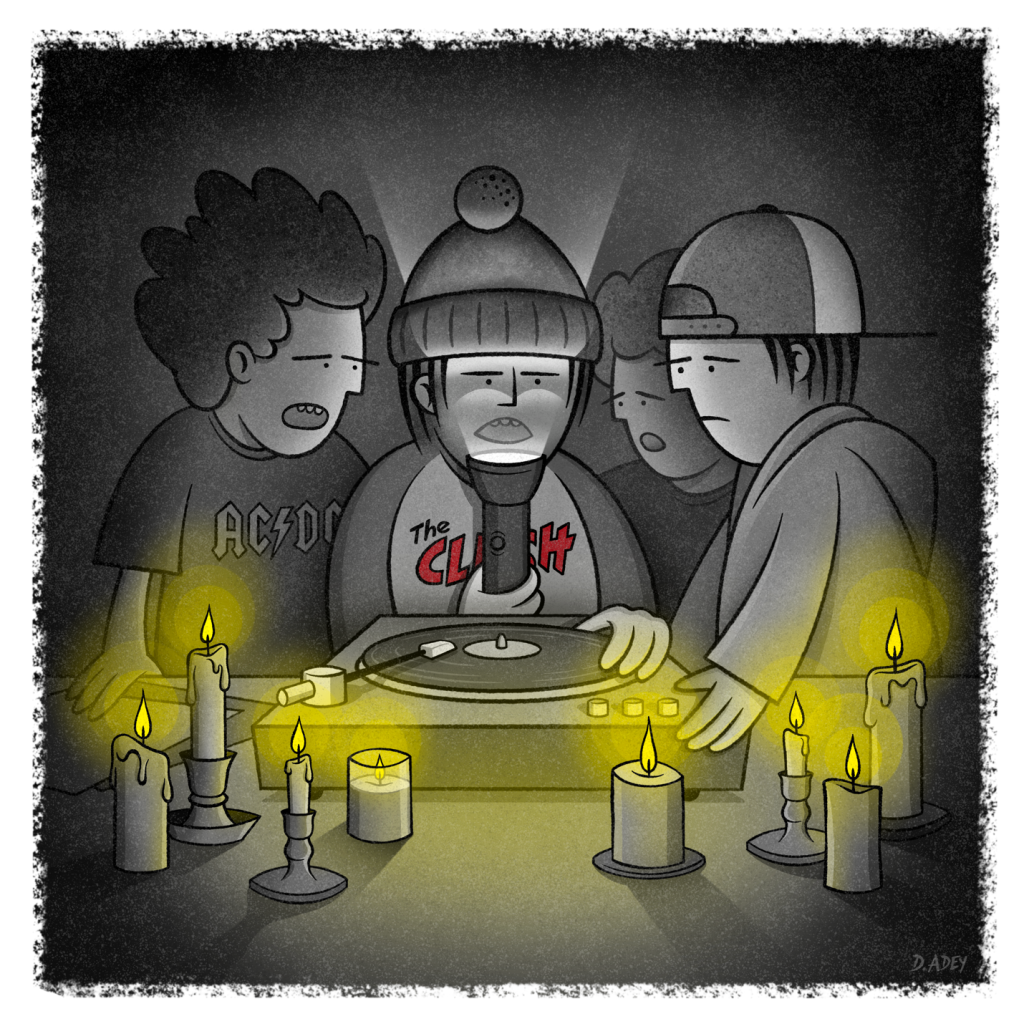
But in the halcyon days of my teenage years, when music was a life conviction, there was one band that mattered more than any other, the first band that became my band; “The only band that matters.” I was ten when I bought my first Clash record at Sam Goody in the Rockaway Townsquare Mall, several miles away in the neighboring town. Ever since the initial thrill from their only two radio singles, I knew I needed to own this record. This wasn’t anything like my dad’s sixties rock or hippie folk music, and it sounded like the antithesis of everything eighties pop radio had to offer. It felt authentic and urgent, and they were singing about important things, grown up things—at least that’s what it sounded like. I was too young to understand the majority of Joe Strummer and Mick Jones’ lyrics, but that didn’t matter. Their raw emotion and rebellious energy were electrifying. They were also smart-asses, and that was cool.
Finally, after weeks of scanning the radio for further signs of intelligent life other than “Rock the Casbah” or “Should I Stay or Should I Go,” I convinced my mom to give me a ride to the mall, where I purchased my very own cassette of Combat Rock. I wanted the vinyl for the cover art and lyrics, but the only turntable in our house was in the family room, and this album required solitude. By the time my dad got “saved,” and we started attending church, I was already music-obsessed, and The Clash was my band. It didn’t take long to figure out that wearing my Clash t-shirt to Wednesday night youth group was a bad idea.
“Straight to Hell”
“There ain’t no asylum here,
King Solomon he never lived ’round here.”
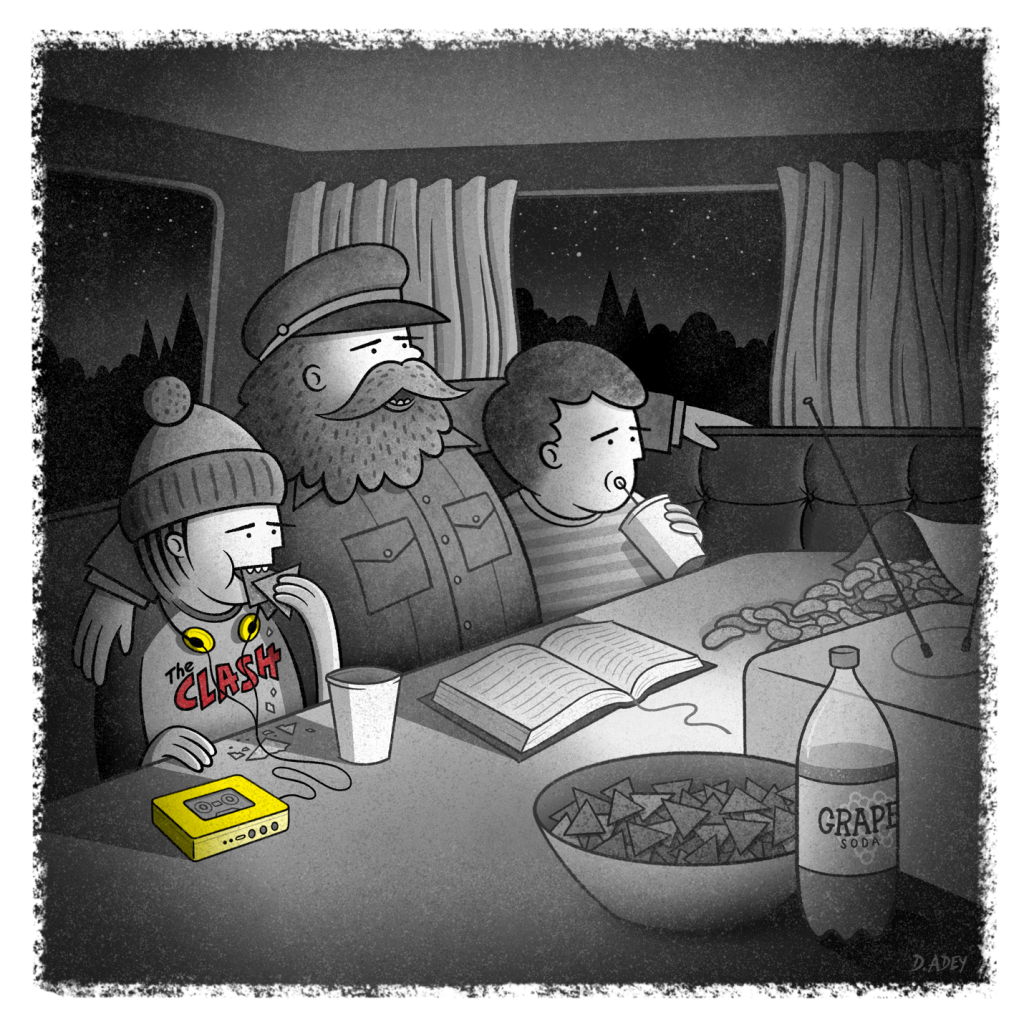
Junior high boys were clearly not the target audience for The Fiddler’s emotional performances, but while the adults gushed over his music, we just loved The Fiddler. Our awkward humor and attention-starved antics were barely tolerable for most adults and inspired eye-rolling or “knock it off!” But not The Fiddler; he joined in and made us laugh. He befriended a few of us boys and had us over to his trailer after Sunday night church to eat junk food and watch Godzilla movies on his tiny TV, like our own exclusive club with inside jokes and burping contests. He liked to tell me I was a “good-looking young man” and said I was a “desirable male,” always under the guise of Christian discipleship to help guard my soul against the sinful ways of the flesh. He also took a liking to my best friend and slept with his arms around him at a youth group sleepover in the church basement. My friend laid there frozen, wide awake all night. Although unthinkable now, this was in the “before times,” a more innocent time when most parents didn’t start wondering where their kids were until dinner was on the table. Somehow, it was easier to fear an invisible, mythical being who was the source of all evil in the world, than to recognize the devil among us. No one suspected a thing. Or if they did, no one said a thing.
“Clampdown”
“We will teach our twisted speech to the young believers.
We will train our blue-eyed men to be young believers.”
As the satanic hysteria in our church reached Defcon 1, I was reveling in the euphoria of a mountaintop spiritual awakening at summer church camp in upstate New York. It was an unforgettable week with altar calls and emotional commitments to God, topped off by my first open mouth make-out on the last day of camp in full view of my friends who watched through the church bus windows. I was the last to board and, with a bit of extra swagger, triumphantly took a seat near the front with some friends.
As we settled in for the three-hour drive home, we started talking about music, as was our routine. We debated the virtues of The Clash, The Violent Femmes, R.E.M., Talking Heads, The Police, U2, Pink Floyd, etc., with the intensity of a young Lester Bangs, thoroughly impressing ourselves, and, we assumed, everyone around us, with our insightful observations. About an hour into the trip, I made a reference to The Grateful Dead, “Casey Jones,” and recited the lyric “drivin’ that train, high on cocaine.” Our youth pastor, who was sitting in front of us and had been listening in, whipped around with a hawkish look and said, “I thought you were a more mature Christian!” I idolized this man. The euphoria of my spiritual (and libidinal) awakening was suddenly shattered, and I felt my entire body flush with shame. I quietly stared out the window for the remainder of the drive.
“Rock the Casbah”
“By order of the Prophet, we ban that boogie sound.
Degenerate the faithful with that crazy Casbah sound.”
It was a startling smackdown and an abrupt leap from the Casey Jones express to the iron rails of fundamentalism: one way, no detours, no scenic route, and the only way off was in a flaming wreck into the abyss with the Balrog. My mind was now filled with thoughts of Satan, our Wednesday night rock-theology classes, and the growing pressure from my church mentors that music had become an idol that I must surrender to grow closer to God.
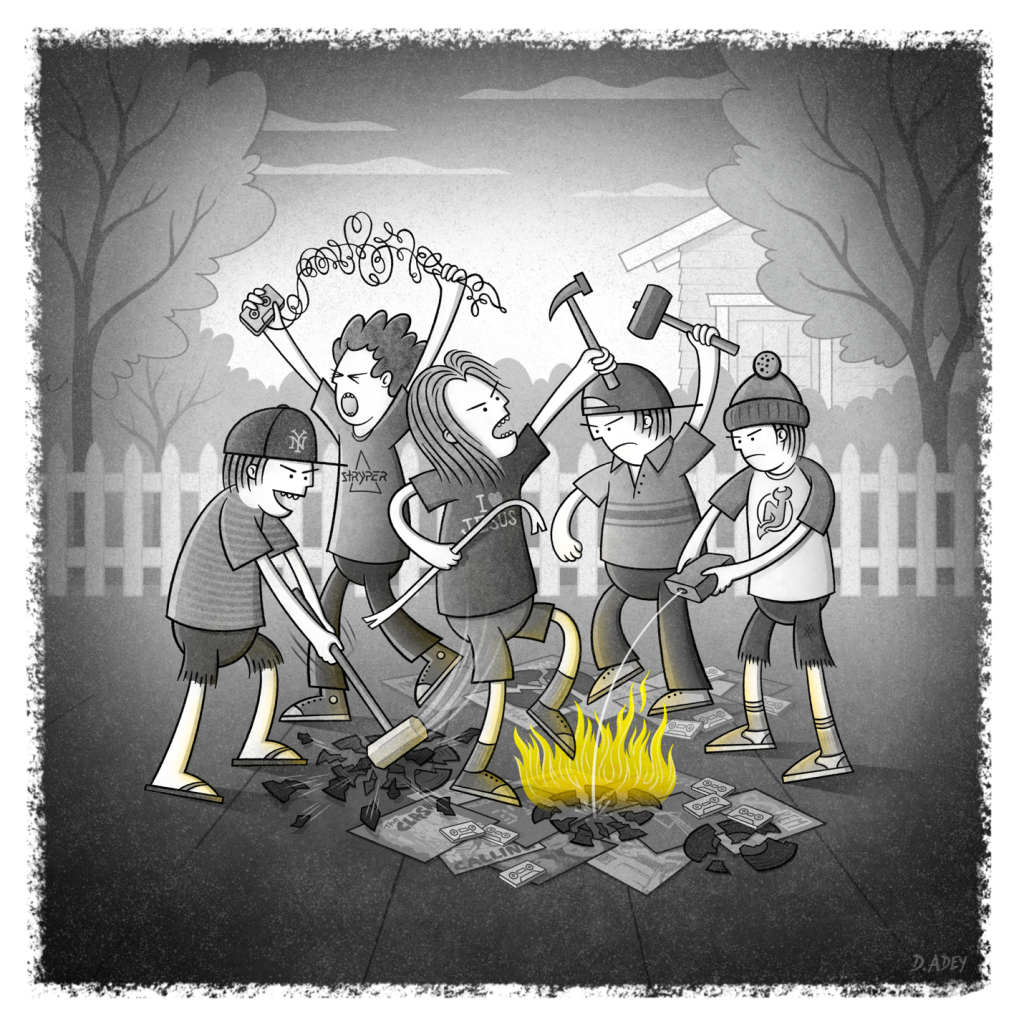
When the bus pulled into the church parking lot later that night, my mom was waiting in our family station wagon. I hopped in the back seat and informed her that God told me to burn all my records and tapes. So later that week, with a few church friends, we doused the pile with lighter fluid and lit the match. We jumped up and down, smashing, burning, and hollering like a liturgical mosh pit, squirting more and more lighter fluid until I accidentally set my friend’s foot on fire. The whole scene was over in about fifteen minutes, and I was left to clean up the mess alone, scooping up the smoldering shards with a snow shovel to clear the driveway before my dad got home from work.
I was praised for my youthful piety and obedience to God by my church community, which felt pretty good for a while. But within a few weeks, in the silence of my music-free room, I regretted my misguided sacrifice. As an introverted junior high boy, music was a life raft on the hormonal seas of awkwardness, and now it was gone, along with a few years of savings I had spent building my collection. I was once again stuck with the musical slot machine of radio, which was clearly rigged to land on Huey Lewis, Madonna, and Wham.
Not long after this spectacle, The Fiddler drove the church van full of boys to the local Christian bookstore to check out the latest selection of Christian pop music. We entered through a blast of potpourri and scented candles into a one-stop shop of commercial Christendom. The lady behind the counter directed us to the music section and handed us a photo-copied chart. You could look up your favorite secular bands and cross-list them with Christian alternatives. I was desperate for something to fill the void, so I took a chance on several church-approved cassette tapes. They sounded like decaffeinated tribute bands with heaping spoonfuls of saccharine earnest-y, and heavy-handed dogma, and they were even more preoccupied with Satan than Black Sabbath! I was missing Joe Strummer more than ever. Within a few months, I quietly began re-purchasing the records I had sacrificed, raking leaves, mowing lawns, saving up, one chore at a time. I thought my parents might be disappointed by my sudden reversal of zeal, but they too, were growing skeptical. They may not have approved of all my music choices, but they never tried to censor it.
Years later my mother told me that the record-burning incident was a turning point for her. As an Irish-Catholic daughter of an Army Lt. Colonel, speaking truth to power wasn’t exactly her strength. But in a subversive act of redemptive defiance, she drove me to Sam Goody once again to help rebuild my collection. She even chipped in for London Calling when I came up a little short. The reality that the authority of the Church wasn’t always a good influence was beginning to sink in.
“Four Horsemen”
“They were given all the foods of vanity,
and all the instant promises of immortality,
but they bit the dust screamin’ insanity!”
The Zealots may not have been paying close attention to Joe Strummer and Mick Jones’ lyrics, but they heard just enough to recognize their blend of smart-ass sarcasm and anti-establishment rebellion as a challenge to their beliefs. They convinced themselves that The Clash, and pretty much all non-church-approved music, was damaging to our young souls and responded with a sensory deprivation plan. Even if they weren’t watching over us, God was, and just like Santa, “He sees you when you’re sleeping, he knows when you’re awake.” Except the promise of God’s omnipresent surveillance within their sacred Panopticon wasn’t Atari games and action figures, but redemptive incarceration, a plea bargain of sorts, sparing us from a death sentence that had been handed down before the dawn of time. I already knew I was a screw-up, but I had no idea I was on death row!
The ethos of our little church was founded upon a terrifying dichotomy of life and death, heaven and hell, and the message I received each Sunday morning, Sunday night, and Wednesday night was that the secular world was a dangerous black-and-white hellscape clearly divided between angels and demons, us and them. We were at war, and we were the good guys. Our self-imposed exclusion provided a sense of superiority and a perception of persecution that gave credence to our cause. While the “narrow gate” reserved for “us” admitted only born-again Christians, the tribe of “them” seemed to be growing and now included Catholics, mainline Protestants, Jews, and even the Presbyterian minister of my grandparent’s church who baptized me as an infant. He was a Princeton Seminary graduate who didn’t believe in the literal interpretation of scripture; clearly, not one of us.
Our shrinking world was alive with a powerful mythology of spiritual warfare. Satan was hiding around every corner, in everything that seemed cool or fun, and the god of my youth was a petty, micromanaging bully who hated fun and was kind of a dick. The rapture was coming “like a thief in the night,” and if we didn’t resist the devil, root out the antichrist, slay the demons, destroy the ring, blow up the Death Star, hack Skynet, kill the Space Invaders, and defeat Randy Macho-Man Savage, we were all screwed! It was in this dizzying cacophony of voices at the age of thirteen that I became a skeptic. My orientation to the Church began to shift, but it took decades for me to understand, on a human level, that there is no Us and Them—“after all, we’re only ordinary men.” There is only “us,” but Pink Floyd was on the naughty list too.
“Garageland”
“Back in the garage with my bullshit detector.”
I was in my twenties when we all learned that The Fiddler went to prison for child pornography and molesting young boys. We weren’t surprised. Although nothing physical happened to me beyond awkwardly long hugs, I knew it didn’t feel normal. But when you’re thirteen, awkward is normal. You’re stuck in a feedback loop because there is no reference for normal at that stage of life. He was an adult and a Christian leader; we were kids, and in those days, that was enough.
I didn’t realize it at the time, but the irreverence of The Clash was like a double-dose vaccine of skepticism, inoculating my soul against far more infectious and dangerous forces that flew into our suburban homes on the wings of an angel, and I had the pre-existing condition of youth. If I had been “…lost in a fantasy that blinded me until Your Love Broke Through,” my life may have been set on a very different path, but thanks to The Clash, I hated that fucking song! The Zealots may have had me for a few hours each week, but Joe, Mick, Paul, and Topper had me every day and every night. Like Guy Montag’s friends in the woods, The Clash had imprinted on my soul, and the 451ers were too late.
It was much later when I learned that “Rock the Casbah” is a protest song about the Islamic fundamentalist ban on disco music in Iran. The Middle East and the Islamic Revolution weren’t on any of our minds then, but within the confines of my tiny bedroom and our provincial New Jersey existence, Joe Strummer had a way of making the world feel larger and smaller in the same raspy breath. The Clash had cracked open a window in The Fiddler’s van, and I could feel the rain.
“Death or Glory”
“But I believe in this and it’s been tested by research.
He who fucks nuns will later join the church.
Death or glory becomes just another story.”
There are plenty of good memories of church life in those years and many wonderful people that I still love dearly. But the dominant narratives were infused with undercurrents of fear, judgment, manipulation, and control—a tragic theological mutant of the love, joy, peace, patience, kindness… and radical forgiveness and acceptance that I would eventually come to know as foundational to the gospel of Christ. By the time I left for college, my parents had moved on. They often expressed remorse for some of their decisions in those years and for ever allowing me to spend time with The Fiddler in the RV. My dad often said, “I wish I had stopped you from burning those records,” but I’m grateful he didn’t. It turns out the cult of certainty is far more dangerous than Black Sabbath and a lot less fun. Learning from one’s mistakes isn’t much fun either, but it’s far more effective than being forced to avoid them. And in a twist of poetic irony, it may have been The Clash who helped save me from the Church and then inadvertently provided a much wider and gracious path back, busting down the shrinking narrow gate in favor of an ever-expanding kingdom of God.
I sometimes wonder about the metalheads of my youth that I once feared. I like to imagine that their favorite bands imprinted on them early in life in a similar way that The Clash imprinted on me. Perhaps it was Black Sabbath who cracked open a window in whatever fogged-up van they were trapped in. My teenage son loves The Clash, but they will always be dad rock for him. Buffalo Springfield was my dad’s favorite band, and I can only imagine what they meant to him when his friends were being shipped off to the other side of the world to die, and he was one of the “young people speakin’ their minds, gettin’ so much resistance from behind” as he burned his draft card in front of the Pentagon. Maybe in some small way, they also helped him resist indoctrination from the evangelical thought-police who taught us to fear our neighbors.
“I’m Not Down”
“I’ve been shown up, but I’ve grown up.
And I’m not down, no, I’m not down.”
Who will be the voice that my son and his generation will hear? Is it even possible in such a fractured media landscape to illuminate a new path with “three chords and the truth,” let alone Joe Strummer’s “…two chords and some vague ideas?” Will anyone break through and shine a prophetic light as so many dangerous ideas thaw and re-emerge in front yards across America? When will the forsythia bloom again, signaling the end of this season, offering a sign of hope and beauty against this colorless landscape of fear and hatred, which is somehow, once again, offered in the name of Jesus Christ? I wish I knew the answer, but my eyes and ears are wide open. Amidst this prolonged dark winter I remain a faithful skeptic, resisting the certainty of the hopeless cynic, which is perhaps, the most constructive form of rebellion.