
Kevin Young’s Night Watch counsels readers to forget (for a moment) Rembrandt’s Night Watch and to pay attention to the people in the art museum. In his latest collection, Young engages in a similar method of close looking and finding, in the epic journeys of grief and resilience, from slavery to freedom and inferno to Paradise. The collection’s four sections are variegated, inspired by Young’s father, Rainier Maria Rilke,All Souls Day, the conjoined twins, Millie-Christine McCoy known as “Two-Headed Nightingale,” Dante’s Divine Comedy and how it informs Rauschenberg’s Dante illustrations, and the African American cosmologies and spirituals that have grounded Young.
Young is a star-studded author of sixteen books of poetry and prose, including poetry collections Stones (Knopf, 2024), shortlisted for the T.S. Eliot Prize; and Blue Laws: Selected & Uncollected Poems 1995 -2015 (Knopf, 2017). He is the poetry editor of The New Yorker, where he hosts its Poetry Podcast.
I was delighted to speak with Kevin Young over the phone about the concept of finding each other in the allegorical underworld, articulating the in-betweenness of yearning and mourning, point of views of all versus one, and in writing his own version of cantos that’s urgent for the now.
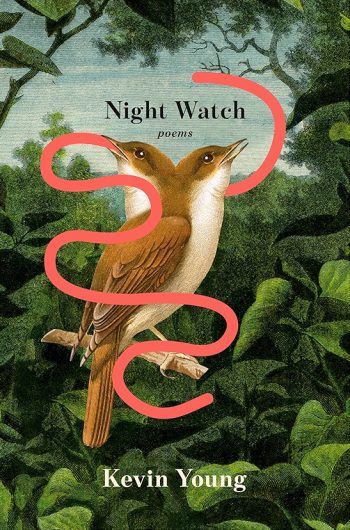
The Rumpus: Night Watch begins with an epigraph by Eavan Boland: “How will I know you in the underworld? / How will we find each other?” In what way does it serve as a frame for the poems that follow?
Kevin Young: Night Watch is a book that took many years. There was a time when I thought it was almost too dark to do anything with for a while, so I had it in a drawer.
When COVID-19 hit, I pulled the book out, and it seems really to be about the now—and maybe always—but especially then. That quote by Eavan—who actually died during that time—was an epigraph that spoke to me in her inimitable way.
The book as a whole is interested in the finding as much as the knowing and the discoveries of grief, but also of survival, and ends with a kind of paradise. I guess it’s interested in not just the underworld, but in a kind of afterlife that might be something to think about, and aspire to, whether that’s on Earth, or some other imagined or real realm.
The Rumpus: The one-page poem “Cormorant” follows that apt epigraph. In it, you introduce oxymorons–”Nobody’s angel,” “your crown, unkempt,” “crucifix / unpraised”—in describing the cormorant. How do the epithets introduce the themes of Night Watch through a kind of close looking, that brings the speaker back among “the memory of my father / driving home, his hands a map / pointing out shacks where Negroes / once lived, now / only timber & anger?” To me, it feels like searching through hell as a landscape, but also searching through familial as well as ancestral and historical memory.
Young: Wow! That’s a big question. Thanks for reading the poems so closely.
“Cormorant” was a poem that in some ways could have been in Stones, my previous book, a book about Louisiana and thinking about the past. The stones are many things, including gravestones. There are two graveyards in Louisiana, where my mother’s and my father’s family, respectively, are buried—including my father. And so “Cormorant” seems separate to me in some way because it was a poem of memory, but also of my father’s memory, which was so vibrant and specific whenever we’d be driving in Louisiana, and he’d point out–to call them landmarks is not exactly right but–places that were haunted for him and thus for me. He was troubled by the landscape, which is to say, by the injustices that once prevailed. I write that it’s “still there / for him forever”—that forever was a long time, and since he’s gone it feels only all the more present. He leaves a trace as well. And there’s his stone, of course, but there’s also his memory which suffuses that place.
The cormorant is this angel of a kind—and that’s the one you get. There’s something beautiful about them: I love how cormorants don’t have wax on their wings, so they dry them, and they sit with their wings outstretched “like a crucifix,” as I say. It’s certainly not a bird that people eat or treasure, so that disregard is part of the landscape, too. Yet I wanted to say—to my father, to the bird— “if only / I could see you again, hungry, / waiting, at the edge of the bayou.” This idea of this cormorant as this apparition haunts the poem.
The Rumpus: I love what you said about the angel of a kind as the angel you get.
If the traditional dichotomy of good versus evil is visualized in the Western tradition as light (the sun) and dark (the night), how does the poem, “All Souls” invert that on the craft level? What I noticed immediately was the very short line lengths, and the combination of couplets and monostitches. Could you speak a bit about the crafting of “All Souls?”
Young: “All Souls” is a sequence that is mysterious almost to me. Sometimes these voices come, and what I like about how it came is it wasn’t scared to leap and move between thoughts—and couplets and single lines are perfect for that. The poem has a tone that is yearning, but it’s slightly more mournful than a poem like the title sequence in “Book of Hours,” which it resembles in some ways.
On the one hand, a traditional book of hours is a holy text, one of prayer and thoughtfulness. I was trying to create my own in both the poem and the book by that name. But in this book, “All Souls” is very much a poem of transition, thinking about both All Souls Day and the days of in-betweenness that it charts. There’s a kind of danger, too, in the ways it considers loss. It talks about a coyote as “tired as I am,” and this coyote as a figure, it turns out, reappears in the start of the long sequence “Darkling” that ends Night Watch. In the Dantean beginning of that sequence, there’s this coyote skull. So there’s connection drawn by this coyote—and not just like a Wile E. Coyote, one of my favorite childhood, comical figures—but this eerie coyote.
The strange thing about if you ever see a coyote—or a “kai-yoht,” in two syllables, as some people say—is that you know right away that it’s not a dog. There’s this weird moment when you recognize it, and there’s something primal: That’s not a dog. That uncanny quality of recognition is throughout “All Souls.”
The Rumpus: Night Watch consists of four sections: “Cormorant,” “All Souls,” “The Two-Headed Nightingale,” and “Darkling.” In your “Acknowledgment and Notes,” you describe “The Two-Headed Nightingale” as being “spoken by Millie and Christine McCoy, conjoined twins born enslaved in 1851” who “often spoke of themselves as singular” and who wrote, “We have but one heart, one feeling in common, one desire, one purpose.” What was the thinking behind choosing to write about the African American twins in persona?
Young: Millie and Christine were conjoined twins who were stolen from their family, and then later rescued. There was actually a lawsuit, which the family won, for their kidnapping. What I love about them is that then they made themselves into these performers, which they had been initially without their consent. They became these beautiful singers by all accounts, and crafted their own songs. I want to get a sense of their harmonies, which perhaps not surprisingly, were so close and beautiful.
The twins thought of themselves as one being, and as a miracle, and I want to capture that. The McCoys sang for royalty, but I also think they were royalty, with what I call their “royal I”— multiple selves that was also one self. The poem was a way to talk about that and give them their due.
There was always one twin who was a little less physically strong, and in the end, one of them passed away first. If you’re one being and one of you passes away, (or one half of you), say, what is that moment? I want to try to understand her agency, but also a self which she both expressed and at times had to hide.
So those poems came, and they seem to talk to other poems in the book—thinking about “All Souls,” and here’s this one soul that is also an all.
The Rumpus: What you mentioned about the royal “I” is so interesting, because the speaker in this sequence refers to herself interchangeably as the royal “I” or “we” or as “us” (calling to mind the acronym for the United States). How do points of view work in the “Two-Headed Nightingale?”
Young: There is a way in which she also spoke of herself, like I said, in a plural fashion. As she says at one point in the poem, “We own / many tongues” or “Each of our hands / a language.” They were “The Two-Headed Nightingale,” a name they embraced, but they were also called the “African United Twins.” There’s a moment where she’s touring Europe, and she encounters this image of the devil which she feels looks more like her, but then she also feels it looks nothing like her. I think that’s what’s really powerful. And then, and there, the audience embraced her. I also wanted to give a sense of her own embrace.
In the end of her life, her family bought property that she had been enslaved on. I want to convey that full circle quality of her life, and it required thinking about her in these multiple pronouns and multiple selves.
The Rumpus: Some poems in “Darkling” were originally commissioned by the Museum of Modern Art for its Robert Rauschenberg retrospective. In what way are these poems a translation (literal and cross-media) or dialogue (across culture)?
Young: The curator Leah Dickerman at MoMA commissioned the first part of the sequence, which I ended up calling “The Dark Wood.” I’ve long admired Rauschenberg and learning about his “34 Illustrations for Dante’s Inferno” I was just as inspired by the way he made them as by the images themselves. The challenge was to do what he did with the Inferno, which was read to him, and then he responded to, canto by canto, image by image. For me, the goal wasn’t just to riff on Rauschenberg, but really to try to recreate those conditions to respond in some way to Dante.
It just so happens that the John Ciardi translation of Dante that was read to Rauschenberg was the same Dante I read when I was a teenager. I was struck by this confluence of memory and influence. As in translations of Dante, like those of my once-teacher Seamus Heaney, the question is “How do you make your own version that’s urgent for now?” Translators do a version of that, but how do you write your own one and just like Rauschenberg, how does one not illustrate the cantos but recreate them? In the end, I do sometimes invoke the language of Dante via Ciardi—and I suppose via Rauschenberg in some way—guided not by Virgil but by “the dead.”
Without telling anyone, after MoMA published Robin & I’s Inferno, I kept going. So there’s a Purgatory and then a Paradise section. The poems are preoccupied with some of the same concerns about loss and recovery, and of “how will we recognize each other,” as the epigraph.
The Rumpus: I am amazed by how Dante’s Divine Comedy (Signet, 2009) has propelled you forward, canto by canto, as the middle of the woods becomes the middle of the speaker’s life, through train announcements, medical office speech, and the like. How were you able to blend hell with African American cosmologies and spirituals that have grounded you in writing the new poems?
Young: Many Negro spirituals contend with Paradise, as well as the trials and tribulations of Earth and of life. I love that combination, which the enslaved who created the spirituals created, in a profound way. Those “Black and unknown bards” made what some people call the “sorrow songs,” which were so powerful in terms of how they think about the afterlife. But they also are coded as an actual place. While singing of crossing the River Jordan, they’re also signaling crossing into Ohio and being free. So there’s a consideration of freedom that’s at play.
I often think about those kinds of survivals in a musical way, the ways that Africans and then African Americans were able to sustain their spiritual lives in the face of not just hardship, but horror, and at the same time create these worlds in which we can inhabit and imagine and dream. That’s a big inheritance.
For me, because I love the cosmology Dante created, it made sense to blend that in a musical sense too, not in a necessarily literal one. In the book, like in the spirituals, Paradise is a process: it’s something you can hope for and work toward. And at times, and this is true of our times, we don’t know if we’ll get there. So it’s very much about the wish for more and for better, as well as about the faltering and footsteps along the way.
The Rumpus: Do you feel like the Dante or his terza rima form influenced your form of mostly tercets with variations in creating this music in “Darkling?”
Young: Without a doubt. I mean, that form influenced me from the very beginning of my writing.
I was starting to write when I first read Dante as a teenager, and how can you not be influenced by him? The list is long of those influenced, but I think we all are. Rereading him after I’d really written much of “The Darkling,” or when I was starting to try to think of the three different parts of this sequence, his great imagination, but also his vision, struck me.
The form also did that, too. I have a book called To Repel Ghosts: The Remix (Knopf, 2005) about Jean-Michel Basquiat, also in tercets. There’s a kind of epic quality to the tercet that I always have loved, and that goes through a few of my collections, including Stones.
The Rumpus: Nearing the end of the epic journey in Night Watch, you speak to Rembrandt’s eponymous painting only to counsel, “Forget the Night Watch.” What is ekphrasis to you?
Young: Having seen Rembrandt’s painting, it’s quite striking. The first part of the poem thinks about that painting. But then, I was also interested in the people in an art museum seeing or not seeing what’s there on the walls. How do artists depict light? But also, how do people ignore Van Gogh’s Sunflowers? How do you ignore that amazing image? But people manage to, and so a lot of that “canto” is interested in that.
In the Purgatory portion, there’s a poem for Keats: “The death / mask made of Keats / no longer breathing— / look at it / not look at us.” There’s that quality of being seen, but of not seeing, or recognizing, what’s there.
The Rumpus: Do you have any closing thoughts that you would like to share with your readers of the world?
Young: I’ve been reading from Night Watch lately and I’m often struck by some of the humor in it, even in poems that are somewhat serious, even in “Cormorant,” which is in some sense an elegy. It’s also a poem thinking about names and the pleasure of naming and of existence, which the book is too. I hope people get to hear all the different tones in the collection. You can’t have only one tone in a book about someone as dynamic as Millie-Christine, or Dante, or my father, for that matter. I hope that fullness of being is reflected in my work.