The First Book: janan alexandra
The Author: janan alexandra
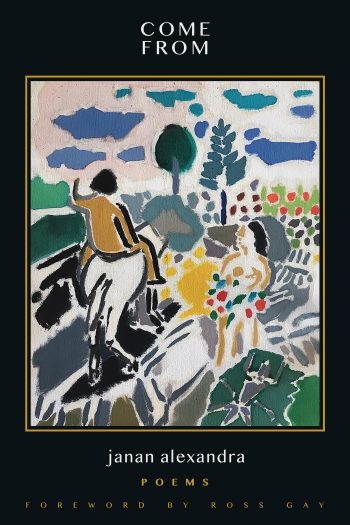
The Book: come from (BOA Editions, 2025)The Elevator Pitch: In 25 words or less, what is your book about?
The ordeals of aliveness! Broken mother tongues. Awe and gratitude. The tactility of language. Family history. Ongoing postcolonial loss. Belonging in diaspora. Girlhood. Cats. Beautiful ruins.
The Rumpus: Where did the idea of your book come from?
janan alexandra:
As with probably most things in my life, there wasn’t a single defining moment when the idea for the book was conceived. I think of it more like clay: shaping and reshaping, or waves washing up on shore, bringing little bits of detritus and glass and seashell to the surface. I do remember having the crystalline realization that I was writing a book I needed to read, and perhaps that’s the biggest project for many of us—to create what we need and haven’t yet been able to find out in the world. Part of that, for me, was a book that could enact what it can feel like and look like to have the particular relationship I have with Arabic. And for that to matter.
Rumpus: How long did it take to write the book?
alexandra:
Ballpark three to five years, depending on how you count. The bones of the work emerged as I wrote my MFA Thesis in the spring of 2021—that was probably the earliest iteration of the book. Lots changed between then and 2023 when the manuscript was picked up by BOA Editions.
Rumpus: Is this the first book you’ve written? If not, what made it the first to be published?
alexandra:
Yep!
Rumpus: In submitting the book, how many nos did you get before your yes?
alexandra:
I bet I submitted the book to about 10 or 12 presses between 2021-2023. And I got some straight nos and I got some encouraging nos and then I got some very encouraging almosts—it was chosen as the finalist for the 2022 Donald Hall Prize and I think it made it on a shortlist at Persea maybe, can’t remember!
Rumpus: Which authors / writers buoyed you along the way? How?
alexandra:
Oh gosh. I refer you to the very succinct acknowledgements on pages 105-108 of my book!
TL;DR no one does anything alone. So many have helped me along the way: fed me,
read my work, picked up the phone, wrote letters of recommendation or blurbs or forewords or feedback in loopy purple ink, loaned me books and films and records, have been a friend to my heart, gifted me the most finite resource in their life—their time. Some very specific writers who have helped make my life in poetry possible: Ross Gay, Aracelis Girmay, Ellen Doré Watson, Kevin Quashie, Carolina Ebeid, Jeffrey Pethybridge, Noah Davis, WLS, Nathalie Handal, Kaveh Akbar…the list goes on like this, forever.
Rumpus: How did your book change over the course of working on it?
alexandra:
It became more itself. The sections got tighter and the reasons behind order and sequence became more sturdy, more chewy. Nathalie Handal helped me see that the book wanted to move toward Arabic which is why the Arabic abecedarian sequence is all grouped together toward the end. (These poems used to be interspersed throughout the whole collection). That was a big change and so astute/sensitive on her part.
Rumpus: Before your first book, where has your work been published?
alexandra:
I’m honored to have had poems and essays published in lots of places in print and online.
Some favorites: Gulf Coast, Mizna, The Adroit Journal, Rusted Radishes, The Georgia Review, Ploughshares, and of course, The Rumpus!
Rumpus: What is the best advice someone gave you about publishing?
alexandra:
Oh, you know I really haven’t gotten much advice about publishing. Maybe that’s unlucky in some ways but I think of it as lucky that so much of the writerly advice I’ve gleaned from my mentors and teachers and friends and comrades has touched deeper matters of making. Poets!
But let me think. This isn’t advice, per se, but somewhere along the way I learned from my friend Noah that he had a very regular and disciplined submitting practice. I can’t remember the details but I remember thinking, “Wow that’s smart.” I think he submits work every month or something like that, maybe even more. That was useful—a model for how to build a habit of sending out work frequently. Some advice I’ll give you, dear reader: don’t spend money on submissions. Jeez! If you can avoid it!
I’m pretty chaotic when it comes to my digital organization so I don’t have any fancy systems or anything. But now I’m remembering I think Lisa Ko once said that she collected her rejections and tacked them up on the wall or something like that, as evidence of her success—that is, evidence of the larger more fortifying success than getting something published, which is the success of writing the thing to begin with and sending it out into the world with nothing but a little stroke of hope. So, from that I learned something very important which to this day informs how I feel about publishing: just send the work out if you’re excited about it. It doesn’t matter if it gets picked up or rejected or whatever. Just make and send. Make and share. Keep making. See what happens. Try again! That’s my business. The idea that rejection should fill us with despair, I’m skeptical about that. I mean, think of how many truly exquisite photographs come out of a roll of film? Maybe two or three out of 36 exposures if you’re lucky? It’s all practice.
Rumpus: Who’s the reader you’re writing to—or tell us about your target audience and how you cultivated or found it?
alexandra:
I’m writing to myself first: writing to and for myself, trying to help myself figure things out, stay alert to beauty and wonder and curiosity, find language, find my own language. That’s the primary urgency of writing. Target audience? Anyone who wants to come along! Probably anyone who is similarly subject to the ordeals of aliveness and the many weathers of deep feeling—not everyone wants to go there. But my audience is likely made up of folks who believe in the primacy of feeling and the wellspring of wisdom, knowledge, rebellion, and care that can be found if we stay attentive to and curious about what and how and why and where we feel.
Rumpus: What is one completely unexpected thing that surprised you about the process of getting your book published?
alexandra:
Until the publication process for come from was well underway, I had no idea, not even the slightest inkling, that as authors we are the ones who write the jacket copy for the book’s back cover! I guess I had always read the jacket material on books and imagined that there was a job out there—an editor or agent or similar someone at every press and publishing house, some lovely, very smart, exceedingly well read expert on all literature—who read and created that content for each forthcoming title in the publisher’s catalog. Ha, imagine! If that person does exist, I love them.