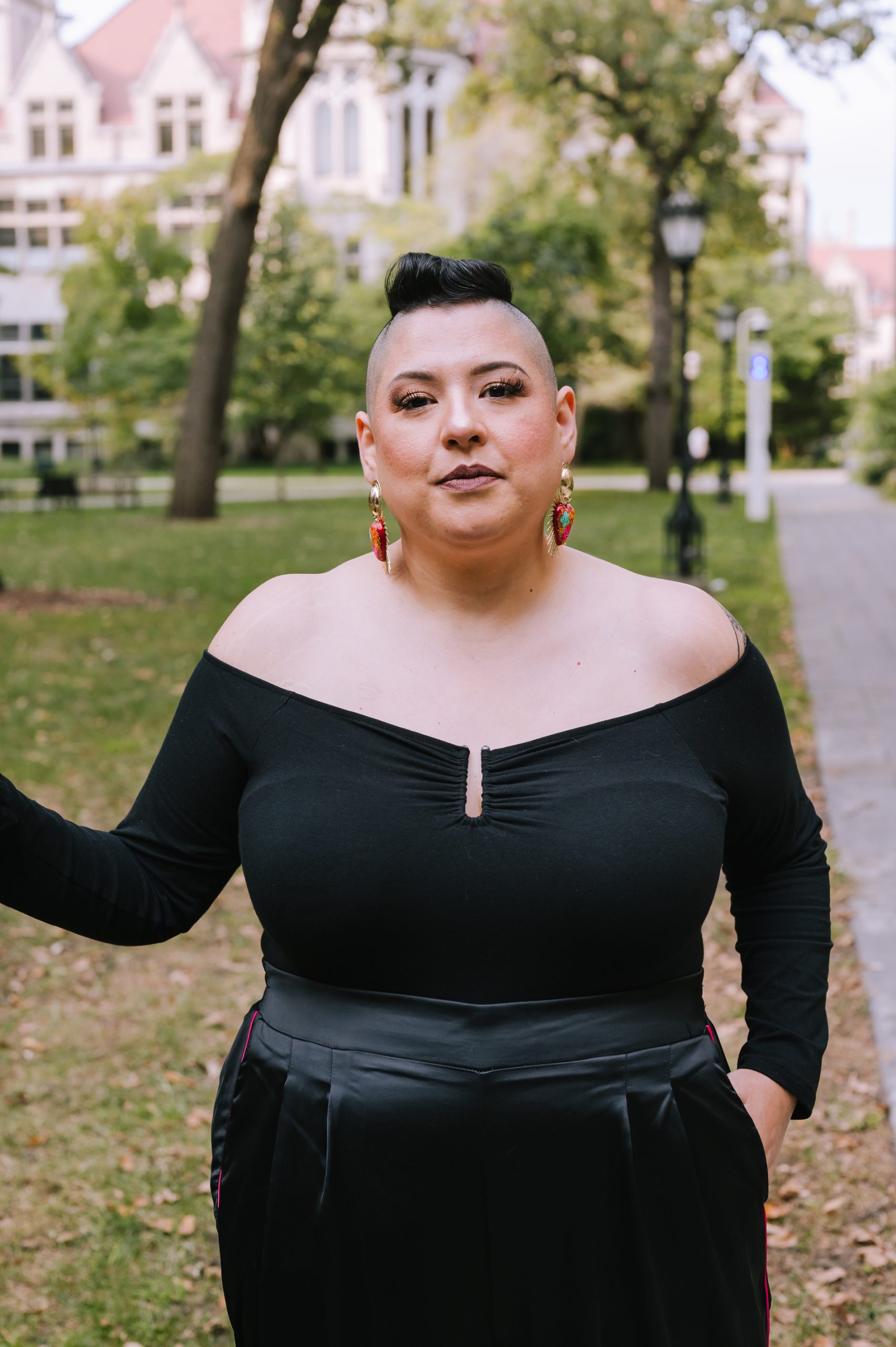
m. mick powell sees dead people, specifically dead girls, specifically dead Black pop stars. The presence of legends like Phyllis Hyman, Whitney Houston, and Aaliyah Haughton flickers throughout powell’s first full poetry collection, Dead Girl Cameo: A Love Song in Poems. Even as a university professor, powell knows that there is value in studying the otherworldly. A bricolage of ghosts, stardust, music hits, and generational trauma, Dead Girl Cameo offers a unique path to communication with ancestors and asks those still living to consider what becomes of discarded idols.
I sat down to talk with mick via Zoom on a dreary Monday evening to chat about doom and gloom, her personal conversations with the dead, and how the light of Black women’s music manages to shine through even the thickest darkness.

The Rumpus: This is a book about dead girls, but I want to kick us off in the land of the living. You start the book with an epigraph from Saidiya Hartman’s “Venus in Two Acts,” and you go on to reference the essay several times throughout the book. What’s your relationship with Hartman’s essay, and how did it contribute to the birth of Dead Girl Cameo?
m. mick powell: That’s a great question; I really love to talk about this essay! I read this essay for the first time when I was an undergrad at The University of Connecticut. I was studying gender and sexuality studies; it was one of my majors. I was first introduced to [Hartman’s] Lose Your Mother, then through that, I came to find the essay. [Hartman’s work] was just so transformative for me on a deeply spiritual level. On a scholarly level, it really broke so much open for me and even expanded the definition of what scholarship is as I concurrently was meeting poets like Audre Lorde and June Jordan on the page and experiencing their work for the first time. I was just so captivated and given words and language that I didn’t even know or have at that time. It was just like, “Wow, this is teaching me so much!”
The essay wasn’t always a part of the collection. Once I started working with my editor at One World, I realized the thing I struggled with the most was the order and the structure of the book. It was actually years into the book where I reflected on Hartman’s essay and the phrase “dead girl.” Then I went back to more intentionally interweave it with my manuscript. The essay itself was just such an echo, almost like a haunting. Not in a frightening or ghostly way but more like following me and helping me make meaning out of so much.
Rumpus: That’s interesting. So, in your mind, haunting isn’t necessarily negative, but more sort of an omniscient presence?
powell: Yeah, like this ever-present, ever-knocking, ever-curious, infinite thing that is surrounding me. I even think of my obsessions as things that haunt me. I think I want to be joined by the dead. I want them to be with me. I want to be with them more. So, I welcome that sort of feeling that sometimes feels kind of scary.
Rumpus: Thank you for clarifying what these words mean to you! Continuing on about influences and what persists throughout the book, we also see the works of several modern Black women poets, like Taylor Byas and Brittany Rogers. I’m curious about what you’re aspiring to weave with these threads that others have spun. It all seems very intentional, and you’ve done really masterful work incorporating their poems into yours.
powell: I do think about this book as a sort of tapestry or something that I’m weaving together. Honestly, I’ve thought about the book in so many different ways—maybe it’s a stage play, maybe it’s a musical. I love collage; maybe what I’m trying to collage throughout the collection is a series of alternative Black girlhoods.
Thinking about the Black Venus superstar as I mention in the introduction to the book, then thinking about Black girls who are childhood stars—most of them were stars as even preteens or young teenagers, but certainly by their early 20s. I’m primarily engaging with the celebrity and superstardom and the ramifications of that aspect of girlhood on my own Black girlhood. I think this conversation about Black girlhood and queerness and fame comes across in the collage I’m creating with the folks who I’m engaging with and bringing in [to the book].
Rumpus: Calling it collage is definitely appropriate! I definitely see what you’re speaking to, and I think the readers will too. In the poem, “Dead Girl Cameo,”, the speaker seems to want to protect what is referred to as the “holographic frame of the dead girl,” insisting that the dead girl can’t be left to “dissolve into the familiar dark.” Why is the ether of dead girl pop star worth preserving?
powell: I have several things in mind as I think about this particular question. One starting place is that when I was writing the book, I was very preoccupied with the idea of being perceived as a celebrity worshiper in a non-critical or very capitalist, very consumerist way. I do hope that when people read the book, my nuance is felt. That’s what I hope. Because really, fuck celebrities. I just want to say that on the record, fuck celebrities, fuck billionaires. I just want to be clear about that.
Still, thinking specifically about pop stars and celebrity is something that I’m very interested and intrigued by.
Hartman poses a similar question in the epigraph that I use at the start of the book, when she says, “Why revisit the event or the non-event of a girl’s death?” I think here in that sentence, thinking about the event and the non-event of the death was particularly interesting to me. On the night Whitney Houston died, it was the night before the Grammys. She was in her hotel room at the Beverly Hilton. And Clive Davis, her lifelong manager, was having a pre-Grammys party where she was set to perform. She passes away and the show just goes on, right? The show just goes on. There’s no stopping. The Grammys go on the next day. Of course, there’s a tribute to her, but the show just goes on and she’s upstairs dead in the bathtub.
It’s a national event in so many ways. It’s a major moment in music history and American history and the history of my life, but it was also this non-event too. The world doesn’t stop, not even the world in which she was so much a part of, not even the world in which she was supposed to physically be. Nobody stopped. These are some of the biggest superstars in the world, and their deaths are non-events. I think that’s very interesting to me, so I think that’s part of what’s worth preserving around their deaths.
I also think your question is asking about the ether too, which is about their lives and their afterlives and their potential lives or potential futures. I hope that I’m re-humanizing them in a way that’s not sort of infantilizing and that is more hopefully nuanced. I’m engaging with these worlds that could have been possible in different configurations of our realities, and that gets me really excited.
Rumpus: That last part brings me to how you’ve got these cool, dainty little butterflies on the cover and that’s a very butterfly effect-sounding implication: What if there’s a universe where Whitney Houston DID make it to that Grammy’s party. There is a universe where Aaliyah’s flight landed safely, and so those nights would have been non-events in a different way? Since we’re left in the plane of existence where the events didn’t necessarily work out in favor of those women, how do we sustain some record of what has happened to them along with the acknowledgement that they did exist? That’s a good chunk of what I’m hearing in what you’re saying.
powell: Yeah, that’s absolutely it.
Rumpus: Time is an odd notion throughout the collection. We see blurring of the lines between the realm of the living and the realm of the dead. There are interesting situations where we’re seeing presently-dead girls who are living in the poems, and within the poems they are also seeing and engaging with the dead girls before them.
For example, in “Left Eye backstage with her whole hand in her mouth,” Lisa “Left Eye” Lopes is seen talking to the phantoms. So even though she’s no longer with us—we have this scene where she is still here and she’s talking to the phantoms and they’re having a really intense conversation about how she sees her future. These phantoms that Left Eye is dancing with, interacting with, and then eventually becomes, do you think that they’re picking and choosing people in the realm of the living to speak to, or do you think that they are just existing out there and ready for anyone who is brave enough and ready to engage with them?
powell: Yes, time is certainly slippery in the book. I do believe that. I do believe in kind of having a spiritual connection with the dead, and I do believe that we live in a spiritually thin world. The veil between us living folks and folks who have passed on is so thin, and I think the door is open to the spiritual world. I want to acknowledge that so much of the work I feel like I’m doing is of course archival, but then it feels kind of like conjuring work as well.
When I watched Whitney Houston’s first live television performance [on the Merv Griffin show], it’s just so… phantom-esque, even the color, even the overlay, it just feels like there’s something happening there that is just otherworldly. I’m thinking about these moments in time, these moments in history, and then also leaning into my intuition and reading between the lines of things.
When Aaliyah died, my mom told me that now that she had passed on, I could write letters to her, and she would be able to read them more than she would be able to read them in real life. That death opened this door to having a closer and a deeper relationship. It transformed so much for me in ways that helped me also cope with the death of my loved ones as an adult because I didn’t have to feel that death was so final, that death meant we would never speak again, or that I couldn’t feel them. I don’t deny what death takes from us, but to know that it’s not so totalizing was such a savior to me.
Rumpus: I’m fascinated by this idea that someone dying in this world actually makes them more accessible overall, and sort of opens a line of communication. You know, people do that with all types of celebrities. People love to do that with Princess Diana. She was the people’s princess, and the people are flocking to her post-mortem.
I want to turn toward the fact that you seem to use the book to speak to this often silenced or hidden truth that many of those who routinely harm Black women are Black men, and other people from the Black community. I am curious about how you manage to survive and navigate a world in which even our own community is regularly contributing to our destruction.
powell: This feels like such a present question for anybody who’s keeping up with the stuff with Diddy, for anybody who’s watching or hearing about people on social media, like the Chris Brown stuff. The book originally originated as a chapbook idea that was specifically exploring sexual violence in the music industry, particularly for Black women, for Black femmes, and before the sort of viral moment of #MeToo.
I think there’s all of these tensions and conflicts and the violence of the industry. I think about these Black men and Black men superstars who have support across our communities, which is still absolutely wild to me. I have to remember that it’s actually not wild. It’s important to say that we all are operating under this misogynistic, white supremacist, heteropatriarchal capitalist society. We’re all swimming in that—Black men too. So, I do believe in restorative justice, transformative justice. I do believe that’s part of my survival too, believing in a world where justice looks different for people and healing looks more possible. And that’s how I think I survive… it’s difficult though, the world can be so vile.
Rumpus: Thank you. That question comes in reflection of the poem, “The Duet of Whitney and Bobby Kristina,” and how the speaker is talking about this “genetic propensity for fracture,” which appears to be speaking to generational trauma—the fate of the mothers is the fate of the daughter. It’s all very tragic and very sad that not only are these two people passing, but they’re passing in the same way, kind of stars burning bright and fast. It seems to evoke a narrative that this is something inherent or ingrained.
If that’s true, and if these cycles that you’re describing are manifested at the molecular level, if they’re in our DNA, do we have an opportunity to change the narrative? What would that look like if it is possible?
powell: Hartman tells us that we can’t understand the lives of Black people in the United States today [without] contending with slavery. I think that the intergenerational effects of the slave trade run so, so deeply, and we see it come up to the surface in this really tragic, harrowing story of Whitney and Bobby Kristina. The question of escaping that type of fate is a systemic matter.
I do believe it’s possible to break generational patterns. I encountered a clip of Nikki Giovanni and her saying that Black people are the most fantastic people in the world because in the most brutal conditions, we still were able to love. We were still able to form families and kinships and friendships and make music and dance. I feel like that is the escape because it’s beyond the material, the monetary. There are plenty of Black billionaires, and that does nothing for me. That’s not the thing that’s going to help. That’s not the escape.
Rumpus: That’s a lot to sit with. I do think that your collection is actively contending with these things. You’ve given me a lot to think about, and I think readers will appreciate that as well.
To turn to something lighter, if I’m basing my answer on the frequency of mentions in the book, perhaps I could guess, but please tell us which of the dead girls from the book is your most beloved and why.
powell: I’m kind of curious about your guess first.
Rumpus: Well, my guess would be Whitney. And then you have on the Whitney shirt.
Powell: That’s so funny, I was thinking about how I’m wearing the Whitney shirt! It’s so, so hard, but I do have to say that it is Aaliyah. She’s my favorite, always been my favorite artist since I was a very young child. She’s my first crush, the whole nine. It’s the 24th anniversary of her passing, and I’ve been saying that I wrote this book to avenge her. In my mind, even in childhood, I was like, “I have to do something, whatever I can do with whatever power I have.” It just happens that I’m a poet, so it comes out in the book. I’m like, “I just have to do something.” So yeah, she’s one of my favorites.
Still, Whitney is an absolute daily, and she means so much to me. Speaking to the structure of the book and how often Whitney comes up, she also happens to have just the longest career. I’m also interested in her queerness, and there is this more public storyline with Whitney Houston and Robyn Crawford and the life that they shared together—the love that they had. So she becomes this really critical kind of case study. Her story becomes so central, because I just found so much that I could look toward for the book, like the poem about her performing at pride. Robyn’s reflection on that particular performance was that Whitney was so free and having the most fun she’d ever had. It was just so lovely.
So, if I could pick two, they (Aaliyah and Whitney) would be the two.
Rumpus: Yes, we can definitely make room for two favorites!
Moving toward the end of the book, I found it important to highlight that the book doesn’t end in death. If this is a play, it’s not a tragedy. Death is kind of the main event that sort of occurs throughout the book, but the book itself ends in meditations on remembrance. A question to you as the poet, and the author: how do you want to be remembered once you join the realm of these dancing, beautiful dead girls?
powell: This feels like such a haunting question (in a good way)! I think I would say, given the cover and the last line of the book, I’d like to be remembered as a butterfly. I think I’ve been so captivated by butterflies throughout this process for a number of reasons. Butterflies don’t live very long—most of them maybe two weeks, three weeks tops. When we see them, we’re encountering them in these really brief, fleeting moments. They’re so beautiful, and we get graced with their beauty. So I hope that I am a butterfly, somebody who blesses people with a radiant beauty, not just in words, but hopefully in spirit and in community. That’s what I hope for.
Rumpus: Oh, to be a beautiful, flying thing. Well, I hope that for you. In speaking of hauntings, and messaging, can you give a statement of what blessings or warnings you intend for the songs of the book for the dead to impart to us as the living? What are we supposed to be hearing?
powell: I think the message is: Protect Black femmes. Just value Black femmes. I just want to say that very crystal clearly. That’s the message.