
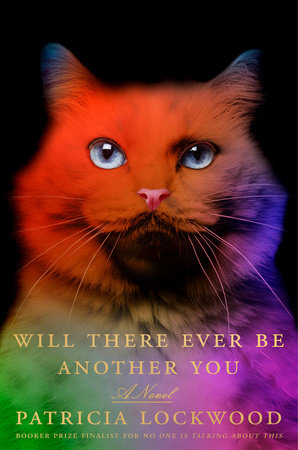
Maybe it’s Covid—I mean it was Covid—or maybe it’s fairies, but the protagonist of Will There Ever Be Another You (Riverhead, 2025) has lost herself. Patricia Lockwood’s dizzying work of autofiction is set in the early days of the pandemic, when almost nothing is known of Covid, and long Covid is even more mystifying. What follows is a deep dive into the sensory experiences of a character who can’t quite make sense of the world, but with Lockwood’s lyricism and sharp humor, it is wondrous, nonetheless. Over the course of the novel—through hallucinogenic mushrooms, through art forms such as metalwork, literary criticism, and screenwriting, through a life-threatening medical emergency and the careful tending of a gruesome wound—we re-emerge in the physical world.
When I spoke with Lockwood on the phone (Miette purring on her lap), the double awareness of reading autofiction—of accepting a story on its own terms while knowing, or perhaps denying, that much of it is real—extended to our conversation, which slithered uncannily from the book to life and back to the book again. She and I spoke about the fluid borders between mind and body, self and other, individual and world, and about an illness that won’t sit still to be looked at. It might be in the body. It might be in the mind. It might be in somebody else’s mind or body that is mingling with your own. It is probably also in the landscape and the weather and, yes, definitely in that cat you’re holding.
The Rumpus: You write about being interviewed in Will There Ever Be Another You. I want to start by naming how impossible that makes this one! I love the idea of it as a hall of mirrors, but then there is this self-consciousness that comes along with that. Is that part of some master plan?
Patricia Lockwood: No. In fact, I would say that my whole interview M.O. is to open my mouth and let a big jumble fall out and then kind of sift through it, seeing if anything is true. It’s usually true but there’s no premeditation.
I do think about them later because it’s funny, your adrenaline goes up, your heart’s in your chest, and you’re like what could possibly happen that would be causing my body to feel like I’m being hunted by a bear? So, afterwards you wonder if this is really how you think, how you feel, how you write. This is the target of these interviews—how does a person write?
Rumpus: So is that how you write? Spewing it out and looking at it later?
Lockwood: No! It’s almost completely different. I’m a sentence writer and I’m a line writer.
This book was a little bit different because it had to be constructed syllable by syllable, but typically I’m working in terms of the unit of the sentence, the line, the paragraph. Little bricks.
When I first consider a question or a poetic problem, I think in metaphor almost before I register what the thing is. It’s the reason you end up writing poetry. Looking at a vase you’re like, “Oh too late!” The metaphor is immediately what you see. And that’s just always been the way that my mind works.
So it is different, but I like to do spoken interviews because sometimes you find out what you think or you surprise yourself.
Rumpus: Does it still happen, that you surprise yourself?
Lockwood: The reason I’m not an actor is because I would say one line and think that was really great and then I would just do it that way every single time with no way to break it and make something new. It’s like echolalia. But good questions prompt you to break up those old concretions. With each book you get a new fresh chance.
But there will be themes that everyone brings up. In this book, I was surprised that everyone wanted to talk about the mushrooms and reading Anna Karenina? There was even some trepidation about including the Anna Karenina chapter because it is directly from notebooks and is really inside the novel in a way that people can be fearful about because what if people haven’t read this? It’s a little bit inside baseball. But every single person has wanted to talk about it.
Rumpus: It was perhaps the part that most put my body inside the book, and I definitely want to talk about the book in terms of bodies. The character is eating hallucinogenic mushrooms and reading Anna Karenina, taking notes about it that are smart and trippy at the same time: “we ourselves are in the train that will take Anna under the wheels.”
But it’s also that I’m sitting here reading a book and here are these pages and the narrator is reading this book and talking about these pages. And inside that book, Anna Karenina is holding a paper-knife and reading a book. “It is her body, slice, slice, moving us from page to page.”
Lockwood: It’s endlessly recursive.
Rumpus: It surfaces what, to me, is a main concern of the book—the blurring of borders between the self and the world. “The landscape taking bites of you, to incorporate you into its own flesh.” When something happens in the world, the woman feels it in her body.
Lockwood: I wanted to center the book in sensual perceptions because those were all I had. I had a series of notebooks with endless descriptions of these sensual perceptions, this feeling that she had become the world, that she became what she looked at. If she looks at a cat, she turns into the cat. Speaking to another writer, she turns into that writer. She’s reading Anna Karenina, she becomes Anna Karenina. She’s participating in weather systems. She’s joining the headache outside her. She’s joining a sort of insanity that’s going on outside of her as well.
I thought that I can describe. I didn’t know the explanation for any of it at that time. But if you center things in granular perceptions, you’ll be able to carry people into that state.
And when I hear reactions, it’s sort of split between “Well, I understood everything that was happening” and “What’s going on here?” So, maybe the state itself was not unusual. Maybe we all joined the world outside of us in a different way at that time.
Rumpus: That seems related to how the book creates a connected experience between people. We often lose the border between one mind and another. “They were in each other’s minds, as they were on the telephone, finishing each other’s sentences and visiting the set of the past.” There are many entries into something like a shared consciousness.
Is the book marveling at that connectedness to both the world and other people? Or is it struggling to reconcile it? Or maybe trying to fight it back into the individual?
Lockwood: It must’ve been marveling because there was this desire to document it. There was this heightened strangeness, but there was also heightened awareness.
I wonder a lot about going into bodies. That was something that I always felt when I was a child. You would go into other bodies while you were watching basketball and that was always true of me. I would stand next to the television and feel myself pirouetting or sailing over people’s heads. I was identifying with these beautiful athletes.
I don’t know why this resurfaced in a way that seemed a nightmare, but it was at times very beautiful.
Some of the interesting chapters are where it happens with her family members, because it’s one thing to feel that way about a stranger, when it’s a blank canvas. But with your family you’re bringing so much to bear. What happens when you feel yourself at odds with a father or a mother? When you suddenly have this sense that they are your enemy, but you can still enter into their bodies and feel that vulnerability?
So, I do think that it was marveling. There are all these descriptive passages that would be written right before a storm blew through where you felt that you were lifted into the air and you were flying. I would write ten to twenty pages and not really understand later what had happened or what had carried me into that state. It was something about the aura. Aura is a literary term but also a medical term. I was living inside that a little bit. It was something medical, but it was also literary.
Rumpus: Is it bodily or about the mind?
Lockwood: It was really one of those spreading things that you didn’t know where it was. If you can’t feel your hands or your face, is that neurological or is that centered somewhere in the body? It was so extreme that you didn’t know where it was located, so that’s why you located it in the world. If you feel like you’re flying, if you feel like you’re on fire, if you feel a part of yourself lengthen or disappear—maybe it’s easier to extend that to a wider realm and not just think about it in terms of your body.
Rumpus: I keep thinking about the social implications of this way of experiencing the world. There’s such a tendency in our culture to treat illness as personal failure, rather than a societal concern, so we move away from vaccinations and masks and other ways to protect each other. But if we can sense the connection between the self and the world, between the self and other people, can that help us in terms of public health?
Lockwood: That’s kind of a big one!
What I felt at that time, as a person who had [Covid] early on, is that even if my greatest enemy were ill—when you looked at them on the news and saw them heaving for breath—you felt it. Even though it’s the one person on earth that you don’t want to feel this physical empathy for, you still did because you had that experience, that sensation that you might die in the night.
There are people I don’t want to empathize with, that I don’t want to wish a long and happy life to, that I want to set up a big celebration and dancing in the streets when they die. But it’s hard to prevent a body and mind from empathizing, having had that experience.
So it was something that linked us. You couldn’t stop it from getting into any corner of the world. You couldn’t prevent that identification either.
There’s part of you that is still trying to get in those cracks. That’s a thing that literature is trying to do, that poetry is trying to do, that the human spirit tries to do. It’s a difficult thing to stop.
Rumpus: How does the form of this book play into these ideas?
Lockwood: I wanted it to be something that you could enter through 100 gates or 100 doors. I wanted it almost to be bibliomantic, like you could open to a page and find a refrain there and see if it applied to you at that particular moment in time.
So in the sense of structure, something like a house of cards, a whirlwind, something that happens in the round or is in orbit. It doesn’t have a solid center because she feels herself to be absent at the center, but everything is in flight around her.
Rumpus: The book examines different forms of art: literature, criticism, TV, screenwriting, metalwork, music—so many more. And not only in their finished form, but they’re often in process. Sometimes we get them being taken apart as they’re analyzed.
Lockwood: I do something like ekphrasis of place. You go to a museum and write your way through the museum or a concert and you write your way through the concert. I respond to art. That’s what my criticism is. You’re always having these thoughts and reactions. I envisioned some sort of all-genre where all of that went in.
Rumpus: It’s also still about the pandemic. This portion of the book takes place at the end of lockdown, when people are starting to emerge.
Lockwood: What was happening, at that time, is that everyone was trying to not have the job that they had, whatever that was. What if I ran a bakery and made my sourdough loaves every morning? There were so many people in that metalsmithing class who were like I can give up my job. I can sell these $12 things to people instead. We were searching for something in art. We were searching for ways to not be in our own lives and not be ourselves.
A part of that was necessary escapism. What else were we supposed to do but sit around and watch movies with whoever happened to be in our pod? There was one point where we were all listening to sea shanties for some reason. Or I was watching every single movie about killer bees. We couldn’t be out in the world in the same way.
What marks a sort of re-emergence in the book is the point where you can be with other artists and talking to writers at a pub and you can go to other countries and be back in the world. As we were doing that it felt very new. It felt like time was beginning to travel forward again.
Rumpus: The metalworking chapter felt so physical. It felt like this relief of being able to touch things with your hands instead of only mediated through a screen.
Lockwood: The other thing that returns us to the world is the illness of another person. The other emergence in the book is having to tend to a very concrete body that is not your body, that is not nebulous in any way. You have a very specific order of things to do to help this body.
Rumpus: The health crisis is snuggled between different art forms. Care and healing feel like another way that we make meaning in the world.
Lockwood: And another thing that you do with your hands! Absolutely. It’s true even in the first chapter, in “Fairy Pools,” you’re slipping down and down. It was true in No One Is Talking About This (Riverhead Books, 2022). There’s this endless slide down a wormhole. How we were receiving information was really in our bodies by the time lockdown arrived, and we were even less in our bodies because of that than we would’ve been otherwise.
But you have to return to it if you’re ill or if someone else is ill. Then there is something productive to be done with the hands, like you can use a blow torch, you can solder a joint, you can change the dressing of the wound.
Rumpus: Also reconnecting the mental to the bodily, to the physical.
Lockwood: I mean, I’m never going to win a dunk contest going into bodies while watching basketball! But there are ways that we were in our bodies when we were kids that don’t seem as true anymore. We were out in the woods. We were throwing rocks at each other, building little houses. It was very concrete. Maybe when you’re not supervised, when other people don’t know where you are, you are really in yourself.
Rumpus: Do you worry that writing about illness this way makes it harder for people to take long Covid seriously?
Lockwood: That was the last thing I worried about. The one thing I didn’t want to do is write that hyper formal clinical illness narrative that really wanted everyone to believe me. That’s not what it was like at all. So I’m not going to dignify it in that way. I’m going to write about the experience.
Rumpus: And people connect with that.
Lockwood: Well, yeah, even people who had normal experiences also have stories that something odd happened. I have that bit about her brother who would think he was back in Afghanistan, which was true. So this is clearly affecting some of us neurologically. It’s doing this other thing to these other people. That’s the way it seems to be.
I have noticed readiness to talk about it now. At first, we were locking the vault, sealing it up, never mentioning it again. But actually, I don’t know that that’s what people want to do. It was so full of peculiarities.
Rumpus: For a while it felt like nobody was going to write about Covid, like we weren’t going to have art about it.
Lockwood: We didn’t know how to solve this problem in an Avengers movie, so in the world of an Avengers movie, there’s no Covid. A lot of pandemic novels were about a place where everyone could get away from it and not directly have to deal. I totally understand that, but as a person who was writing about it from the very beginning, probably one of the first to go into detail about the post-viral state (for the LRB), the horse was out of the barn. So, I was like, “Okay, once again, it’ll be me taking on this task that no one wants. There’s a ton of freedom in that.”
Rumpus: That doesn’t make it easy.
Lockwood: You can be the first one to be like, “Listen bitch this makes no fucking sense and I’m gonna be the one who comes out to say it.”
Rumpus: Having Covid and then sleeping for six months, which was my experience, didn’t make sense. So, to me, the book is something else, and then it comes together at some point and sense begins to come back. My experience of the book is looking around and saying, “Wow what a strange thing this is.”
Lockwood: I suppose the question is what should a book written from within this state look like? Should there be a narrative that can be grasped? Should you attempt to draw people inside the whirlwind with you, or throw them down the flight of spiral stairs?
That was the model that I took from things like Leonora Carrington’s Down Below and other asylum narratives, one of my great passions in life.
Since we don’t have a sense of what a book like this should look like, you get to do the thing where you draw diagrams of the hallway and label it “God’s perineum” or whatever. So in a way there was almost total freedom to talk about it anyway you wanted.