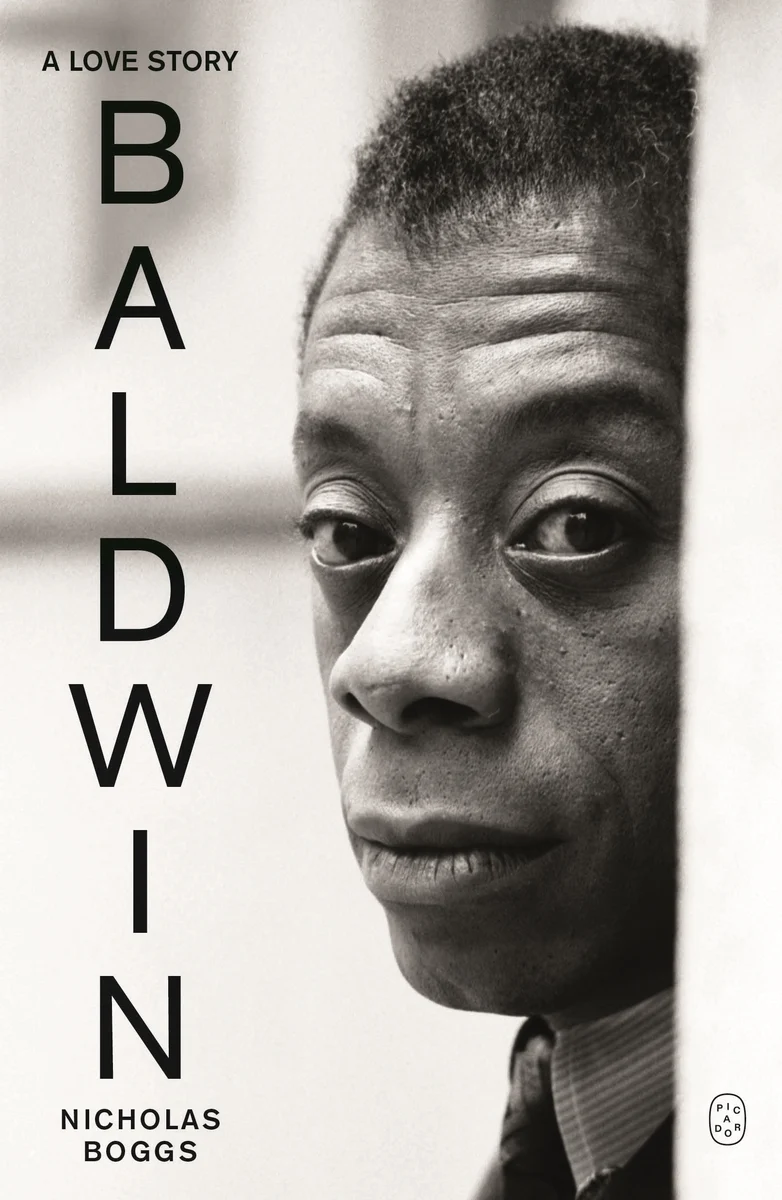
Ironically, Nicholas Boggs’ Baldwin: A Love Story finds me heartbroken. Boggs depicts James Baldwin throughout much of his twenties and early thirties as a meandering, dispositionally frenetic, somewhat directionless artist (if “artist” could even encompass the enormity of such a person’s career), floundering across multiple cities, searching for purpose, love, and writing inspiration. Similarly, as I wade through the swampish, uncharted territory of my third decade, I find myself hyper-aware of the ways in which my life feels notably undefined by a clear professional trajectory or stable romantic partnership. Instead, it is punctuated primarily by my mercurial tendencies to seek romantic love and professional fulfillment, yearn for political revolution, but in equal measure, to self-isolate in the hopes of conjuring surgent creativity.
As Baldwin’s “Paris years” see him vacillate between an intense manic fervor and a near-deadly malaise, I find his early career challenges eerily relatable; I grimaced, wept, and grinned in frequent alternation at Boggs’ stunning recounting of this season of Baldwin’s life. Like Baldwin, I possess an intrinsic urgency concerning what I have to say and to whom, but often lack the consistent calm necessary for introspection and its consequential productivity. Perhaps the most terrifying mirrors in this narrative Boggs constructs are the unsavory and unreconciled contradictions within oneself that have yet to be acknowledged, informed by the dystopian Americana in which I, like Baldwin, was molded. When I first read a book authored by Baldwin, I was a graduate student studying for my comprehensive exam. Go Tell It on the Mountain and Giovanni’s Room had me awestruck, not merely due to Baldwin’s incisive literary renderings of daily life, but because I realized that my thoughts—particularly those I had about love, identity, prejudice, and community—were woefully unoriginal; they had all been thought, dreamt, and written about thoroughly by someone else who came before me.
Fortunately, I have since come to reframe this notion. Unlike Baldwin, I have the privilege of existing in the afterward of his brilliant life. As Boggs aptly states, “It is because Baldwin created these images of Black same-sex love that the next generation of readers and writers would not encounter the same soul-crushing blankness that he had.” Instead, I have joined a lineage of Black writers and thinkers like Baldwin, who were, in many ways, moored to the responsibility of weighing their individual longings–namely romantic love and professional success–against the larger cultural desire to sew racial, sexual, and gender-based liberation into the American fabric. James Baldwin (or as he was referred to by those who knew and loved him, “Jimmy”) is far from an understudied figure; for most Black Americans, he is central to the literary and political zeitgeist of the Civil Rights era. Numerous biographies have been written about him in the years following his death in 1987; Baldwin himself, keenly aware of his own indelible significance and sensing the end of his life was near, appointed his longtime friend David Leeming to be his official biographer. And yet, Baldwin: A Love Story undeniably gifts something new to the genre of the Baldwinian biography: a vast, complicated composite of a person brilliant, deeply afflicted, and emphatically loved (though not always in the way he wanted). Ultimately, Boggs constructs a narrative of Jimmy, positioning love—the romantic, the unrequited, the erotic, professional, and familial—as expressly central to both his work and life.
In tandem with his goal of centralizing “love” in Baldwin’s narrative, Boggs also seeks to overwrite the meme-ified and sanitized deity that Baldwin has become in the digital era. He creates an opening for Baldwin’s legacy to be complicated, animated, and potentially even problematized by his nuances and contradictions. He invokes writer and archivist Harmony Holiday’s rebuke of Baldwin’s cultural flattening: “‘Given the realities and complexities of Baldwin’s personal life and how they infused his work, ‘it’s almost sinister that he is used by the literary and cultural machine as a symbol of the uncomplicated and elegant great Black Hope, the well-adjusted unwavering Black intellectual to whom we can all look for an example of how to master the discipline and the image of artistic genius.’” Much like his famous contemporaries Martin Luther King Jr. and Malcolm X, Baldwin’s essence has been reduced to a soundbite, a TV-turned-YouTube interview snippet, a glossy photograph of his unmistakable massive eyes and gap-toothed grin; an exemplar of American exceptionalism and a lavish, trans-continental, cosmopolitan life.
Through Baldwin: A Love Story, Boggs engages and questions what we make of the Baldwin who ghosted the Yaddo Artist Residency, ignoring requests to pay a costly phone bill (the residue of incessant calls to an emotionally distant Swiss lover)? Or the Baldwin who, in his later years, took many young men (often barely of legal age) as simultaneous lover and protégé? And what of the Baldwin who attempted suicide at nearly every significant juncture of his life: standing at the edge of a bridge, attempting to hang himself in his low-end Parisian hotel room, swallowing a handful of pills on more than one occasion—and then surviving due to the love of various family members and friends insisting that the world needed to hear from him? In this love story, Boggs implicitly asks: is Jimmy still lovable within the fullness of his humanity? In a meta sense, Boggs’ primary endeavor with this text is nearly identical to what he describes as a fundamental pillar of Baldwin’s writing: “It was all connected, he was realizing, to be an artist, for him, was to be a truth teller about everything—race, sex, politics, love—and it was also to be, in a word he would use with increasing frequency in the years to come, a witness.”
While it was regularly assumed, before and after Baldwin’s death, that he was an expatriate, Baldwin insisted in interviews and essays that he was a “transnational commuter,” maintaining a lifelong emotional tether to his Black American identity, as well as his family and friends living in the US. His non-traditional education began with Bill Miller, a young white teacher who first took Baldwin to the movie theater as a child in New York, encouraging his literary and ideological curiosity, followed by a brief but rapturous religious rearing as a young pastor. Later, he had a deeply intimate and complicated relationship with Beauford Delaney, a Black homosexual painter who became a spiritual and emotional father to Baldwin and a foil to Baldwin’s own abusive stepfather. Delaney left an indelible mark on Baldwin’s relationships to art, love, sexuality, and race.
Baldwin: A Love Story makes noteworthy how fluidly sexuality functioned in Baldwin’s literary world and personal life. Having experienced love affairs with many men and intense emotional connections with women, it was surprising that the overwhelming majority of Baldwin’s iterations of romantic and sexual companionship were with men who were primarily—or nearly exclusively—attracted to women. Despite how the lexicon of queer identity has blossomed in the twenty-first century, I erroneously assumed that many of the men who engaged in same-sex relations in the nineteen-sixties and seventies understood themselves privately as gay men who partnered with women for the sake of appearances. To the contrary, Boggs recounts Baldwin’s reflection of sexuality as far from binary and categorical. He states, “‘the word ‘gay’ has always rubbed me the wrong way,’” and later, “to the people who were my lovers, the word ‘gay’ wouldn’t have meant anything to them.” Baldwin’s perspective on sexuality, especially in the years following the writing of his groundbreaking second novel Giovanni’s Room, became increasingly racialized, with Baldwin insisting that fear of homosexuality was a clear derivative of white masculinity’s fundamental rebuke of love and intimacy, regardless of gender.
Again, many of the romantic or sexual lovers taken by Baldwin were functionally heterosexual. They “queered” their physical, romantic, and domestic relationships with women by allowing themselves to engage in transient partnerships with Baldwin. Lucian, Arnold, Yoran, and Alain are just a few of the names of men who were primarily attracted to women with whom Baldwin shared intense, sometimes years-long romantic connections. Their dynamics blurred the boundaries of categorization between family, lover, partner, friend, and collaborator. But these nebulous iterations of love were not without consequence. They often left Baldwin feeling bereft and heartbroken, themes he would explore repeatedly across his literary and political writings, and which would come to fuel his literal and figurative movements. Baldwin’s relationship with Lucian Happersberger, a Swiss man he called the “true love of his life,” would perpetually boggle the constructed role of “lover” in Baldwin’s world. Happersberger ultimately took several female partners, fathered children, and yet at times lived in domestic partnership with Baldwin. Notably, Baldwin’s romantic and sexual relationships with men were not unlike his deeply intimate platonic relationships. Engin Cezzar, a Turkish man he called his “blood brother” and with whom he cultivated a longstanding collaborative friendship, inspired Baldwin’s long-term stints in Istanbul. Similarly, his relationship with David Baldwin, his biological brother, grew to be of paramount mutual significance over the course of their respective lives.
Though there is no question that writing catapulted Baldwin’s career, Boggs depicts him as so much more than a writer. Baldwin cultivated full-scale theatrical productions both in the U.S. and overseas, with persistent attempts to get his books and plays adapted into television shows and films. And though many years of his adult life saw him regularly residing in France and Turkey, Baldwin maintained a fidelity to documenting and speaking about the experience of Black Americans, ultimately becoming well-acquainted with notable civil rights leaders such as Martin Luther King Jr., Huey P. Newton, Jerome Smith, and Malcolm X during his trips back to the U.S. As such, while his novels were lauded for cleverly teasing apart the nuances of sexual and racial identity, it was his essays and interviews that were often both salubrious and riddled with indictment, perpetually prodding the cultural imaginations of white America in an attempt to unravel the non-sensibility of anti-Black racism.
It was Baldwin’s conceptualization of love, however—about which he was known to publicly rave in his younger years and for which he perpetually pined in his older ones—that seemed to undergird all of his writings. In the sunset of one of his early relationships, Baldwin recounted, “it was the dream of love which was ending. I was beginning to realize, most unwillingly, all the things love could not do. It could not make me over, for example. It could not undo the journey which had made such a strange man and brought me to such a strange place.” Later, however, Baldwin wrote in a letter to a dear friend, “Love is the only thing that makes this sad world bearable in the least, all that redeems any one of us from the horror of ourselves and our condition.”
Baldwin was complicated. He was prone to outbursts. He over-consumed alcohol throughout much of his life, likely a corollary to the familial obligation and financial tumult he consistently navigated. He frequently borrowed money from friends, family, and mentors in his younger days (most of which went perpetually unrepaid), and later experienced stretches of meteoric financial ascent followed by further financial strain. He was prone to near-delusional levels of fantasizing and talking about the “marriages” he might (but never did) actualize with the men he loved. I was aghast reading his response to a letter written by one of his best friends, a woman named Mary Painter with whom he corresponded for much of his adult life, informing him that she had been sexually assaulted by a Black man who was a mutual friend. Boggs illustrates Baldwin’s response as callous, as it was largely sympathetic towards the assailant, writing, “To contemporary eyes, at the very least, Baldwin’s response to the assault of his closest friend can’t help but read as woefully insufficient. His worry that Lonnie would feel ‘betrayed’ comes off as almost preposterously insensitive, as does his assertion to Mary that ‘I love him and very often, as now, I feel very sorry for him, I tremble for him.’” Baldwin seemed to posture at times—regurgitating heteropatriarchal ideologies of his homophobic peers as he toed the line between man and not-man, as a Black male homosexual. Later in life, with contemporaries such as Audre Lorde, Toni Morrison, and a young Nikki Giovanni, Baldwin’s internalized sexism and performative machoism seemed to give way to a more flamboyant, fluid reading of gender.
As a Black, queer, gender-nonconforming man in my early thirties, I hold both new reverence and new fears regarding what I myself might someday be called to embrace or sacrifice in pursuit of literary and political self-actualization. At one point, Boggs speculates that Baldwin consistently, albeit subconsciously, chose lovers with whom he would ultimately fail to sustain an enduring romantic love in order to preserve space for his biggest priority: his writing. At many junctures, Baldwin’s life seemed to personify the age-old trope of the tortured artist, scrambling desperately toward the fleeting hedonistic catharsis offered by sex, alcohol, cigarettes, and romantic dalliances with nonreciprocal lovers. Boggs also traces the paths of some of Baldwin’s closest friends, lovers, and confidants, detailing the extent of their substance abuse and bouts with mental instability. Most notably, Boggs outlines myriad difficulties Delaney, Baldwin’s “spiritual father,” faced as he too spent decades bouncing around cities in Europe, navigating experiences as a renowned and prolific artist, and as a deeply mentally ill person. Delaney was institutionalized many times because he experienced paranoid auditory hallucinations.
To me, Baldwin: A Love Story has only one notable stylistic shortcoming. The author takes a decentralized, omniscient narrator’s perspective for nearly the entire account, and then somewhere toward the end of the book, somewhat jarringly inserts himself into the storyline. When he introduces illustrator Yoran Cazac as another possible lover and collaborator of Baldwin’s, Boggs assumes a first-person perspective. Cazac illustrated a children’s book Baldwin penned called Little Man, Little Man. It feels like a somewhat superfluous attempt to tie the thread between Boggs’s effort to get Little Man, Little Man back into circulation in the late 2010s and his ultimate decision to pen this sprawling biography. It is not until the book’s closing author’s note that Boggs even shares his first encounter with Baldwin’s legacy, as a young gay white boy in an eighth-grade English class. This might have offered helpful context earlier in the book, had he wanted to take more of a prominent role in its cadence. Boggs holistically manages a rich narratively driven tone—with brilliant crescendos and gut-wrenching rising and falling action. He only inserts speculative context or analysis that feels deeply earned and substantiated by Baldwin’s own writings, or first-person accounts from his loved ones. I just wish for a more seamless shift between the author’s decision to incorporate his own experience as a fledgling Baldwin scholar and the final narrative arc of Baldwin’s life—or that he had not incorporated it at all.
Ultimately, gratitude doesn’t fully encompass the feeling I have toward Boggs for this textured portrayal of Baldwin’s life. The book undoubtedly accomplishes its ultimate mission of rehumanizing Baldwin, replacing the posthumous, uncomplicated literary deity to whom we’d been introduced by way of the Black literary canon years ago. Personally, it was a healing balm to read this account, and to know that my own yearning, fraught creative endeavors, and present emotional turbulence are not without precedent. It’s nice to think that there could come a day when my own archival contributions to this lineage of Black queer thought could be helpful to some forthcoming writer finding their way. Baldwin himself said it best: “Any real artist will never be judged in the time of his time; whatever judgment is delivered in the time of his time cannot be trusted.” Here and now, however, I am just glad to live in a world where Baldwin did exist, although he would never witness the future proliferation of his ideas—fertilized, tended to, and harvested in the decades since his departure. So Boggs has done us a great service with this account, bringing just a bit more Baldwin into the world, and too, revealing the wealth of love he left behind.