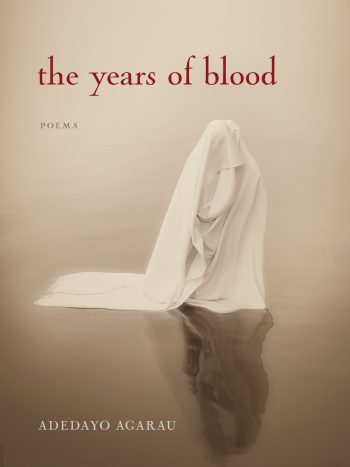
In an ideal world, when one thinks of childhood, what we hope would be associated with the memory of those years is innocence, wonder, laughter, and a view of the world unmarked by its horrors and darkness. Yet, in The Years of Blood, Adedayo Agarau plays no games, and does not, even for a moment, make us forget the other kind of childhood: the real nightmares one cannot simply wake up from, open wounds that insist on being touched, a ghost town of pounded flesh, scattered bones, disappearing children, and empty graves.
Agarau’s debut poetry collection is not an easy book to read and it shouldn’t be, not when you consider the terror of tragic killings, abductions and sexual assault that plagued Nigerians and continues to cast a shadow of dread and crippling fear over the nation. The world Agarau depicts in these poems are not unfamiliar to us but still, his writings sear our minds with vivid images that jolt us with the shocking realities of violence, demanding our attention in the most urgent and heartbreaking way. These poems are entrancing, gripping, wondrously tender and intimate, even in the face of unthinkable brutalities.
Over email, Agarau talked about his writing process, growing up in Ibadan, and resisting the single voice in poetry, among other things.
Rumpus: Adedayo, I’ve been thinking about a light note on which to start this conversation, but I keep returning to the haunting images in The Years of Blood–children being kidnapped, a body being pounded in mortar, a body being burned, children killed in their sleep. I mean, how do we begin if not indeed with the darkness? As I read, I kept wondering how you fared as you wrote these poems. I wondered how much of the writing was painful. Where were you when you wrote? What did taking breaks from the subject look like? Were there moments this felt too overwhelming and what kept you going?
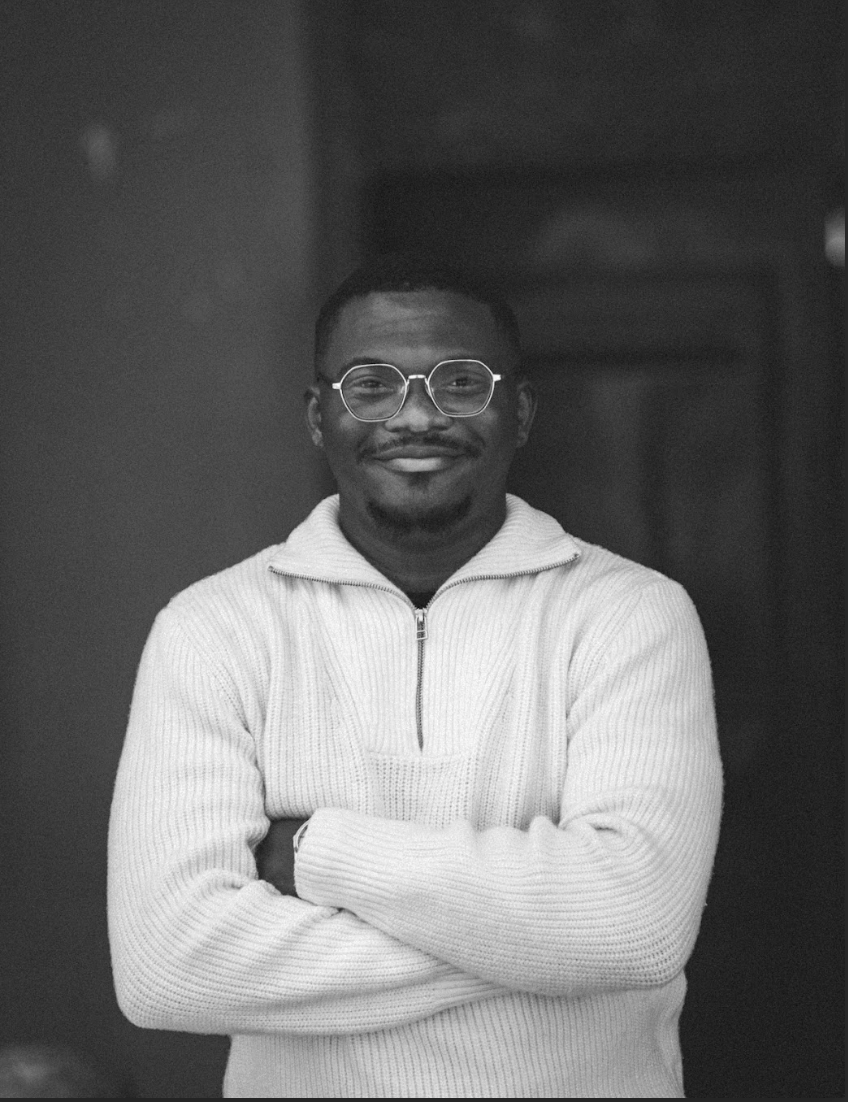
Adedayo Agarau: Tryphena, thank you so much for this question, which exposes your care for the writer beyond their writing. When you live in the cold of the Midwest, your first winter, you will quickly realize the cold pushes everything beneath the skin, so you grapple with the depression that comes with the cold, which in some way, supports the project you are working on and lets you dig deeper inside yourself.
I remember I was in Coralville when I wrote “Doomsday.” I lived on 7th Street, at The Banks. There was a wasteland in front of the apartment, and a large field adjacent to the building. A few feet away, the Xtreme Center, which is adjacent to the UI hospital, [is] where I was checked into when it became too heavy to continue to be myself or navigate all these on my own. I just stopped showing up in school for a few weeks and did not bother the program with what I was carrying. I quickly realized I was looking for the reward of finishing the thesis, a catharsis I did not know I was in search of when I left Nigeria. It was like the mantle that fell on Elisha [the prophet in the Bible]. In some ways, it looked like there would be no sense of release if I did not feel like I had arrived at the final poem.
Rumpus: What did community and safety look like during those years in Iowa?
Adedayo Agarau: I am sincerely grateful for the time I spent in Iowa under the leadership and mentorship of Mark Levine, Tracie Morris, and Elizabeth Willis. Every opportunity I get, I return to the memories of people whose presence was critical to my survival in Iowa—Adams Adeosun, Adeniyi Ademoroti, Njera Frazier, Otosirieze Obi-Young, Mofiyinfoluwa Okupe, Okwudili Nebeolisa, Othuke Umukoro, and other Nigerians in the program. They get what it’s like to arrive in the most critical Iowa weather, carry upon yourself a book that feels bigger than you, and write it. We spent many Saturdays together, cooking, dancing, eating, and arguing. I remember the morning of the 2023 Nigerian election—we held ourselves in Niyi’s living room. I made some food. As we followed the news of the violence, we cried. That’s safety. That’s it.
Rumpus: The collection is dedicated to Ibadan, and I love how you call it the city of your youth. Many of these poems are grounded in a sense of place, and it is almost impossible to lose sight of the collective distress at the heart of this. What has growing up in Ibadan taught you? And what has it taken away from you?
Adedayo Agarau: I think living in Ibadan, growing up there, in some way, obliterates a trauma of this kind—or of any kind, by scattering it into the errands, the heat, the after-school lessons, the long queues at bank ATMs, your mother screaming down on you because you have not done the dishes, your father arriving from work and watching the news at 9. To put it another way, life is always in motion, but even at that pace, the body, although temporarily silent, is still archiving. The city, to answer this directly, would teach you attention. In fact, being Nigerian demands a level of attention to and awareness of the physical environment that accompanies you everywhere else. There is, to borrow from physics, a mixing flow, which describes the uniform state of chaos. There is always something to be aware of, afraid of, be careful of, or be wary of. Every single day on X, there is an electronic placard of a missing person, such that even returnees, or visitors, are taking up that national consciousness of an already installed chaos that requires taking up “Nigerianness.” Yet, my greatest confusion is the numbness to this state, which sometimes is our most natural state. I am tempted to answer the question of what Ibadan took from me as “people” or “childhood,” but Ibadan did not do that—people did that.
Rumpus: What do you pay attention to these days?
Adedayo Agarau: The news. Nigeria. Books coming out and the required texts I am studying. Nigeria seeps into everything. It is impossible to forget or remain indifferent to the tragic political and economic misappropriations emerging from Nigeria. I believe your country haunts you in the most bizarre way, and you cannot do much about it. I sometimes listen to music to try to escape all this, or play FIFA with friends, and spend time strategizing for the UnSerious Collective and the Arole Agarawu Prize, which I am now administering. I am editing Agbowó Magazine’s upcoming issue and reading critical reviews of poetry for The Rumpus. I picked up Tennis after showing promise in ping-pong. I started what seems to be a novel. I should try running. I should try swimming too.
Rumpus: Did you know you wanted a book this heavy when you began? What changed? What stayed the same?
Adedayo Agarau: I don’t think it occurred to me how dark it could be inside this collection. Lucky to have captured both the music and the beauty of the city. The first draft of this book was very surreal, almost darker but less intimate. In the second version, I wrote the personal I into the collection.
Rumpus: There is hope in the poems too, and when one comes across it, it can feel like such a sweet relief. You almost do not expect to find it, especially after reading about the dreadful and horrific things. In “On Joy,” you write “I want to / lift the hope from this poem & give it to the dead / person’s mother” and in “Years of Blood,” you assure the reader that light is on its way, that even in the midst of the bloodshed, trees blossom and there’ll be fruits to feast on.
Adedayo Agarau:
At the end of The Years of Blood, we all go to sleep. In sleep, we are granted, albeit briefly, entry into the metaphysical sanctity of dreams—if they arrive—or the void of unknowing that sleep sometimes brings. Sleep, in this sense, can be understood as a return to innocence, a temporary erasure of the burdens and inscriptions of the waking world. John Locke’s notion of tabula rasa explains that temporary permanence further. In the state of sleep, we momentarily revert to this blankness, unencumbered by memory or expectation, allowing for the possibility of renewal. Sleep becomes a site of potential, where innocence—however fleeting—can be recovered, and where the self is, for a moment, unmarked by the Ibadan’s violence and certainties. We needed that much innocence—or a world where access to powers is used ethically—and it seems anything in the hands of a politician is a weapon against his people.
If the reader circles back to the collection’s beginning, they encounter “Wind” once again, mirroring the way wind greets us each morning and stirs our anxieties anew. The Years of Blood resists that certainty of calm because, really, where is the calm?
Even now, somewhere in Olubode in Ibadan, someone drifts to sleep, perhaps dreaming about the fate of their ambitions, because tomorrow marks a pivotal day—a new job, a new beginning. But come morning, at the bus stop, this person texts friends in a WhatsApp chat: they are en route to work—“Wish me luck,” they might say. And that is, perhaps, the last time the friend hears from them. Forever.
Yet, in a world shaped by forces beyond our control, luck is rarely sufficient when confronted by those who exploit or oppress, who steal or take. The collection is preoccupied with the search for permanence, interrogating whether lasting meaning or joy is possible amidst this taking. This brings me to a central question: What constitutes joy, in a landscape so fraught? In a recent seminar, a respected colleague suggested that W. H. Auden’s “The Fall of Rome” and Joan Didion’s essay “On Morality” might hint at a sense of hope if read against the grain, but I remain unconvinced. Light, too, is governed by time—its presence or absence shifting with the hours—and, as the Yorùbá people say, drawing from scripture: “Bí ẹ̀kún bá pé dé alẹ́ kan, ayọ̀ ń bọ̀ ní òwúrọ̀” (If weeping endures for a night, joy comes in the morning). When morning comes is what remains unanswered in the Biblical text or the words of our fathers.
Rumpus: Kwame Dawes has talked about the role of poets as the chroniclers of the sentiment of our time. The need to write persistently in the face of threats of erasure and silencing, of violent and complicated times. This is precisely what you’ve done with these poems: paid attention to the world and interrogated its cruelties on the page. Despite the daunting nature of that responsibility, I am curious to know what you enjoy most about being a poet.
Adedayo Agarau: Kwame is so full of wisdom and is a writer whose works inspire me to continue. I think, as a poet, it’s often the consciousness of self and country that the poet carries that I enjoy. In what ways can we fracture what is left of what we have? In what language is the fracture existing? How do we invent further fracturing? Who is the self, who is the I, who is the country? There are poems that ask questions, and there are poems that answer those questions. That limitless node of binaries is what I find truly fascinating as a poet. In The Years of Blood, though, I think what is critical is the multiple selves that exist in the collection. The I resists a single voice—sometimes dead, other times, alive and in fear—and I think that, that is fascinating to me. Stories often limit the view of the speaker or the entrance that the reader uses into the story—a poem invites you, warns you, and then confounds you.
Rumpus: Who are some poets you often return to, poets who also resist the single voice and invite you in? Is there a poem in this collection that took you by surprise?
Adedayo Agarau: Yes, M. NourbeSe Philip, Cheswayo Mphanza, Tess Liem, Remica Bingham-Risher, Richard Siken and several other writers. The poem that took me by surprise is “Boys Who Never Die,” because it feels the most different from my writing style.
Rumpus: The poem “Bámisé” is dedicated to Bámisé Tóyosi Ayánwolé who was abducted in 2022 after boarding a BRT in Lagos and later found dead. I was devastated by this news and relieved to read that the driver was convicted of the crime in May. The poem “Waiting for Her Son” is written for Samson Yérokun. How differently do you approach writing these poems?
Adedayo Agarau: Both poems, although elegiac, treat loss using different subjects, are doing something quite similar, yet are sutured by the Yorùbá understanding of wind, spirit, and the restless presence of the dead, which I didn’t use sparingly in the collection. In Yorùbá cosmology, wind is a carrier of voices, ancestral breath, and warnings that unsettle the living—and in The Years of Blood, it sometimes marks the intrusion of the invisible into the visible world. Òkú, the ghost, gestures toward the belief that untimely death denies the dead their passage into rest, leaving their spirits to wander, pressing against our waking lives. This spectral presence haunts because the past is never fully past, and now, the dead must persist as an ethical demand in the present.
The consciousness of the living dead is present in both poems, as this single consciousness haunts the entire collection. “Waiting for Her Son,” however, responds to a more intimate absence. Samson Yerokun was my student pastor when I was at the Federal Polytechnic, Ede. I find myself drawn to anthropological liminality, where for Samson’s mother, or any mother at all, waiting is a refusal of closure—a state in which she suspends and resists the world’s demand for narrative resolution.
Rumpus: Five years ago, you published The Arrival of Rain (Vegetarian Alcoholic Press, 2020) and before that, your chapbook, The Origin of a Name (Akashic Books, 2020), of which Mahtem Shiferraw notes, “By bearing witness to their grief, [Agarau] establishes himself as a mediator of sorts, serving, in a sense, as the alternative subject to carry their collective mourning.” Can you think of any moment over the last few years when you’ve made an intentional shift or strengthened your resolve in how you think and write about poetry?
Adedayo Agarau: Absolutely. This seems like the right moment to express my gratitude to my teachers—Professor Niyi Osundare, Elizabeth Willis, Mark Levine, Tracie Morris, Patrick Phillips, Aracelis Girmay, Aaron Van Jordan, and many others—whose conversations have not only helped me open into myself but have also shaped my theoretical and poetic sensibility. Under their influence, I found myself intentionally turning toward Yorùbá spirituality and cosmology as frameworks for understanding the workings of miracles or the placement and displacement of grief, while also thinking critically about the ecology of Yorùbá oral traditions and their structural relation to memory and testimony.
Rumpus: In your Acknowledgements, you mention that this collection “seeks to heal the world by documenting.” Let’s talk about healing. What does it look like on an ordinary day?
Adedayo Agarau: I return to Lucille Clifton’s “won’t you celebrate with me” too often:
“come celebrate
with me that everyday
something has tried to kill me
and has failed.”