
Twice a month I enter the only women’s prison in Connecticut to record incarcerated women as they read books for their children. At home afterward, I convert the audio files into QR codes, attach those codes to the actual books the women read from, and ship the books to the children. The idea that the children hear their mother’s voices read to them as they hold in their hands the books their mothers held as they read, is why I do this. I look forward to the hours I spend in the presence of these women because I know I am helping span the gulf of time and space between them and their families. Sometimes the women cry, feeling the immense burden of having done something that resulted in their children losing them for a significant amount of time… sometimes for the child’s entire childhood. Many of the women are in for drug and alcohol related crimes, some are there for crimes of violence. The vast majority of the women have been victims of trauma and abuse prior to prison. When I pass through the security gates and drive away after our sessions, I often wonder about the severity of the crimes these women committed to be imprisoned within those cinder block walls. My experience while there recording, though, is entirely as witness to mothers who are hurting, who miss their children, who want to connect in one of the only ways they can. There are more sides to a person than a prison sentence can reveal.
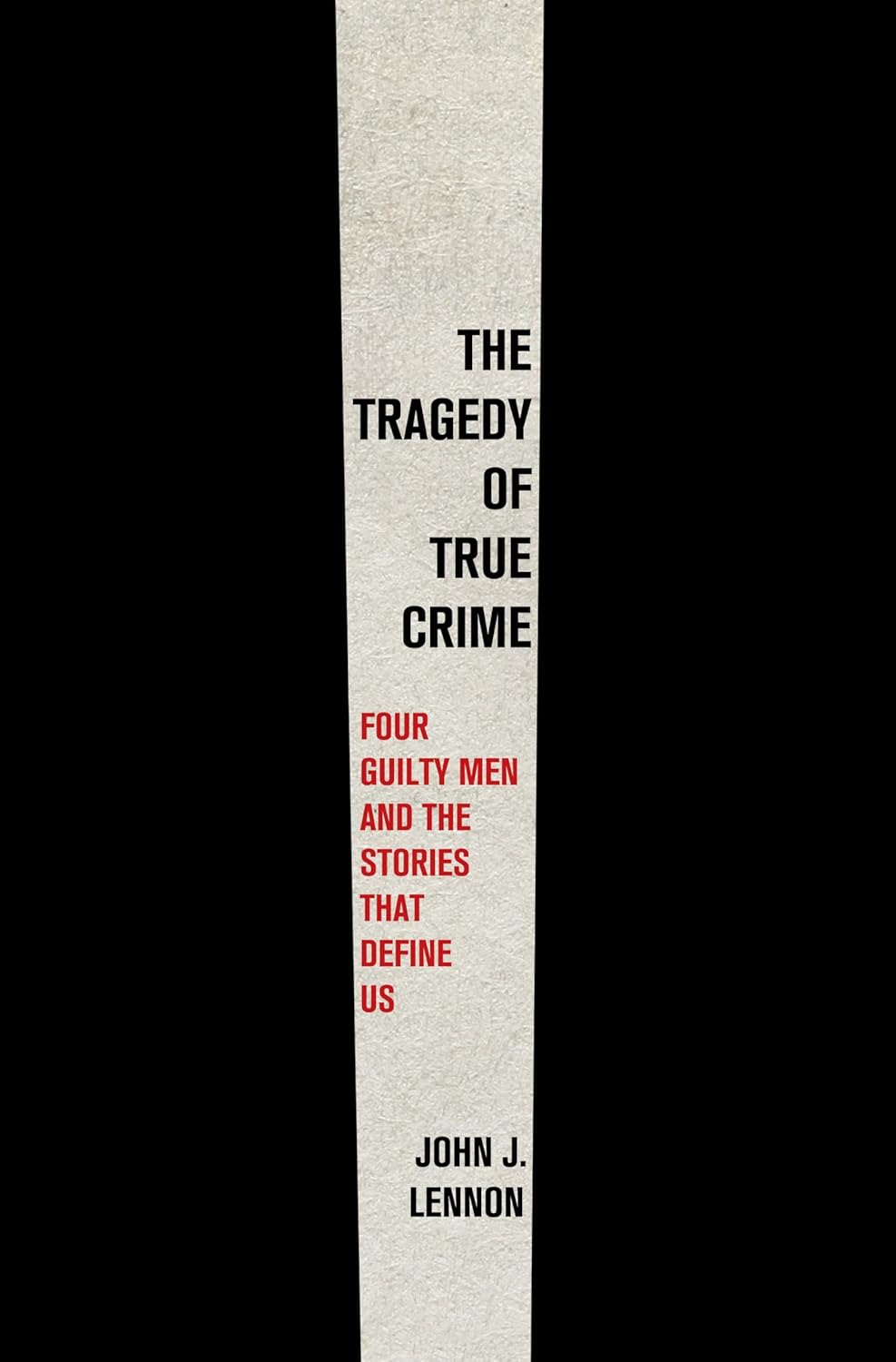
I’m drawn to stories about people who are incarcerated. I can’t easily explain why, but I’ve been like this for many years. And while I have seen a few segments of true crime stories on TV, I never come away feeling I know anything more about the person who committed the crime—I only know the crime itself, sometimes in gruesome detail, with imagery I regret having seen. Rarely does one encounter a story about a crime told from the perspective of the criminal; how many criminals are also good writers? “The Tragedy Of True Crime: Four Guilty Men And The Stories That Define Us” by John J. Lennon is told by a currently incarcerated insider, who is also an esteemed journalist. The title of the book is a double entendre, as it both reveals the real tragedy of the four murders it delves into, as well as a condemnation of the true crime genre so popular in contemporary entertainment. 84% of the US population consumes True Crime media, according to Edison Research and popular true crime TV shows like “The Jinx: The Life and Deaths of Robert Durst”, “The Yogurt Shop Murders”, “American Murder”, and” Murder 360” (to name just a few of so many) have only added to the growing phenomenon. As I write this, I feel disheartened that as a society we have chosen true crime (as opposed to fictional crime) as our most popular current genre of entertainment; it always involves a perpetrator and a victim—and always affects a vast number of loved ones on both sides of the story. How is that entertaining?
Lennon begins with a preamble that states he uses the real names of all significant characters (except when asked not to) and with this intention, Lennon is already making the point that these are real people. Real people who committed terrible crimes… but unlike the true crime genre, this will not be some salacious account that is meant to entertain. Instead, Lennon’s access brings the reader deep into the worlds of four men (himself included), who have wildly complicated histories, difficult upbringings, and whose actions have landed them in the harsh reality of our carceral system. You come to understand these men so intimately, they are no longer just their crime. And in the end, the book is a blatant indictment of the true crime genre; Lennon is no longer just a murderer, an inmate—he’s the author telling the truth in a way others cannot.
Lennon didn’t enter the prison system as a writer. He entered in 2001, as a twenty four year old drug dealer, with a 9th grade education, who killed a man on a Brooklyn street. He was sentenced to 25 years to life (with three additional years for drug related crimes.) Over the course of the next twenty-four years Lennon learns the craft of journalism, beginning with his time in Attica, where he was transferred after being shanked with an ice pick by a friend of the man he killed. It is there that Lennon gets sober and discovers his passion for creative writing through a workshop. That was 2009 and through perseverance and honing of his skill, his first piece was published in 2013 in The Atlantic, which Lennon describes as his “first real accomplishment in life”. It is in Attica where Lennon befriends three other murderers. The book interweaves their four stories, with Lennon diving into the others’ pasts as a means to understand his own actions. As Lennon writes: “I live with the men I write about in this book. We share the same label and regrettably, I have more of an understanding of what they did than any other true crime storyteller.” As a result, what Lennon lays bare before us is ”immersive reporting meshed with memoir”, which leads to him being utterly forthright about the responsibility he takes for his own crime.
The book begins with an incident in 2018, when Lennon is duped into doing a TV interview by producers who tell him the process will be “fair-minded and respectful.” Instead, he finds himself face-to-face with Chris Cuomo, who is conducting an interview clearly being crafted for the true crime audience in all the worst ways, complete with “shadowy reenactments.” Seventeen years after the murder Lennon committed, the segment is not exactly a fair introduction to the man Lennon has become. The segment is titled “Killer Writing” and the series itself is titled “Inside Evil.” As Lennon points out, “The saga ends at the crime-and-punishment phase, but that’s only half the story. I contend that the lives lived in prison after a crime are just as fascinating, and important, as those that were spiraling before it.” Clearly the “Inside Evil” situation was one of the inspirations for his writing this book, “Who can most honestly tell our stories? Cuomo? Capote? Carrere? What about me?” In an era of calling storytellers out for appropriation, Lennon’s voice rings loud and clear as an insider, the most truthful of sources to relay the stories. He makes reference to The Marshall Project (a Pulitzer prize-winning news organization focusing on criminal justice, whose founder, Bill Keller is one of his mentors), which champions an insider format in journalism. In 2014, Keller launched the “Life Inside” section of the Marshall Project, giving Lennon an opportunity to write about his peers, “connecting the personal to the universal.” By 2016, Lennon was put on the masthead of the Marshall Project., which led to his writing appearing in Esquire and the New York Times, among other publications.
Lennon first introduces us to Shane, whom he meets at Sing Sing in 2017, just after Lennon is transferred from Attica. Before writing about Shane, Lennon observed him for months. The word from other inmates was that Shane’s crime was “crazy.” What made Shane’s story stand out was that Shane killed his male lover in a brutal manner. As Lennon writes, “When you learn about the crime before you meet the person, it makes you recoil; it colors everything about them. In your mind’s eye, another sick scene plays out-stabbing, strangling, dismembering—all while you’re trying to have a conversation with the guy. It’s why I try to avoid learning details about my subjects’ lives before I meet them. It’s too disorienting, and it feels unfair. My advantage as a prison journalist is my access.” Lennon points out that because of the limitations imposed by prison, he is not additionally pre-influenced by being able to do internet searches on his subjects. Instead he has the most unencumbered view of these men, as he spends years observing them, culling through their histories, and trying to decipher who these men are at this moment in time—and what paths led them to the present.
Lennon’s next subject of investigation is Milton, who at 17, killed two priests, for which he received fifty years to life. Lennon meets him in 2019, when fifty-year-old Milton is working towards his Masters in Theology. Not knowing where Milton’s story would take him, Lennon spent countless hours with him, trying to understand the darkness that led to his taking the lives of two men: “I reminded him I murdered a man, too. I told him I wanted to try my hand at telling true crime stories in a more thoughtful, sensitive way than I so often saw it done, understanding what it’s like to have been in that dark place where you take a life and then get to a better place where you want to live in a meaningful one.” Lennon never judges the men he portrays because he is constantly relating to their traumatic pasts. One might argue, though, that while it is through the fortitude of these prisoners that they better themselves over the years, and evolve into “better” humans…their victims did not have that chance to evolve in their own lives. As a reader, I believe you have to embrace the idea that terrible trauma exists in this world, with the possibility of an awful, violent outcome—and while Lennon never upholds the trauma as an excuse for murder, it does inform him to see these men as more than just the crime they committed. In other words, sometimes you cannot reduce a murderer to the act of the crime itself. And sometimes, redemption exists. You have to want to embrace these notions—or you will not be able to see the merit of the journeys these men undertake—or even the reason for Lennon to have written the book.
Lastly, Lennon tackles one of the most widely known murder cases from the 1980’s: Robert Chambers, also known as “The Preppy Murderer.” Rob, as Lennon refers to him, was 19 when he killed 18 year old Jennifer Levin in Central Park. Rob is 54 when Lennon first meets him in Sullivan (another prison Lennon is moved to during the course of his incarceration) and is serving his second and longer prison sentence, having already served 15 years for Levin’s murder. His second term is for a drug-related crime, and Rob’s longstanding addiction to drugs is one of the recurring elements Lennon follows. Easily able to get his hands on previously written material about that infamous murder, Lennon was eager to hear all about Rob’s childhood, which Rob openly admits “If there were problems, I made them. But everything was offered to me.”
Though Lennon was brought up in the projects of NYC and Rob had the opportunity to attend private schools, Lennon sees the underlying commonality of pain in their lives, and weaves in and out of both of their early years, almost interchangeably, often in the same paragraphs; the reader has to pay close attention to avoid conflation. Both men suffered early on and often at the hands of their parents, who were challenged by their own demons with drugs, alcohol, and mental illness. Lennon makes the point that Rob’s mother was an enabler, while his own mother knew that her son was troubled and capable of violence. In either scenario, the murders ultimately come crashing down on both families: “There’s no upside for the murderer’s mother—and it’s the ultimate test of unconditional love. Let’s say you get your kid a good lawyer and he beats her rap. Then what? Or he gets convicted and sucked up into the system. Then what? After we kill, the world shifts; everything is sideways. And the effects of our crime ripple; they are almost kaleidoscopic.”
While I found the similarities of these four mens’ pasts to be illuminating, I also found their portrayal confusing at times. It’s almost as if Lennon was so eager to connect the potentially disparate dots, that he sometimes blurs the lines at the cost of clarity. Several times I had to go back and reread paragraphs to make sure I understood which story line he was unfurling. At one point Lennon is writing about Shane and his lover/victim and the years of the AIDS epidemic in NYC, when he slips in a paragraph about his stepfather and his stepsister, who had AIDS. It is inserted clumsily and seemingly to no avail; it’s as though Lennon has shuffled his deck of cards so often, you can’t find the card he first showed you.
Sometimes Lennon uses scenes from the other mens’ lives as a connector to his own; as in when Shane puts the body of his lover in the trunk of his car. The next paragraph begins: “After I picked up the rental car, with E.’s body still in the trunk….”, a reference to the murder Lennon himself committed. And sometimes the connecting element is a moment in time, as in the comparison he makes between himself and Rob during each of their 7th grade school years. I wasn’t sure where Lennon was heading, but almost always it is Lennon’s ongoing attempt to make sense of his own life through the recounting of the other men’s lives. It is a valiant effort, not always clearly articulated.
Throughout the book Lennon reveals the crimes and lives of the other men in astounding detail, as if he had been there, as an omniscient narrator. Whether it is abuse at the hands of an adult in their lives, or the thoughts running through their heads after the crimes, the specificity of the recollections make the stories absorbing, chilling, and most of all, real. Lennon has succeeded in telling their stories in ways that permit their humanity to come through, instead of just their crime, with the hope it will bring understanding and perhaps compassion to what are undoubtedly very complicated lives gone terribly wrong.
Through the process of journalism, moral reckoning, and of creating this book, Lennon admits to finally finding his own compassion. And ironically, Lennon believes that had it not been for the murder he committed and the subsequent prison term, he probably would not have become a writer. It is indeed a tragedy that his highly commendable writing skill and this book come with such heavy collateral damage.