
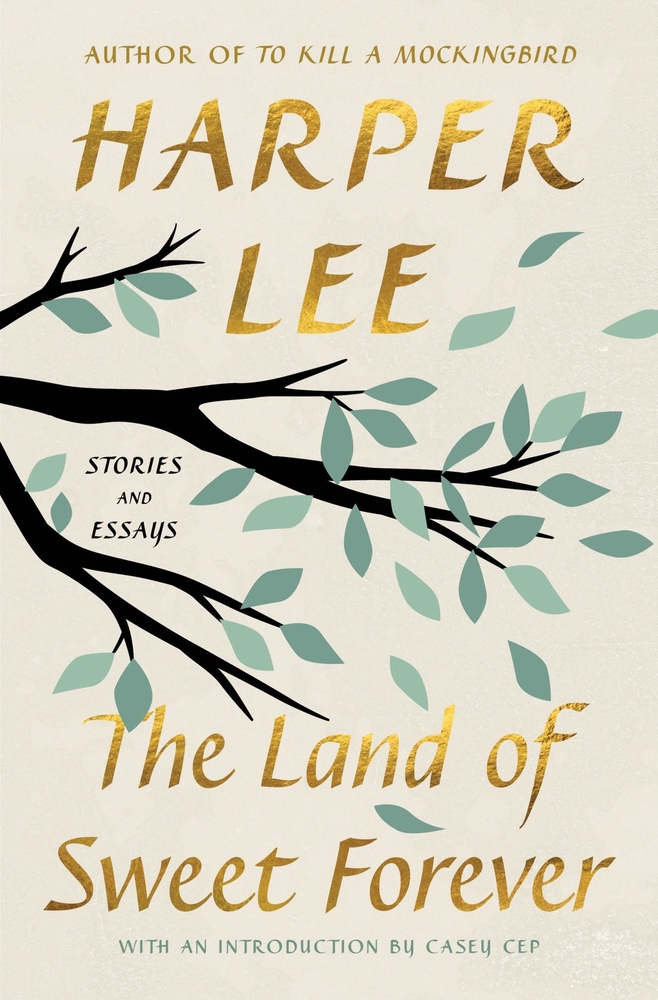
It’s impossible to talk about Harper Lee’s new book, The Land of Sweet Forever, without talking about To Kill a Mockingbird, the novel that made her famous 65 years ago. And it’s impossible to talk about Mockingbird without talking about its controversial 2015 sequel, Go Set a Watchman. Some thought Lee would not have agreed to publish Watchman (which she wrote before writing Mockingbird) had she been in full mental and physical health at the time. (She was 89 and died the following year.) The book came out anyway. And now, nine years after her death, HarperCollins has released another.
The Land of Sweet Forever: Stories and Essays (Harper) is a posthumous collection of short work “long believed to have been lost or destroyed,” according to its publisher. Mockingbird fans will recognize many of the faces and places in these pages, albeit in their nascent, underdeveloped forms. Lee wrote the eight previously unpublished stories early in her career, before Mockingbird, and in many ways they read like training ground for her famous novel. The fictional setting of Maycomb, Alabama, appears in several stories, along with characters named Louise Finley and Jean Louie Finch—who would later morph into the Jean Louise Finch (nicknamed Scout) of Mockingbird.
Casey Cep, Harper Lee’s authorized biographer, has penned the introduction to Forever. In it, she makes little mention of Watchman, in which 26-year old Jean Louise Finch—the grown-up version of Mockingbird’s child protagonist—visits home after living in New York. During her stay, she learns her beloved father, Atticus (who was the moral center and hero of Mockingbird) has joined white supremacists in their backlash against Brown v. Board. At the time of Watchman’s release, critics panned the book for its bumpy storyline, while Mockingbird fans felt betrayed by the sequel’s unflattering portrayal of Atticus. Watchman fails on both a craft level and in its accommodationist conclusions, but I agree with critics who found its version of Atticus more honest and interesting than the Atticus made famous by Mockingbird.
Forever echoes Watchman in places, suggesting that Lee, like many authors, recycled bits of her unpublished stories to form her novels. According to Cep’s introduction, Lee, unknown at the time, sent the stories in Forever to “little magazines like Tomorrow and literary mainstays like Harper’s Bazaar and The New Yorker”—to no success.
The first story in the collection, “The Water Tank,” is by far the strongest. It’s a darkly comedic account of a twelve-year-old girl who, after hearing talk on the playground at school, becomes convinced she is pregnant. Lee’s voice is on full display in passages like the one below, in which her pitch-perfect dialog brings the setting and characters to life:
Maybelle’s blond plaits seemed to stand out sharply against the sky, the high-school building behind her shifted a little.
“All right,” the plaits wiggled, “get this and get it straight: If a man touches you after you’ve started you’ll have a solid baby!” Maybelle smacked her palm on the bench.
The color left Abbie’s face, and she heard her own voice come from inside the high-school building. “You mean if a boy asks you to—?”
“That’s right. And if you do it you’ll have a baby,” the plaits nodded triumphantly.
The protagonist, Abbie’s, ignorance of her own body is striking yet familiar. Lee writes, “Abbie looked for the baby every morning when she got up, and prayed it would come out when she mashed her abdomen.” It’s unclear whether Abbie actually is pregnant; she recalls a boy “with his pants unbuttoned hugging her.” But what matters is that Abbie believes she is. Lee’s deft hand turns the knob darker as the story proceeds. Abbie, imagining telling her father about the pregnancy, muses, “Maybe he would smother her with a pillow—no, he wouldn’t. He’d send her away.” By the end, you understand that Abbie intends to kill herself by throwing her body from the water tower. The story walks a neat tightrope between humorous and harrowing and unfortunately resonates even today.
A version of “The Water Tank” story also appears in Watchman, but instead of a girl named Abbie, it’s Jean Louise (or Scout) who thinks she’s pregnant after a boy kisses her. She too plans to jump from the water tower but is saved by a friend just in time. In the Watchman version, gone is the foreboding menace and undercurrent of social commentary. Instead, the misunderstanding serves as a lightly humorous example of Jean Louise’s naivete, her reaction just another one of her hijinks.
No other story or essay in Forever comes close to matching the quality of “The Water Tank.” Instead, like many of the scenes in Watchman, they read like vignettes from a writer finding her voice. “The Binoculars” is a first-person account of a kid who gets in trouble for knowing how to read on the first day of school. Lee later incorporated this anecdote into Scout’s character development in Mockingbird. But as a standalone story, it begs the question, “So what?” The stakes are practically nonexistent, and the voice is too underdeveloped to be of interest on its own.
“This Is Show Business?” follows a New York twenty-something who shows up to work assisting a lighting tech, then winds up driving a car from parking space to parking space all afternoon. It’s a humorous character study but the story, much like the car, traverses pages while going nowhere. “The Viewers and the Viewed” offers witty-ish commentary on contemporary films of the time, but Lee’s humor has always shined through character and dialog, and with little of that here, there is likewise scant cause for laughter. “The Land of Sweet Forever” recounts a young woman who bonds with a young man from her small town over their mutual outrage about the church’s modernized doxology. As the two graduate to talking about books, their dynamic becomes a bit flirtatious, but that’s pretty much it—it’s a sketch more than a story.
Critic Laura Miller appropriately dubbed the fiction in Forever, “dinner-party anecdotes.” They are missing a narrative arc, but you can see Lee working out characterization, setting, and dialog as she feels around for what will become her signature humor. Take, for example, the opening line of the title story, which reaches for a wry send-up of Jane Austen: “It is a truth generally acknowledged by the citizens of Maycomb, Alabama, that a single woman in possession of little else but a good knowledge of English social history must be in want of someone to talk to.” Clunky and missing a punchline, this pastiche of Austen comes off like Scout Finch wearing a prom dress. Compare to the opening of “The Pinking Shears,” which is similarly run-on but entirely Harper Lee: “After it was all over Daddy said it was my fault, but to this day I say it isn’t, that the child had a perfect right to cut her own hair if she wanted to.” One clangs; the other sings.
The stories in Forever also “reveal some of the contradictions and conflicts [Lee] would spend her life trying to resolve,” as Cep writes in her introduction. One of these “contradictions” figures prominently in “The Cat’s Meow.” In the story, a young white woman who has been living in New York travels to her segregated hometown after the death of her father and stays with her older sister, who has hired a “Yankee Negro” gardener. The gardener impresses the sister and her white neighbors with his courteousness and intellect; they think he’s “the cat’s meow.” That is, until he skips town. One of the white neighbors confesses to the two sisters that he knew the gardener was an ex-con, out on parole after being imprisoned for a minor infraction 20 years ago.
Throughout the story, the narrator silently judges the racist attitudes of her sister and the neighbors but never speaks her mind. Instead, she repeatedly changes the subject or bites her tongue, reflecting, “The last thing I wanted was a row which would separate me from the only family I had left.” The story ends on her silence:
“Doe?” I said presently.
“What?” she said. She looked around the corner of the paper at me. I suddenly felt ten years old again.
“Nothing,” I said.
She resumed reading.
This story is one of the most interesting in the collection for the ways it explores white silence and complicity, but it has its problems. While dialog is a key tool Lee typically uses to develop character, the gardener has almost none; we learn his story through the speech of the white neighbors. This choice underscores Lee’s observation of which voices ring loudest in segregated southern towns, but it also excludes a narrative that could have given the story more depth. (Black voices are also conspicuously absent from Watchman.) The white characters are likewise underdeveloped, and at thirteen pages, the story feels rushed, like Lee is hurrying to make a point rather than taking the time to let her characters fully come to life.
“The Cat’s Meow” echoes a scene in Watchman, in which Jean Louise’s aunt invites the young white ladies of Maycomb over for coffee. The women repeatedly make overtly racist statements, to which Jean Louise responds only in her mind. When finally she challenges one of the women out loud, she backs down from the confrontation:
Hester bristled: “Are you insinuating—”
“I’m sorry,” said Jean Louise. “I didn’t mean that. I do beg your pardon.”
In both “The Cat’s Meow” and Watchman, we encounter a young woman who feels she no longer fully belongs in her segregated southern town yet can’t bring herself to give it up. Tellingly, she struggles to imagine challenging the racist assumptions of the community that raised her without sacrificing her place in it. With further revisions, either story could have become an incisive examination of the ways white women offer their silence in exchange for the privileges of white supremacy. But this tension that was so prominent in Lee’s early manuscripts is missing from Mockingbird.
In the late 1950s, Lee caught the eye of publishing company J. B. Lippincott. But they were less interested in Watchman than in a new manuscript Lee had begun to write that reimagined the characters during their childhood. Lee and Hohoff collaborated closely on revisions to the manuscript for years, ultimately emerging with Mockingbird as we know it today—a Depression-era tale of a young white girl and her father teaming up against racism in a small town. Lee said in 2015 of the rewrite, “I was a first-time writer, so I did as I was told.” The book Lippincott published to great success in 1960 showcased the talents of an author who had matured greatly in the elements of her craft (dialog, plot, tone). But it also presented a sanitized version of Atticus Finch and a morally unambiguous storyline that many have rightly criticized as a white savior myth. Gone from the new novel were the adult questions readers can see Lee grappling with in Watchman and now Forever.
While the fiction in Forever helps illuminate the evolution of a famous author, the nonfiction in the back half of the book is anachronistic and, at times, embarrassing. “Love—In Other Words” (published in Vogue in 1961) consists of abstractions both inoffensive and unmemorable. As an example of love (did we need one?), Lee paints a picture of a boy who waits outside his dying grandfather’s hospital room until the old man miraculously revives. The story is sparse on specifics, lending it the feeling of an uninspired church sermon—a sense which Lee’s quoting of St. Paul only enhances.
The next bit of nonfiction is a recipe for crackling bread, published in The Artists’ & Writers’ Cookbook in 1961. Its final line (“Some historians say by this recipe alone fell the Confederacy”) will elicit little laughter from modern audiences.
The book’s penultimate selection, “Romance and High Adventure,” is a 1984 lecture that, according to Casey Cep’s book Furious Hours, Lee reluctantly delivered as a favor to her sister. Speaking to the Alabama History and Heritage Festival, Lee rhapsodizes over the regional historian Albert James Pickett, a planter, enslaver, and supporter of Andrew Jackson. His book, History of Alabama, is an account of how European settlers wrested control of the land from its Indigenous occupants. Lee calls the book a “unique treasure” that “should be in every high school library in the state.” The piece is one of the longer works in a short book, and its inclusion without context suggests an editor injudiciously scrounging around for content with which to pad out the pages.
A few weeks before HarperCollins released Forever, I visited Emory University and combed through some of Lee’s letters and memorabilia. In one folder, I found a silly, somewhat satirical set of rhymes Lee was playing around with, which an archivist had carefully labeled “poem.” I doubt Lee would have called the scratchings poetry. Similarly, Forever bills itself as a collection of stories and nonfiction, when in reality the pieces here are windows into a writer’s lifelong process of honing her thinking and her craft.
I am always bemused by this tendency to romanticize famous writers. In a publisher’s press release in March, Harper president Jonathan Burnham predicted of Forever that it would “build on Lee’s considerable legacy and deepen our appreciation of her remarkable talent.” If anything, however, Forever—like Watchman—calls Lee’s legacy into question. That’s in part because the book’s artistic quality is subpar, but we shouldn’t be surprised to find an author’s early work underdeveloped. Rather, Forever occasions a second look at the book Lee is most known for, the book that middle and high schools around the country still use to teach a tidy narrative about racism. If Forever sparks a national reckoning with Mockingbird, I’ll be grateful to Lee’s estate for suddenly “discovering” it. But in all likelihood, with a million-copy first printing, this new release will only reinforce Lee’s pedestaled place in the American imagination.Lee published very little between Mockingbird in 1960 and Watchman in 2015. Fame, Lee said, made writing difficult. In a letter to a friend in 1961, she wrote about her frustration with Esquire over a story they commissioned but never published. (Why wasn’t this story included in Forever?) Then for a while, she pursued a novel about a murderous preacher that she ultimately filed away unfinished—and that Cep took up. If Forever (like Watchman) is an attempt to feed those fans long hungering for more Harper Lee, it doesn’t satiate. With the exception of “The Water Tank,” there’s no new work here, only archives with a pretty cover.