I. Animal becomes mineral,
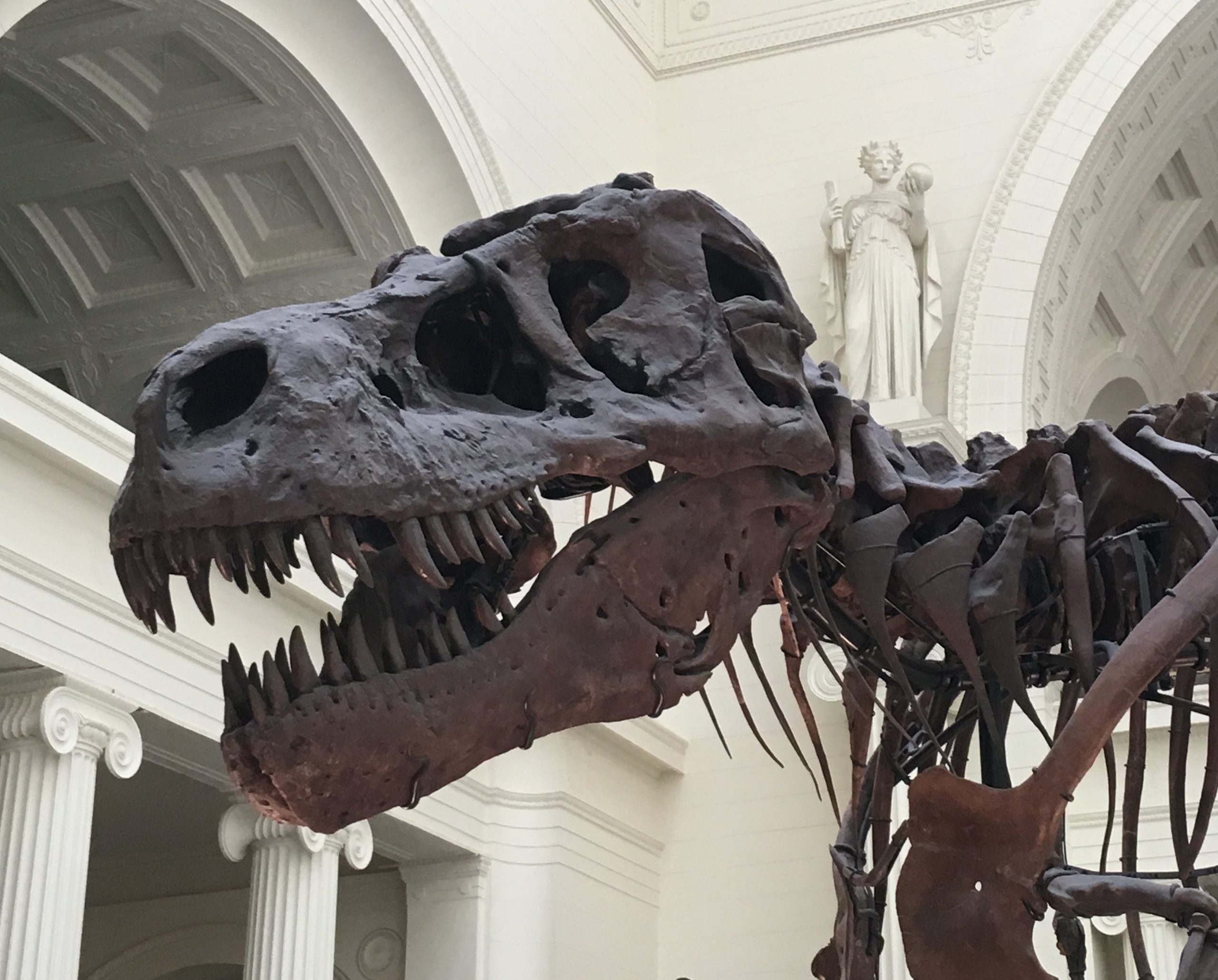
The dinosaur died sixty-seven or so million years ago in the waters of a seasonal stream in what is now South Dakota. This Tyrannosaurus rex was elderly, north of thirty by some accounts, arthritic, weakened from infections, tortured by a wretched toothache, scarred from the conflicts demanded by a predator’s diet. Perhaps, in the end, disease did the dinosaur in, or hunger, or the exhaustion of age. Perhaps the current was too strong. Seven tons of tough flesh and bone would have made a welcome meal for the neighborhood’s carnivores, but the earth had gentler notions.
The waters of that seasonal stream prepared the
remains of once and future regent for fossilization. The
current, coursing past like mourners paying collective respect,
deposited silt instead of gravedirt in steady tribute until, at last
sediment covered the tyrannosaur over entirely, a humble
defense against scavengers, an embrace through decay. De-
composition of soft tissues and other organic matter made
space for something new. Mineral-rich water flowed in and—
through chemical reactions not wholly understood,
transformed the calcium and phosphate of the lingering
bones into iron, calcite, siltstone. As ages and epochs passed,
the stream dried up for good, the climate changed, continents
drifted. For many millions of years, the fossil endured.
The process of fossilization is a slow transubstantiation. In time, animal becomes mineral and mineral remembers. This is what I want for myself.
I want to become a fossil.
The remains of the dinosaur that died sixty-seven or so million years ago were spotted in the summer of 1990 by a commercial fossil hunter named Susan Hendrickson. Sue and her colleagues from the Black Hills Institute of Geological Research worked under sweltering sun to excavate hundreds of bones, using pickaxes and paintbrushes in turn. After several weeks of effort, they had their fossil skeleton—once a creamy marble, but long since darkened by the patina of deep time.
For their careful labor, the Institute possessed the largest, most complete, best preserved Tyrannosaurus rex ever unearthed. From the start, they called the specimen “Sue,” a name that stuck, though it is stylized these days in exuberant capitals—SUE—to distinguish dinosaur from human.
Amidst a dispute over custody, for some time, the federal government confiscated the fossil. SUE, you see, was excavated (with permission) from the property of Maurice Williams, a member of the Cheyenne River Sioux Tribe. Eventually, the courts determined that this fossil was in fact “land” held in trust by the United States for Williams. SUE was his specimen to sell.
In 1997, the fossil sold at auction for the outrageous sum of 7.6 million dollars (not to mention a hefty additional fee for Sotheby’s) to the Field Museum of Natural History. Corporate behemoths McDonald’s and Disney sponsored the acquisition. And so the T. rex headed to Chicago, as “a gift,” McDonald’s executives reasoned, “a gift to the world for the millennium.”
After thousands of hours of careful work by paleontologists and fossil preparators, a re-articulated SUE was introduced to “the world” in May of the new millennium—given pride of place in the museum’s grand central hall, a soaring space drenched in white—bright, sacred, and warm. The Field’s architecture is neoclassical, modelled after an ancient temple on the Acropolis dedicated to Athena.
The subsequent surge in visitation was a credit to SUE. Some people made long pilgrimages to marvel at this superlative specimen. Other people, like the girl growing up in a nearby suburb, got to know SUE through happy proximity. And because her grandma—my grandma—volunteered at the Field Museum. What I’m saying is, SUE exists as a part of my millennial childhood just like the Spice Girls, like Space Jam, like summers spent getting sunburned on the shores of Lake Michigan.
II. a humble miracle,
At the turn of the millennium, I attended at a Catholic K through 8 named for a pope who was, at that time, partway to sainthood. Each morning our principal led prayers over a crackling PA system and each morning the plaid-clad student body acknowledged in one tired voice our namesake’s recent spiritual promotion, “Blessed Pope John, pray for us.”
My parents sent me to this parochial school for the good education it promised. We weren’t parishioners. On Sundays, I attended Lutheran services with my mom, so I was something of an amateur anthropologist conducting participant observation of the Catholic faithful. I memorized the prayers, dutifully completed my rosaries, attended school masses, and went to confession.
“Bless me, Father, for I have sinned. I, uh, talked back to my parents.”
I never could think of anything more interesting to confess.
The school required me to participate in this particular sacrament, but prohibited me from receiving the grace of others. Baptized into a Protestant sect, I couldn’t take Catholic Communion. While my classmates consumed the body and blood of Christ, I’d remain in my pew, kneeling with hands clasped and head bowed, showing the appropriate amount of respect for a ritual from which I was excluded. Sometimes, though, I’d join the Eucharistic queue. As others extended their hands to the priest, grasping for their gifts, I’d cross my arms over my chest as if laid out for burial. This was to signal that I was in no fit state for the sacrament, yet still I wished to receive a blessing. Who wouldn’t?
According to Catholic teachings, something miraculous happens when the priest consecrates the bread and the wine. Though there is no outward change, though these things are not empirically altered, they become in substance and essence the real bodily presence of Christ.
This is the doctrine of transubstantiation.
If you were to inspect the bread before mass and then again after the priest’s sacred repetition of Christ’s declaration—“this is my body”—you’d find it in the same physical state. You must take transubstantiation on faith.
When I learned about how fossils form, how bone becomes stone, I recognized transubstantiation in its most literal sense. On visits to the Field Museum with my grandma, I wondered at the dinosaurs and other fossilized creatures on display. They were animals once and here they stood as statues. No holy phrases required for this miracle, just time, sediment, and some favorable circumstances.
I didn’t think that SUE was the savior. But I did know, in my young bones, that the museum was a place of worship.
III. if the elements allow
For animal to become mineral, material conditions have to be perfect. It’s exceedingly rare for terrestrial life to fossilize; it’s a process contingent on so many factors.
The production of fossils is perhaps best understood through a theory of prehistorical materialism.
Did you laugh?
If you didn’t, I completely understand. The joke has an audience of one and she’s long gone.
My grandma, a matter-of-fact woman, taught history and civics at a public high school on Chicago’s South Side. More to the point, in her early adulthood, she was a card-carrying Communist. Her memory is a blessing. May my bad Marxist humor entertain her memory.
Brooklyn-born to Jewish immigrants from Eastern Europe, my grandma, Lillian, weathered a childhood of Depression and came of age into a world at war. She married Jack, the grandpa I’d never meet, a Navy airman turned travelling salesman. They had three kids in quick succession. They moved around for his work, often, eventually landing in Chicago for good in 1955. She was 35 years old when she moved to the city where she’d spend the rest of her life.
Lillian never lost her Brooklyn accent, maybe because so many of her childhood friends made the same move to Chicago. This community sustained her while she raised kids, worked, was widowed. This community kept her socially connected and politically engaged into old age.
She lived a secular life, worshipping no gods except curiosity, art, and culture. She put her faith in science and devoted herself to the acquisition of knowledge.
Cigarettes were the one indulgence she allowed herself, though she went out of her way to get a good deal on them. Because the vice taxes were far lower in Indiana, she drove across state lines to save on her Raleighs.
By the time I came along, in 1989, my grandma was retired and comfortable, but committed to her thrifty ways. In the pantry of her apartment in her Hyde Park high rise, she stashed plastic grocery bags many years older than I.
17. From the living room of this Hyde Park apartment
16. on the 17th floor that was in fact the 16th floor,
15. because she lived in one of those old buildings that,
14. in deference to superstition, refused to acknowledge
12. the existence of a certain story judged to be unlucky…
11. she had an enviable if limited view of Lake Michigan,
10. its ever-changing canvas a hopeful aqua in spring,
9. high-summer cerulean, frigid grayscale through winter,
8. storm-churned into nervous greens, opaque browns
7. framed on either side by skyscrapers of pale brick,
6. this privileged perspective a constant reminder that
5. things change and times change, slowly or swiftly but
4. surely, so wouldn’t it be far better to embrace this vantage,
3. difficult to see from the distracting street, busy with life,
2. but evident to one with a bird’s eye view from a window
1. on the 17th floor that was in fact the 16th floor.
In retirement, Lillian filled her years with museums, friends, and frequent international travel. She lived frugally, but lived well; she saw the whole world on a school teacher’s pension, social security checks, and survivor benefits.
In the year 2000, at the grand age of 80, my grandma gave up her Raleighs and all other cigarettes for good. She’d been smoking since before The War and then, one day, she wasn’t smoking anymore.
Could you kick a 60-year habit? Would you even choose to try?
Her decision was a rational one. Cigarette taxes had gone up, yet again. Besides, scientists were in loud agreement that cigarettes were harmful. Social consensus had shifted too. And so, not unlike Indiana’s nearby sand dunes—ancient drifts shaped and reshaped by prevailing winds—Lillian became a new version of herself.
If the conditions are right, we become fossils in our old age. Which is to say, if the elements allow, we are capable of enduring and evolving all at once.
As a metaphor, the fossil has been badly abused. Not static, not obsolete. No; a fossil is evidence that one thing can become another.
IV. for matter to endure
I lived within shouting distance of the Chicago border for the first 18 years of my life. On the beaches where I spent my summers, I could gaze south along the shore toward the city’s skyline, toward my grandma, toward SUE.
I left my North Shore suburb for an East Coast college, then grad school in a different state, and more grad school in another. I’m a historian by training and a teacher by trade. I’m 35.
Because my family valued education, because my grandma and all three of her kids worked in the sector, because I was a good student, and because I heard no other calling, I stayed in school as long as I could. I knew, when I started my PhD, there was no guarantee I’d get a secure faculty job. The academic market in the humanities has been abysmal for years. Why cultivate some niche expertise? I suppose I just had faith that things would work out. They always have; there’s historical precedent.
What I didn’t account for in my early 20s, when I chose this path, is how the itinerancy of academic employment would erode me. Every year or two, a new apartment in a new city where I struggle to become part of a new community.
I live in California these days, in a small city on the Central Coast where I teach, as needed, at a public university. I chose to move here, when my last teaching contract ended, because here my partner has roots. It’s not really how things are done in academia. And there isn’t full-time work for me here, not yet. Maybe not ever.
It’s January 2025, and I’m speaking with a man from the Employment Development Department, who has called to verify my current lack of employment. I had been assigned a course for the coming quarter and was preparing to teach it, but low enrollment resulted in its cancellation.
“You’re a university professor?”
“I’m an adjunct, which means I—”
“I understand,” he interrupts, gently.
Two major public university systems function in my state. Both rely heavily on adjunct labor. Practically half of all instruction is done by scholars off the tenure track, many of whom have short-term and part-time contracts. There –are thousands of us in California and thousands more across the country, contingent workers without whom the system wouldn’t work. I imagine that the man on the other end of the phone processes our unemployment claims daily.
I can’t keep moving. I fear if I continue to chase contracts around the country, the elements will wear me down until I’m weathered into nothing. I need to stay still long enough to become part of my environment, but I can’t sustain myself on piecemeal contracts either.
I want to become a fossil.
The thought has been with me for years, a fantasy of certain whimsy. Or is it whimsical certainty? Lately, as professional precarity threatens my long-term prospects, the fantasy becomes fixation.
I want to become a fossil.
There’s something I must confess, mortifying though it is, because my Catholic education conditioned and compelled me to participate in this particular sacrament.
When I am on contract, I specialize in courses that will, in theory, prepare undergraduates for the real world. I teach critical reasoning, persuasive writing. Sometimes, I even teach eminently practical tasks, like how to craft a resume or to write a compelling cover letter. It is my responsibility to set students up for collegial and professional success.
Who am I to be trusted with this responsibility? What would my students think if they learned I’d just certified my eligibility for food stamps? I’d understand if they had doubts about whether I had anything of value to teach them.
Fossilize me. Please.
Most nights, sleep arrives slowly. I lie beneath my weighted blanket and imagine the earth embracing me, minerals in the groundwater making me into something new, something more enduring. Some nights, I picture myself as steely hematite or luminous calcite. In my most indulgent fancies, I see myself becoming opalescent. It could happen, if the conditions are right. If I just stay still long enough.
Did I lock the deadbolt?
The question is unwelcome, but it would be impolite not to reply. Researcher that I am, I require empirical evidence to substantiate my answer. Memory won’t do. So I slip out of my warm bed to confirm what I already know to be true. The door is secure. I didn’t even leave the apartment today.
Back in bed, I return to the urgent work of manifesting my permineralization. A gleaming pyrite would be nice, don’t you think? A shiny fool for all eternity.
When I do fall asleep, I sabotage the project. As my dentist reminds me every six months, I grind my teeth terribly. The particular dentist changes often, given how frequently I relocate for academic contracts, but each one tells me this: night by night, I am gnashing my molars to dust. This is a problem, because our teeth are our best hope for fossilization.
The little mammals that lived alongside SUE, the critters whose descendants evolved into me and you, are largely known to us only through the enamel-clad teeth they left behind, too fragile and vulnerable to be preserved in their entirety.
V. beyond the borders of Faith.
Through fossilization, animal becomes mineral and mineral remembers. But there are things that mineral forgets, questions that mineral can’t answer.
Was the dinosaur that died sixty-seven or so million years ago male or female?
For decades, because the dinosaur was named in tribute to a woman and because the team at the Black Hills Institute had its own theories, SUE was regarded as female. The Field Museum used gendered language to refer to its star specimen. The general public has long spoken fondly of “her.” And yet, there isn’t enough data to know SUE’s sex for certain.
Some years ago, someone thought to bring the question to SUE directly.
“What are your pronouns?” asked a fan on social media.
“The science is out on that… but they/them,” answered the official @SUEtheTrex account.
The museum didn’t immediately follow the lead of its gutsy social media account. Eventually, though, after pressure from the public, the Field made SUE’s nonbinary nature the official position.
Though long dead, SUE managed to issue a press release.
“I would like to state that my preferred pronouns are ‘they/them’… As in, ‘SUE is… a majestic murderbird, and Chicago is lucky they grace the city with their presence.’”
The museum updated its exhibit text. SUE’s social media account corrected people who misgendered the dinosaur, sometimes gently and sometimes with snark.
An act of trans-substantiation, if you will.
It’s February 2025 and SUE’s social media accounts still announce their nonbinary identity. It’s a small thing and tectonic too, because the federal government has taken the injurious and scientifically illiterate stance that trans people do not exist. This same administration is gleefully terminating funding for scientific research, for education, for the arts. It uses heavy machinery to bore into the landscape without concern for what these clumsy tools will demolish.
Don’t they know that the proper excavation of fossils requires precision? Don’t they see that the most valuable things involve an investment of time and careful labor under sweltering sun?
Here’s another confession. I am relieved my grandma isn’t here to witness this—the utter contempt for educators, the devaluation of science, the erosion of our communities of knowledge. Her world doesn’t exist anymore. The life she lived, the kind of life I imagined I’d make for myself, is no longer possible. When I mourn her, I mourn that too.
It’s March 2025 and the administration is incarcerating students who have
crossed continents in their pursuit of knowledge, all because those students act
on conscience and because they were born beyond borders that have only
existed for a mere moment in terms of geological time.
It’s April 2025 and federal officials crow about the promises of novel
de-extinction technologies. They plan to de-fang the Endangered Species
Act. If they do, more creatures will go the way of SUE.
It’s May 2025 and the class I was contracted to teach this summer
teeters on the verge of cancellation, my summer income along with it.
Not enough students signed up. I won’t be paid for the weeks of
preparation already completed.
I call home to the Midwest for consolation.
“I’ve been praying for you,” my Mom, the Lutheran, tells me.
“That’s very kind” I reply, and I mean it. I’ve never been one to turn
down intercession. I envy the conviction that calls a person to
prayer.
I don’t ask for much,” she clarifies, “just that your hard work pays off.”
I’d be glad for that grace, for my effort to lead to something stable.
At present, though, I just want to be paid for the work I do.
It’s June 2025 and I won’t be 35 for much longer.
I want to become a fossil.
When I catch myself breathless at the tiring march of time, I think of SUE. What’s a year, a century, a millennium to an animal-turned-mineral that has abided age after age? SUE reminds me that accumulation is the entire point. The accumulation of hours and, if the elements allow, the accumulation of sediment, miniscule matter that cooperates with time to create a fossil.
There’s one last detail in SUE’s story that brings me comfort when I am adrift in doubt.
It’s a detail I always forget to remember.
That summer in 1990, when Sue the fossil hunter spotted the remains of SUE the T. rex resting in the earth, they were just north of Faith—a place in South Dakota and a virtue that no longer sustains me.
I had faith in myself, once. I don’t anymore. What has faith done except render me inert? If I am to become a fossil, significant and enduring and capable of substantive change, I can’t rest on faith or hope for certainty. I must accept my contingency—which is, after all, a fundamental feature of fossilization. No future is promised, no fossil is guaranteed.
So, I’ll do as SUE and settle beyond the borders of faith.
Faith is hard; fossils are harder.