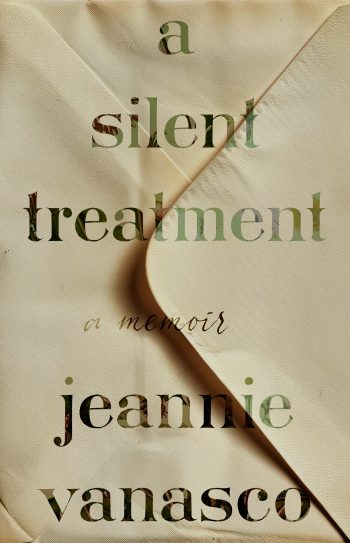
In her third memoir The Silent Treatment, Jeannie Vanasco explores the phenomenon of punitive silence as she writes through an incident in which her mother refused to speak to her for weeks. Although her mother lived in her renovated basement and they’d always been close, Vanasco shares that this behavior occurred regularly, often seemingly out of nowhere, leaving her confused and hurt. The longest silent treatment lasted for six months.
Throughout the book, Vanasco attempts to understand her mother’s behavior in the hopes that she can change this painful pattern. As a psychotherapist who cohosts a podcast on depictions of mental health in film and television, I appreciate the honest empathy Vanasco brings to the page. Compassionate curiosity leads the way as Venasco traces her mother’s childhood, considers their current circumstances, and holds a mirror up to her own behavior. Desperate for answers, Vanasco turns to a myriad of sources, from conversations with her spouse and friends, notes from therapy sessions, symbolism in film, and even asking questions to her Google Home Mini. An intriguing exploration into duty, relationship, and the anguish of not knowing, The Silent Treatment invites the reader to experience what it is like to be ignored and to not understand.
I spoke with Vanasco over Zoom where we discussed the urges to pathologize behavior, craft considerations, Nicolas Cage’s acting skills, and more.
The Rumpus: What compelled you to write this book?
Jeannie Vanasco: The books I’ve chosen to write, I felt this need to write them, so I’ve organized my life around them. When I finish them, or the editor takes it away and tells me I’m finished, suddenly I feel sad because now how am I supposed to arrange what I’m perceiving? It’s a very strange experience. I’m happy that it’s done. In a way I’m also sad. I’m also excited to move on to the next thing. My mom hasn’t read it yet.
Rumpus: Is she waiting until it comes out?
Vanasco: She had already told me she wanted to wait until it was officially out. She knows what’s in it, and I went through a list of the things she might be upset about. She seems very relaxed about it. We’ll see. Maybe we’ll get The Silent Treatment Part Two.
Rumpus: I hope not! You mention throughout the book how your mom gave you explicit permission to write this. She wanted you to write it, and you felt this book was for her. I’m curious if resolution has occurred, or if this feels nerve-wracking for you?
Vanasco: She’s fairly laid back about [the book]. She could be the patron saint of memoirists. I’m surprised by how relaxed she is or seems to be. I will say, in regards to permission, it’s always tricky. Just because someone says you have permission, how sincere is that? I did question if she is giving me this permission because she thinks this will be helpful and she knows I’m a writer and this is what I do. As far as how things have gone, this is kind of a spoiler, but it’s why I decided to include a one year later at the end of the book, like a movie flash forward. I was thinking about the nature of the silent treatment. It was cyclical while she was living with me. It felt unpredictable at times but it kept happening. I didn’t want the reader to leave
thinking it’s going to start up again. I have to communicate that things have been better. There’s been a happy ending which is nice.
Rumpus: That’s not necessarily how these things go so it’s lovely to hear.
Vanasco: I read an excerpt at the Tin House workshop and another writer came up to me and said, “Our moms are a lot alike” and attached a diagnosis that she thought her mother had Borderline Personality Disorder. I never use a diagnosis in the book. My mom hasn’t seen a therapist but there was a sense in which I thought, how much is this the circumstances she’s in and something she does when she’s trapped? I was nervous about someone saying “Okay Jeannie’s mom has this or this,” not that I mean to stigmatize anyone with BPD. I was thinking in the book about the larger circumstances, and what forces are acting on her that push her in this direction.
Rumpus: So much of this book is about trying to understand a set of behaviors, and a clinical diagnosis is often a way to label, to simply encompass a set of symptoms and it doesn’t necessarily honor the complexity of a person’s experience. You tried so hard to understand your mom, her emotions, and her behaviors, and you didn’t oversimplify or pathologize any of it. Your depictions were empathetic throughout even though it was clear that you were hurting because of her behavior.
Vanasco: Some writing I did was coming from a place of anger and I stepped back to think, “How fair is it to include this?” I didn’t put that writing into that book, and I did some process journaling to help me see how my anger is flattening the situation and I’m looking for a quick answer by trying to find a diagnosis. The problem is that it removes me from being at fault in any way. So [even if my mother’s] behaviors are in line with a diagnosis, I had to move away from the pathologizing because I noticed I was removing myself from any kind of blame.
Memoir is very selective. You’re trying to find a shape for the experience. Doing that side writing helped me see my mother as more complex, but also not fall into that trap of martyring myself. I was trying to figure out how it’s hard to be a person. It comes down to that. Yes, mother and daughter conflict can be hard. It’s just hard to be doing the best you can and it never seems to be good enough. I’m glad it didn’t come across as villainizing her.
Rumpus: It shows that it is hard to be a person and to be a person in relationship with other people. The book shows a conflict between cognitive understanding and emotional experience, which might be especially hard for people like writers who try so hard to understand something. But some things don’t make rational sense. Your mom’s behaviors don’t make rational sense even though you were trying so hard to find patterns or reasons or repair. It brings up questions about what we do when we don’t understand something and we are hurt and confused. What was it like to have this process in your life and then bring it to the page for this project?
Vanasco: From a craft perspective, I’m writing from within the experience rather than writing a memoir where I’m looking back at something from the past. I think that when you’re inside of an experience you’re looking for cause and effect. The more time passes, the more cause and effect look very easy and attractive. Hindsight perspective can be very useful. But I think this is why I like writing inside of the event because when I’m outside of the silent treatment, my mom suddenly becomes so wonderful, everything is okay, and I very quickly push aside how much pain I was in during the silences. Intellectually I know it but it’s very hard to access that pain.
There are so many factors into why we behave the way we do. When I would ask my mom why she uses silent treatment she would say she didn’t know. And I appreciated that because I think she genuinely didn’t know. I think that conventional knowledge is to wait until you have enough time to process the events before you write about it. Maybe it’s changing but when I was in graduate school for creative nonfiction that’s what I was hearing. It’s not necessarily bad advice, there’s usefulness in that, but writing from within the experience, I was able to capture some of the feelings I can’t access outside of the silent treatment. I was doing all of this research into punitive silence. I mentioned Kipling Williams who formalized the study of social ostracism. I was reading case studies of long term silences and there is that element of wanting to feel helpful. I thought “Here’s a case study, one person’s experience from within a silence.”
I am interested in cause and effect. It’s very telling, the links we make. Even if they are not right, it says a lot about who the person is at that moment. I was very afraid of accessing anger (directed) at my mom. In those moments I am looking for easy cause and effect. I was looking for ways to protect myself from getting angry at my mom. I was kind of doing what my mom was doing with the silent treatment. She would use the silent treatment so she wouldn’t say something she’d regret. It’s a protective measure.
Rumpus: You looked to so many sources for answers and information. Conversations with friends and husband, notes from therapy sessions, asking your Google Home Mini for answers, “Hey Google!”, and then the psychological research. I’m curious about the decisions you made to bring these sources into the book and how the sources interact with your experiences and your voice as the narrator.
Vanasco: During my mom’s silent treatments I lost so much confidence. What the silent treatment does after a while, and this is reflected in the research, people report feeling like they didn’t deserve to live. I integrate the research from a place of showing my own insecurity. I wanted to include the research in a way like diegetic sound in movies. Whatever the character is hearing is what we’re hearing. I wanted the research process to be a part of the narrative because I was having a hard time acknowledging my feelings. I was going to research to distract myself while also trying to understand it better. I wanted to introduce it in a way that showed me not knowing.
I didn’t know much about the silent treatment when I started this. I initially pitched the book looking at the history of punitive silence but it felt like homework. What was more interesting to me was the ways in which I was reaching for research, like going to Youtube and hearing non-academics talk about their experiences, or looking at case studies. I didn’t want to look at big philosophical texts to understand my situation. I wanted the reader to see me being stressed and anxious and I wanted to communicate that desperation for answers. Then I had to consider how to turn this research into scene, and the [conversations with] the Google Home Mini comes in.
Rumpus: It seems like research can be used to legitimize an author’s experience at times. You turned that tendency on its head—even with this research and even as you were looking into so many things, there is no concrete answer. I know in the therapy world, even with so much research, there’s so much we don’t know about the human experience and yet we all have to keep plugging along.
Vanasco: I am very interested in the essay form and that place of not knowing. Going back to (Michel de) Montaigne who popularized the essay in the 1500s, that idea of “what do I know?” All of us are searching for answers for something in our lives. I like when someone is coming at the subject from a place of not knowing and I am there with them. I can’t think of anything more intimate than being inside somebody else’s head and watching them think through something and be confused. To me that is a form of intimacy and I want to welcome the reader in that way.
Rumpus: You use so much metanarration, not just about learning about punitive silence and trying to understand your mom but also about the writing process itself. As a writer and a professor of creative writing, how did the writing process inform the structure and content of the book?
Vanasco: There’s this idea that you learn the craft of writing so that you can forget the techniques, and when you’re writing you’re not thinking about it. Ideally you’re just writing. As a writing professor I spend so much time talking and thinking about craft, so it’s hard to turn off that part of my brain. I think it can be both good and bad. That might have something to do with why my work is very meta. Though when I look at very old writing, even in high school and junior high, I was doing this.
When my mom wasn’t speaking to me I couldn’t write in the house. I’d go in my car. I’d use my phone’s voice memo app. I’d write on scraps—all sorts of things. That process probably does have something to do with the more fragmented structure and the white space. The process is very much tied to where I was doing the writing. When I was at home, I had to get in the car and outside of the house. I do think that writing about my mom while living with my mom was like the ultimate challenge. Then I landed on the idea of using parentheticals. I’d remember things my mom had said and written, both positive and negative, and it interrupts the narrative. The meta passages are also a place for me to question what I’m doing while also thinking about the ethics of memoir, how fair I am being. That was my means of reflection.
Rumpus: The film The Conjuring kept coming up, and Nicolas Cage too, as you considered things like disagreement and possession and misunderstanding. Can you speak to bringing those pop culture topics into the book?
Vanasco: This was one of the most devastating periods of my life. I got to the point where I questioned if my mom even loved me. I had to keep some of it funny for myself. I didn’t want it to be sad sad sad. That’s not fair to the reader, but I also turned to humor at times to distance myself from what was going on. That was how I coped.
Once I was excited about including Nicolas Cage, I had to think about how I could write him into the manuscript so that he’s hard to remove. I needed to do all I could to examine his importance, the layers of meaning, and how it relates to my conflict with my mom. There was a lot more Nicolas Cage initially and I had to pull back. What do I care if my mom thinks Nicolas Cage is a good actor, or whether she thinks he is handsome or not? It showed that I will argue with my mom about anything. When I include details like that, I want there to be some levity, but I’m also thinking [about] what it is saying about my relationship with my mom. I didn’t want it to be a lengthy memoir. It’s about silence so I wanted it to be quieter. And I’m writing it as my mother’s daughter. I can let in other parts of my identity, but what events are reflective of my relationship with my mom? An argument about Nicolas Cage, that’s about right.
Then The Conjuring… I was thinking that I didn’t want to watch any movies about possessed mothers, but it can be interesting for metaphoric reasons. The fact that the mother gets possessed in the basement, but she’s tricked to go into the basement, I’m thinking, “Did I trick my mom?” I was looking for opportunities where I could have humor but it’s also reflective of something more heartbreaking and devastating, too. I didn’t want the book to be all sadness.
Rumpus: You wrote in the final chapter that you told your husband, “No more memoirs after this, I promise.” But you also hinted at bringing your cats into your next project. Do you have plans for what you’ll do next, or have you started a new project?
Vanasco: I told myself I would never write a book in this way again. I wouldn’t get a book under contract before it’s done, but I’ve done it. My plan for the next book, more broadly, is about my late twenties when I was on Social Security disability and it was a crucial support. It seems especially important to write about now as I’m seeing all this funding being cut for people who need it. I am also fascinated by this idea that I had to prove I had a mental illness but in order to prove it I had to do so much work. That’s the seed of it right now. I got excited about it because I landed on a voice and a style for it that’s different from my previous books. Once I have an idea of what the voice is and I can feel excited about it, I feel comfortable getting under contract.
The cats would be the ultimate writing challenge because a big part of this book was a delayed adolescence, and seeing my parents as imperfect and that it’s okay, that people aren’t perfect. I don’t think I’m ready to go there with the cats. That’s such a challenge! I think they are absolutely perfect and I don’t know how I would write about them. Someday I would love to write a book about the cats.
Rumpus: It can be challenging to write about difficult life events, even retraumatizing. How did you take care of yourself while writing this book, and what advice would you give to other writers when they’re writing about their lives?
Vanasco: I do recommend a process journal. It’s where I reflect on the writing I’m doing. Also, I watched a lot of standup comedy. I listened to upbeat music. I tried to get out of the house. I tried to think of things I enjoyed and what would get me laughing. Maintaining friendships and being around my friends was very crucial.
I didn’t have a good therapist at that time unfortunately but in previous years I’d had an excellent therapist. I do think therapy is so helpful. I found when I was seeing a really great therapist, I had a much easier time writing. It was really hard in the absence of a therapist, just being able to be protective of myself while I wrote. I was less likely to retraumatize myself while writing when I was with my therapist. I’m in the process of trying to find a new therapist.