A week after your grandmother’s funeral you cut your tongue off with a pocket knife. The blade is cold, smooth-edged, PoPo’s maiden name hammered onto both silver faces: 花, meaning flower, but also, to spend. One clean cut and your tongue culls from your mouth, careens into your palm like a milk tooth.
You unbury a jam jar from the depths of your kitchen and stuff it with dirt. You press a hole into its middle with your thumb, nestle your tongue inside. You burn a stick of incense and encircle your tongue with the scent of tanxiang, the same incense you burned at the funeral. You aren’t really sure what you’re doing, but you remember when you asked your mother at the funeral, “Is PoPo getting the gold as soon as we burn it?” and she said, “Doesn’t matter. It’s more about intention.”
In the pale light of the windowsill your tongue stretches, tastebuds catching the last dregs of sun. It must be hungry, you think. You gave yourself an impromptu haircut in the kitchen sink last night and you take pinches of baby hairs from the floor of the basin, holding them hesitantly above your tongue. Its pink body opens down its central indent, flashing small pearls of teeth, two rows of them like a shark. You sprinkle the hairs inside and your tongue swallows them. It digests for a moment, then opens its mouth for more.
You haven’t gone grocery shopping since you got laid off a couple weeks ago, and your fridge is filled with moldy takeout, energy drinks, years-old birth control. You scavenge the floor of the living room and find a beetle, belly-up under a bookshelf. You lift it onto your palm by a leg, outstretch your hand toward the windowsill. Your tongue’s mouth opens and a smaller tongue winds out from it, curls around the beetle, drags it inside. As it swallows you feel lighter, the darkness beginning to unthread. After your tongue is done eating, it settles back to how you remember it: still and placid, like a bull asleep in a pasture.
PoPo was the one who taught you how to work with plants, how to draw a box around a living thing and pack it with just enough air to breathe. Each time you visited her in Queens you’d bring her sleeves of milkweed and iris seeds you’d layer between the clothes in your suitcase. When you handed her the packets she would give you a stiff handshake as a thank you, her mouth opening as if to say something before closing back into a line. You learned years ago that if you hugged her she would just stand there, her shoulders tensing. It was similar with your grandfather: each time you saw him he would fold you an origami heart out of a five dollar bill and slip it into your pocket while you weren’t paying attention. But if you ever showed him the heart, tried to thank him, he would just shrug, rummage his hands around in his pockets as if he was looking for something.
Your grandparents only spoke Cantonese, which you were always saying you were going to learn but didn’t manage to do before PoPo died. Your first language was Mandarin—before it seeped out of you, so slowly you didn’t even realize it was happening. But it was less like Cantonese and Mandarin were one river parting into two on opposite sides of a mountain, and more like one was the mountain and one was the river, winding towards some other valley.
Your mother calls and tells you about the rock she found buried by the stream near her house, matte black with an eye of white beading its crest. Each time you’ve seen her since the funeral her pockets are pregnant with stones. Tiny rocks with speckles like robin eggs, triangular rocks that bend into sharp points, rocks with prehistoric fossils embedded into their sides. You walk arm and arm with her through her neighborhood, but her eyes stay trained on the ground, searching. “When was the last time you called GungGung?” she asks, her voice crackling over the receiver. To talk to him about what? you try to say, but the words catch in your throat, come out as a sharp sputter. “Can you hear me?” she says. You try again, but your mouth remains silent. Next time she calls you let the phone ring.
After going out for a midnight smoke, you leave the door to the fire escape ajar and find a moth in the living room, clinging to the shade of a table lamp. It has eyes for wings, antennae that bend toward the light. You cup it in your palms, bow three times before ushering it into your tongue’s mouth. The body of your tongue bulges up around the moth, moving it through its stomach like a mouse in the belly of a snake, before regurgitating it onto the windowsill. You run your finger over the moth’s abdomen, saliva bubbling on its twitching wings. Your tongue must only like dead things, you decide, bodies hollowed of themselves.
A week passes and your tongue grows bigger, hungrier. You’ve fed it a cockroach, a praying mantis, a colony of ants you found strewn around a gum drop on the kitchen floor, their limbs contorted like flower stems. On the way to the corner store there’s a rat flattened next to the gutter, entrails making a maze of the asphalt. Your tongue is the size of a fist now, and its jaw shuts around the rat, folds it inside.
Right before you walked into the funeral home your mother tsked and said, “Chinese people are so bad at death.” She said it like she said your uncle’s name when he got into the catnip and she had to pick him up from the police station in the next town over, his eyes red and vacant. She had rolled her eyes at him, dragged him back to the car by his ear. Like he was a nuisance, a child. “Sweep your hand over your head when you walk in,” your mother said, “And make sure to excuse yourself before you sit down on the toilet, or else the ghosts won’t know to move and you’ll shit on them.”
Through the door of the funeral home were two identical windowless rooms, each with a coffin at the far end. The air was sour and chemical, a grainy buddhist chant playing on a ten minute loop from the loudspeakers. Inside each room were bouquets engulfing the walls and a sea of Chinese people dressed in black, slung over rows of plastic chairs. At first you couldn’t tell which room had your family in it, so you trailed behind your mother until she went into the one on the right, following at her heels like a puppy.
As soon as you walked in, a man grabbed you by the shoulder, lined you up with your girl-cousins. He went down the line pinning a red flower in each cousin’s hair and when he got to you, you realized PoPo had died with you as her granddaughter, and it would remain that way forever. You had never considered coming out to her, didn’t even think it was possible.
You spent the rest of the funeral folding paper into gold nuggets, offerings for PoPo. You liked the ritual of it, letting your mind churn as you put a finished piece of gold into the bag, picked up the next one, started again. It wasn’t like the other funerals you’d been to, where you sat slumped in a church pew, chewing at your cheeks while women dabbed at their mascara. At PoPo’s funeral there was no crying, no speeches, no sentimentality. Just sitting, folding, bowing, burning.
While you worked you kept getting caught up in gossip between one aunt or another. Someone’s cat had gone feral and had to be euthanized. Your cousin had been staying with your aunt and uncle when they found him in the backyard kissing the neighbor’s son. Just last week there was a snowstorm so harsh, the black dye whipped out of your aunt’s hair as soon as she stepped outside to get the mail and left her roots white as uninked paper.
No one mentioned PoPo, although her body was lying skyward at the far end of the room. Even with your back turned you could feel the shadow of the body pulsing behind you. When it was your turn to approach her coffin, lay a blanket over her for warmth in the afterlife, you saw her face up close. People always said you looked like her—lips small and round like a rosebud—and it was then that you understood what they meant.
When insects and rodents can’t satiate your tongue, you give it pieces of yourself: jagged fingernail clippings, blood squeezed from a papercut, empty packets of testosterone, the sheared off collar of the silk qipao your mother wore to her wedding, that she gave you to wear to yours. Each day that passes your tongue grows, thickens. Its pink body deepens to a wet red, a color only meant to be seen by the inside of a body. You transplant your tongue into a glass bowl, then a cast iron pot, then a fish tank from a fish you don’t remember ever owning. Your head feels beautifully empty, the most it has since the funeral, like a forest with the trees milled down to a pulp.
In front of the bathroom mirror you try out new tongues. You wedge a silver dollar behind your teeth but cold seeps into your gums, the coin clinking against your molars, sending a sharp buzz through your skull. Next you behead a scallion with your pocket knife. The cylinder of it fits comfortably under your palate, but when you breathe air whistles through the scallion like a bone. You spit it onto the porcelain lip of the sink, wipe your hand off on your sleeve. You look in the mirror. I had to do this, you remind yourself—and you don’t need a tongue anyway. Even without it you’ve been feeling more yourself these days. You used to look in the mirror and your face would disassemble entirely: your eyes turning to twin river stones, your nose a stub of driftwood, the rounds of your cheeks the shells of beetles. Now there’s something more whole starting to appear, rising to the surface like a body.
Everyone who was born in the year of the dog wasn’t allowed to look at the coffin as it was lowered into the grave. You turned around and found GungGung, asleep in his wheelchair. Snow gathered on the shoulders of his coat. A few months before PoPo died, he fell down the stairs and your mother moved him to a rehab facility. You had never spoken to him without your mother as a translator anyway, but when he moved to the facility he stopped speaking completely. He spent all day in front of an endless stream of Cantonese game shows, his face changing shapes in the neon light.
When you went with your mother to pick GungGung up for the funeral, the people at the facility had given him a buzz cut, the sharp contours of his skull visible underneath the fuzz of hair coating his head. You thought it looked like he was going to war, and then you couldn’t remember whether he had actually fought in a war, or what war that would have been. You had a vague picture in your head of him crouched in a mud trench, rifle cocked in his hands as grenades cratered the field around him.
Halfway to Chinatown GungGung unlocked the sliding door of the car and tried to wheel himself onto the road. He strained against the seatbelt, your mother yelling in the front seat as traffic blared outside the open door. After a minute he gave up, collapsed back into his seat. For the rest of the ride he thumbed through a stack of old newspapers. Every so often he would grunt, shake his head at the page. At the graveyard you studied his sleeping face, worrying that it was the last time you were going to see him alive. That, like PoPo, he would die without you ever having said a word to him in a language you both speak.
You pare off the fingers of your left hand, splitting them off at the joints and bowing three times before casting them into your tongue’s mouth. You shuck flesh off your stomach with your switchblade, drop the pieces into your tongue’s mouth from above. As the last piece of flesh disappears into the dark, the image of GungGung, head down in the trenches, lifts from your bones like a bird.
After a few days the cavities on your stomach seal over with membranes of new, delicate skin. You finger the caverns, press into their soft middles with your pointer fingers. Things have been getting better, you’re sure, but some days you can’t stop thinking about doing this to your whole body: pruning away everything and regrowing it from fresh. Being clean and unmade, body stripped of body.
Your right knee has been itching at the bend, so you sever it below the knee, saw through it with a steak knife. It’s a relief when the bone disconnects. You replace the leg with the broken-off branch of an oak tree, the splintered end latching onto your kneecap. Crouched on a pillow in front of your tongue, you lift the leg above your head, bow until your forehead scrapes the floor.
The weight of your tongue is too much and the fish tank shatters—the glass singing as it opens. Or maybe your tongue is just stubborn, doesn’t want to be contained. You pull it out of the mess of glass shards and stand it up on the ground next to the window. Its veins are webbed around its base like the roots of a tree, the apex of it curling past the crown of your head. Your mother mailed you a satchel of rocks and you arrange them in a circle around the foot of your tongue, repeating what you remember of the chant from the funeral as you place each one. It has been months since you’ve talked to your mother, but she must have hundreds of stones by now.
One morning the scent of burning wakes you. A thread of smoke snakes across your room, the tail end of it hanging above your face, close enough to kiss. You stumble out of bed, follow the winding trail to the corner of the living room. Smoke seeps out from between your tongue’s clenched teeth, grey ribbons coiling outwards. The scent is the same as the one that wreathed the courtyard of the funeral home, cobblestone walls fencing in the furnace you helped your mother toss paper offerings into until the sky looked ready for a storm. You inhale the smoke and can taste everything that burned that day: a dollhouse-sized mansion filled with dancing girls with red-stamped cheeks, cutouts of pekingese dogs, a leather massage chair, three flat screen televisions, a myriad of fake designer purses, and bags and bags of paper gold that everyone had spent hours folding, shaping in their palms.
For days the smoke gathers in a fog, your apartment throbbing with the taste. The smoke is so thick you can’t see your hands when you stretch your arms out in front of you. Your tongue must be somewhere in the room, but you’re not sure where. You imagine it disappearing, metamorphosing into the smoke like a man in a noir. When you walk from one end of the room to the other, your body whittles a tunnel through the smoke that takes minutes to zip shut. In the haze of your apartment you mistake the succulent on the coffee table for a green-winged parrot, a porcelain bowl for the moon, the shadow behind the kitchen door for your mother.
The smoke has smothered the light from the windows, obscuring the turn from night to day, from one day to the next. You spend your time spread on the couch. You inhale mouthfuls of smoke to see how long you can keep them in your lungs. You pick up the rocks that dot the floor and balance them on your chest while you hold your breath, laying so still you’re no longer sure if you’re alive.
When the smoke finally disappears you’re not sure how much time has gone by. The air is clear, flicked open like a blade. Outside, the night is warm. Maybe it’s spring. Your tongue rests in the corner, taste buds expanding and contracting in rhythms.
The scent of burnt paper lingers and when you inhale a single thread of it whips through you. The smell leads you to the corner, where the smoke hovers in a cloud over an armchair. You approach it. In the angular dark of the room, the cloud condenses over the armchair. It churns midair until nearly opaque, folding into the shape of the cushions. As you lower yourself into the identical chair across from it, the fabric of a dress unlatches from the smoke, the hem falling to where two narrow ankles disappear into thick-soled clogs. A head emerges from the collar of the dress, the dome of a perm blossoming over it in tufts. When the small red mouth blooms at the center of its face, you recognize it. The ghost sits with fists clenched, shoulders squared, as PoPo always had. Moonlight moves through the ghost’s body in blades.
The last time you saw your grandmother alive, you helped her plant orchids in the front yard of her house. The day was cold, the imprint of the moon hovering above the end of the street. You were both on your knees, bent over the flowerpots. In each pot she hollowed out a cavern and placed an orchid at the center. She smoothed the dirt down with her left palm, and you did the same. She caught a drop of sweat from her temple and licked it off her pointer finger, and although there was no sweat to wipe, when you brought your fingertip to your tongue you were sure you could taste salt. The morning passed like that, the front yard silent except for the bubbling fountain of the buddha glued to the brick stairs with moss.
PoPo went inside to get a glass of prune juice, and you stayed with knees pressed to the earth, sprinkling fertilizer into the pots. When you finished with the fertilizer, you picked up an orchid and stepped to place it in the sunlight. As you bent to lower it to the ground a hand gripped you by the wrist. Your skin pinched under the pressure, rolling over bone.
You turned around, and there was PoPo, holding you still. “No,” she said, her pupils thin, jaw clenched. It was past noon, and the air was dry, dust swirling the streets. You couldn’t tell what you had done wrong. She released her fist, your arm dropping limp at your side. She grabbed the orchid from your hand and turned from you, going to put it back with the others.
You later found out from your mother that orchids couldn’t be planted in direct sunlight, that the leaves would singe and shrivel in the heat. But for days after the memory of it roiled in you: your wrist clutched in her fist, the first and last word your grandmother ever said to you, the single syllable of it opening and closing like a flame.
So as she lays draped over a chair in your living room, you say as little to your grandmother as you did when she was alive. You don’t tell her about how you didn’t know her name until you saw it tattooed on the cardboard sign at the funeral home. You don’t tell her about the joint you smoked in the women’s bathroom, how you exhaled the smoke out the window and it threaded down the streets of Chinatown like a song. How for the rest of the funeral you were small and outside of yourself, floating near the ceiling like a dragonfly. You don’t tell her about the drive to the graveyard, how you fell asleep and dreamt about her on the plane to America. Or about how in the dream it wasn’t her sitting there, but you: peering out the window, scanning the land below you for some kind of sign. You don’t tell her about how the morning you got the phone call that she was in the hospital, you were in the bed of a boy you had met at a gay bar the night before. You don’t tell her how after you got off the phone, the boy asked you if anything was wrong and you said, “No, of course not.” You don’t tell her about who you are, who you’re trying to be, to become. You don’t tell her how the day after her funeral you called a gender clinic, the man on the other end saying, “Are you still there? Would it be better if we called back later?” You don’t tell her how already the testosterone was moving through your blood, taking root. You don’t tell her about how it felt like you didn’t have a tongue years before you cut it off. How the first time you kissed someone, your tongue flailed against their teeth, already trying to escape. Most of all you don’t tell her that you wish you still had a tongue, that your mouth has been hollow without it.
But before the thoughts can finish reverberating through your head, the ghost is moving, writhing. It lurches up from the chair, collapsing forward onto the carpet, spreading open like a palm. The notches of the ghost’s spine rise upward from the pool of its body, and with it a new form blooms, branching from the spine, outwards and upwards. The ghost’s arms extend to the same length as its legs until it’s standing on four thick muscled limbs, the fingers and toes elongating and sharpening into hooked claws. From the ghost’s back sprout the arches of wings, curving wide and open like the bow of a ship. The neck snakes upwards, but the head of the creature remains your grandmother’s—her pupil-less eyes hanging from her face like two silver spoons.
You approach the ghost and it bows its head, the breeze from the open window running patterns through its translucent feathers. In the corner, your tongue stirs, the tip of it unfurling upwards, peering at you. For a moment you stare back at your tongue, the shadows between you slashing the floorboards open at the seams. You lift your hand into the moonlight and dust motes encircle the stubs of your fingers like moths. Maybe in the next life I’ll learn how to mourn, you think, how to be good at death.
You turn away from your tongue. You wrap your arms around the ghost’s neck and hoist yourself onto its back, lace your fingers together at its collarbone. It charges at the exit to the fire escape, the door slamming open and rattling in its frame. As the ghost pushes off and into the sky, the yellow eyes of the city blink between veins of grey highway a hundred feet below you. You turn back to catch a last glimpse of your tongue, but all you find are the windows: dark, unyielding. When you wheel back around the wind blows all of your hair straight back, the cold air stinging your skin into pinpricks. The ghost’s wings beat steadily as you pass over parks and suburbs, pale gray lakes and barren fields, the hand of night smudging the land into approximations.
The ghost lands at the foot of the cemetery gates. You dismount, twilight ripening around you. When you turn back around, you find yourself alone, the crickets clicking a familiar tune. You push open the iron gate, step inside.
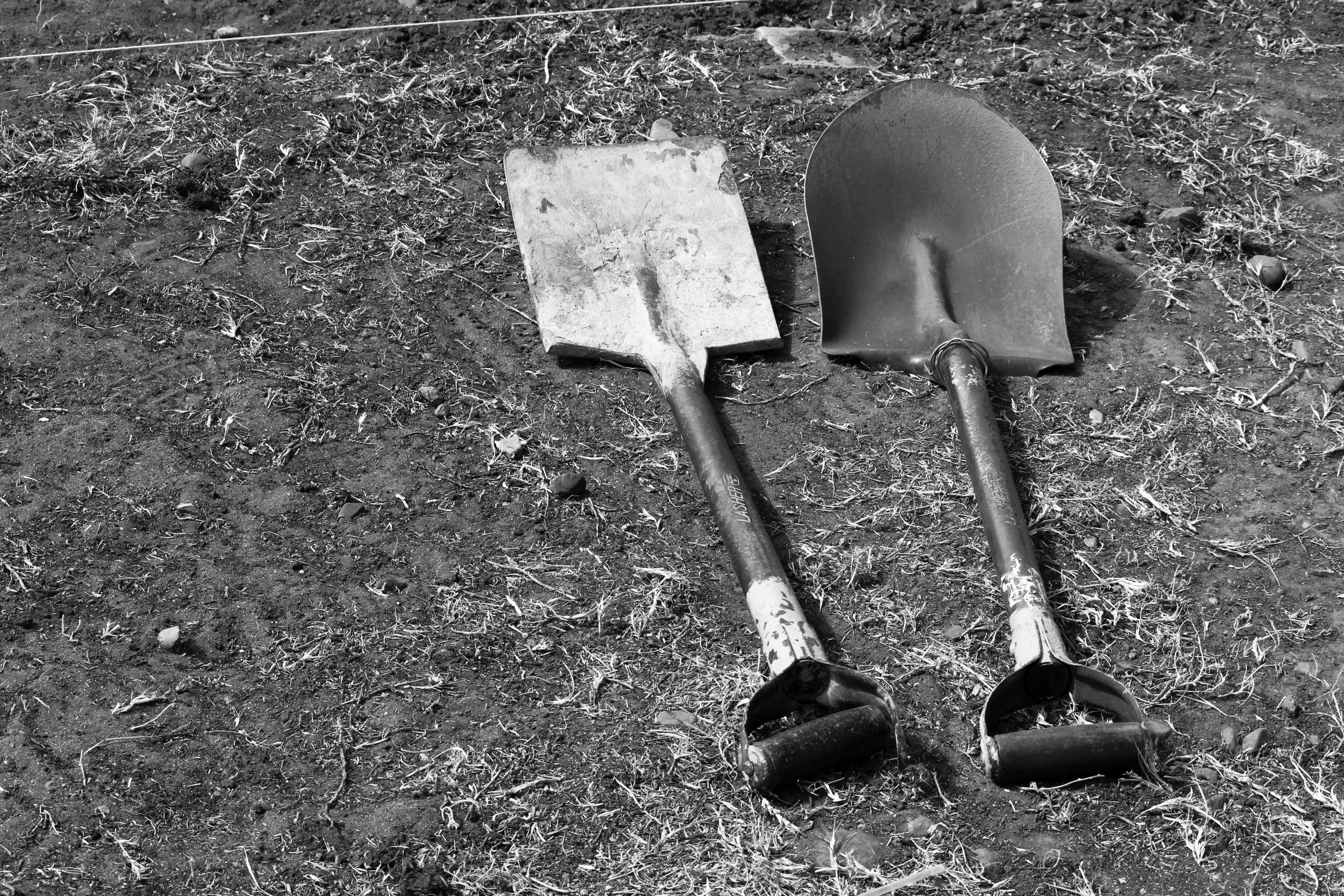
You wander through the rows of gravestones, examining their polished faces. Each family of graves has the oldest generation at the front and each following generation fanned out behind it like a flock of birds. You pass a grave with fresh dirt clotted at its base. A silver shovel rests on the grass nearby. You pick up the shovel, grip it with the cutting edge pointing up, spearing the sky.
PoPo’s gravestone is made of red speckled stone, her name carved onto the face in white letters. You remember the last time you were at the family plot, the evening after the funeral. As the car was rumbling back up the road you looked out the back window and thought you saw PoPo standing right where you’re standing now. She was fumbling with something in her hands, moving it from one hand, to the other, and back again. It had glinted in the light, like gold.
The dirt at the top comes off easily. The wooden handle of the shovel digs into your palms, the dirt flinging over your shoulder, a mountain growing graveside. As you dig deeper the dirt is coarser, cracked in dry layers like skin. The sun rises, concentric circles of light radiating as it balances on the horizon. The crickets’ song fades out and the cicadas replace them. By the time the black shell of the coffin emerges your arms are numb, your body an afterthought. You climb down into the hole, haul open the door of the coffin, and find her: still intact, still your grandmother.
You slip the knife out from your pocket. Her tongue comes off just as easily as yours did, and you pluck it from her mouth like a rosebud. You lay down next to her in the coffin, rest your head on her shoulder. The early morning light undoes itself across your vision, the sky a perfect white rectangle above you. As you slip your grandmother’s severed tongue into your mouth, wind blows across the graveyard, and any words you might say—had been waiting to say—dissolve into the wind, twisting into nothing more than air.