
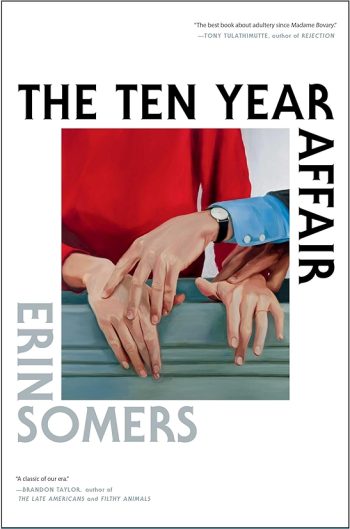
A friend recently described marriage to me as a gamble, an investment made at a specific moment in time. We get married despite knowing who our long-term selves will be—what they may need or what they may want. In Erin Somer’s newest novel The Ten Year Affair Cora, the protagonist, meets Sam at a baby group. In their small, idyllic town in upstate New York, she watches his mouth. We are introduced to this sensuousness, this fantasizing early on, understanding that fantasy and restraint will be central themes throughout the novel. Both Cora and Sam have children and are married to other people.
This is where The Ten Year Affair circumvents, or reinvents, the classic adulterous story. Esther Perel, the Belgian psychotherapist, says that desire and affairs require two main things: attraction and obstacles. But I think Somers would argue that they also require imagination. Somers masterfully leads us through ten years of fantasy and restraint between Cora and Sam using alternative timelines. In one timeline, Cora and Sam consummate their extramarital affair; the other centers on domestic monotony, PTA meetings, comforting lives.
In many ways, The Ten Year Affair is a novel about marriage and familial love. The pretend affair may be the motor or sun of the story, that the marriages and children and friendships orbit around, caught in its gravitational pull. When Somers talks about Cora’s relationship with Sam’s wife, Jules, she mentions that “it is just as compelling as her relationship with Sam.” We sense this care in the novel. This equal literary treatment of the romantic and the platonic. It reminds us that despite our expert compartmentalization skills, fantasies will always have some basis in reality. Though they feel like they occur in a silo or vacuum, they involve real people with real relationships. Will the two worlds—the fantasy and the reality ever meet?
Erin Somers and I spoke for an hour over Zoom. We talked about millennial disillusionment in the state of late capitalism and how humor, in writing, is a tool too many writers leave on the table. This interview has been edited for length and clarity.
The Rumpus: This is a novel that originated out of a short story published in Joyland in February of 2021. How did you use the scaffolding or structure of the short story to build the novel? Were you aware of the areas you wanted to expand ahead of time?
Erin Somers: It took a while to sell that short story. So long, that I kind of gave up, but I did think the concept had legs. Because no one initially wanted it as a short story, I started to expand it even before it had sold, so I was well into a draft when the story was published in Joyland. It was well-received and that put pressure on me for the novel. I didn’t want to disappoint those people. I felt like I had to earn the novel length because people already liked the short story. I asked myself, “Why does this need to be novel length? And why does this need to be longer if it already exists in this form that has succeeded to the extent that people connect to it?”
The biggest challenge was earning the length and to do that, I felt like I had to build Cora’s world out much more. I had to make the world of the town really compelling, introduce minor characters who are fun to watch and observe, give her a work life and think about what I wanted to say about ambition and women in the workplace, all these things.
I also had to figure out what to do with the conceit of dual timelines. At novel length, I wanted to maintain that conceit without it getting boring or tedious while also pushing it to a new place.
Rumpus: What stayed similar from the short story into the novel is the idea of two alternative timelines, these metaphysical “vectors.” One in which Cora lives with her husband and children and does not engage in an affair with Sam, and another where she does. I love when you write, “She thought of him in both timelines. In one it was with longing and despair and the other with longing and regret.” These parallel timelines are so clear and stacked—how did you keep all the timelines in sync?
Somers: Through a lot of revision. I had to feel it out and do a bunch of drafts and see if the balance felt right. From the beginning, the reader knows that the events are imagined. I didn’t want to overstay my welcome with the world of the affair in case it started to feel low stakes—to where the reader is asking: “Why are we spending ten solid pages here if none of this is really happening?” So I pared a lot of material down for comedic effect and emotional resonance, but made sure not to spend a tedious amount of time there.
Ultimately, the timeline that matters is the real world, and the second timeline serves to illuminate Cora’s inner life. One way of thinking about it is an inventive way of writing her interiority. A device to show us her true desires in any given moment. There are earlier drafts with a lot more time in the world of the affair. In one chapter, I send them abroad and in the edit it was like, “Now why would they be in France for so long? Why would they also be going to Marrakesh?” My editor helped with this. She was good about not letting me get carried away.
Rumpus: Humor and comedic timing play such big roles in the novel—I’m curious how you approach humor when you write.
Somers: I love writing humor; it’s what gets me to my desk. The humor comes pretty naturally, which is part practice and part good luck. It’s baked into my worldview. Whenever I’m starting something new, I’ll have this moment of terror where I’ll think, “What if I’m not funny this time? What if it went away?” I don’t totally trust it. But then I’ll get up the courage to start and of course it’ll be there. I’m sure all writers experience some version of this—what if I sit down to write and I’m suddenly a completely different person?
In general, humor is such a great tool for getting the reader on your side. It helps to invite her in and form an immediate allegiance. It’s a tool a lot of writers leave on the table. I’m constantly reading books and wondering why they aren’t funny, or why they aren’t funnier. I know the answer is because the writer isn’t funny, or doesn’t see herself as funny, or is not willing to attempt humor and fail. It’s a hard thing that looks easy when it’s done right.
Rumpus: Do you think that you’re funnier on the page than you are in real life?
Somers: Yes. I can polish and rework it and there’s no shyness or the stress of trying to negotiate a situation socially because there’s no feedback in the moment. There’s no one to not laugh so you take more chances.
Rumpus: There are several different types of intimacy that this novel explores: physical, emotional, platonic, imaginatively sexual and plainly sexual. Can you tell me about the ways in which you approach intimacy in your writing? And specifically how you wanted this novel to explore intimacy?
Somers: The Ten Year Affair is very much a novel about marriage but it is also about friendship. Cora’s relationship with her friend Jules was as compelling to me as her relationship to Sam. It’s fraught and there’s a competitiveness. There’s this line about them: “Some women wanted to compete, and others, like Cora, wanted to lie down in the road and let traffic roll over them.” The tension between them borders on sexual, particularly in one scene toward the climax of the book. I played around with that—there is definitely a discarded draft where Cora and Jules hook up. Ultimately though, it seemed juicy enough—or even juicier?–to have this contentious, difficult relationship between them, which can’t find catharsis through a sexual encounter.
Writing the book, I thought about marital intimacy versus romantic intimacy a lot. The difference between your relationship with the person you live with and your relationship with the object of your desire. Romantic love versus familial love. I think the book ends up being unexpectedly tender on the topic of familial love. Like you’ve got this comedic, sexy, ironic surface but ultimately it celebrates hanging out with your kids day-to-day.
Rumpus: Reading this made me think of the philosopher Lauren Berlant’s concept of “cruel optimism,” especially in the world of late capitalism. She writes that we are attached to things (romantic love or upward mobility), but the conditions of the world (inequality, unstable politics) make those things increasingly unattainable. Do you feel that these characters may be “cruelly optimistic?”
Somers: That could be the theme of the novel. These characters long for signifiers of adulthood that don’t exist in the same way anymore. There isn’t a stable and prosperous middle class, and marriage doesn’t mean what it used to as a signifier of adulthood. Roles around parenting and a domestic life have completely shifted. These characters are aspiring towards aims that don’t have any basis in reality anymore or cultural significance. The question for Cora becomes “So what then?” If nothing matters, then what do you make of your life?
This is a big question for people arriving at middle age right now. Or really any time since the middle of the last century. It echoes the question at the core of the great post-war infidelity novels that I’m referencing in the book. Except life has gradually grown emptier since then, jobs more abstract and less remunerative, comfort harder to come by. Still, it’s human nature to chase fulfillment.
Rumpus: For much of the novel, there are minor indiscretions between Cora and Sam in reality, and many moments of indiscretion in the alternative timeline. This left me thinking about the definition of cheating and infidelity, even imaginary infidelity, as a distraction amidst a life of monotony. Tell me about the ways you were thinking about cheating, as a concept, while writing this novel.
Somers: I approach the concept of cheating from a judgmentless place. I don’t have any moralistic feelings about the concept where I create binaries between what is cheating and what is not. I also didn’t want to bring that kind of framework to these characters because I thought that introducing any authorial judgment of their actions would not serve my aim. Where it becomes a big compromise for Cora, specifically, is when she talks about the consequences for herself if she engages in this potential entanglement with Sam, which is that she may fall in her own self-regard.
That’s how I approach it: the offense of cheating is against the people you love and against your perception of yourself. When the interpersonal dust clears, you have to live with yourself and your own actions. I see that as more literary and meaty and interesting rather than the right or wrong of cheating or the kind of behavior that society approves or disapproves of.
Rumpus: I want to ask you about constraints, both point of view and the setting as constraints. This novel is written in third person, close to Cora, and set in the seemingly idyllic Hudson Valley in upstate New York—how did these formative constraints provide freedom for this novel?
Somers: Constraint helps. It’s unchecked freedom that can be scary. I sometimes spiral over the question: “Why this word and not any other word? Why this sentence and not any other sentence?” I get the same feeling that I get when I consider the infinite bounds of the universe. It’s just too heady. A few rules reign in that feeling of chaos.
I chose close third to give the voice some literary distance. When you step back into third, the narration becomes slightly more objective. I also thought the POV lent itself to the fact that it’s a riff on a John Updike or a Richard Yates novel–something that would have this cool and detached style. In terms of being constrained to the setting, I had fun with that. I was able to imagine the town and fill it out as richly as possible, and instead of going broader I really loved going deeper. Giving the reader more details—providing landmarks, making sure the reader knows where Cora walks in town, the coffee shop, the school, the library—was rewarding as opposed to limiting.
Rumpus: There are a few symbols throughout the novel that continuously crop up—a mushroom, herons, other birds. I’d love to know the ways in which you approach symbols and image systems in your work. Do they come through organically?
Somers: All that stuff is really mysterious and intuitive. I didn’t know about the birds until I imagined the hotel. I actually drafted some of the book in a hotel room while my husband took the kids for a weekend. That’s where the “big, anonymous hotel” came from, but I added a few details. The birds came to me intuitively because I think proper names of the natural world are beautiful and work really well in prose. Something about it clicked and I thought the birds would be a great image to keep bringing back.
One of the images that signifies that we are in the imagined world is that the hotel is alive with birds and vegetation, and it ends up serving the larger theme of vibrancy and fantasy. Those connections that appear to you intuitively can be teased out through revision and built upon, but I don’t go into the work knowing them.
Rumpus: You capture this paradox of millennial, or materialistic disillusionment and attachment so perfectly in this novel. When Cora is talking about her job at a marketing company, you write, “Oddly, they needed her, or acted like they did, though the decisions she made struck her as inconsequential.” I’d love to know more about how you wanted Cora and the peripheral characters to reflect the world around them? (whether it be socially, economically et cetera.)
Somers: You see it mostly through Cora’s job, and Sam’s job too. They both have the kind of jobs people call “email jobs.” White collar but with almost no quantifiable utility and no status. No prestige. I’ve held many of these jobs in my life. There isn’t a sense of purpose attached to them; it’s not your passion. And particularly people in my generation, millennials, were sold this bill of goods of “pursuing your passion,” and then you arrive in adulthood and most people really can’t do that.
Cora’s boss illustrates what you’re talking about too. He’s not a villainous boss, but a guy just muddling along. He’s a sort of well-meaning middle manager who would rather be rock climbing. His job sucks too, and doesn’t fulfill him, to the point that he eventually finds a rich guy to marry and expats to Thailand. It’s a system where almost no one wins. But again, it’s like, “Okay, so how do you tolerate it? How do you make it mean something?”
Rumpus: Is fantasy actually better than reality?
Somers: I don’t think so. I think that is what the novel is getting at at the end. These fantasies start out as sexy to Cora but then real life begins to infiltrate the fantasies. She and Sam, in this imagined world, fall into moments of domesticity or they have an argument in her fantasy—it can’t help but be colored by real life.
My personal beliefs on real life is that it’s a feast. We get to be in the world and see things and listen to music and eat good food and laugh with our friends and have children or not, hopefully by choice. Real life has so much going for it.