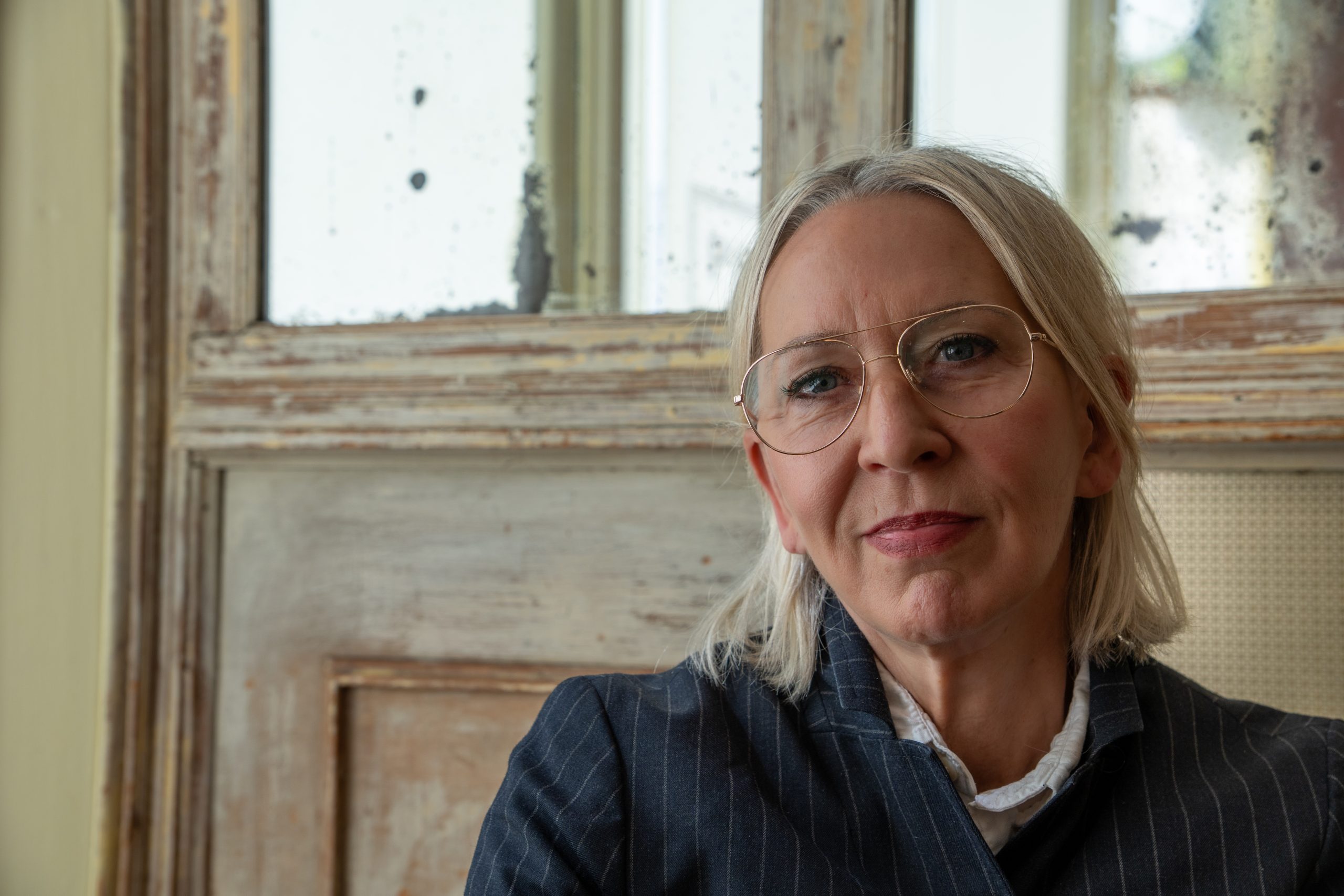
Gabrielle Hamilton always wanted to be a writer. She moved to New York City, supported herself in the catering world, and got an MFA in writing from University of Michigan, but in her twenties she never did manage to write a book. She took a hard left and went full-bore into the restaurant world, left her writing dreams behind, and opened her own restaurant called Prune.
Over a decade later, at the height of her restaurant’s success, her first book, a memoir called Blood, Bones & Butter (Random House, 2011), came out to universal acclaim and, frankly, this passionate and incisive book blew a lot of our minds. It was about food but it was about so much more. It was a New York Times Best Seller and went on to win a James Beard Award in the literary category. Lucky for us, her dual passions for food and writing were officially tangled up.
Her forthcoming and second memoir, Next of Kin, touches on some of the same themes as her first but also goes to different and darker places. After two of her siblings die, Hamilton starts to see her parents in a different light. With eloquence and anger and brutal clarity, she pulls the curtain back to systematically examine the dysfunction that has been there all along. Next of Kin, is a very moving, rhythmic, and beautifully written excavation of her family and patterns of behavior that she no longer wants to accept.
I was very honored to spend an hour with Hamilton over Zoom. We talked about incontrovertible truths, storytelling, and how cooking and writing are in the end quite complementary.
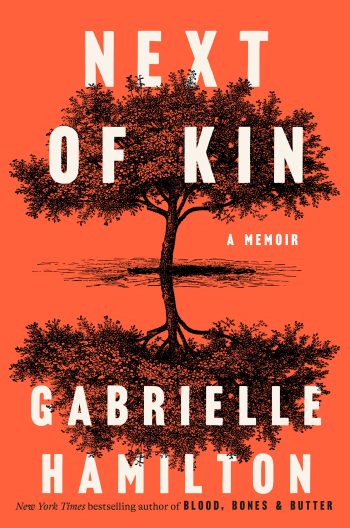
The Rumpus: I finished reading Next of Kin last night.
Gabrielle Hamilton: So it’s fresh!
Rumpus: Very fresh. And last night, I re-read the opening of Blood, Bones & Butter. There you all are, in the kitchen, your mom’s everpresent apron, the big table that you chopped and ate on, the flurry of activity. It’s all a bit romantic. Is it just me or is Next of Kin stripped of some of that romance?
Hamilton: You’re one hundred percent accurate. Blood, Bones & Butter is sort of the glowing moon of the family life and of everything that I was seduced by. It is all the front-facing beauty of this life, this family, this era. The lamb roast, sleeping out by the fire pit at night, all the kids giggling and farting in their sleeping bags, the lamb roast smoke, the French mother with her perfect eyeliner, the incredible and charming father. The book is all about my total infatuation and enamorment with that ethos and that time.
Rumpus: How did you approach writing Next of Kin? I certainly see flashes of Blood, Bones & Butter within Next of Kin but these familiar moments are somehow more somber, less shiny, from a different angle.
Hamilton: Well, too much saturation and enchantment can be perilous. Next of Kin is really the dark side of that moon, very scrupulous, realistic, flinty, clear-eyed. It’s the infrastructure, the architecture, the wooden plywood behind the scenery. It’s a look at the backstage cable that holds up the beautiful scenery and dappled sunlight on the front side. In this new book, the organizing event of Next of Kin is the suicide death of my oldest brother. And yet it’s not exactly his death that is examined. It’s sort of the circumstances that led to this incomprehensible death and the fact that it’s not the only death of a sibling in our family. I started to find that very suspicious and curious. Why are the parents winning and the children losing? Why are the kids dying and why are the parents apparently thriving? That’s why you don’t find any of the romance, the wood smoke, the eyeliner. It’s very backstage, makeup removed, smoke machine off. The house lights are up.
Rumpus: The book does have an element of mystery to it, as if you are collecting details, looking for answers. In fact you begin the book with your mother and her response to a phone call from a New York Times fact checker.
Hamilton: The fact-checking became a discipline when I worked at The New York Times for five years and now is ingrained in my body. It’s such a relief to not have to query one’s own memory, or its veracity and to just stick with the facts. The fact-checking at The New York Times used to feel so over-rigorous to me. You’re going to fact check my story about peanut butter custard? Really? But it turns out that, in fact, I had the name wrong or the year wrong so I really came to rely on it. Once you have your data it’s incontrovertible and it’s such a relaxing place from which to write. You’re just swinging back in your hammock with your arms behind your head, dozing peacefully, resting on the heavy lifting that the data provides for you.
Rumpus: It’s so comforting when no one can pick it all apart. It’s just truth. And I might add, very different from your father’s tendency to embellish in his storytelling.
Hamilton: Exactly and that’s why I open with the fact checker and carry it all the way through because I don’t want to rely on fiction or enhancement. I just want data. And I would like the data to speak for itself. And obviously, I’m structuring the sentences. I’m deciding what data to include and what to omit. There’s no delusion here that I’m not in control of the material and that I’m not manipulating you, the reader, in a certain regard. Obviously, I understand what the project of writing is. I had to stay hard and fast in the neutral data. I didn’t want to be really opinionated or condemning. I didn’t want to litigate the loss of these children and the quality of the parenting or the shortcomings of the era in which we were raised, the gestalt of the time being all about self-reliance and neglect. Maybe not neglect but children had a lot of independence that they don’t have now.
Rumpus: The ethos in your family is built on pulling up your bootstraps, sharp humor, and a wild kind of resilience. There’s a moment deep in the book when you realize the most serious afflictions you have seen in your family are crowded teeth and bushy eyebrows. It’s as if there was this whole veneer that was keeping you all moving along. When you finally start to see the more complete picture, the difficult truth about your family, was it a bit of a relief?
Hamilton: What I’ll say is this: there was no veneer. We are a hale and hardy bunch: a real soccer team, a family of self-reliant, very funny, witty, hard-working, sort of that old Protestant-y, stiff upper lip, super polite, well-mannered, all of those things. My observation is that we are not only those things and if we start to wholesale adopt that as our persona, as a group, it can lead to our own peril. Because at the same time we are also wounded and tender and fallible and we need help or community. I needed to get away from all of this and really explore a different way of writing and living.
Rumpus: When and how did you start exploring these different ways of being?
Hamilton: I can tell you exactly the point where it changed. It was when Todd, my first brother died and my father said: “Well, if you have to lose one, at least it’s the one you liked least.” And in the moment I kind of giggled because that is the kind of crap we were used to hearing all of our lives,that kind of straightforwardness. I admired it in a way. My father can take such scrupulous self-inventory that he can even discern which of the deaths of his own children is a better death. At the same time I felt this clench in my stomach and asked myself, “What is wrong with this picture?” And that’s ten years before the suicide death of Jeffrey. When Jeffrey killed himself, my dad left a message on my voicemail that said: “Well, that’s over,” as if some sort of fatal inevitability had arrived, as if it had been written and it must have had to have happened. It was the comment on his death and the sort of shrugging—as if the fates had intervened—that made me sit way the fuck up and pay very serious fucking attention to how I was raised and how I was living.
Rumpus: Your father used to say something along the lines of either you’re the best or you’re nothing, that second place doesn’t count. How did your father’s relationship with creativity, success, and mediocrity impact your artistic choices?
Hamilton: My father’s deal was that as a young man he really wanted to be a painter. He went to Yale, did some graduate work, and then went to RISD. And he felt vehemently, passionately, that the world does not need another mediocre painter. He self-selected out because he deemed himself mediocre. He knew he was not going to be a great painter and in his mind there was nothing in between. If you’re not going to be a great painter and make a massive contribution, then get the fuck out. I think that’s really valuable. I adhere to that, but I must say I don’t think I needed to hear that message as a child when I was exhibiting some talent as a writer. There were objective external signals for all five children that maybe we had some gifts that could be cultivated but my father crunched it all to mangled bits with his utter fear of being eclipsed by his own children and their talents. I wish he had been more in love with us and able to be proud of us both privately and personally. I’ve heard he was very proud of us in public at a dinner party where it does reflect very well on him to be the charming old man who lets a tear come down the corner of his eye as he’s talking about his children. But in private he was letting us know that we’re not as good and we never will be. I think that’s very confusing for children.
Rumpus: And yet you write that your father was one of your best teachers?
Hamilton: I admired his unrelenting ability to self-categorize as mediocre and then to take himself out of the game of painting altogether. So he went on to have a thirty-year career of industrial set design and I thought, “I’m gonna do that too.” I really wanted to be a writer my whole life. I showed some promise and some talent at a very young age. My second grade poem made it into a national poetry magazine along with all these other tiny little signals that you desperately need when you’re so young that give you encouragement. But I still was living with, “If I can’t be Hemingway, then I’ll be nothing.” And, so I opened a restaurant and fell back on a trade, exactly as my dad did, and I took the model to heart.
Rumpus: Did running a restaurant ever shift from feeling like a trade to something more artistic?
Hamilton: Eventually, yes. When I came back from graduate school with my MFA and I still found myself dicking around with my days and not writing the great American novel, I said a real final goodbye to this long-held dream and passion that I would be a writer and I opened Prune Restaurant. I’m not saying that was an easy day. I did have to lie down on the floor and bawl my brains out for quite a while. But having shed the tears and unlocked the doors, there was a profound energy available from not having such cleaved ambitions. All of that sort of looking over your shoulder thinking: “I should be a writer, but wait, I’m working a sixteen-hour day in the catering kitchen and oh, I want to be a writer but I’m going to go prep the lamb instead.” To have that jettisoned, suddenly, your cargo back there, your cargo van is a lot lighter, and you can really focus. It was so fun to get into Prune, to have an undivided heart, to put all of my energy into one thing. And I will say that inside Prune, I just sublimated all of my writing desires. When people talk about writing they will often say writers have a way with words. Obviously, it requires some wordsmithing. But as Ta-Nehisi Coates says: “Writing is thinking.” It reveals your thinking. And so, Prune became a place where a lot of thinking was happening. And it showed up on the plate, at the table, in the server, in the playlist, on the menu, in the sense of generosity and open-heartedness and play and joy that was in there.
Rumpus: Do writing, cooking, running a restaurant, and recipe development come from different parts of your brain or do they feel like they come from the same place?
Hamilton: They’re quite antidotal to each other. I’ve felt that for a long time. When the concerns of food and eating and cooking and managing feel too mundane, too quotidian, too day-in, day-out, sort of factory-like labor, I have loved turning to the page where you can occupy your mind on more thoughtful things and let your brain really run loose. Conversely, I’ve always loved coming into the restaurant at the end of a long writing day or in the morning after a despairing weekend of grappling with writing and the empty page, the human condition, all the crap that you’re trying to do as you write, and to have a healthy prep list that’s so easy to take down, so tangible.
Rumpus: It is so satisfying to finish something.
Hamilton: Yes, you get all that celery chopped and into a container, labeled, dated, and it feels like a victory. So I’ve loved them in concert with each other. I’ve been so glad to have both hustles; they’re both my jobs. I do notice that in writing, my hospitality impulses and my restaurant training show up. Weirdly, I would say my work in hospitality is one of the greatest influences on my writing.
Rumpus: In terms of organization and discipline?
Hamilton: No, in taking care of the reader.
Rumpus: Oh wow. I didn’t expect you to say that. Can you tell me more?
Hamilton: I’m not here to waste your time or your money. I’m not here to blow your mind, either. I don’t like reading books where you can feel the writer fiddling with you and admiring themselves as they manipulate the words on the page. I don’t love a self-congratulatory writer—you can sniff it on the page immediately—more than I like to sit down in a restaurant and be interrupted by the waiter, the chef, repeatedly, where you can’t ever eat your meal without their full instruction and interference. I really adhere to the school of, “You want to see the art, not the artist.” I should be receding and leaving you with a very, very delicious meal on the plate for you to enjoy. If we’re gonna carry this sort of food metaphor through, I’m going to anticipate what you want and need. I know I’m gonna take your jacket. I know you’re gonna be thirsty. I know you’ll like these crispy, crunchy things. I know you’re gonna want something interesting to eat, but not so esoteric that you can’t eat it, or that you’ll feel guilty if you mess up the arrangement on the plate.
Rumpus: How does the reader experience this hospitality?
Hamilton: As a writer, I want to take care of you, your time, your money, and your attention. You want a page turner, but you don’t want a beach read. There has to be enough on the plate, on the page, to chew, to savor, to enjoy. If it’s McDonald’s, you hate yourself later, you feel like you’ve just read a beach read book. But you can’t make the writing so dense that the reader can barely digest a paragraph. I want to take care of you and give you something great. Like when a chef comes and spends forty-five minutes tableside when you’re trying to have dinner with your husband, or your wife or your family, and I’m like, “Step away, man. This is not about you.” Same with the writer on the page, you have got to delete these grafs that are self-indulgent. Come on, have some discipline. Take care of your reader. You’ve got to put yourself aside. I know that many people, all of us maybe, have stories to tell. And I also know that very few of us were given the gifts of writing. Having a story and writing a story are two different things, and I take the job very seriously. I’m here to write mine, but I’m really here to write yours, and hopefully you’ll find yours in what I put on the page.