The Writing Workshop often administers this advice: a writer should never write about a tragic experience until it has passed. An experience too close to the surface of the writer’s present life would be too emotionally inaccurate, representative of only a narrow frame of one’s life at its most heightened moment. Only proper distance and time can resolve this tension, this advice tells us.
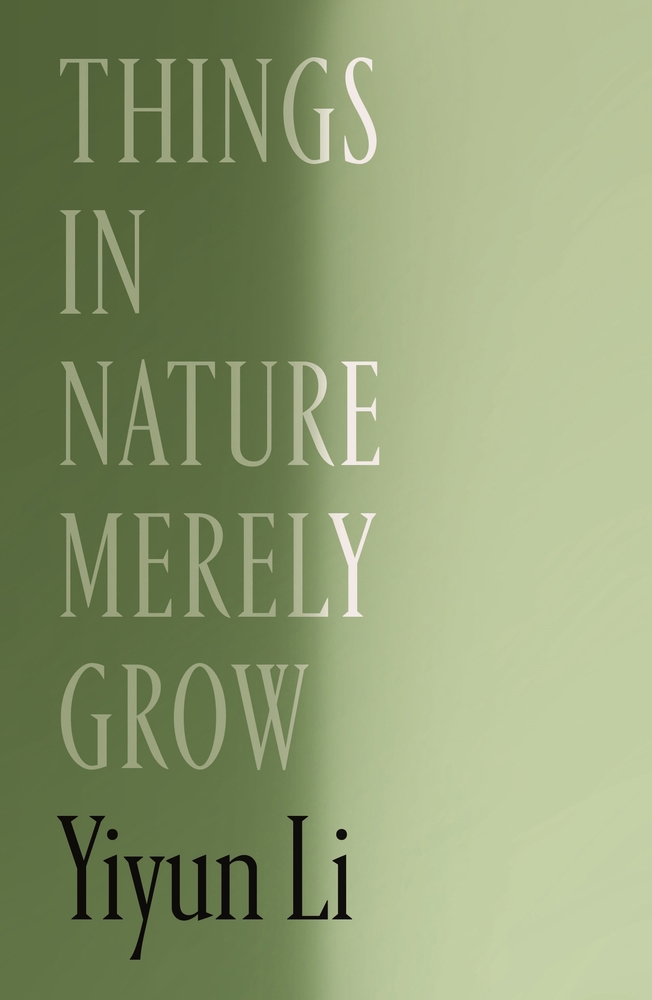
The problem: What if the tragedy has no end point? In Yiyun Li’s latest memoir Things in Nature Merely Grow, the author spurns the term “grief” and its attachment to endings. For Li, the definition of grief is tied to an eventual forgetting, some return to normalcy after departing the shadow of loss. Grief has become too easy of a word, too glib, a hasty naming of a probable end to something that provokes discomfort for those witnessing it at a distance but which the mourner herself will carry for the rest of her life.
As a writer who contends with grief regularly in my own work, Li’s memoir possesses a surprising clarity around the topic of loss that may be startling to those who anticipate it to have a more overly emotional shape. It is Li’s unflinching look at not-grief, what she instead calls the “abyss” (in which “grief is not given a place by design”), that drives the memoir, following several books now (Dear Friend, from My Life I Write to You in Your Life, Where Reasons End) that similarly grapple with suicidality, death, and loss—her own, first her son Vincent, and now her son James. Li describes Things in Nature Merely Grow as a book for James, just as Where Reasons End was a book for Vincent. The abyss is the setting in which we begin and end, an author’s confession that she cannot provide any answers as to how to grapple with not just one loss but the death of now two sons:
This book is about life’s extremities, about facts and logic, written from a particularly abysmal place where no parent would want to be. This book will neither ask the questions you may want me to ask nor provide the closure you may expect the book to offer.
The book proceeds to live up to this statement’s promise of uncertainty, its persistent questions, and its quiet despair. Perhaps it is this frankness that prepares readers like myself to enter into the abyss with her, an invitation to witness rather than project upon or borrow her experiences of loss. While some may find this role of observer to be far too removed from the subject of loss for their comfort, I find myself deeply aligned with Li’s belief that the feeling of loss has no end, and where despair lives in the end of a life as well as the record of that very life.
What, indeed, does it mean to write a book for a child following the loss of another? On February 17, 2024, James Li, son of author Yiyun Li, died by suicide, remembered by his fellow Princeton classmates and teachers in The Daily Princetonian as having “the capacity for being very profound” and “unparalleled wit” as well as being a “shy and kind student.” In Things in Nature Merely Grow, Li commends this reportage as she considers the task of writing her own words for James and the understandable difficulty of doing so. In contrast to Vincent whose exuberance and love of added flourish in his prose (“Adjectives and adverbs are my guilty pleasure!” he once charmingly declared), Li describes James as more reserved and selective with his words, motivated by logic whereas his older brother leaned towards the kind of bigness and color abstraction affords. And so, a memoir for James must match the orderliness with which the young man approached his life; the memoir resembles an inventory of a life told through a series of short essays reflecting upon themes of time, nature, literature and the weight of words, and the relationship between a mother and child.
Known for her precise style of writing, Li’s emotional sharpness and economy of language in Things in Nature Merely Grow performs an even greater acuity in voice that reproaches critics who desire more sanitized descriptions of death and suicide or who unfairly apply moralistic views of such on her and her sons’ passing. Li describes the public despisal of her use of the word “die” when she talks about the deaths in her life, “(especially in China)… equating this linguistic decision to coldheartedness or evil.” She even remarks that other parents are so uncomfortable about Vincent’s suicide that they have requested permission from her to lie to their children and say that he died in an accident instead. This bypassing of the truth, Li argues, “can be the beginning of cruelty and injustice.”
In the chapter “Minor Comedies—for James,” Li shares her unfortunate familiarity with critiques of her work and circumstances, from Chinese and American critics alike, whose horrendous remarks range from gleeful celebrations of Li’s children’s deaths as some twisted divine punishment for having abandoned her home country of China to write in English to the charge that she has abandoned her children for a lavish lifestyle abroad (“to the giddy tabloids who called me the murderer and the killer of my children; to the trolls who fabricated sensational stories about my life (apparently, I often abandoned my children for a glittering high society in Europe”). The chapter reads as a bleak list of injuries that Li has suffered, turning such accusations into a darkly humorous look at the ways in which others may turn someone else’s tragedy into an opportunistic occasion for self-promotion–a father writes with a proposal to send his daughter to Li’s house to serenade her with her violin in the hopes that she may grease the wheels of the Princeton admission office; a writer she does not know offers to dedicate her book to her after sending an unsolicited manuscript with a request to find a publisher. The litany of minor comedies goes on. Though hardly a comedy at first glance, the chapter illustrates the author’s refusal to perform a sentimentality that the public seems to demand from her, turning the lens instead to the ways in which others seek to exploit James’s death and turn her losses into sensationalized gossip. I marvel at the bluntness of her accounts of these transgressive moments, usually abandoned in favor of softer remembrances of those lost. And then again, what could be a better balm for a writer, exhausted at being a vessel for disingenuous acts of sympathy, than to turn these occasions into a roast? .
One of the challenges that Things in Nature Merely Grow takes on is the unachievable appeasement of reader expectation. This book is not a guide for those who have lost a child or other loved one through suicide. A review from Kirkus Review notes that though the book is “elegantly written and deeply thought through… [it offers] little comfort for those who may be experiencing similar travails.” What is lost in this type of commentary is the incredible insight and autonomy with which Li regards her children’s lives and deaths, where her children’s choices around how they live and choose to die belong to them. There is no directive for the reader or offer of any judgment about suicide, only that in response to her most recent loss of James, “A book is a placeholder, no more, no less.” Li seems acutely aware that to comb through the reasons as to why, to assign blame to oneself or others, to offer herself anything but “radical acceptance” would be to move farther from the subject of James, whose essence she has tried to the best of her ability to capture in these pages.
The lack of judgment with which Li approaches James’s suicide in Things in Nature Merely Grow may unnerve readers who interpret this tone as unemotional or lacking in vulnerability, but it would be a failure to not see the young man portrayed in this book—a lover of philosophy and classical literature, from Wittgenstein to Camus, interests which Li shares and which allows her to revisit the same passages he has read in search of the illuminations he would have discovered in those pages. He was shy, mysterious to even his own mother, but nevertheless, Li offers no blame or anger but only facts:
That a mother can do all things humanly possible for her children and yet cannot keep them alive—this is a fact that eschews any adjective.
Children die, and parents go on living—this, too, is a fact that defies all adjectives.
For a son who prefers the sparseness of words (“James would not like a book written from feelings”), these statements will have to suffice for the reader. Read as a parent’s final gift to their child, this stylistic choice is as achingly devastating as the content of loss itself.
Side by side this exploration of James’s life and death is also a lesson in gardening, a pastime which serves as a similar placeholder for Li’s children’s passing as the books have done, where “Writing a sentence again and again until it feels right” and “Comparing the hues and scents of two roses on the same branch” bear the same weight in marking time. It is Li’s friend William Trevor who advises her to start a garden as it “takes up what time there is.” This advice would come in handy for Li’s navigation of the loss of her two sons. While Li makes clear that the garden is not a symbol for an eventual path to recovery, but every seed and bulb is a placeholder:
My garden is not a metaphor for hope or regeneration, the flowers are never tasked to be the heralds for brightness and optimism. Things in nature merely grow. There is no suicidal or angry rose, there is no depressed or rebellious lily. Plants have but one goal: to live. In order to live they grow when they can, and go into dormancy if needed. They live until they die—and either they die as destined by nature or are cut down by other elements in nature. A garden is a placeholder. Flowers are placeholders.
In this passage where the title of the book is the same as its central argument, “Things in nature merely grow” indicates the futility of compulsory hope. The only consolations live within the garden, the flower, and the understanding that every living being lives and dies. Readers may consider this despairing, and in a sense, it is. But for those who have known what it means to lose a loved one and cannot escape its grasp in the abyss, this message merely stands true. What kind of radical acceptance might we lean into if we too can honor every being’s impulse to live or die? What if death’s inevitability is not something we turn away from in fear but which we accept as part of our contract with life itself?
I wonder about the books I would write for the people I have loved and lost, what wild shapes they may take to match the hole that their absence has left in my life. The truth is that these books are unwritten for a reason and will probably remain so for some time. The arduous task of painting an emotionally clear portrait of a life that has passed, akin to finding a book’s shape, will always come up short. Li seems to know this challenge intimately, and her attempt to write it anyway resonates as a lesson about the sharpness of attention that only a proximity to death and dying can offer in its inconsolable clarity.
These are the provocations of this book, which fulfills its commitment to a lack of closure, offering in its end, the final image of absence—a mother and child as two hands, and then one day, a hand finds itself pressing against an absence, the other hand no longer there to hold it. Instead, this hand grasps “everything and nothing that is called now and now and now and now,” or the weight of the present and where the losses never diminish in size. How indeterminable, this abyss. Yet what else could anyone say but that the bottomless cavern feels fitting for the magnitude of this loss? That as a reader, we have no choice but to hold a mirror to ourselves, the abysses in which we cultivate our loneliness, and which, we too, try to survive. This is not a book that offers consolation, but it does ask us to expand our capacity to challenge the social discomfort with the subjects of death and suicide, to stare into those places where we can see our humanity laid bare.