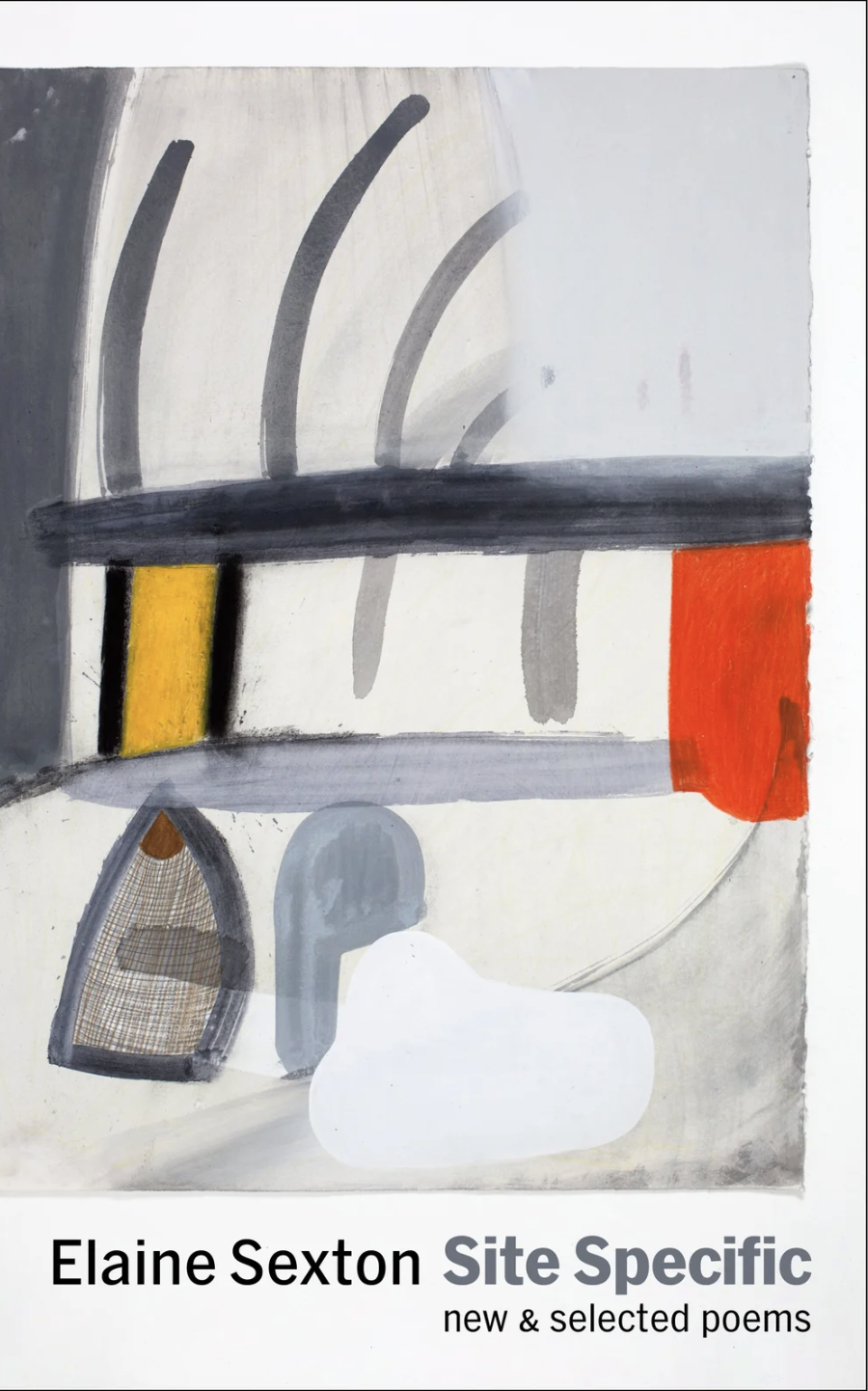
Elaine Sexton is a poet of swift, clarifying observation. She employs a sweeping visual sense of movement and frequently uses the notions of direction and indirection, foreground and background, to express her life’s journey. Juxtaposing the specific details of place and present with the inferred and unclear feelings from her past, her poems are driven by a fluid and assured trajectory. But we are also exposed to her frequent navigational pauses and questioning. The world at large is a place of passing light, landscape, and colorful scenery. The work hurries forward at an everyday, leisurely pace, before slowing, sometimes even stopping altogether. She can back up, take a side trip to the past, before speeding onward. Meandering, or negotiating tight curves in her present moment, Sexton finds herself constantly glancing in the rearview mirror to the past. She shares with us her disorientations, her panic over having misplaced the coordinates of old losses, newer love, and the failing certainties of this suddenly frightening, modern world. She reveals to us the profound confusion and sorrow when our older selves forget the familiar way home.
The road, the car, the driver, and the passing country landscape all function as symbolic lodestars for Sexton’s poetic imagination. Her poems can zigzag through the everyday and persuade you to join her at some sudden highway wayside. Tender attention to nature’s visual details melds with intimate reflections on distant memories or concerns about an ecologically threatened world.
One minute we are on a coastal road; the next we share quiet thoughts in a country house, while looking at an old screen door which conjures up temporal family memories. At another moment we are watching a jet trail high above in the sky, aware of the encroaching modern and complex world nearby. Dabs of descriptive language about her life on the scenic shores of the North Fork of Long Island can bring her into ekphrastic communion with John Marin’s painting Small Point, Maine. She speaks of her everyday with quizzical concern. Her world is constantly in motion yet capable of sudden stillness. She can write meditatively about a screen door, an incandescent light bulb, or even a dental cleaning. In her poem “When It’s Good to Stop Talking,” she, tongue in cheek describes sitting in a dentist’s chair, under the influence of anesthesia, while sharing a daydream. From this mundane reverie she resolves worries about life and death, personal loss, and manages to solve the question of world peace. She writes:
			I solved all the problems, all
			The road blocks

			To world peace, yesterday, while
			Under the influence

			At the dentist. And not
			For  the first time I can’t  remember

			How, but the bliss of it remains
			Keen. I was changing

			The world as the surly hygienist
			Informed me she would be

			Putting a bridge
			In my mouth.. . .
Her humor and tenderness here end with that funny double entendre of the literal “dental bridge” being figuratively compared with a “bridge to world peace” or a “bridge over troubled water.”
Sexton’s range of feeling moves from cleverness to lyric moments of sensual recall, as when she’s “stroking the silky, slender strands of a memory” in her lover’s hair, while preparing for an evening meal.
Her facility for poetic language is effortless. Short line lengths are offset by smart and skillful line breaks. Her stanzas vary in form, some syllabic, all rhythmically regular and reflective of an assured technique. She is adept at recovering snatches of autobiographical details and offering moments of quiet epiphany.
Sexton is the wonderful intimate “friend” we would most love to spend our days with, sharing conversation and blithe optimism, warm truths and common life sorrows. In her ars poetica entitled “Poetry,” Sexton blends familiar themes and strategies. She opens with a scene of sunlight, nature, and a path off a road.
She writes:

When the air is this soft, when insects and
Birds are the soundtrack, when your skin is
dried salt from the sea, and your clothes are
strung out on a line in a yard whose
path to the road is familiar and
empty and open to an ocean you hear but
can’t see, whose wash is alive with
a friend who is dead, and has yet to confess
he will ever be otherwise, whose voice
keeps your grieving at bay, for the heart that keeps
breaking is yours, as the past co-exists with
the present . . .

This  blending of a domestic outdoor scene  with the invisible sounds of the sea  in the distance is a typical device in  Sexton’s work. It is as though the rhythms and mysteries of life and nature, of pristine solitude, are ever present, reminding her of the eternal vicissitudes of time and place, present and past. This is put so succinctly in her phrase “the past co-exists with the present.” This idea of coexistence and simultaneity is a constant in Sexton’s poetry. Life is a lovely observation, watching  the vista ahead while remaining  conscious of the receding past and the attempt to keep our grief at bay, our darker thoughts far behind.
She speaks later in her poem of a “stand-alone moment” where she feels safe. It’s a place where no one she knows “is suffering, or dying, or trying to” and the “intimate weather is real” and “untethered,” to “a place where your heart and the heart you once / broke forgives you, and retreats to, after”
exposing themselves like roadkill,
whose corpse threatens to upstage what
surrounds it, where you discover how
culpable and capable of cruelty
you can be, or have been, but also of practicing its
opposite, where time is now animate
and exceptional, but also reliably
unaccountably unkind.
Sexton resides in the liminal spaces between an unaccountable and unkind time, and a time that is animate and exceptionally beautiful. She indeed sees fate as mercurial, much like the weather: delightful in its pleasant moments yet ever aware of the cruelty of past personal weaknesses, blind indifference, time wasted, and the petty grievances perhaps toward family members long gone.
Three of my favorite poems are newer ones, though all the poems in this collection, old and new, promise surprising discoveries and unique, unflagging language. “Mother in a Box” opens with an arresting line that suggests a casket, the mind’s bony casing, and also the constricting psychological box of maternal influence and imprinting that any daughter might experience:
There’s always room for the mother. She contains multitudes.
          She is the shape we make when we mark pages
                   And paint, our complaints framed
                           By all that came before, before her mother, and her
          Mother before her . . .

Again she describes a setting where she can taste the sea air that she cannot see:

But hear, touching salt air, the sun framed by
          Clothes lines, alive in mosquitoes, singing
                   And stinging in a box
                         Which is slab, and tendency, which is memory, and
                                                                Cemetery.

This agile shift from concrete image to abstract idea, to metaphor and back to concrete imagery is handled with such aplomb and fineness of thought,  while remaining  so sonically interconnected as to amplify the moving rhyme of “singing” with “stinging.” This echo continues in “tendency,” “memory,” and “cemetery.” Sexton is able to achieve the best qualities of poetry through her use of compression and sonic transformation.
“Screen Door,” the second poem, contains sensory details transformed into metaphor: the screen door here reflects both bothan inner and an outward function, showing present, past, and future as though joined as one , gently swinging open and closing with age. The door, like memory itself, presents the aging, battered mind, still showing its former resiliency, which entertains both entrances or exits in a long life. She begins by saying: “I can’t stop hearing and touching its/ splintering and yawning/ its mothering, its calling its bang.” With the alacrity of Wallace Stevens and his poem “Snowman” or Carlos Williams’s “The Red Wheelbarrow,” Sexton is able to seize upon a single image to expose difficult thoughts on life, on perception, and apperception. She’s ever aware of the mind’s powerful capacity to link everyday objects and outer reality with the inner mind’s experience, forever caught between life and mortality, the animate and the inanimate, living and nothingness, agency and final loss. She finishes:
Its weeping its mind never
Satisfied its roads diverging in a
Wood its spine its sunshine
Of later afternoon its doing
What it says it is going to do
The way it paints its own way
Its draw its draft
Its closing and not closing
Its back door its back
To everything overgrown grass
On the other side of
Its wrist its small knob
Its metal its morning
It’s always very early morning
Her reach as a poet is broad, and she draws from many artists. I have not offered many examples of this in her collection, but a third favorite Sexton poem of mine is “3 a.m.” The poem is an homage to Charles Simic. Sexton ably captures Simic’s playful style, where inanimate objects or concepts are made animate and personified, to serve as slippery metaphors and ironic, surreal fables. The poem describes the elusive character of sleep, especially for one who badly needs more of it. She writes: “Sleep is frisky and fretful, illusive/ and smooth. And withholding.” And when she most asks for “sleep’s favor in return,” sleep apparently offers “nothing.” In the end, sleep “runs and runs, it runs/ a wild streak,” as though it were dashing in the dark “chasing rabbits, chasing sheep.”
As I’ve said, a Sexton poem drives us forward as actively as our mind’s constant consciousness. We find ourselves sometimes in midjourney, where grief for her dying brother, thoughts of her mother’s hard work and creativity, or an unsatisfying walk through Rome, where nostalgia for the past must meet with the hard present, all flash by. She is ever processing her world, bound to its natural beauty, its seacoasts and night ferries, its roadside pullovers, to enjoy stillness, take in the breeze, or draw in that lengthy breath. You will enjoy this collection. Spending an hour or two or even a few minutes with Sexton is a delight, a wonder, where you can sit back and enjoy the ride with a most capable driver.