For the past eight years, although it is the land of Wabanaki Indigenous tribes on Turtle Island, I have been living in what is now called Maine in the United States. Common refrains for people of color like me–even for people of color who have lived in Maine their whole lives–are “Where are you from?” and “How long have you lived here?” in a predominantly white state, where only fifty percent of its residents live here full time, and where immigrants of the global majority are referred to as “New Mainers” while white immigrants aren’t. Maine and most of the New England area is referred to as “LGBTQ+ friendly,” which is what supported me in coming out as queer and nonbinary.
For Gaar Adams, a white queer journalist from the Midwest, being asked “How many years here?” as a standard question while living in the United Arab Emirates–an area of the world where the majority of its residents are non-citizens– “tinged with a deeper question, a challenge” when it comes from fellow queer people: “How well have you done to make your way here” in an area of the world where LGBTQ+ identities, sexual activities, and nontraditional gender expressions are illegal.
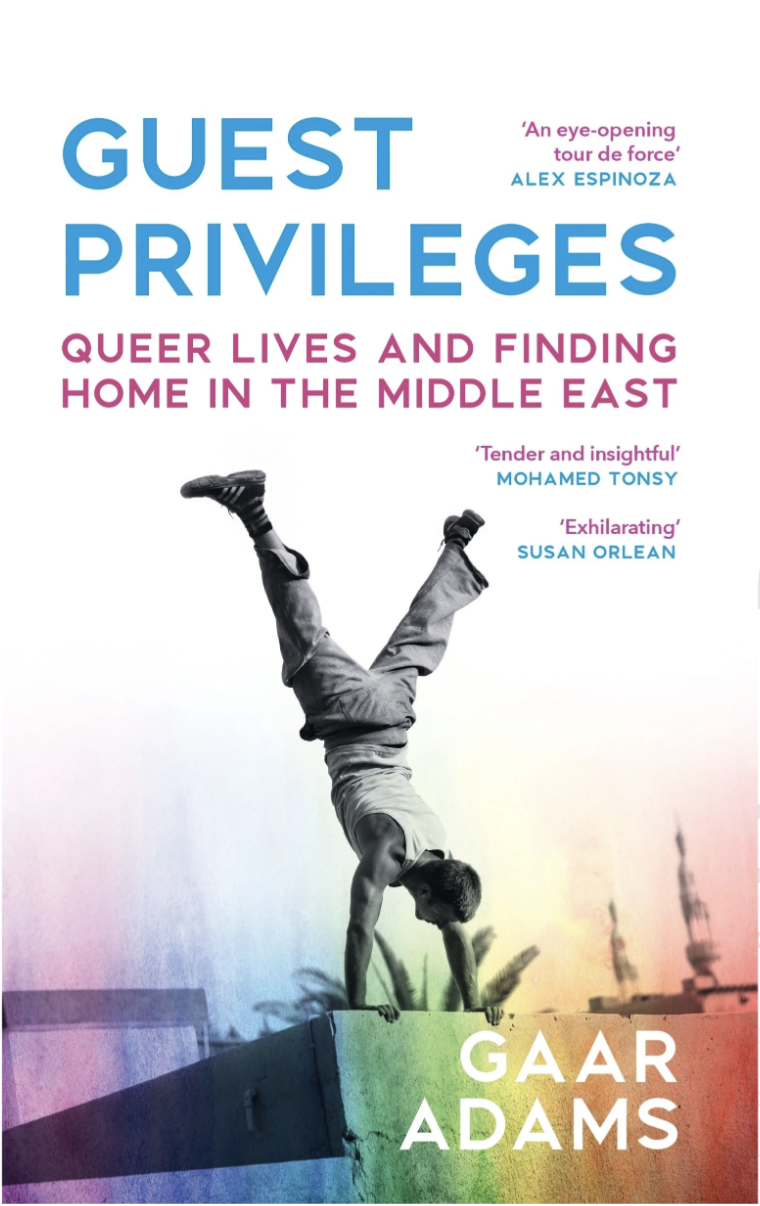
Guest Privileges is an admirable account of Adams’ ten years in the Gulf unpacking how queer and trans people are able to live, survive, and find belonging in a region of the world Westerners deem as “impossible.”
“I had seen how both migrating to this place where queerness was illegal and yet living a life of queerness there were viable modes of operating” .
Adams tackles that common notion along with his own biases around “Isn’t it harder there?” . My favorite example is how Adams thought the first person he met, Imran–an Iranian ice skater–was attempting to flirt with him because he’d read about straight couples leaving their phone numbers in purses or bags to covertly connect; Imran simply wanted to connect Adams to fellow queer men in the area. Regardless of where you are in the world, it is hard being a member of the LGBTQ+ community; but simultaneously apparent the LGBTQ+ community is everywhere. Which is why, no matter how many external systems try to erase this community, it is not disappearing anytime soon.
I appreciate how Adams addresses the diversity of life for the queer and trans people he talks to in the UAE without ignoring the privileges of living in the West. The only resources for coupled “expats” in the UAE are for cisgender heterosexual military couples, and the only resources on LGBTQ+ life and travel in most travel guides is about illegality as a way to tell its readers “avoid these countries altogether” . One common pattern Adams finds in his conversations with queer and trans people in the Gulf is how subversions of traditional gender roles, class roles, and what is considered illegal is used to their advantage.
Reggie, a singer and drag performer for a karaoke bar, is able to perform his queer musical act because the UAE has a law forbidding audience members from engaging with performers onstage and vice versa.
Shivani, a third culture kid studying to be a teacher, lives with her girlfriend Yasmine because, while on paper, they each live with their parents, in their apartment they live as gal pals. They cause“double trouble” of living as a queer couple and living as an unmarried couple because they “know how to work the system.” It helps that it’s more socially acceptable for women to hold hands and show affection towards one another.
Marie, a Filipino trans bakla (a Filipino term to describe someone of a third gender or someone who is gender expansive) who works in a salon, is able to make money in both “male” salons and “female” salons thanks to his gender nonconformity. Marie is in a group chat with fellow baklas who want to move to Abu Dhabi to do the same work. Again, Adams confronts his own biases on “shifting identifiers” for trans people in the region; they are “subverting not just UAE laws but [Adams’] own attempts at trying to classify and categorize him by my expectations in the LGBTQ+ community.” As someone who works with incarcerated trans people in Maine, where expectations are always ever shifting for them in the politics of fugitivity and identity, this resonated with me.
Although I didn’t like his use of the word “model minority” to describe himself, (since it is often a term used for Asian immigrant communities) , I value Adams’attention to the difference between queer racialized people and queer white people–especially touring queer white men–making space for themselves in the Gulf. He even ventures into the historical context of “gay American men of independent wealth” often taking advantage of The Middle East as a “utopia” for their privilege. Citing them taking advantage of party space, taking advantage of Brown bodies without consent, and more.
While attending a UAE concert of the publicly-known queer band Scissor Sisters, Adams’notes his surprise that, while the majority of attendees were white and dressed more “conservative” than at a typical queer concert, Jake Shears, the band’s lead, , never mentions queerness.. This is where Adams meets his current husband, Sunil–a South Asian man from Australia.After the concert, they head to Reggie’s karaoke bar, where the majority of their fellow attendees were, thankfully, Brown men in non-Western clothing.
One of the most intriguing parts of this memoir/journalistic undertaking is the analysis of queer marriage, infidelity, and cruising. When Adams first moved to the UAE, he was partnered with an American white man named James. They met in college in New York, then both proceeded to get education jobs in the UAE. While Adams, regardless of the risk, wanted to explore as much of his surroundings as possible, James, because of the risk, wanted them to stay inside as much as possible. After two years of living together, James chose to leave and relocate back to the U.S. while Adams chose to stay. I’m sure it didn’t help that Adams would leave James in the evenings to cruise.
Cruising intersects with infidelity not just for the author, but for many men seeking simultaneous public and private affection, because of what is not allowed in the light of day. The author seeks a partner with shared goals. For the people the author talks to–including those he has acted as a lookout for or an extra willing participant with–it could be shared identity, it could be an escape from a traditional heterosexual marriage/family structure, or the “less apparent [is] the notion of knowledge and trust [amongst all the men involved].” Adams doesn’t judge himself nor the people he has chosen to converse with and engage with over time. This challenged me in my own judgement of infidelity and how it attracts heightened scrutiny through a queer lens.
When Adams and Sunil finally begin their relationship, they share the same valuation of community, regardless of risk. However, there is more to unpack after Sunil proposes to Adams while in Australia. Adams’ acceptance triggers a move away from the UAE. They are fortunate in their ability to relocate, owing this freedom to Sunil landing a job in the UK and same-sex marriage being legal there. Adams was “bothered by the seemingly inherent inequity of the act of marriage” because of the afforded privileges marriage allows even though not everyone in the world wants to or can get married.
Even with these privileges in different contexts, there is a period of adjustment. Adams writes, “Even in places where LGBTQ+ rights were more enshrined, it would still take us days before we began to publicly express any affection. To refrain from doing so was the reality we lived and knew.” While searching for wedding venues in the U.S., navigating a restaurant bathroom with the blaring news of Trump’s trans military ban in the background, “It was the kind of quick calculation of perceived and real danger that I’d been doing all my life, not just in the UAE, but also here, since I was young, in this place that was supposed to be home.”
It truly perplexes me how surprised the author is every time queer people are eager to talk to him and invite him into their spaces. My first mission moving to Maine: finding Black people, queer people, and trans people. And I did. And I do. Our people are able to see each other; especially when we’re purposefully seeking each other out in the most conspicuously covert of spaces.
It’s beautiful how the shared experience of queerness and migration was able to make Adams’ten years of learning and discovery so impactful. To interrogate whiteness and migration is always important, and I’m glad the writer has that sense of awareness virtually throughout this book. To witness the bureaucracy and legalities that don’t stop queer and trans people from simply existing is a witnessing worth entering into.