
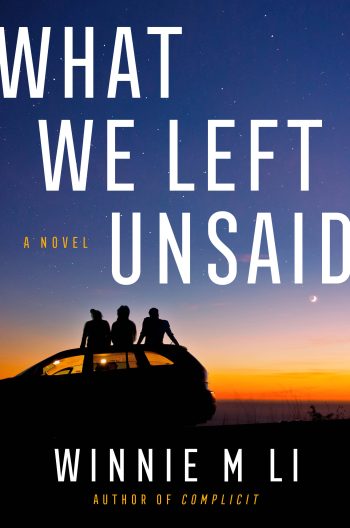
In 1991, a traumatic incident at a gas station outside the Grand Canyon leaves the Chu family with a wound that goes unhealed and unspoken about for decades. Winnie M. Li’s latest novel What We Left Unsaid is a novel exploring the lives of three adult siblings as they contend with a hidden history of personal violence that’s mirrored in the American landscape around them.
Li’s first novel, Dark Chapter (Polis Books, 2017), was nominated for an Edgar Award and translated into ten languages, followed by the critically acclaimed Complicit (ATRIA/Emily Bestler Books, 2023). A departure from her previous crime novels, her latest work follows the experiences of Asian American siblings who decide to drive America’s historic Route 66. Along the way, they’re forced to confront differences in their income level, genders, and political views, as well as their relationship to their family and childhoods—including the secret that’s been driving a wedge in the family for years.
I spoke with Li over Zoom to discuss what compelled her to write a road trip novel, the history of Route 66 and racial violence in America, her approach to mapping plot points onto landscapes, and her research process, which included driving Route 66 with her young child shortly after the COVID-19 pandemic. This interview has been edited for length and clarity.
The Rumpus: This book follows three Asian American siblings—Alex, Kevin, and Bonnie—as they take a road trip along Route 66. Can you talk about how you first conceived of this book, and what intrigued you about writing about adult siblings in particular?
Winnie M. Li: I think I came up with the idea for the novel to give myself an excuse to drive Route 66. That was one element to it. Then I asked, “If I’m going to write a road trip, who’s going to go on it?” That’s where the estranged adult siblings came into play. I’m an American expat, and a number of my friends who are also American expats had drifted from their own siblings over politics. These people no longer felt they could connect with their brothers or cousins because they voted for Trump, and I wanted to look at that. I wanted to write a book taking three adult siblings who ostensibly have something in common, but at this point in their lives don’t. They’re forced to spend time together for six days driving through a kind of foreign country to them, and that’s going to force them to address their issues.
Rumpus: Why did you set the novel along Route 66?
Li: There probably isn’t a road in America that’s as iconic as Route 66 in the cultural imagination. Initially, you had people from Oklahoma traveling Route 66 to get to California, which is in The Grapes of Wrath. In the history of Route 66, there’s an embedded narrative of moving westward to achieve the American dream, even though a lot of Okies got to California and were turned away at the border. You had people from America not being allowed into California, which is an interesting reflection of our conversations about borders today.
A few decades later, it was built up as a tourist enterprise. Pop culture songs came out about Route 66. It built up its own mythos, and I wanted to look at that. Broadly, the book is about trying to explore this myth of America and the stories that we tell ourselves or America tells itself about the country that we are.
Rumpus: There’s a point at which one of the siblings muses that even when on vacation, people “flock to their own tribe.” Do you think this would be true even if America was safer for people of color and other marginalized groups or do people just always crave what’s familiar?
Li: Some of us are more home-oriented and seek out the familiar, but that can be weaponized in quite dangerous ways, and I think we need to be critical of narratives around who belongs or who your people are versus who they aren’t.
I think people have certain natural inclinations in terms of whether they seek the familiar or like to strike out. In the novel, Alex is the sibling who always wants to venture into uncharted territory. As someone who’s more like Alex, I’m always in favor of speaking to new people or exploring new territory, but a lot of people don’t like to travel because of the danger of setting foot into the unknown. For me, I find it quite thrilling to be in a new place.
Rumpus: In one scene, the characters visit a museum about Route 66’s history in Texas, and they observe that the museum presents a “version of America where people of color don’t exist.” The characters seem to encounter that image of America throughout the novel.
Li: It’s a vision of America we’ve all been fed, regardless of our demographics. When Alex goes to Branson, Missouri, she sees a vision of America that has no place for her as an Asian American lesbian. Bonnie, Alex’s older sibling, married into that vision. She’s married into a New England, highly-educated, elite family, and she doesn’t necessarily see that as being problematic, but she also knows she’s lost part of her own heritage as well. For so long, we’ve been fed this idea that the greatest part of America is the fact that a certain demographic is allowed to chase the American dream.
When I was going to Route 66 museums, I saw there was only a certain kind of person driving Route 66. We see that in classic road trip narratives in which predominantly white men get to crisscross the country seeking glory and adventure. They get to know the people without feeling threatened physically, or like they’re out of place. I wanted to write something that challenges that from the perspective of people of color.
Rumpus: As I read about the racial terror that the characters experience along Route 66, I thought about sun down towns, which banned Black people after dark and made it almost impossible for Black travelers to find a place to stay along Route 66. In fact, there are a lot of references in the book to the racialized violence that Black Americans experienced during the Jim Crow era. These insights tend to be told from Alex’s perspective, who is married to a Black woman and often compares the Asian American experience and the Black experience. I’m curious if you can talk more about those similarities and differences.
Li: Each minority community has its own struggle against white hegemony, but we’re often blind to those other struggles, and we’re only concerned about our own injustices. This comes up in a scene in which Kevin asks Alex, “Why do you care about Black Lives Matter?” This is before Kevin knows that Alex is married to a Black woman, but Alex realizes there’s a certain hypocrisy in the fact that she only started caring about the Black American experience after getting married to a Black woman.
I don’t want to speak out of turn, but there’s a racial hierarchy in the Asian American imagination in terms of who we want to assimilate into. I wanted to acknowledge prejudice within Asian American communities towards other minorities and probably vice versa in different ways, but I’m not writing from those other perspectives. There’s all these different forms of injustice out there. Obviously, Asian American people haven’t faced the same level of physical violence in comparison to Black communities. But there were Chinese railroad workers whose bodies and labor were exploited and treated as disposable, and there were Japanese internment camps. All these histories need to be acknowledged.
Asian Americans are not often seen as troublemakers. We’re not seen as being physically dangerous, but that often leads to a sense that you can walk all over Asian Americans or you can take advantage of them economically. I’ve certainly noticed older Asian American generations who just don’t want to put up a fight. There are different cultural reactions between the generations in terms of how much of this injustice we’re going to be okay with, how much of it is to be expected when you immigrate to a new place, and how much we’re going to speak up about it.
Rumpus: In your acknowledgements, you wrote about the book being informed by a three-week road trip you took shortly after the pandemic. Can you talk about that experience and what you learned during that trip that helped inform the novel?
Li: I had a child quite late. I was 41 when I finally gave birth. To some extent, I was maybe trying to reclaim my ability to travel despite being a mother in the midst of COVID. I pitched it to my partner, and I was like, “Well, we could fly to Chicago and rent a car, and then we could drive to see my parents in LA by driving Route 66.” He was like, “Are you crazy?” I was like, “What do you mean? It’s totally possible.” This tends to be the dynamic in our relationship.
I’m used to traveling, but I’d never driven for three weeks on the road. My partner didn’t have a driver’s license at the time because he grew up in London. I was doing all the driving, which was stressful because I wasn’t the most confident driver at the time. We had a 22-month-old and he was still sleeping a fair amount. So, I was like, “Okay, if we just plan the driving so that it coincides with his nap, then he’ll get 2-to-3 hour naps in the car, and that’s fine.”
We did it, and it was great. We didn’t really explore night life very much. There were museums we couldn’t go to because our child was sleeping, but it was enough to get a sense of the landscape. My partner had never seen the Grand Canyon, so when I pitched the idea to him, he was like, “Oh, I’ve always wanted to see the Grand Canyon.” I can’t remember if I then decided to make it the climax in the book, but I didn’t really have a plot worked out yet. I had to do the drive first, and then I figured out the plot.
Rumpus: Were there other forms of research you did to write this novel?
Li: One fruitful book was Blue Highways by William Least Heat-Moon, which is a non-fiction travel log written in the early ’80s. Taking only two-lane highways, he basically drove as far on the perimeter of America as he could. It’s a fascinating glimpse of these out-of-the-way places in America that maybe don’t exist in the same way anymore. Rain Man and Little Miss Sunshine were two big influences in terms of road trip movies that had fractured families going on a road trip, but again, those were all white main characters.
In my book, I wanted every road stop to mark a shift in the dynamic between the siblings, but I didn’t find that many books that mapped the emotional journey onto the physical journey. They had specific places where certain revelations happen, but the revelations weren’t tied to the history of those places.
Rumpus: Did you map those plot points to the geographic locations in advance?
Li: I don’t really tend to plan too far in advance. The first draft of the novel actually didn’t have the past story line. My editors were like, “Oh, you should create a dual timeline to create some tension.” I was like, “Okay, I’ll have this thing in 1991 that happens in the Grand Canyon.” So, I knew everything was building up towards the Grand Canyon.
I wanted a big climax where all the siblings get to show off their different skills, but I didn’t plan out all the other stuff until I was writing the book. After the first draft, I was like, “Okay, what’s going to be the midpoint? Where does this act end and this act begin?” I had to figure out at what point Kevin would have his dark night of the soul in Tucumcari. It was a combination of tweaking and trying to move plot points, pinning them onto geographic spaces.
Rumpus: You noted that this book was written “under contract” in your acknowledgements. Can you talk about that process and how it differed from your previous novels?
Li: It just means that I didn’t have to worry about getting a book deal for the book because it was a two-book contract. Complicit was the first and the contract included the second book. Every author reacts differently to that. For me, I was just like, “If I already have a book deal, I can afford to push the envelope more artistically.”
My previous two books were sold as crime, which was not necessarily something I sought out. I didn’t want to be pigeon-holed as a crime writer. Unless you’re writing cozy crime, there’s a certain tone of darkness that tends to hang over crime and suspense novels, and as a survivor of trauma myself, I don’t want everything I write to be dark. This novel is meant to be more about healing, reparations, and the mending of estranged sibling relationships.
Previously, I found there was so much anxiety, like, “I’ve written this entire thing. Am I gonna get a book deal or is all that effort just going to go down the toilet?” Because I knew the book was going to get published, I could afford to experiment a little bit more. I wrote a pretty loose first draft and showed it to my editor, and then my editor moved, so I got a new editor. They came up with some useful suggestions and some not so useful suggestions, but at least it was reassuring to know that I already had that book deal, so I could rely on them for editorial input earlier on in the process.
Rumpus: Does the road trip novel have the same sort of salience where you live in the UK? Is that something your publishers thought about?
Li: There isn’t the same kind of cultural imagination about road trips in other countries. I teach creative writing at the University of Birmingham, and one of my colleagues made a joke, saying, “In the UK, we just don’t have as much land for us to resolve our issues on.” A road trip here would just be a day.
My British publishers are emphasizing it less as a road trip and more of a sibling relationship drama. I was like, “Well, we can mention Route 66 in the marketing.” They’re like, “We don’t really think it’ll appeal to readers.” But I disagree; I think Brits are interested in America. The weirdest thing about living in the UK is that there are faux American diners in the British Midlands. People drive all this way to eat hot dogs and hamburgers. I think British readers probably would enjoy learning about American history.
Rumpus: At one point in the book, Alex wants to visit the site where her mother experienced a traumatic incident. She ultimately fails to find the site and then decides that it’s enough for her to personally know that the trauma happened, and she doesn’t need to confirm it by seeing it again. Do places of trauma need to be revisited or memorialized in order for individuals to be able to move past them?
I think it’s hugely powerful, but it’s not possible to memorialize everything. Some of that comes from like my own experiences as a survivor of stranger rape. My first book, Dark Chapter, was about my stranger rape, when I was followed by an Irish traveler who was 15 years old. He violently assaulted and raped me when I was hiking. I was 29 and that changed the course of my life. It’s very clearly etched in my memory: that hike that I went on in that very specific park in Belfast. When I was researching for that book, I had a friend drive me to the entrance to the spot where the assault happened, but I didn’t actually want to set foot there because it’s too heavy. What is to be gained from physically setting foot there? It’s the idea of it that has the power.
We set foot in all these different places where any number of massacres or horrible things could have happened, and we don’t know about it. We’re never going to possibly know about all the things that have happened in human history or even to the people we know. It’s a bit like the conversation between Alex and her mom, where her mom never tells her what happened at the Grand Canyon. It might never be enough to satisfy Alex’s curiosity, but what’s important is the acknowledgement that something happened and that it had an impact. For Alex or for any of us, the ghost of knowing is enough.
Rumpus: Is the ghost of knowing enough on a macro level? What happens to a society whose trauma is always left unsaid?
Li: As a movement, we do need to be speaking about this more, but everyone has their reasons to stay silent, and it’s tied to survival. I don’t think people realize how prevalent sexual assault is, or the impact it has. In my case, I couldn’t work for a number of years. It’s now been 17 years since my assault, and I feel like I have recovered, but it impacted me for decades after. I’m reading Virginia Giuffre’s memoir [Nobody’s Girl] right now, and if you think about all the perpetrators who have left massive trails of damage in humans’ lives, it’s because it’s not spoken about that they’re able to continue getting away with it.
What I was trying to do with this book was show how the unspoken nature of it can become a cancerous growth in the family. I was reacting to a different generation and culture, specifically older Asian women, and how they probably wouldn’t want to speak about these things—or in a lot of cases, they haven’t. If Bonnie, Alex, and Kevin had never gone on this adult road trip, they might have never figured out what happened to their mother. They never would have fully appreciated what their mom had gone through as a young immigrant.