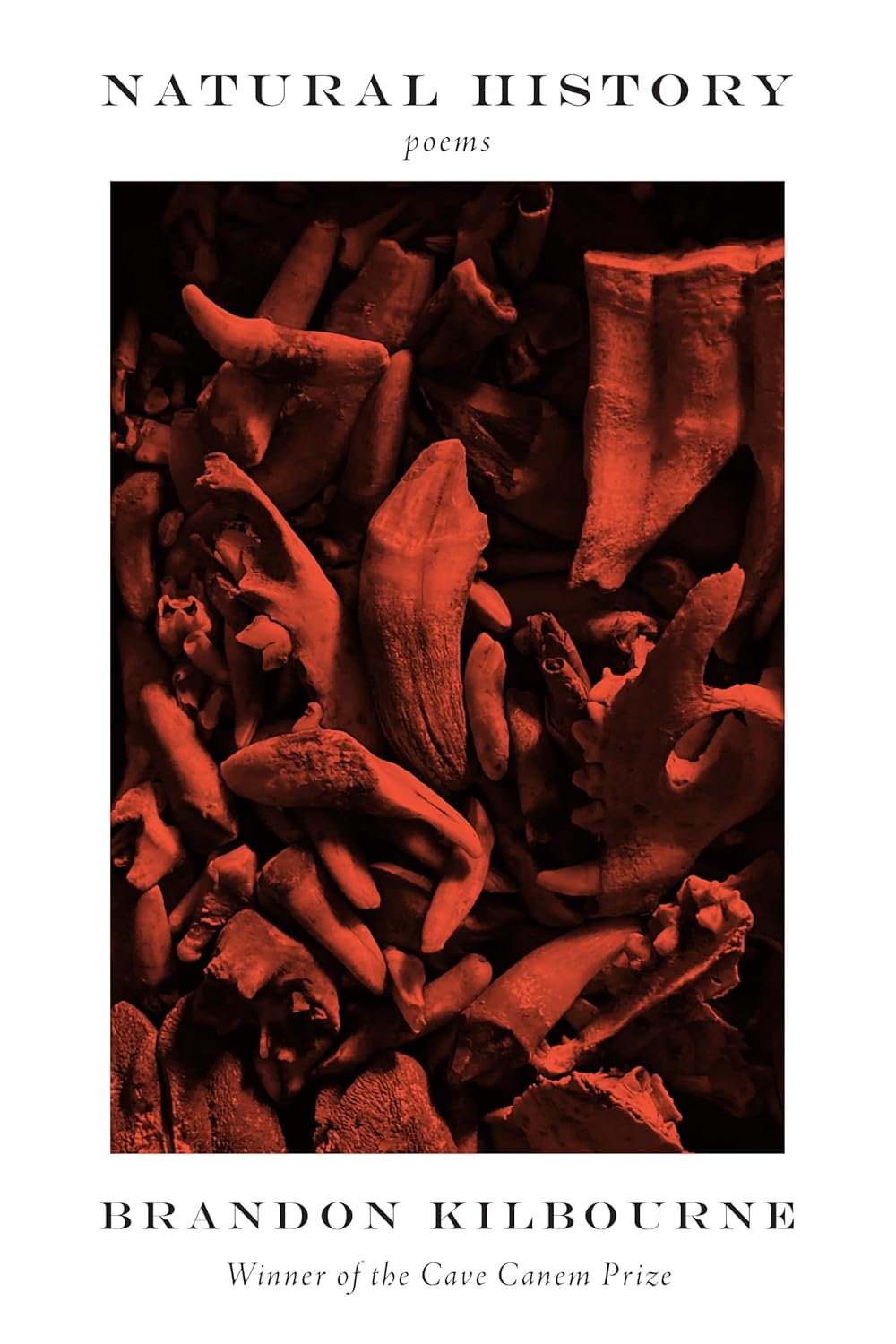
Natural History opens with a section called “The Curious Institution”, in conversation with the centuries-old euphemism for slavery, “the peculiar institution”. This sets the stage for the rest of the text, which never lets the marvelous curiosity of the natural world overshadow its historical tendrils.
The first poem towers into the collection, placing “the feet of a precipice-tall skeleton” in our line of view. These are the feet of the Giraffe Titan, a dinosaur whose skeleton was excavated from a site in the former German colony in what is now Tanzania. Constructing images for us of “bridge-span necks and column / limbs”, of “the head-crowned neck crashing down / like a felled alder, the impact thundering / as if a deposed god was hurled to Earth”, Kilbourne asks us to consider if the Giraffe Titan (Giraffatitan brancai) could have imagined “scavengers biting into its cold skin, / its bones swallowed by tidal mud?” And further still—could it imagine “twenty men in Berlin” deciding the fate of its continent, bringing with it “plantations, mines, and […] black skin in the mouths of ravenous empires?” This behemoth of a first poem ends with an utter damnation, reminding us that:
A predator is a predator after all, regardless
of the time in Earth’s history—they simply
differ in their habit and the hunt: some
sink their honed teeth into a scaly hide,
a roar professing their territory; others
convene over a landmass map, howling
false claims in English, French, and German.
This first poem is a microcosm of the entire book—Kilbourne expertly balancing an overwhelming, childlike joy of discovery with the oft unacknowledged underbelly of the natural sciences and its historically exploitative methods. While we as readers marvel at the sweeping scope of biology clawing its way through time, we also sit with the immeasurable cost of colonial extraction and death.
“From the fifteenth to the eighteenth century,” Kilbourne tells us in a notes section at the book’s end, “naturalists in Europe relied upon ships traveling across the Atlantic to bring, if not additionally source and collect, specimens from Africa and the Americas.” Of course, these ships rarely just carried research specimens at the height of the trans-Atlantic slave trade. Nothing in science during this time, as we’ll learn throughout Kilbourne’s work, existed separately from the racial horrors occurring concurrently. Scientific discoveries often come at the cost of “habitual / barbarity”, readers will understand, to animal life, human life, and natural disruption.
Leveraging how the poetic can evoke viscerality in the way an academic text might not always be able to, the poem “Natural History” situates us in a suffocating juxtaposition of revolving perspectives. From enslaved people in the cargo hold — “ELEVEN of us tried to starve ourselves”—to what reads like ship manifestos and correspondence between traders and collectors— “Just this week, I catalogued my latest curiosities—/ CRABS and CORALS brought by the Navigator/ from Barbados, vibrant in their colors.” Kilbourne presents no commentary here, and he doesn’t have to. The message is clear because the juxtaposition is the message. These things existed side by side, or rather, within and of one another, and we cannot separate them.
In other poems in the same section, he makes the connection even more explicit. A reprise of the first poem, “The Giraffe Titan (II)” explores the voracity of this “terror of its time” who once “preyed upon / lands home to other animals,/ availing itself to the food / that would sustain them, untroubled / by whether then they might perish”. Though long extinct, Kilbourne reassures us with chilling confidence that “evolution has a knack for / repetition,” “rehashed her ravaging Titan […] in a much smaller / human’s stature.” Make no mistake, Kilbourne demands, the “continent-gorging greed” of the Giraffe Titan is alive and well and took the form of rapacious European humans exploiting Africa with no regard to its inhabitants.
The second section, “Memory Museum,” turns toward the personal but never strays from Natural History’s central thesis. Here, we are treated to interpersonal fare: in the poem “Memory Museum”, the speaker meditates on the grand arc of time and evolution while showing a friend around the Museum für Naturkunde Berlin. Even the building itself is never just a building, but “a memory / of colony and war, a divvied city, and a mother / bringing her toddler to see dinosaurs—the Earth’s own / stone memory”. In “Frau Kahnt”, a neighborly interaction holds the weight of grief both personal and historical. Everything is steeped in its origins, from a Portuguese shellfish calling to mind stop-motion childhood sea monsters to the storied ingredients of a Brazilian stew calling back to worlds:
Old and New, spice caravans of the Silk Road
and Sahel, the aftermath of the Crusades, ambitions
of empires, conquistadors and the conquered,
unknown sails and unnamed lands dotting
horizons, saffron fortunes, food offerings
to orishas.
Kilbourne enjoys trapping moments in amber and then examining them from a place of history and awe. It makes for a very cohesive collection, as even these personal diversions from scientific fare feel welcome given the similar framework and perspective. This section also builds more scaffolding for our speaker, who occupies a wonderfully intentional and interesting place in this work. Whenever he appears, it is with great care, only to add a precise and earned lens through which to observe the current scene. Later on in the collection, Kilbourne’s human speaker enters a scene when almost stepping on four plover eggs, for example, to illustrate the avian mother’s “ploy and plea / to lure my human footsteps away and safeguard an eggshell future”. Kilbourne’s own intentionality with the human speaker is an incredible mirror of how the book asks humans to behave in more considered ways of their impact on that which they seek to observe. To add some caution to unbridled curiosity, which had historically not contained nearly enough care.
In the third section, “Dispatches from Ellesmere”, readers are gifted a long meditation on Ellesmere Island and the “375-million-year-old” fish fossils buried there. The Tiktaalik rosea was a fish with a wrist, Kilbourne tells us, marking ancestry to the tens of thousands of species of animals living today. And in 2006, Kilbourne was part of an expedition to recover new specimens from this island. Kilbourne and his team “retrace how fish equipped us for footsteps / by pioneering the vertebrate limb”. Indulgent descriptions anchor each poem in a profound sense of place: “the ruin of a glacier on the horizon / hemorrhaging meltwater past our feet” or “a summer midnight ignorant / of moonlight and constellations”
Beyond gorgeous scene-setting and insightful musings on scope and scale, here we also see Kilbourne implicate himself and other modern researchers—they aren’t exempt from Natural History’s skepticism, either. Unearthing a Tiktaalik roseae specimen is described as a grave-robbing, for example, a “time capsule broken open”. In a show of powerful integrity, never does Kilbourne let the researcher be a neutral observer, even when disturbing the fossil of an ancient, long dead fish. Even the speaker quietly taking in the beauty of the natural world around him is challenged by the emergence of a fox—
its offward
slinking form like a brusque reproach
of my presuming for even a second
that I had this valley to myself.
This is a refreshing consistency toward accountability that doesn’t let its own speaker off the hook, signaling a mature and measured debut voice.
Kilbourne’s position as a Black evolutionary biologist lends a specific lived and learned expertise that elevates the work beyond conjecture. In the final section, “Blindfold Wonder”, the speaker invokes the ghostly specter of notorious racist and skull collector Dr. Samuel George Morton. An unfortunately seminal figure of the natural sciences in the 19th century, Morton collected over a thousand human skulls to further his hypotheses about anatomical racial supremacy. Kilbourne forgoes any poetic devices for the start of the section’s titular poem:
I suppose that if Dr. Morton had met me,
he would have fantasized about my skull
assuming its place among the shelves
of his collection.
Alongside the horrors of many of the forefathers of the field, this poem documents the speaker’s falling in love with the subject he would ultimately devote decades of his life to. A young speaker is overcome with wonder at New York’s American Museum of Natural History, at “a timeline recorded in a giant sequoia’s tree rings, / a giant squid plucked from the aphotic abyss”, only to return twenty years later with clearer vision. As an adult, he notices Roosevelt looming above “the paired African and American natives attending / him on foot” and “cultures whittled / down to whelk-shell costumes and carved tusks”. It is this tension that Kilbourne asks us to hold with him—to marvel in both awe and disgust. To stay curious about the spectacle and any potential blood underneath.
I almost feel guilty quoting as much as I do in this review—like in the act of critique I am spoiling readers in advance of the joyous wordplay and craft at play. Trust that in addition to the lovely quotes featured here, the whole book is a treat in terms of language. Natural History is dense with lush, tactile description, as if the book itself is an elevated nature journal. Each poem crackles with the heat of the poet’s expert and searing gaze, a witness to colonial crime that leaves no trail of evidence buried.
Kilbourne avoids melodrama, instead opting for the starkly descriptive—honest, observant, total. As the long meditative poem “Dioramic Idylls” notes, “the meticulous details overawe us”. Mirroring the models he invokes in several poems, Kilbourne’s writing is dioramic in its own way, staging intricate scenes and sensuous environments for readers to ground themselves in while engaging in an otherwise cerebral and temporally vast text. Rarely does the esoteric, scientific language overwhelm—lines about “skull shards, rhombus scales, and cleithra” are balanced with clear, accessible theses: “Cuvier only deduced extinction / in 1796. In little more than a century,/ we have already mastered it.” Kilbourne could have used his knowledge to render a reader lost, grasping for handholds. Instead, he guides with casual, deep intellect through the entire body of work, trusting the reader to meet him in a middle ground of common understanding and a desire to learn further.
These days, the popularity of scientific poetry isn’t anywhere near the heights of say, confessional or lyric poetry. There is certainly still an assumption around the mismatch between science and art. Kilbourne adds solid evidence against any notion of incompatibility, proving that poetry and science can and do make for a fine concoction, and when done well, can construct crucial bridges in common understanding of the world around us. Natural History valiantly joins other contemporary works in this subgenre like Kenny Bradley’s Night Science and Rosebud Ben-Oni’s If This is the Age We End Discovery, proving hard lines between science and poetry irrelevant.
A necessary addition to the fields of both natural history and contemporary poetics, Natural History is a clear-eyed instructor, a brutally honest museum guide, and a fellow explorer entranced by all we must reckon with in pursuit of discovery.